Running mobile UA across multiple channels simultaneously is one of the most misunderstood strategies in growth marketing.
In our experience, apps that expand channels at the right time can see meaningful improvement in blended CPA, but apps that diversify prematurely — before establishing a stable per-channel spend floor — see CPAs inflate significantly due to insufficient conversion data for algorithmic optimization.
According to AppsFlyer's 2025 Performance Index, the top 10% of advertisers by efficiency run a median of 3.2 channels, not 7 or 8. The key is sequencing: concentrate first, then expand methodically as each channel hits diminishing marginal returns.
Page Contents
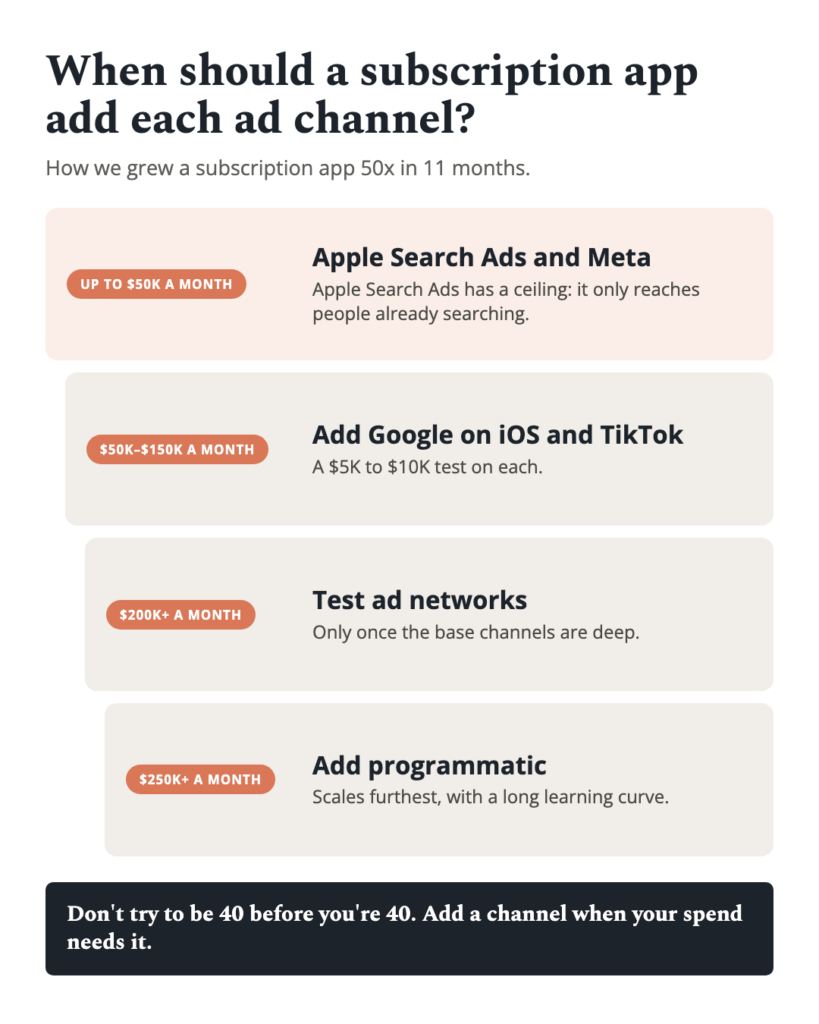
What is the recommended channel expansion sequence by monthly UA budget?
| Monthly UA Budget | Recommended Channels | Primary Channel Allocation | Secondary Channel Allocation | Testing Budget | Key Constraint |
|---|---|---|---|---|---|
| $5K-$15K | 1 channel only | 90-100% | 0% | 0-10% | Insufficient data for multi-channel learning |
| $15K-$50K | 1-2 channels | 70-80% | 20-30% | 5-10% | Secondary channel needs 50+ conversions/week minimum |
| $50K-$150K | 2-3 channels | 50-60% | 25-35% | 10-15% | Creative adaptation costs become significant |
| $150K-$500K | 3-4 channels | 40-50% | 30-40% | 10-15% | Attribution complexity increases; need MMP |
| $500K-$1M | 4-5 channels | 30-40% | 40-50% | 10-15% | Audience overlap across channels becomes measurable |
| $1M-$3M | 5-7 channels | 25-35% | 45-55% | 10-20% | Need dedicated channel managers per platform |
| $3M+ | 6-8+ channels | 20-30% | 50-60% | 10-20% | Incrementality testing essential to avoid over-attribution |
What are the average CPIs and D7 ROAS benchmarks by channel and app category (2025-2026)?
| Channel | Gaming CPI (iOS) | Gaming D7 ROAS | Non-Gaming CPI (iOS) | Non-Gaming D7 ROAS | Minimum Daily Budget for Learning |
|---|---|---|---|---|---|
| Meta (Facebook/Instagram) | $1.80–$3.50 | 8-15% | $3.00–$7.00 | 5-12% | $100–$300 |
| Google App Campaigns | $1.20–$2.80 | 6-12% | $2.50–$6.00 | 4-10% | $150–$400 |
| TikTok Ads | $1.00–$2.50 | 5-10% | $2.00–$5.50 | 3-9% | $200–$500 |
| Apple Search Ads | $2.50–$5.00 | 12-22% | $3.50–$8.00 | 8-18% | $50–$150 |
| Snap Ads | $1.50–$3.00 | 5-9% | $2.80–$5.50 | 3-8% | $150–$400 |
| Unity Ads | $0.80–$2.00 | 7-13% | N/A (gaming focus) | N/A | $200–$500 |
| ironSource | $0.60–$1.80 | 6-11% | N/A (gaming focus) | N/A | $200–$500 |
| AppLovin | $0.50–$1.50 | 8-14% | $2.00–$4.50 | 5-10% | $300–$600 |
| Reddit Ads | $3.00–$6.00 | 3-7% | $4.00–$9.00 | 2-6% | $100–$300 |
| X (Twitter) Ads | $3.50–$7.00 | 2-5% | $5.00–$10.00 | 2-5% | $200–$500 |
How should creative formats be adapted across channels?
Need help scaling your mobile app growth? Talk to RocketShip HQ about how we apply these strategies for apps spending $50K+/month on UA.
| Creative Format | Meta | Google UAC | TikTok | Apple Search Ads | Snap | AppLovin/Unity |
|---|---|---|---|---|---|---|
| UGC-style video (15-30s) | High performer | Video campaigns only | Top performer | N/A | High performer | Moderate |
| Polished brand video (30s+) | Moderate | Moderate | Underperforms | N/A | Moderate | Low |
| Static image/carousel | Strong for retargeting | Display only | Low CTR | N/A | Moderate | Banner only |
| Playable/interactive | High for games | Top performer | Emerging | N/A | Not supported | Top performer |
| App Store screenshots | N/A | Auto-generated | N/A | Primary format | N/A | N/A |
| Before/after transformation | High for utility apps | Moderate | High performer | N/A | High performer | Low |
| Fail/challenge ads | High for casual games | Moderate | Top performer | N/A | High performer | High performer |
| Text overlay on gameplay | Moderate | Strong for UAC | Moderate | N/A | Low | High performer |
What does a unified measurement stack look like for multi-channel UA?
| Measurement Layer | Tool/Approach | Cost Range (Monthly) | What It Solves | When to Implement |
|---|---|---|---|---|
| Attribution (last-touch) | AppsFlyer, Adjust, Branch, Singular | $500–$10,000+ | Which channel drove the install | Day 1 (mandatory) |
| SKAN/Privacy-safe attribution | MMP SKAN dashboards + SKAD Network | Included with MMP | iOS attribution post-ATT | Day 1 for iOS |
| Blended CPA tracking | Custom BI dashboard or Looker/Tableau | $200–$2,000 | True channel-level efficiency | $50K+/mo spend |
| Media mix modeling (MMM) | Robyn (Meta open source), Meridian (Google) | $0 (OSS) to $50K+ (consultants) | Channel-level incrementality at scale | $500K+/mo spend |
| Incrementality testing | Geo-holdout, ghost ads, PSA tests | $5K-$20K per test (lost revenue) | Proves true lift vs. organic | $150K+/mo spend |
| Post-back and server-to-server | MMP + internal data pipeline | $1K-$5K setup | Revenue event accuracy | $50K+/mo spend |
| Creative analytics | Motion, Appsumer, or custom | $300–$3,000 | Cross-channel creative performance | $50K+/mo spend |
| Cohort analysis | Amplitude, Mixpanel, RevenueCat | $0–$5,000 | LTV curves by channel/campaign | Day 1 (mandatory) |
When should you consolidate vs. diversify channels?
| Signal | Action | Rationale | Example Threshold |
|---|---|---|---|
| Primary channel CPA rising 20%+ over 4 weeks | Diversify: add a new channel | Diminishing returns signal audience saturation | Meta CPA up from $12 to $15+ sustained |
| New channel CPA 2x+ higher than primary after 4 weeks | Consolidate: pause new channel | Insufficient scale or poor product-channel fit | TikTok CPA $30 vs Meta CPA $14 |
| Winning creative exhaustion (<3 week lifespan) | Diversify: new channels extend creative life | Different audiences see creatives fresh | CTR drops 40%+ within 2 weeks on Meta |
| Less than 50 conversions/week on a channel | Consolidate: merge budgets to primary | Algorithm cannot optimize below this threshold | Per Meta's own documentation on learning phase |
| Audience overlap exceeds 30% between channels | Consolidate: reduce overlap channel | Paying twice for same users | AppsFlyer deduplication shows 30%+ overlap |
| LTV/CAC ratio below 1.0 on a channel after 60 days | Consolidate: cut the channel | Channel is value-destructive | D60 LTV $8, CAC $12 |
| Incrementality test shows <20% true lift | Consolidate: reallocate spend | Channel is taking credit for organic | Geo-holdout shows only 15% incremental installs |
| Primary channel at 80%+ of efficient spend ceiling | Diversify: proactive expansion | Prevents crisis when primary channel declines | Meta spend $400K/mo, CPA flat but volume plateauing |
Analysis
The data reveals a clear pattern: successful multi-channel UA is not about being everywhere, but about being in the right places at the right time with sufficient budget to fuel each platform's machine learning models.
According to AppsFlyer’s 2025 Performance Index, Meta and Google continue to dominate by volume and retention, but their share of wallet among top advertisers decreased from 72% in 2022 to approximately 58% in 2025, reflecting genuine diversification among sophisticated buyers.
AppLovin has emerged as a formidable third pillar, especially for gaming, where according to data.ai's State of Mobile 2025, it now ranks in the top 3 for gaming install volume globally.
For a deeper look at which networks rank highest across retention and remarketing, see our AppsFlyer Performance Index summary.
The CPI spreads across channels tell an important story about audience quality versus volume. Apple Search Ads consistently shows the highest CPIs ($2.50–$8.00 depending on category, per Apple’s own benchmarking data) but also the highest D7 ROAS, because users searching for specific keywords have the highest intent.
Conversely, TikTok and in-app ad networks but typically lower early retention, a tradeoff that Adjust’s 2025 State of App Growth report quantifies as a 15-25% retention gap at D7 between high-intent search channels and social discovery channels.
The arbitrage opportunity lies in understanding that blended performance matters more than any single channel's metrics, which is why our best paid channels for mobile UA emphasizes portfolio-level thinking.
Year-over-year, CPIs across all major channels increased 8-15% in 2024-2025, according to Adjust’s same report, driven by increased competition and privacy-related signal loss making algorithms less efficient. This inflation makes scale spend without losing ROAS, not less, because audience saturation on a single channel accelerates cost increases.
Eric Seufert at MobileDevMemo has documented how ATT-era signal degradation compounds the problem: channels with less deterministic data lose optimization efficiency faster, which means over-concentrating on a single platform exposes you to both audience fatigue and algorithmic decay simultaneously.
Our AppsFlyer State of App Marketing summary covers these macro trends in depth.
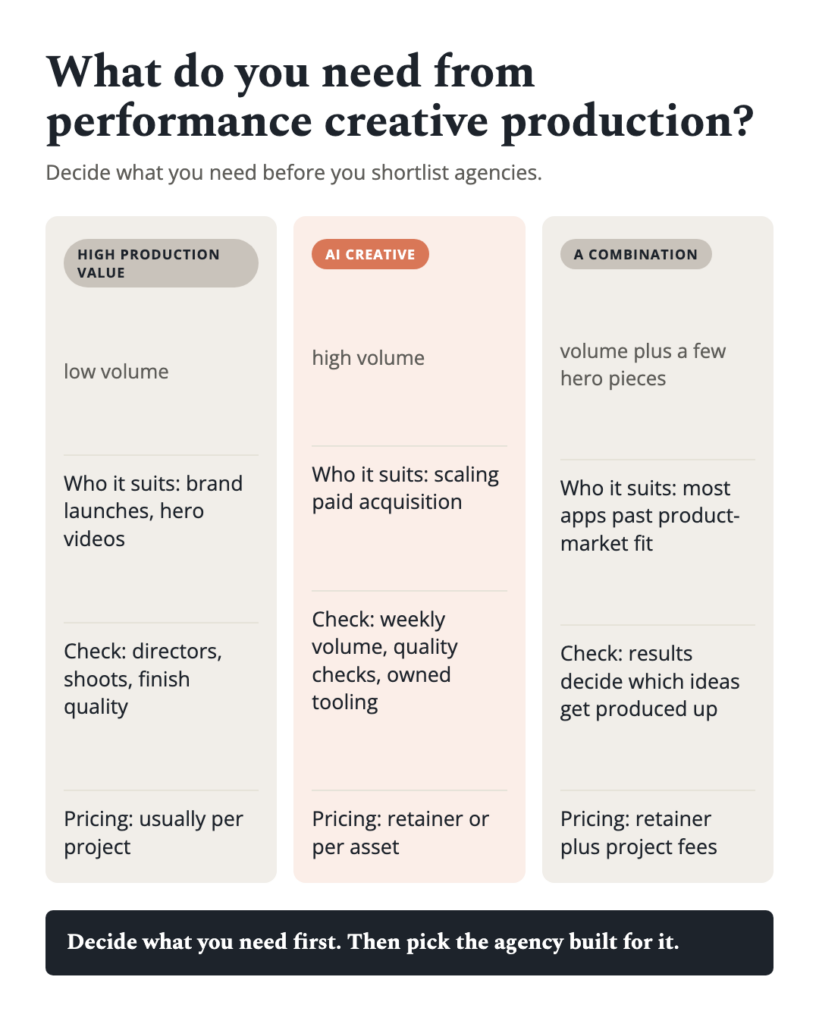
The creative adaptation table highlights a critical but underestimated cost of multi-channel: production. format performance across platforms, where playables and gameplay-centric formats dominate, highlighting how creative quality drives 3-4x more performance variance than targeting or bidding.
For specific creative strategies, see our guides on before-and-after ads for AI photo apps and fail ads for mobile games.
The measurement stack table shows that the cost of proper attribution and analytics scales with spend, but the return on that investment is disproportionately high: according to AppsFlyer’s ROI of Attribution report, apps with proper incrementality testing reallocate 15-25% of budget from over-credited channels, unlocking meaningful efficiency gains without increasing total spend.
What This Means For You
- Start with one self-attributing network (Meta or Google) and do not add a second channel until you consistently hit 50+ conversions per day on the primary, per Meta's learning phase documentation. Premature diversification is the number one budget killer for apps spending under $50K/month. Allocate a meaningful portion of total UA spend to creative production and adaptation when running 3+ channels. Channel-native creative meaningfully reduces CPA versus repurposed assets (UGC for TikTok, playables for AppLovin, keyword-optimized screenshots for Apple Search Ads). In our experience, channel-native creative meaningfully reduces CPA versus repurposed assets (UGC for TikTok, playables for AppLovin, keyword-optimized screenshots for Apple Search Ads). According to Sensor Tower’s 2025 Creative Insights report, top-spending apps refresh creatives 3-4x more frequently than the median advertiser.
- Implement blended CPA tracking at the channel level (not campaign level) once you cross $50K/month. In our experience, blended channel-level CPAs tend to be meaningfully more stable week-over-week than campaign-level metrics, giving you a clearer signal for budget allocation decisions. Tools like RevenueCat for subscription LTV and your MMP's cohort exports are the foundation. For teams evaluating whether to manage this complexity internally, our in-house vs. agency comparison breaks down staffing requirements at each spend tier.
Frequently Asked Questions
How do I handle creative fatigue across 4+ channels simultaneously?
Build a modular creative system where core hooks, value propositions, and CTAs are produced as interchangeable components rather than monolithic ads. According to Sensor Tower's 2025 data, top advertisers maintain 15-25 active creative variants per channel and rotate the lowest 20% every 7-10 days.
A modular approach — producing channel-specific shells (TikTok UGC wrappers, AppLovin gameplay loops, Meta carousel templates) and swapping in new hooks weekly — can substantially reduce production cost per variant compared to building each ad from scratch.
What is the math for deduplicating audience overlap across UA channels?
Pull install-level data from your MMP (AppsFlyer, Adjust) and compare device IDs or IDFV across channels within the same attribution window. If Channel A and Channel B both claim the same install, your MMP's deduplication logic assigns credit to one, but the real concern is bidding against yourself in auctions.
According to AppsFlyer, overlap rates above 25-30% between two channels typically indicate you should suppress audiences or narrow targeting on the lower-LTV channel.
A practical formula: if Channel B's incremental CPA (after removing overlap installs) exceeds your target CPA by more than 20%, reallocate that budget to Channel A or a new channel entirely.
How long should I test a new UA channel before deciding to scale or kill it?
Give a new channel a minimum of 3-4 weeks and at least $5,000–$10,000 in spend before making a go/no-go decision, assuming your target CPA is under $20.
According to Meta's learning phase guidance (which mirrors industry norms), ad sets need approximately 50 conversion events to exit the learning phase. The 4-week window accounts for weekday/weekend variance and at least one full creative refresh cycle.
If your CPA is still 2x+ above target after this window with 3+ distinct creative concepts tested, the channel likely has poor product-market fit for your app.
Does adding more channels increase or decrease attribution accuracy?
It almost always decreases deterministic attribution accuracy while improving your strategic understanding if you layer in incrementality testing.
Each new channel introduces another self-attributing network claiming credit, and according to Eric Seufert's research on MobileDevMemo, the sum of all network-reported installs typically exceeds actual installs by 20-40% once you run 4+ channels.
This is why media mix modeling (using open-source tools like Meta's Robyn or Google's Meridian) becomes essential at $500K+/month: it reconciles over-attribution at the portfolio level rather than trusting any single network's numbers.
Should I run the same ROAS targets across all UA channels?
No. Each channel has a different user quality profile, so applying a uniform D7 ROAS target will cause you to over-invest in low-intent channels and under-invest in high-intent ones.
Industry data suggests Apple Search Ads users typically show D30 LTV that is significantly higher than TikTok users in the same app, meaning a lower D7 ROAS target on ASA still yields superior long-term returns.
Set channel-specific targets calibrated to each channel's LTV curve, and use cohort analysis tools like RevenueCat or Amplitude to map LTV by acquisition source over 30, 60, and 90 day windows.
How do I know if my blended CPA improvement is from channel mix or from creative improvement?
Isolate the variables by holding creative constant when shifting budget between channels (to measure mix impact) and holding channel mix constant when testing new creatives (to measure creative impact). In practice, this means running a 2-week creative freeze during any major budget reallocation.
According to the Adjust State of App Growth report, creative refresh is responsible for 40-60% of CPA variance in mature accounts, while channel mix accounts for 20-30%, and external factors (seasonality, competition) explain the rest.
Build your BI dashboard to log both creative and channel-mix changes so you can attribute CPA movements after the fact.
What happens to organic installs when I turn off paid UA on one channel?
Organic installs typically drop 10-25% within 2-3 weeks of pausing a major paid channel, according to incrementality research published by MobileDevMemo. This is the "halo effect": paid ads drive App Store browse visibility, word-of-mouth, and social proof that feeds organic discovery.
The drop is steepest for channels with high impression volume (Meta, TikTok) and negligible for low-funnel channels like Apple Search Ads.
Factor this organic cannibalization into your true channel-level incrementality math: a channel with a 15% true lift in direct installs may actually deliver 20-25% lift when you account for the organic halo.
Do I need a different team structure to manage multi-channel UA versus single-channel?
Yes, and the transition point is typically around $150K-$250K/month in total spend. Below that, a single skilled UA manager can handle 2-3 channels.
Above it, according to our guide to building a mobile growth team, you need dedicated channel specialists (one per 1-2 channels), a creative strategist who understands format differences across platforms, and a data/analytics resource to run blended reporting and incrementality tests.
Many apps at the $150K-$500K tier find it more efficient to partner with a specialized agency like RocketShip HQ rather than hiring 3-4 full-time roles, as outlined in our in-house vs. agency comparison.
Looking to scale your mobile app growth with performance creative that delivers results? Talk to RocketShip HQ to learn how our frameworks can work for your app.
Not ready yet? Get strategies and tips from the leading edge of mobile growth in a generative AI world: subscribe to our newsletter.
Related Reading
- The complete guide to mobile user acquisition (comprehensive guide)
- Ad compliance for fintech app marketing (2026)
- Adjust State of App Growth Report: Global Trends and Benchmarks (2026)
- How to advertise a social networking app (2026)
- AppsFlyer eCommerce App Marketing Report