Short answer: mobile user acquisition is paid and organic work to get the right people to install your app and then pay or stay. Done well, it runs in a fixed order: get measurement right, start on one channel and feed it enough conversions a day to learn, make creative the main lever, add channels as spend grows, and judge every step on whether your cost per conversion holds. This page is the map. Each section below points to the guide that goes deep.

Page Contents
What is mobile user acquisition?
It is everything you do to bring new users into your app: paid ads on Meta, Google, TikTok, Apple Search Ads and the ad networks; app store optimization; and the referral, content and partnership work that brings people in without a media bill. In practice, for most apps past product-market fit, it means paid acquisition with creative at the centre, because the ad platforms now automate most targeting and bidding and the ads themselves decide most of the result.
If you are new to the terms, start with what is mobile user acquisition and the difference between user acquisition and growth marketing.
Where should an app start?
With one channel, fed properly. A campaign needs enough conversions a day for the platform to find more of the right people and for you to tell good ads from bad ones: ideally 30 a day, and 10 a day is good. You can run on 1 or 2 a day with a small budget, but to test creative rigorously enough to unlock scale, aim for 10.
Which channel first depends on what you are: – Subscription apps: Meta, plus Apple Search Ads for intent. How to pick ad channels for a subscription app gives the full ladder by spend. – Mobile games: Meta on iOS and Google App campaigns on Android; at $500 a day or more, AppLovin can be your first channel. How to pick ad channels for a mobile game covers the order and how to judge each test.
From about $50K a month, add Google on iOS and TikTok with a $5K to $10K test each and judge the trend over weeks 1 to 3. Ad networks come in around $200K a month, programmatic from $250K. For how to split a budget across channels once you have several, see how to split your user acquisition budget across channels.
How much should you spend?
Work it back from conversions, not from a percentage of anything. Monthly budget for one campaign is your cost per conversion, times the conversions a day you need, times 30. The posts on how much a subscription app should spend on user acquisition and how much a mobile game should spend walk through the arithmetic with example costs. Why a creative programme needs a minimum ad spend shows how that arithmetic lands at $50K a month for an agency programme.
When a campaign is working, scale it: about 20% a day if you want to move steadily, or 50% to 100% a week if you want to move fast. Either way, the step is earned by cost per conversion holding as spend goes up. On Meta specifically, see how to scale a Meta ads budget for app campaigns.
Why is creative the main lever?
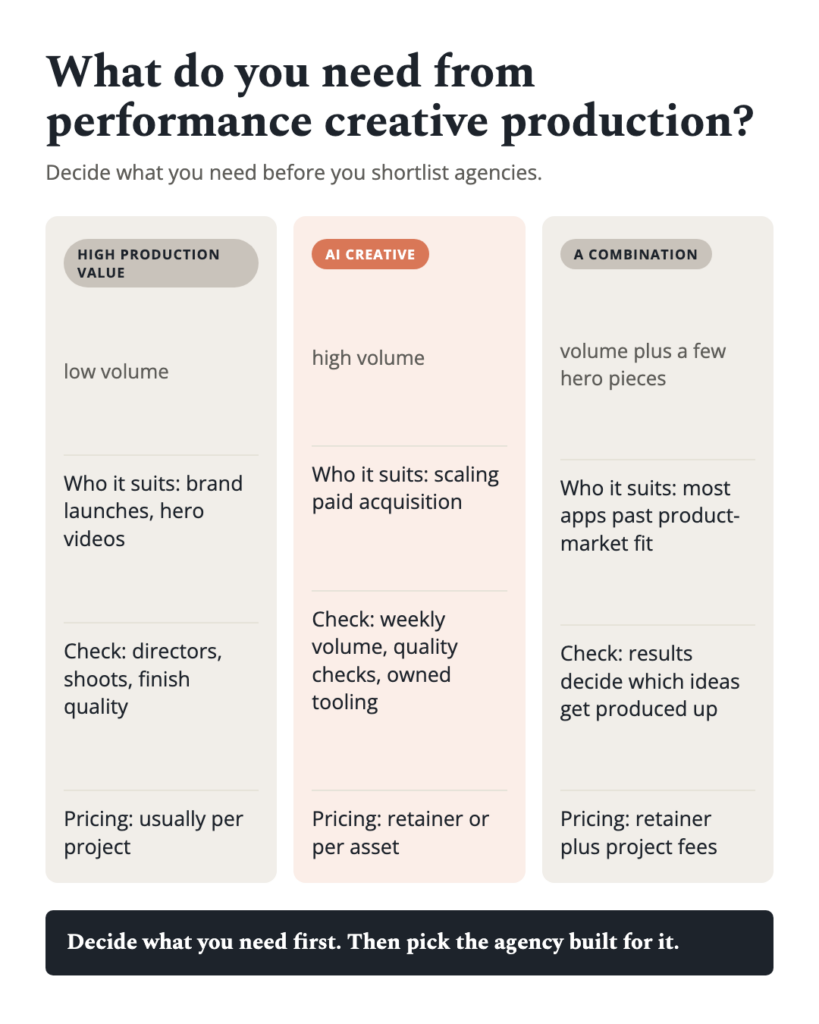
Because the platforms now do the targeting. What you feed them, the ads, decides most of the result, and winners tire, so the teams that scale are the ones that keep finding new ones. That means a steady flow of new creative directions, each tested with several ads across angles, hooks and formats, and a testing budget on top of what your scaling campaigns need.
Start here: – How to structure creative tests on Meta – How to measure creative diversity in your Meta account – How often to refresh a winning ad, and what to make first – How to make AI ads that don’t look like AI – Creative concepts versus variants
To see how many ads a given budget can test, use the creative volume calculator.
How do the main platforms differ?
Each platform has its own mechanics, and the guides below cover setup, what to optimize for, and how to scale on each: – Meta: how to run Meta ads for mobile apps and what AEO is and when to use it. – Google: Google App Campaigns: the complete guide and how to optimize Google App Campaigns. – AppLovin versus Meta: what changes in creative testing. – Meta versus TikTok: which to advertise on.
How do you measure it?
On iOS, attribution runs through SKAdNetwork and AdAttributionKit, which changes what you can see and when. Start with how to fix mobile attribution on iOS and what a mobile measurement audit looks like. Whatever the platform shows you, the number that matters is cost per conversion holding as spend grows, judged against the target your own economics allow.
You may also have heard that you need 50 conversions a week before you can read anything. That is really old guidance, and we would avoid it: why the 50-conversions rule is dated.
Should you do this in-house, with a freelancer, or with an agency?
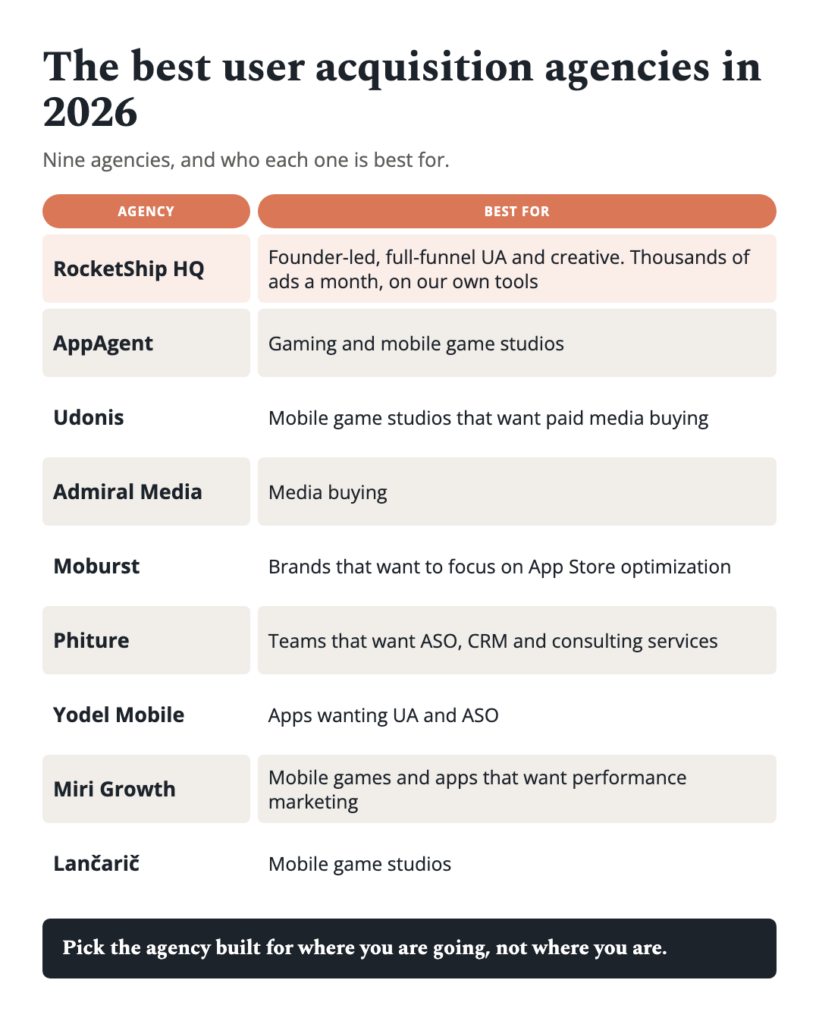
It depends on spend, how much creative you need, and how fast you need to ramp. In-house versus agency versus freelancer compares cost, ramp time, creative volume and risk. If you go the agency route, how to evaluate a mobile growth or user acquisition agency lists the questions to ask, how much a user acquisition agency costs covers fee models, and the best user acquisition agencies in 2026 names the options. We are one of them.
Frequently asked questions
What does user acquisition mean? Getting new users into your app, through paid ads, app store optimization, referrals, content and partnerships. For most apps past product-market fit, paid acquisition with creative at the centre is where the volume comes from.
What are user acquisition strategies? The ones that work share a shape: measurement first, one channel fed with enough conversions a day to learn, creative as the main lever with its own testing budget, channels added in order of spend, and scaling judged on cost per conversion holding.
How much does app marketing typically cost? It depends on your cost per conversion and how many campaigns you run. One campaign at 10 to 30 conversions a day can cost from a few thousand dollars a month to six figures, before agency fees. The budget posts linked above show the arithmetic.
How many ad channels should an app run? As many as it can feed properly, which for most apps under about $50K a month is one. Add the next when the first still has room to grow and you can fund a $5K to $10K test without starving it.