Adjust's 2026 State of App Growth report reveals that global app installs grew 8.2% year-over-year, driven primarily by emerging markets in Southeast Asia (up 14.7%) and Latin America (up 11.3%), while mature markets like North America grew only 2.1%.
Median Day 1 retention across all categories sits at 25.4%, but apps that achieve above-median session depth (4.2+ sessions per day) see 37% higher Day 30 retention.
Paid media now accounts for 38% of all installs globally (up from 34% in 2024), with CPI inflation averaging 12% across iOS and 7% across Android. Fraud rates have declined to 6.8% of paid installs globally, the lowest in four years, thanks to improved SDK-level protections and stricter attribution windows.
The report underscores a decisive shift: the app economy is no longer about install volume alone, but about acquiring users who generate deep engagement in the first 72 hours post-install.
Page Contents
What are the global app install growth rates by region in 2025-2026?
| Region | YoY Install Growth (2025-2026) | Share of Global Installs | Paid Install Share | Avg CPI (USD, Blended) |
|---|---|---|---|---|
| North America | +2.1% | 12.4% | 47% | $3.82 |
| Western Europe | +3.6% | 10.8% | 42% | $2.95 |
| Eastern Europe | +6.9% | 5.3% | 31% | $1.24 |
| Southeast Asia | +14.7% | 18.6% | 29% | $0.58 |
| South Asia (India subcontinent) | +12.1% | 21.2% | 22% | $0.31 |
| Latin America | +11.3% | 13.7% | 27% | $0.72 |
| Middle East & Africa | +9.4% | 8.9% | 24% | $0.89 |
| East Asia (China, Japan, Korea) | +1.8% | 9.1% | 51% | $4.17 |
What are the average CPIs by app category and platform in 2026?
| App Category | iOS CPI (Global Median) | Android CPI (Global Median) | YoY CPI Change (iOS) | YoY CPI Change (Android) |
|---|---|---|---|---|
| Casual Gaming | $1.92 | $0.47 | +9% | +5% |
| Midcore/Hardcore Gaming | $4.85 | $1.73 | +14% | +11% |
| Hypercasual Gaming | $0.38 | $0.12 | –3% | –6% |
| Finance/Fintech | $6.21 | $2.44 | +18% | +13% |
| E-Commerce/Shopping | $3.14 | $0.91 | +11% | +8% |
| Health & Fitness | $4.52 | $1.68 | +15% | +10% |
| Food Delivery | $5.87 | $2.13 | +12% | +9% |
| Social/Dating | $3.76 | $1.22 | +8% | +6% |
| Education/EdTech | $2.88 | $0.74 | +7% | +4% |
| Entertainment/Streaming | $3.41 | $1.15 | +10% | +7% |
Need help scaling your mobile app growth? Talk to RocketShip HQ about how we apply these strategies for apps spending $50K+/month on UA.
What are the retention benchmarks by app category in 2026?
| App Category | Day 1 Retention | Day 7 Retention | Day 30 Retention | Avg Sessions/Day | Avg Session Length (min) |
|---|---|---|---|---|---|
| Casual Gaming | 28.7% | 11.2% | 4.1% | 3.8 | 6.4 |
| Midcore/Hardcore Gaming | 31.4% | 14.8% | 7.2% | 2.9 | 18.7 |
| Hypercasual Gaming | 22.1% | 5.3% | 1.4% | 5.1 | 3.2 |
| Finance/Fintech | 24.3% | 13.1% | 9.8% | 2.1 | 4.8 |
| E-Commerce/Shopping | 21.6% | 9.7% | 5.4% | 2.7 | 7.3 |
| Health & Fitness | 26.8% | 14.2% | 8.6% | 1.6 | 12.1 |
| Food Delivery | 29.1% | 16.4% | 11.2% | 1.3 | 5.7 |
| Social/Dating | 32.5% | 17.8% | 10.3% | 4.6 | 9.4 |
| Education/EdTech | 23.4% | 10.6% | 5.9% | 1.8 | 14.2 |
| Entertainment/Streaming | 27.3% | 15.1% | 9.1% | 1.4 | 22.8 |
What are the fraud rates by channel and region in 2026?
| Region/Channel | Overall Fraud Rate | Click Spam Rate | SDK Spoofing Rate | Install Hijacking Rate | Bots/Device Farms Rate |
|---|---|---|---|---|---|
| Global Average (All Channels) | 6.8% | 2.1% | 1.4% | 1.9% | 1.4% |
| Self-Attributing Networks (Global) | 2.3% | 0.6% | 0.4% | 0.8% | 0.5% |
| Programmatic/DSPs (Global) | 14.2% | 4.8% | 3.1% | 3.6% | 2.7% |
| Southeast Asia | 11.4% | 3.7% | 2.3% | 3.1% | 2.3% |
| South Asia | 13.1% | 4.2% | 2.8% | 3.4% | 2.7% |
| Latin America | 8.9% | 2.9% | 1.8% | 2.4% | 1.8% |
| North America | 3.4% | 1.1% | 0.7% | 0.9% | 0.7% |
| Western Europe | 3.8% | 1.3% | 0.8% | 1.0% | 0.7% |
| East Asia | 5.1% | 1.6% | 1.2% | 1.3% | 1.0% |
| Middle East & Africa | 10.6% | 3.4% | 2.1% | 2.9% | 2.2% |
How does paid vs. organic install share vary by app category?
| App Category | Paid Install Share | Organic Install Share | Paid ROAS (Day 7 Median) | Organic Uplift Factor | Blended eCPI |
|---|---|---|---|---|---|
| Casual Gaming | 41% | 59% | 8.2% | 1.4x | $0.82 |
| Midcore/Hardcore Gaming | 52% | 48% | 11.7% | 1.2x | $2.94 |
| Hypercasual Gaming | 68% | 32% | 4.1% | 1.1x | $0.19 |
| Finance/Fintech | 36% | 64% | 6.3% | 1.8x | $2.78 |
| E-Commerce/Shopping | 44% | 56% | 14.8% | 1.6x | $1.52 |
| Health & Fitness | 33% | 67% | 9.4% | 1.7x | $1.88 |
| Food Delivery | 47% | 53% | 18.2% | 1.5x | $2.91 |
| Social/Dating | 39% | 61% | 7.6% | 1.9x | $1.72 |
| Education/EdTech | 28% | 72% | 5.8% | 2.1x | $1.03 |
| Entertainment/Streaming | 35% | 65% | 12.1% | 1.7x | $1.44 |
Analysis
What does Adjust's 2026 State of App Growth report tell us about the mobile app economy?
The headline story is divergence. The global app economy is not one market anymore; it is two distinct ecosystems running at very different speeds.
Emerging markets (Southeast Asia, South Asia, Latin America, and Middle East/Africa) collectively grew installs by 11.9% year-over-year, accounting for 62.4% of global installs but only 31% of global app revenue. Mature markets (North America, Western Europe, East Asia) grew just 2.5% in installs but generate 69% of revenue.
This gap is widening, not closing.
Adjust’s full report emphasizes that the cost-to-quality ratio has shifted meaningfully: it is no longer sufficient to chase volume in emerging markets without modeling post-install quality at the geo level.
CPI inflation is the second critical trend, with Meta CPIs by mobile app category mirroring the broader market dynamics.
iOS CPIs rose 12% on average globally, with the sharpest increases in finance (+18%), health and fitness (+15%), and midcore gaming (+14%).
This is driven by three converging forces: Apple Search Ads auction density increasing as more advertisers adopt the platform post-ATT, Meta's Advantage+ campaigns consolidating spend toward higher-value (and higher-cost) user segments, and Google's shift toward AI-driven bidding that optimizes for value over volume.
Android CPIs rose more modestly (7% average), partly because Play Store distribution in emerging markets keeps aggregate costs lower, and partly because Android's richer signal environment allows better optimization at lower cost floors.
Retention data reveals a troubling plateau.
Median Day 1 retention (25.4%) is virtually unchanged from 2024 (25.1%), suggesting the industry has hit a structural floor for most categories. The exceptions are notable: food delivery apps improved Day 30 retention from 9.8% to 11.2% year-over-year, likely driven by subscription models and loyalty programs.
Social and dating apps maintain the highest Day 1 retention (32.5%) because of strong network effects, but their Day 30 numbers (10.3%) suggest that even social stickiness decays rapidly without sustained engagement mechanics.
Fraud continues its multi-year decline, hitting 6.8% globally, down from 8.4% in 2024 and 11.2% in 2023.
Adjust’s fraud prevention suite attributes this to three factors: wider adoption of server-to-server (S2S) callbacks that eliminate client-side SDK spoofing vectors, shorter attribution windows (the industry standard has moved from 7-day click-through to 48-hour), and the natural consolidation of ad spend toward self-attributing networks where fraud rates (2.3%) are a fraction of programmatic channels (14.2%). While these improvements are significant, app install fraud financial exposure report, underscoring the need for robust prevention measures.
However, the 14.2% fraud rate on DSPs should give pause to any team scaling programmatic without robust fraud prevention.
In our experience, DSP budgets can absorb meaningful losses to fraudulent installs when proper rejection rules are not in place, which is why we always recommend exhausting SANs before moving to programmatic channels.
The paid-to-organic ratio is climbing steadily.
Paid installs now represent 38% of all installs globally, up from 34% in 2024 and 29% in 2022.
This reflects the maturation of the app economy: organic discovery through app store browsing continues to decline as a percentage of total installs, replaced by paid channels and deep links from owned media. The broader context shows app install ad spend reached $65 billion, reinforcing this shift toward paid acquisition.
Categories with high paid install shares (hypercasual at 68%, midcore gaming at 52%) tend to have lower organic uplift factors, while categories with strong brand affinity (education at 28% paid, health at 33% paid) still enjoy robust organic discovery.
The organic uplift factor (how many organic installs each paid install generates indirectly through improved store rankings) ranges from 1.1x for hypercasual to 2.1x for education, a critical variable in calculating true blended acquisition cost.
Session depth and session length data add nuance to the retention picture.
Entertainment and streaming apps have the longest average sessions (22.8 minutes) but the lowest frequency (1.4 sessions/day), while hypercasual games show the inverse: 5.1 sessions/day averaging just 3.2 minutes each.
The report highlights that apps with above-median session frequency (2.4+ sessions/day) have 37% better Day 30 retention regardless of category, reinforcing that habitual short interactions drive long-term stickiness more effectively than occasional long sessions.
What This Means For You
What does this data mean for your UA budget allocation and market strategy?
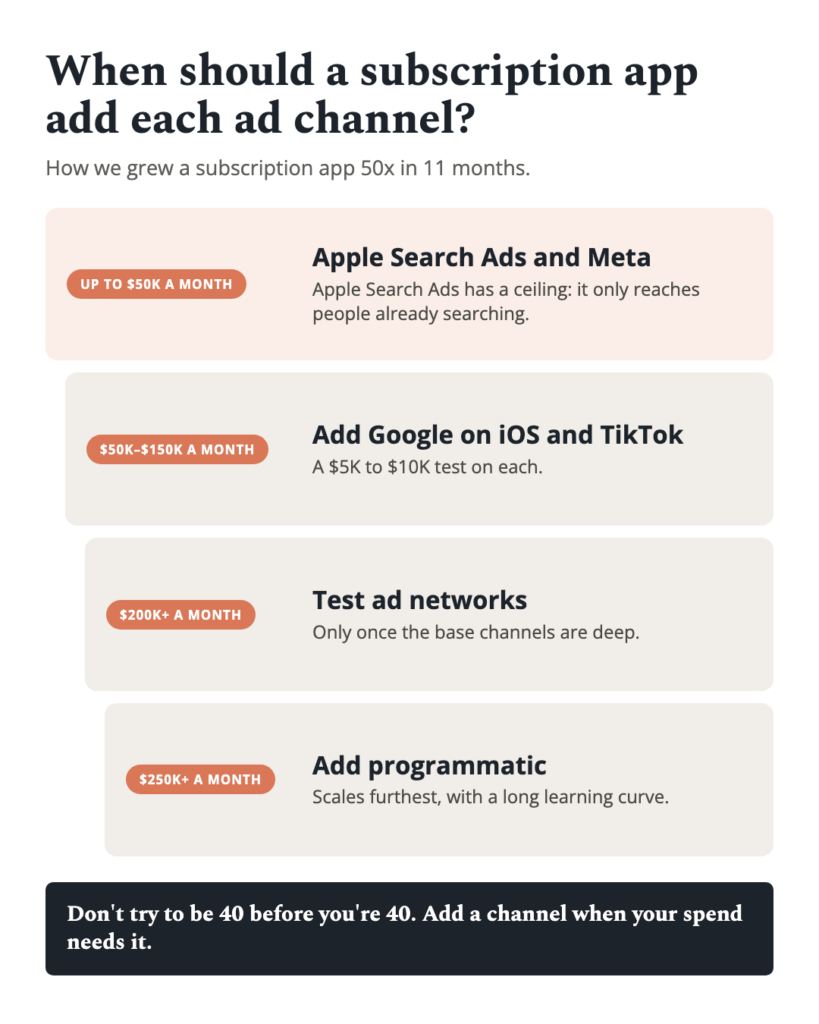
If you are spending less than $10,000 per day on user acquisition, concentrate your budget on one or two self-attributing networks before diversifying. This is not just our opinion; the data backs it up.
SANs show 2.3% fraud rates versus 14.2% for programmatic, which means your effective CPI on DSPs is actually 16-17% higher than reported.
At $5,000/day on Meta, you can generate enough conversion volume (128+ installs daily for AEO campaigns, as post-ATT research has shown) to give the algorithm meaningful signal. Split that same $5,000 across four channels and you starve each one of data.
As we have discussed in our analysis of the best paid channels for mobile UA, the sequence matters more than the mix at early stages.
Use Adjust's regional CPI data to identify arbitrage opportunities, but pair it with retention and LTV modeling.
Southeast Asia's $0.58 blended CPI is tempting, but the 11.4% fraud rate and lower average revenue per user (ARPU) mean your true cost per quality user may be closer to $1.10–$1.40 after fraud rejection and quality filtering.
Compare that to Eastern Europe at $1.24 CPI with only 3.8% fraud and historically stronger engagement metrics for gaming and fintech apps.
Setting your UA budget by region requires modeling these second-order effects, not just top-line CPI.
The retention benchmarks should calibrate your expectations and your creative strategy.
If your casual game has Day 1 retention below 28.7%, the problem is probably not your UA targeting; it is your onboarding or core loop. Fix that before scaling spend. Understanding what constitutes a good CPI benchmark across categories helps calibrate whether your retention issues are masking inefficient spend or vice versa.
If you are above benchmark on Day 1 but collapsing to below 4.1% by Day 30, your content pipeline or engagement hooks need work.
In our experience, monitoring retention curves relative to daily spend is essential: a retention drop on a high-spend campaign deserves far more urgent attention than the same drop on a small test budget.
Weighting your anomaly alerts by spend magnitude helps teams focus on the signals that actually impact revenue.
CPI inflation of 12% on iOS demands a creative volume response.
If you are running the same five ad concepts you launched with six months ago, you are paying a creativity tax on top of the market inflation.
High-performing mobile ads combine a strong hook in the first 1.5 seconds, a clear value demonstration, and a decisive call to action. We have found that offsetting CPI inflation with creative concepts requires continuously refreshing algorithmic exploration, as creative variance commonly explains a substantial share of performance differences within channels.
Industry patterns suggest that apps with a higher creative refresh cadence tend to see meaningfully lower effective CPIs than those running stale creative sets.
For gaming companies specifically, the hypercasual CPI decline (down 3-6% year-over-year) creates an interesting opportunity.
As Matej Lancaric from SuperScale has noted, broad targeting with 20M+ audience sizes can push CPIs as low as $0.10–$0.12 on Android.
The trick is marrying that volume with LTV measurement tight enough to kill losers within 48 hours. The Adjust data shows hypercasual Day 7 ROAS at just 4.1%, which means you need massive volume efficiency and rapid iteration to make the economics work. Running UA across multiple channels simultaneously becomes viable once you’ve proven unit economics at this scale, and in our experience apps that successfully expand from one channel to several tend to see meaningful blended CPA improvement.
The Adjust data shows hypercasual Day 7 ROAS at just 4.1%, which means you need massive volume efficiency and rapid iteration to make the economics work.
Finally, the organic uplift data should reshape how you think about true acquisition costs.
If your education app generates a 2.1x organic uplift, then your effective blended eCPI is roughly half your paid CPI. Factor this into your LTV-to-CAC modeling.
The apps winning in 2026 are not necessarily the ones with the lowest CPIs; they are the ones that understand the full funnel from paid install through organic amplification to long-term retention and monetization.
Frequently Asked Questions
What is the average Day 1 retention rate for mobile apps in 2026?
The global median Day 1 retention rate across all app categories is 25.4% according to Adjust's 2026 report. Social and dating apps lead at 32.5%, while e-commerce apps trail at 21.6%. Apps that achieve 4.2+ daily sessions see 37% higher Day 30 retention regardless of category.
How much does it cost to acquire a mobile app user in 2026?
Global median CPIs in 2026 range from $0.12 (Android hypercasual) to $6.21 (iOS fintech). iOS CPIs inflated 12% year-over-year on average, while Android CPIs rose 7%. North America ($3.82 blended) and East Asia ($4.17 blended) remain the most expensive regions, while South Asia ($0.31) offers the lowest CPIs.
What is the mobile ad fraud rate in 2026?
Global mobile ad fraud sits at 6.8% of paid installs in 2026, the lowest in four years, down from 8.4% in 2024. Self-attributing networks like Meta and Google show just 2.3% fraud, while programmatic DSPs average 14.2%. South Asia (13.1%) and Southeast Asia (11.4%) have the highest regional fraud rates.
Which regions are growing fastest for mobile app installs?
Southeast Asia leads global install growth at 14.7% year-over-year, followed by South Asia at 12.1% and Latin America at 11.3%. Mature markets are nearly flat: North America grew just 2.1% and East Asia only 1.8%. Emerging markets now account for 62.4% of global installs but only 31% of app revenue.
What percentage of mobile app installs come from paid advertising?
Paid installs account for 38% of all global app installs in 2026, up from 34% in 2024 and 29% in 2022. Hypercasual gaming has the highest paid share at 68%, while education has the lowest at 28%. The organic uplift factor (indirect organic installs driven by paid) ranges from 1.1x to 2.1x depending on category.
How do iOS and Android CPI trends compare in 2026?
iOS CPIs rose 12% on average globally in 2026 versus 7% on Android. The gap is widest in finance (iOS at $6.21 vs. Android at $2.44) and narrowest in hypercasual gaming (iOS at $0.38 vs. Android at $0.12). Post-ATT signal loss, Apple Search Ads auction density, and Advantage+ consolidation all drive iOS inflation faster than Android.
What is a good Day 30 retention rate for a mobile game?
Median Day 30 retention for casual games is 4.1%, midcore/hardcore games hit 7.2%, and hypercasual sits at just 1.4%. Top-quartile casual games tend to outperform the median meaningfully on Day 30 retention. If your game exceeds these benchmarks, you likely have product-market fit strong enough to scale paid UA aggressively.
Should I prioritize self-attributing networks or programmatic DSPs for mobile UA?
Start with self-attributing networks (SANs). They show 2.3% fraud rates versus 14.2% for programmatic DSPs, and their purchase-behavior-based targeting outperforms context-based approaches. Only expand to DSPs after exhausting SAN scale at meaningful daily spend levels, and always with fraud rejection rules active.
Looking to scale your mobile app growth with performance creative that delivers results? Talk to RocketShip HQ to learn how our frameworks can work for your app.
Not ready yet? Get strategies and tips from the leading edge of mobile growth in a generative AI world: subscribe to our newsletter.
Related Reading
- The complete guide to mobile user acquisition (comprehensive guide)
- AppsFlyer eCommerce App Marketing Report 2025
- What Are the Best Paid Channels for Mobile App User Acquisition?
- Why Fail Ads Work for Mobile Games
- How to Build a Mobile Growth Team