Short answer: a freelancer is enough when you run one channel at modest spend and need few new ads. An agency is usually the better buy once you are spending meaningfully across more than one channel and need a steady flow of new creative, because it brings production capacity, cross-channel experience and its own tools from week one. A full in-house team makes sense at very high spend, when your edge depends on proprietary data and you are planning years ahead. Many apps end up hybrid: an in-house owner who sets strategy, with an agency producing creative and running media. The deciding factor is usually creative volume, not salary math.
Page Contents
What is the difference between in-house, freelance and agency user acquisition?
An in-house team is people on your payroll: a user acquisition manager, often an analyst, and designers or editors who make the ads. They work only on your app and sit next to your product team.
A freelancer is one independent specialist, usually a media buyer, who runs your campaigns on a monthly fee.
An agency is a team you hire as a unit: strategists, media buyers, creative strategists, editors and analysts, with processes and tools already built. Because it works across many apps, it brings pattern recognition no single hire can.
How do the three compare on cost, ramp and creative volume?
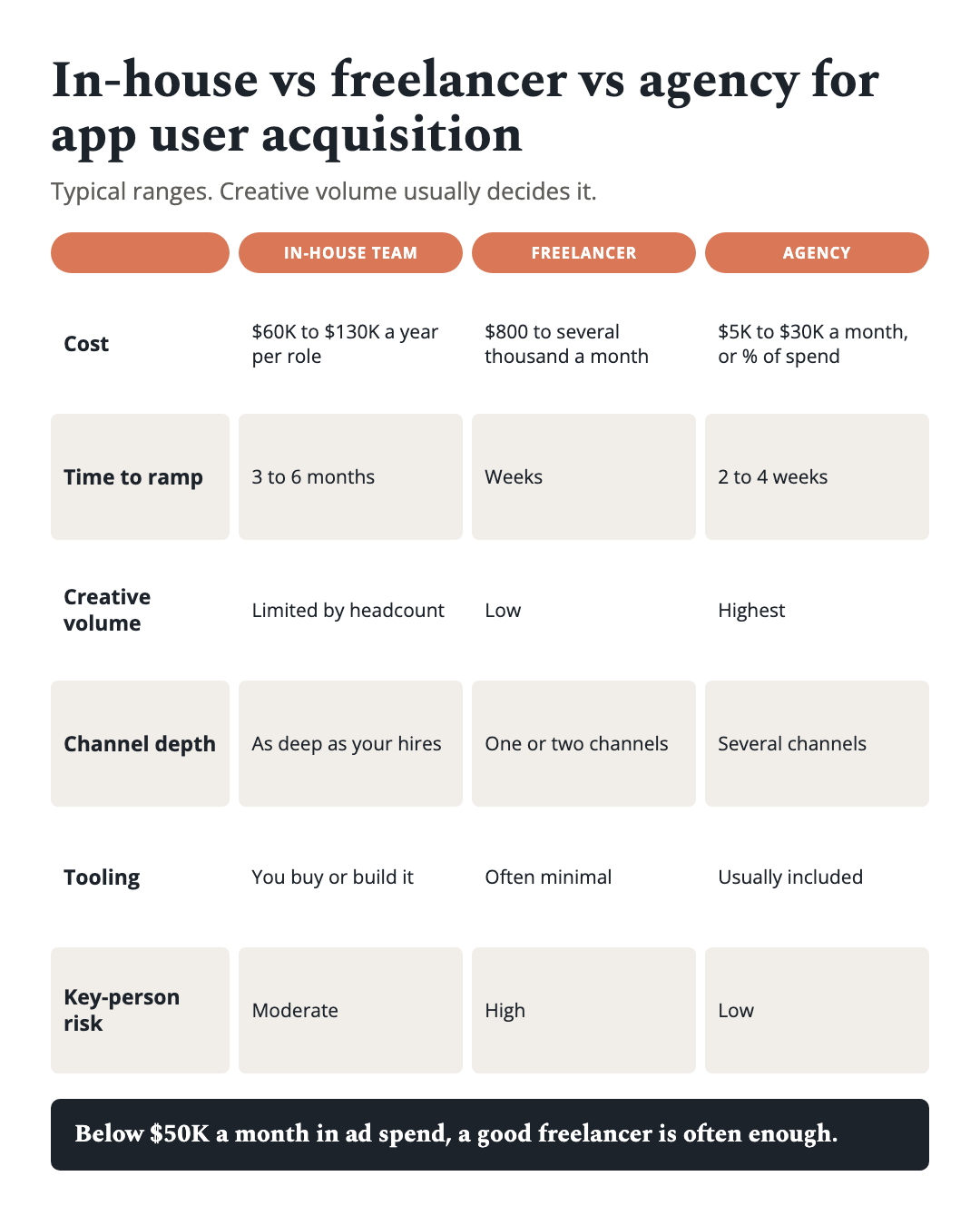
The figures below are typical market ranges, not quotes.
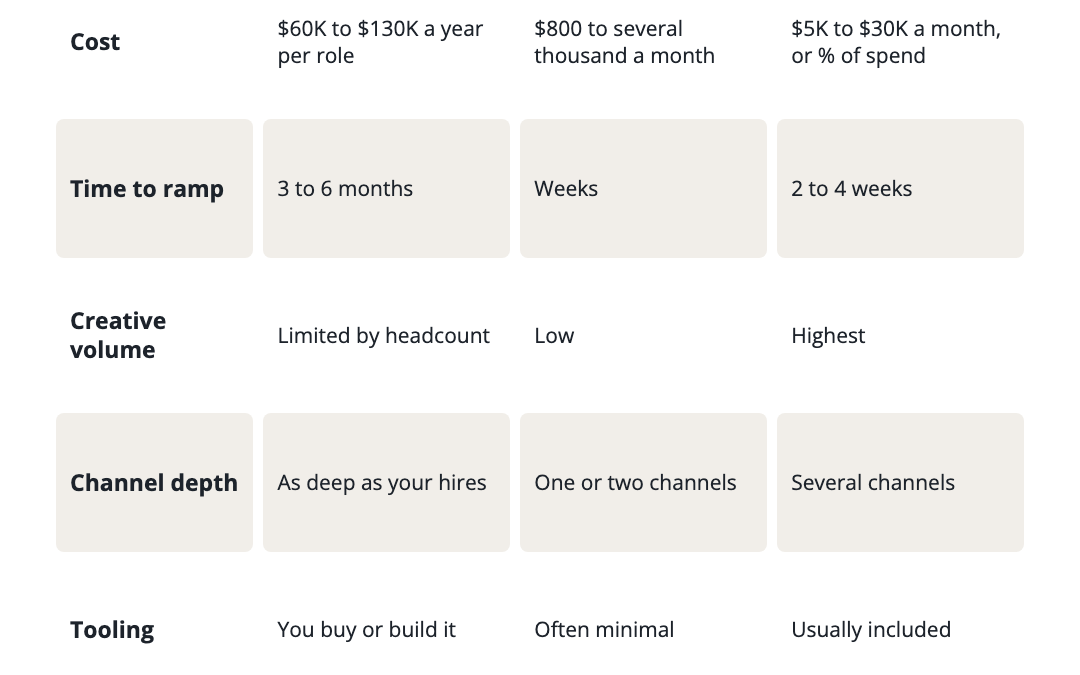
| In-house team | Freelancer | Agency | |
|---|---|---|---|
| Cost | Roughly $60K to $130K a year per user acquisition or creative role in the US; a 4 to 6 person team runs about $400K to $600K a year before tools | From roughly $800 to several thousand dollars a month | Roughly $5K to $30K a month in retainers, or a percentage of ad spend |
| Time to ramp | 3 to 6 months to hire and get productive | Weeks, if the person has worked on similar apps | Typically 2 to 4 weeks |
| Creative volume | Limited by headcount; each new editor is a new hire | Low; creative is often out of scope | Highest; production is the core of the service for creative-led agencies |
| Channel depth | As deep as the people you hire | Usually one or two channels | Several channels, informed by many accounts |
| Tooling | You buy or build it | Their own setup, often minimal | Usually included; the better ones build their own |
| Key-person risk | Moderate; a departure costs months | High; one person is the whole function | Low; the team absorbs turnover |
For a fuller breakdown of fees, see how much a user acquisition agency costs and what percentage user acquisition agencies charge.
The salary line understates in-house cost: add recruiting, management time, tools and the months a new team spends learning before it performs.
Why does creative volume decide it?
Because creative is the single most important lever for paid performance. Meta, Google, TikTok and the game networks now automate most targeting and bidding. What separates accounts is the flow of ads you feed them: new ideas to find the next winner, and variants of the winners already running to extend their life.
That flow is hard to build in-house. One media buyer can manage a large budget, but keeping it fed with ads takes editors, designers, scriptwriters, creative strategists and people who run AI video and image tools well. Each is a hire. A freelancer rarely covers creative at all.
So the real question is who makes the ads, and how many each week. If the answer is “a handful, when someone has time”, spend stalls before budget does. Our creative volume calculator estimates how many ads your spend needs.
When is a freelancer enough?
A freelancer fits when the job is narrow:
- One channel, usually Meta or Apple Search Ads.
- Spend low enough that a single person can manage it with attention to spare.
- Little need for new creative, because you already have ads that work or make them yourself.
- A founder or product lead who can judge the work and set direction.
The risk is concentration: one person is your whole acquisition function. A freelancer is a good first step for a product still finding its feet, rarely the setup that scales.
When does an in-house team win?
In-house wins when three things are true together:
- Very high spend, high enough that a full salaried team costs less than an agency fee would, even after tools and management.
- Proprietary data matters, for example when your edge comes from in-game economy data, internal LTV models or first-party signals you cannot share with an outside team.
- A long horizon. You are planning to own acquisition for years and can absorb a 3 to 6 month build.
In-house teams also have product knowledge. Someone who sits with your product team knows which feature launch is pulling in better users and can change messaging within hours.
What in-house struggles with is creative throughput: most teams hit a production ceiling long before their budget does. For how to staff it if you go this way, see how to build a mobile growth team.
When does an agency win?
An agency wins when you need:
- Creative volume you cannot hire for fast enough.
- Cross-channel experience, because the agency sees what works on many accounts, not one.
- A fast ramp, typically weeks rather than months.
- Its own tooling for creative analysis and production, rather than software bills you pay separately.
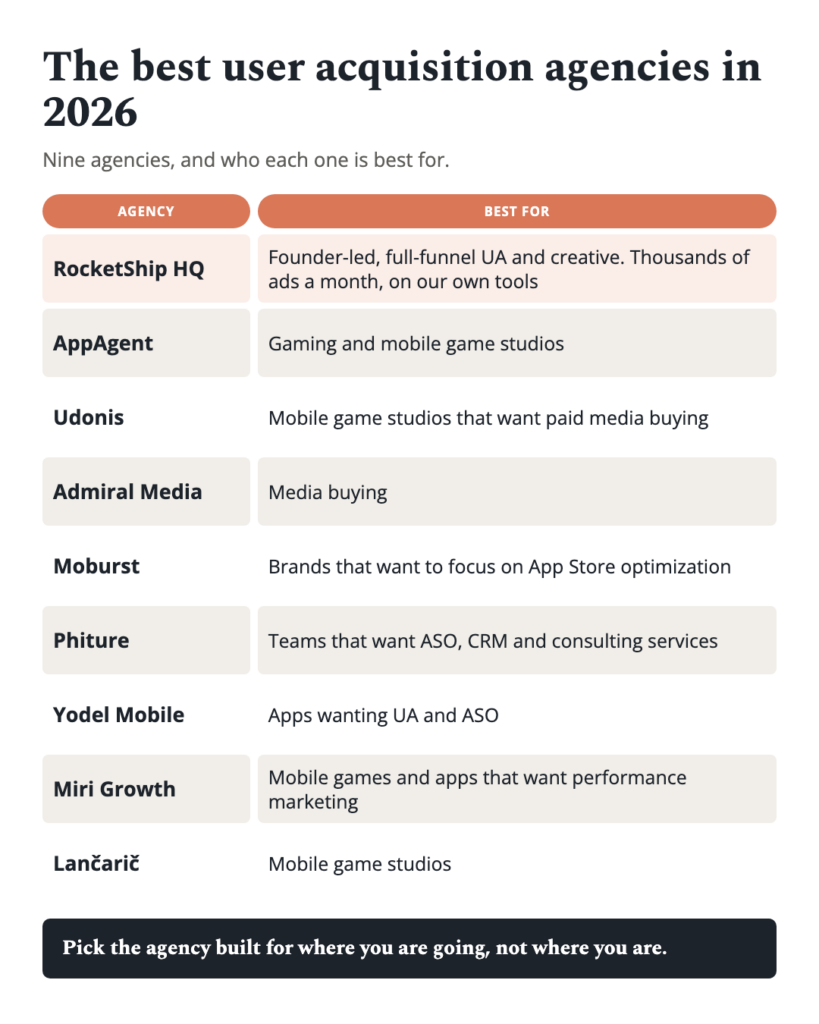
Some agencies mostly buy media; others are built around creative. The creative agency vs media buying agency guide explains the split, and how to evaluate a mobile growth or user acquisition agency lists the questions to ask any candidate. To compare named options, see the best user acquisition agencies in 2026.
Whichever you pick, check retention first. If the users you acquire do not stay, no acquisition setup fixes the economics.
How do hybrid models work?
A hybrid splits the work by what you are best placed to own. Based on your needs, you might keep media buying in-house and buy creative strategy and production from an agency. Or you might keep the product and strategy in-house and buy user acquisition plus creative strategy and production as one service.
The most common version is one in-house growth owner who sets goals, owns the product and data, and holds the agency accountable, while the agency produces creative and runs media day to day.
Many apps sequence it: agency first to find what works, in-house once the playbook is proven, with the agency kept on for creative.
Is RocketShip HQ a fit?
If the comparison points to an agency, RocketShip HQ is one option. Over a freelancer, what we add is creative volume: thousands of ads a month, made with AI-and-human production and tools we build ourselves. Over building a team, what we add is speed: our founder, Shamanth Rao, grew an app from $0 to $1.5M a month in ad spend in 11 months while in-house, so we know what that route takes and how long it runs.
We work with apps and games spending at least $50K a month on ads (why that minimum), and engagements start at $7,500 a month. Below that spend, a good freelancer is often the better buy.
Frequently asked questions
What is the difference between in-house and agency? An in-house team is employed by you and works only on your app. An agency is an outside team you hire as a unit, working across many clients. In-house gives you product knowledge and control; an agency gives you speed, breadth and creative capacity without hiring each role.
What is the difference between a freelancer and an agency? A freelancer is one person, usually covering one or two channels, with little or no creative production. An agency is a team with media buying, creative, analytics and tooling. A freelancer costs less; an agency covers more and does not stop when one person is unavailable.
Is it worth it to hire a marketing agency for an app? It usually is once you are spending meaningfully on paid acquisition and need more new ads than your team can make.
How much do freelance user acquisition managers charge? Typically from around $800 to several thousand dollars a month, depending on experience, channels and spend. Creative production is usually extra or out of scope.
Why do apps move from an agency to in-house? Usually because spend has grown high enough that a salaried team costs less, or because their edge now depends on proprietary data and close product integration. Many keep an agency on for creative after the move.
What is a disadvantage of an in-house user acquisition team? Cost and ramp time: several salaries, tools and 3 to 6 months before a new team performs. The bigger limit is creative throughput, since every extra editor or designer is another hire.