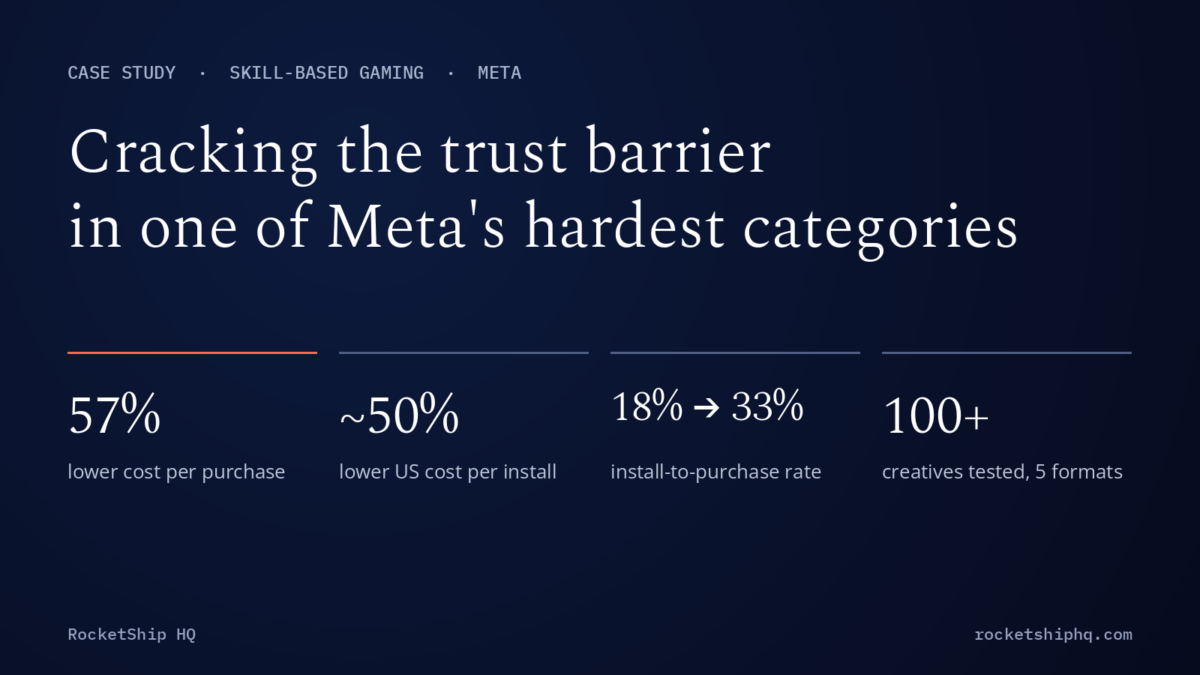
We built a creative-testing engine for a real-money, skill-based gaming platform. It got past the trust barrier in one of Meta’s hardest categories and cut cost per purchase by 57%.
Page Contents
Who this is for
This is for UA and growth teams at mobile gaming apps, especially those in skill-based, competitive or real-money categories. In those categories generic ad creative fails and the main reason people don’t convert is that they don’t trust the app.
The client
The client runs a real-money skill gaming platform. Players compete in live 1v1 matches and cash out their winnings. Meta classifies the category as adjacent to gambling, which rules out most standard performance-creative approaches before you start.
The product’s core promise is that skill decides the outcome, not chance, and that promise is also the creative problem. A cold audience doesn’t believe it. Broad acquisition hooks don’t land and win-showcase ads get filtered, so the creative has to overcome disbelief.
The challenge
Ads were already running, but there was no repeatable creative formula and no reliable read on what could scale. The brief was to build a paid acquisition engine on Facebook and Instagram, covering creative strategy, campaign structure and audiences, and find unit economics that could scale.
Two constraints shaped everything:
- Platform policy. Meta’s gambling classification ruled out explicit cash amounts, close-ups of win screens and odds-style language. Every concept had to promise a financial reward while staying inside policy.
- Trust. The biggest obstacle in this category is belief, not awareness. Real-money gaming apps are widely distrusted, so every batch of creative was really a search for the angle that made the product feel legitimate, fair and low-risk to try.
The approach
The work ran on three tracks at once: creative discovery, account structure and audience refinement. Results from each one shaped the other two.
1. Find the format that converts
We tested five formats with comparable budgets: UGC, faceless, static, AI-generated and animated. UGC was the clear winner and the other formats couldn’t keep up. We moved production capacity to UGC straight away, which stopped us spending on formats that weren’t working.
2. Decode the creative formula
Across 100+ creatives, four things consistently separated winners from losers:
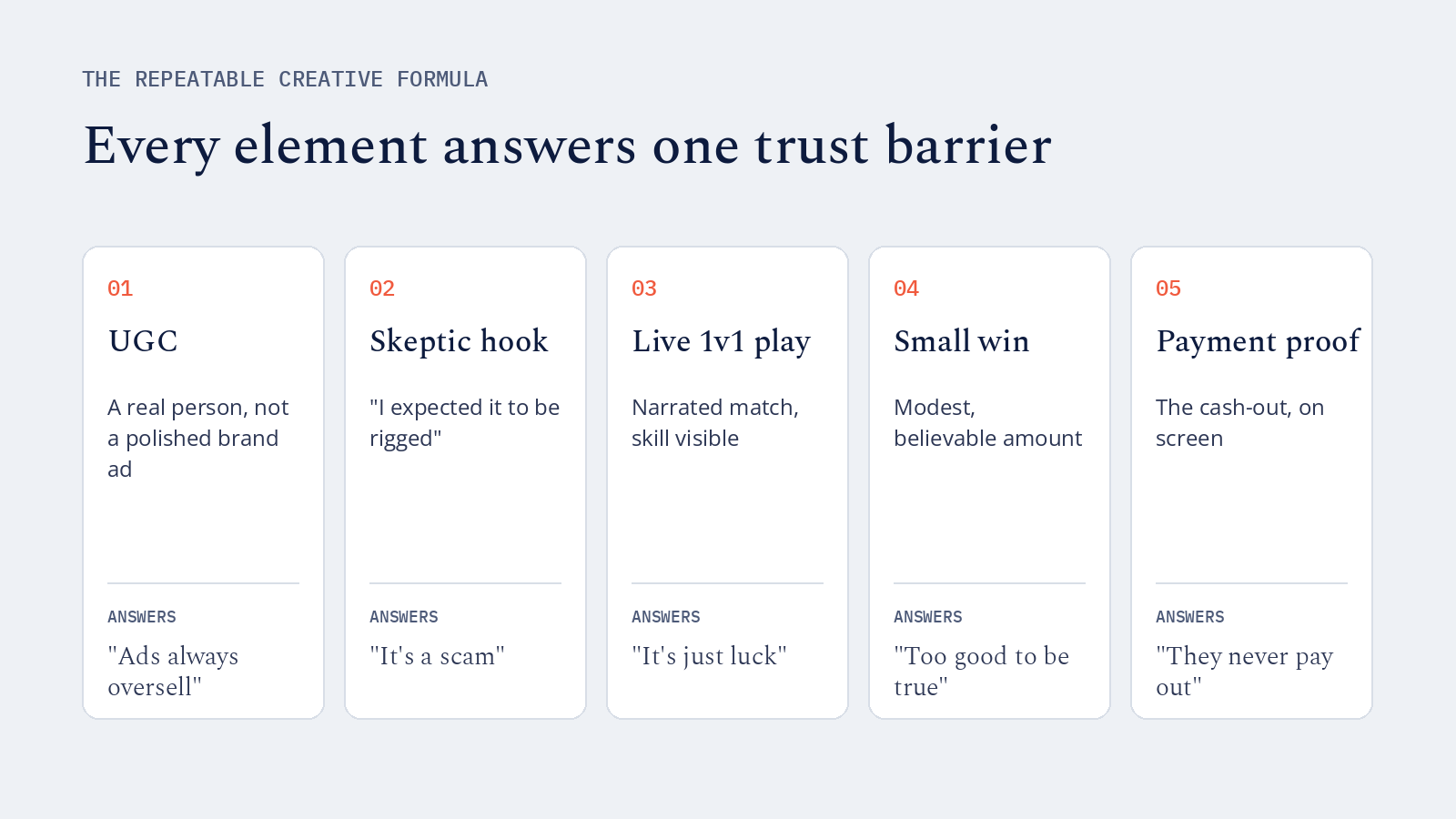
- Lead with the skepticism. Ads that opened with doubt (“I expected it to be rigged”) beat direct win showcases in every test. Showing the doubt first and then resolving it built trust faster than positive framing did.
- Small, believable wins. Modest, relatable amounts beat aspirational jackpots. A small win makes trying the app feel less risky and makes the claim more credible.
- Live 1v1 commentary. A real match with live narration made the skill visible and the win feel earned. Viewers kept watching to see whether the player would pull it off.
- Hooks that don’t oversell. Teasing or building tension did worse than dropping straight into the action. Every hook that oversold hurt conversion.
3. Fix the account structure
As spend grew, Meta’s algorithm kept most of the budget on a few older ads. Newer UGC that performed better couldn’t get enough spend to reach significance. A creative refresh wouldn’t fix that, so we changed the account structure:
- We wound the legacy scale campaign down as fatigue built up.
- We launched a separate test campaign with fewer ads, so new creative got a fair read.
- We moved all UGC into a single test ad set so the ads stopped competing with each other.
4. Focus audiences and placements
Players aged 18 to 24 bought most efficiently in nearly every week. Older age groups were consistently less efficient, so we gradually excluded them. Instagram and Facebook Reels drove most of the volume, and we wound down weaker placements. A separate install campaign in a new country added inventory at a low cost per install without disrupting the core purchase funnel.
The results
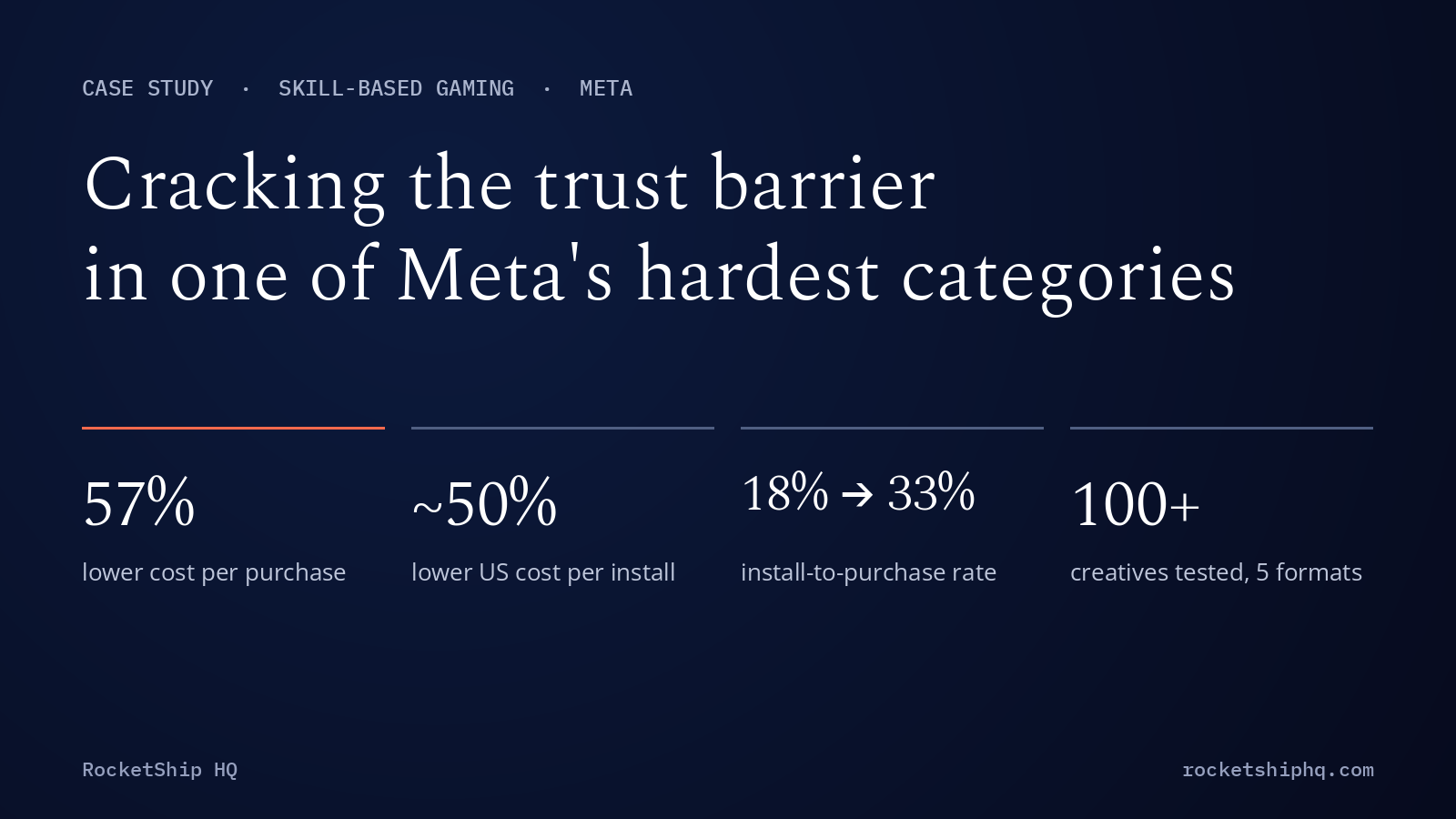
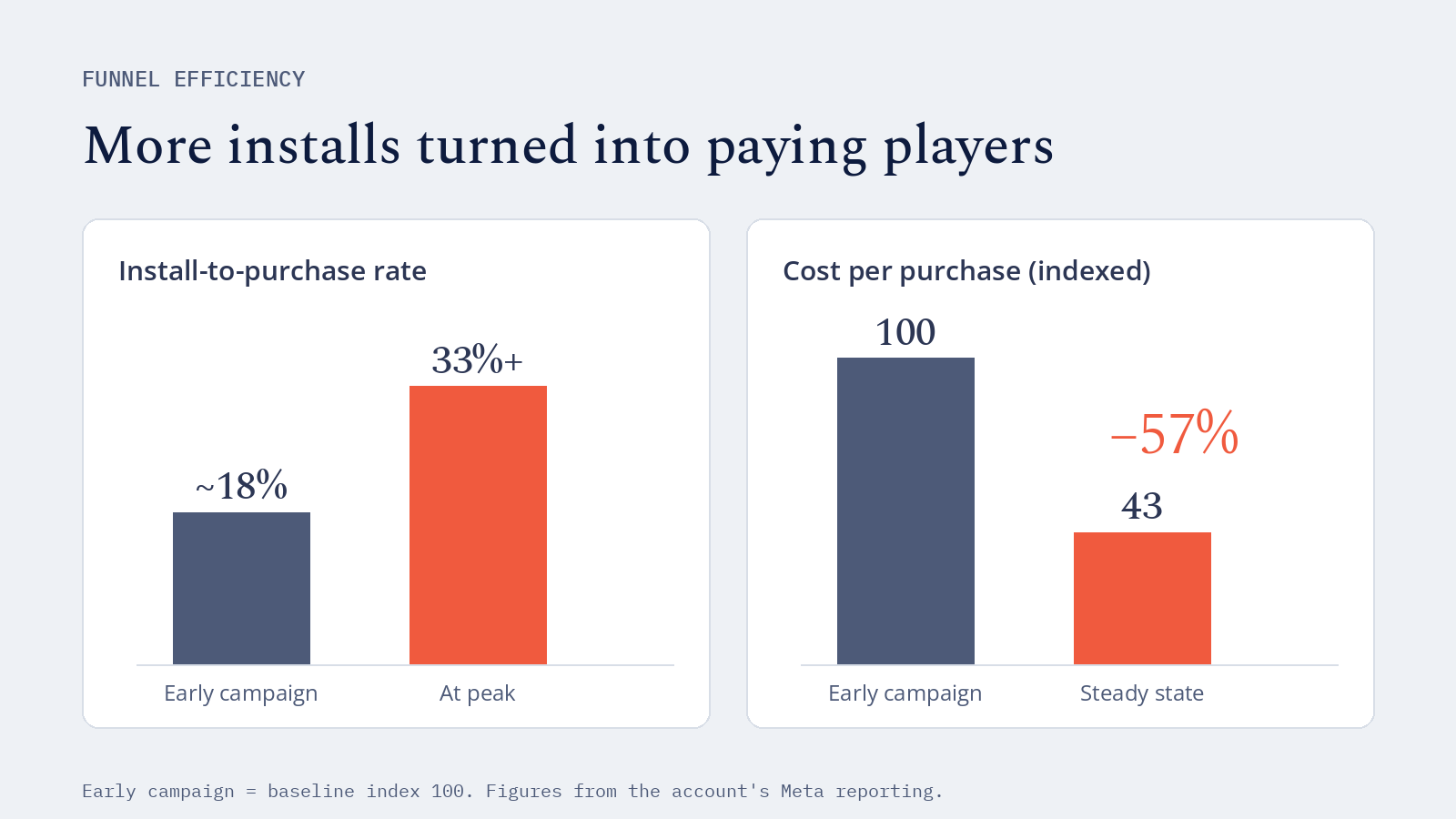
- Cost per purchase fell 57% from the early campaign to steady state.
- US cost per install fell about 50% at peak efficiency.
- Install-to-purchase rate rose from about 18% to 33%+ at peak.
- We tested 100+ creatives across 5 formats to find the winning approach.
The repeatable formula
UGC + a skeptic’s hook + live 1v1 gameplay + a small, believable win + proof of payment.
Each element answers a specific reason people don’t trust the app. The formula works because it’s honest: it shows exactly what the product does and what a real person, who didn’t believe it either, actually won. It carries over to any category where people’s first reaction is “this is too good to be true”.
Spending $50K+ a month and want a creative engine like this built for your app? Let’s talk.
RocketShip HQ | Growth. Accelerated. | rocketshiphq.com