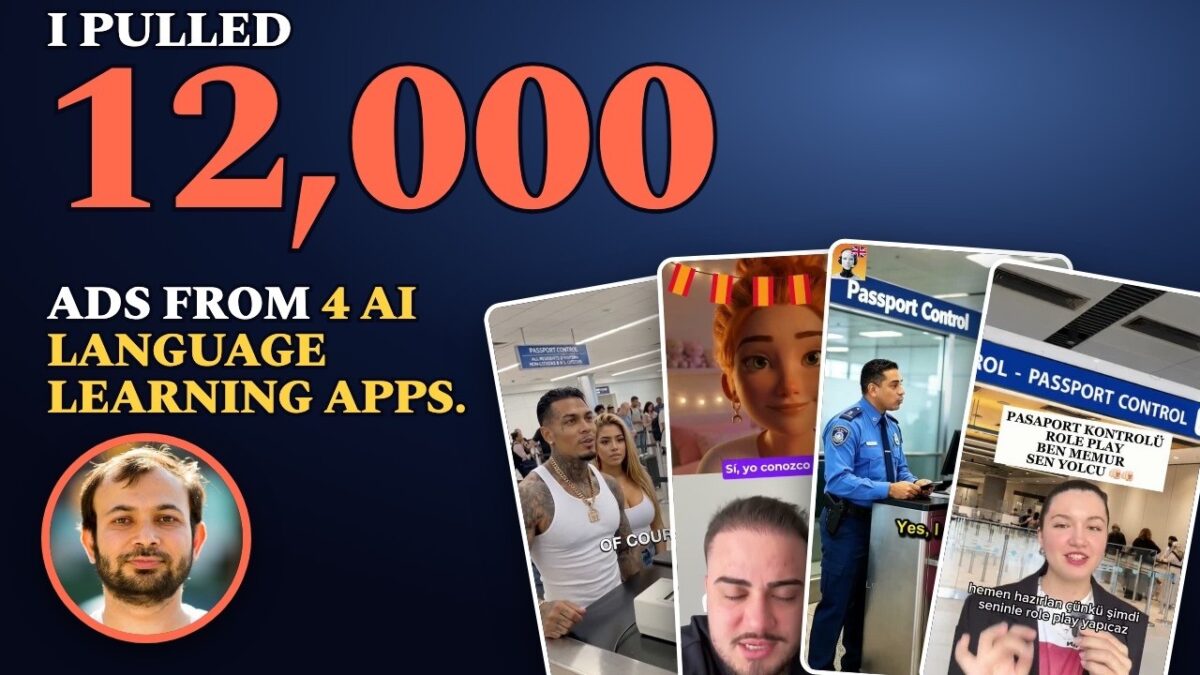
I pulled more than 12,000 ads from BetterSpeak, Praktika, Linguza, and Learna, then read every ad each app launched during one week.
This is a category deconstruction rather than a single-brand audit. The useful question is not who made the best ad. It is what four AI language learning apps are repeatedly betting on, and what the rest of us can borrow.
By The Numbers: 12,071 ads pulled | 4 AI language learning apps | 1 week of activity | 2,593 ads in the audit window | 730 distinct creatives
Page Contents
What each app is betting on
BetterSpeak
Animated skits where English costs someone at work, passport-control scenes, and stories about the years lost by not speaking English. The emotional center is consequence: shame, professional pressure, and being caught out.
Praktika
Real people speaking into their phones, repeat-after-me lessons in language after language, live corrections, and split-screen tutor experiences. The product is shown in use, and the emotional center leans more toward curiosity and progress.
Linguza
AI-generated animated skits, mistakes turned into jokes, professional situations, and street interviews where strangers are asked to translate a phrase. It is the most regional and curiosity-led of the four.
Learna
Wall-of-text ads, long subtitled animated skits, and a robot with a whiteboard teaching phrase after phrase. It shares some category conventions, but its top performers look much more like TikTok-native text-heavy creative.
What you could borrow
The category keeps returning to a small set of devices: show the consequence of not using the product, put an AI character in the coaching role, challenge the user to prove what they can do, translate a winning mechanic into other languages, and keep the mechanic while moving it into a new scene.
The most transferable lesson is to separate the mechanic from the setting. “Years lost” can be opening doors, washing dishes, or any other professional situation. “Prove it” can happen at passport control or somewhere entirely different.
The Unlock
Four apps can all sell language learning, but they are not telling the same story. BetterSpeak leans into consequence. Praktika makes the tutor experience visible. Linguza uses humor, regional context, and street proof. Learna leans into text-heavy, highly legible TikTok formats.
If you are in another vertical, the lesson is to look for the proven device underneath the category surface. A consequence story, an AI coach, a challenge, a translated winner, or a changed scene can travel far beyond language learning.
ABOUT ROCKETSHIP HQ: Website | LinkedIn | Newsletter | Youtube | Podcast Website
FULL TRANSCRIPT BELOW
I pulled 12,000 plus ads from the top four AI language learning apps and did a deep dive of 440 of the ads. So these were the apps I pulled, and as you can see, they’re very established. They’re running hundreds of ads every week. They’ve tested thousands of ads. I took a one-week timeframe, pulled all the ads that were available, did a deep dive of number one, the top 10 ads, my impressions, and number two, all of the ads and themes that they tested during a one-week period.
This was the in-depth analysis I did using BruteForce AI, which is our creative intelligence tool. And these were the top ones for BetterSpeak, and you can play every single one of them. So number one is someone had a passport control. Do you speak English? And again, the second one’s also passport control. The third one is basically someone has been opening doors for 18 years and just still haven’t learned English, and that is stopping him from moving ahead in his career.
This one is speak English better in three weeks, top 10. So you can hear that. So these are the top five. These are the ones six to 10, and I realize the ones on these are not yet playing, but this is a passport control, and this is, again, a passport control, 15 years washing plates, which is a very similar thing as 18 years opening doors. Do you speak English? And again, another, do you speak English?
So you can see the themes that are here, and we’ll get into what they’re testing that crystallizes what the big themes are over here. So these are the ads that they tested during a one-week period. Number one is what we call the years lost. It’s basically 18 years opening doors, 15 years washing dishes, and so on and so forth. So you can see every one of these here.
And the prove-it, prove-it is basically someone in a position of authority is asking that you prove your English. And the third one is where a person, first person, first phone in hand is basically speaking to the camera. These are the other themes that they are testing. The correction, which is someone catching a mistake, pointing it out. Then the phrase, which is stop saying X, say Y. The last one is I left another app to use this particular app.
So these are the big themes, as you can see here, and these are all opportunities. So this gives you an idea of what’s working well, what they’re focusing on, what they’re emphasizing. So the years lost, someone’s really lost a number of years to not knowing English. Someone’s been challenged at passport control. So these are the two big ones, I would say. Now let’s look at our next advertiser. Let’s look at what emotions these ads focus on.
As you can expect, shame, fear of consequence, and somebody has very serious professional repercussions. Caught out, which would be, again, I was challenged and someone tried catching me. So emotions skew very negative here. Now let’s look at our second advertiser, there’s Praktika. Now look at the top five. Women’s learning English while speaking into a mirror, speak with the AI tutor. And you can see here, this person’s speaking to his AI tutor, you show a split screen.
Again, you show the experience of actually talking to an AI tutor, and this person is cooking in the kitchen, the video is not playing, and hopefully I’ll fix it later. And again, this person is in the kitchen, again, talking to an AI tutor here. These are numbers six and six to 10, and it’s a very similar theme here. People are engaging with their devices while talking to an AI tutor. And here are the ads that they’ve tested.
So number one is a correction, which is a tutor catches a mistake, corrects it, stop saying X, say Y. And you can see the commonalities between the other advertisers. This is interesting because you’re asking the viewer to rate their own level and then test it, which is a very different take, which we did not see with BetterSpeak. And these are the smaller three, which is a first person testimonial, learning the language is actually paying off.
This one is also new, it wasn’t present in BetterSpeak, which is, I hate this language, it’s too hard, and someone’s talking to the camera. The last one is prove-it, someone’s challenging you to prove your abilities in a certain language. Here are the ads sorted by the languages they teach. You can see here, again, BetterSpeak was very focused on Spanish, and these guys have different languages here. And here are the emotions a lot of these ads contain.
One of the big ones is curiosity. This isn’t as much of fear or shame, which you can see as a big contrast from the one we saw earlier. And here you see how each dimension, each mechanic is distributed across the different languages they run. Let’s look at the third one with Linguza, and in terms of reviews, this was the smallest among the ones we saw. But again, they’re testing a ton of ads. You can see the passport control, which is a theme that we saw earlier.
She couldn’t check yet. This is somebody at a checkout counter, and she couldn’t help her family. Look at this, again, another passport control. Again, you show a professional circumstance, which shows people using their newfound abilities. And this is basically somebody talking to an AI tutor, similar to what we saw a lot of with Praktika. And these are the 6 to 10. Interestingly, you see this leans more Arabic.
So there’s clearly a regional skew in terms of what these apps are targeting. And these are the big tests that they’re running. Number one is a correction, someone catching a mistake. Number two, again, saying X, say Y. Number three is a POV framing. And these are the smaller three. Number one is prove-it. Somebody asking you to prove your ability. Number two is loss. Somebody’s been working in a job for a number of years.
Lastly, the street interview, which we actually haven’t seen thus far in the other competitors. Again, these are the emotions that each of the ads capture. Much like Praktika, this is much more curiosity leaning, much less negative, much less fear and consequence focused. Let’s look at the fourth of our advertisers, Learna. And yeah, you can see here, this is much more of a TikTok-style wall of text ad.
That’s the top performer, which surprisingly, we haven’t seen much among any of the other advertisers. We saw this is, again, based on stage. And this is, again, a wall of text, wall of text, and this is, again, somebody’s learning and you see their POV experience here. That’s the top five. And as you can see, this is very, very different from what the other advertisers were doing. Number six to 10 is, again, much more comparable to what we’ve seen.
Six is passport control, which we’ve seen for a lot of advertisers. And this is an animated Pixar-style ad, which we’ve seen in some of the other advertisers. This is a conversation between a man and a woman. So you can see here what the commonalities are and what they’re testing and what’s different in each of these. So those are the top performers. This is what they’re testing right now. So stop saying X, say Y. The years lost, which is, again, a theme that we saw before.
And the prove-it, somebody’s challenging you to show your English abilities. And this is much more interesting. The lack of the language is causing them the relationship, which is very interesting. That’s not an angle we’ve seen before. Asking the viewer to rate their level. And lastly, the tutor catching their mistake. That was a full analysis of what these four AI language learning apps do.
And here’s the overall summary of what mechanic they all focus on, what they’re not doing. So if you are one of these four advertisers, you can see the gaps that you have, that you could be testing more of, because it’s somewhat proven for other advertisers. And if you are in any other vertical, these are some of the things you could be learning from this analysis that you could hopefully adapt to your own product. Number one, run the consequence story.
What is the consequence of not using the product? What were they never allowed to do? Are these professional consequences that are debilitating that the product or the skill had them overcome? Show an AI character coaching a user. And that’s what multiple apps do in this analysis. Show a user being challenged. This is the passport control scene, which you’ve seen in all of these apps. Translate the winner into other languages. Lastly, keep the mechanic but move the scene.
It’s like 18 years opening doors, 20 years washing dishes. Really show different professional situations so you can adapt these. So you can certainly learn a lot even if you’re not a language learning app or an AI language learning app. So that’s the end of this analysis. If you’re looking to grow profitably with AI and human assisted creative production, that is focused on performance, please hit me up.
If you are working for one of these language learning apps, feel free to hit me up. Or if you are in any other vertical and want to execute a creative testing program that looks like what you’ve seen, that is based on the kind of analysis that I’m showing you, I am happy to chat. Thank you.
I hope this is helpful. If you would like a deconstruction or analysis of your own ads, or if you would like us to produce performance creative for your product, visit rocketshiphq.com.
Want the full deck with the top 10s, every mechanic, the coverage map, and the takeaways? Get the full AI language learning apps deconstruction here.