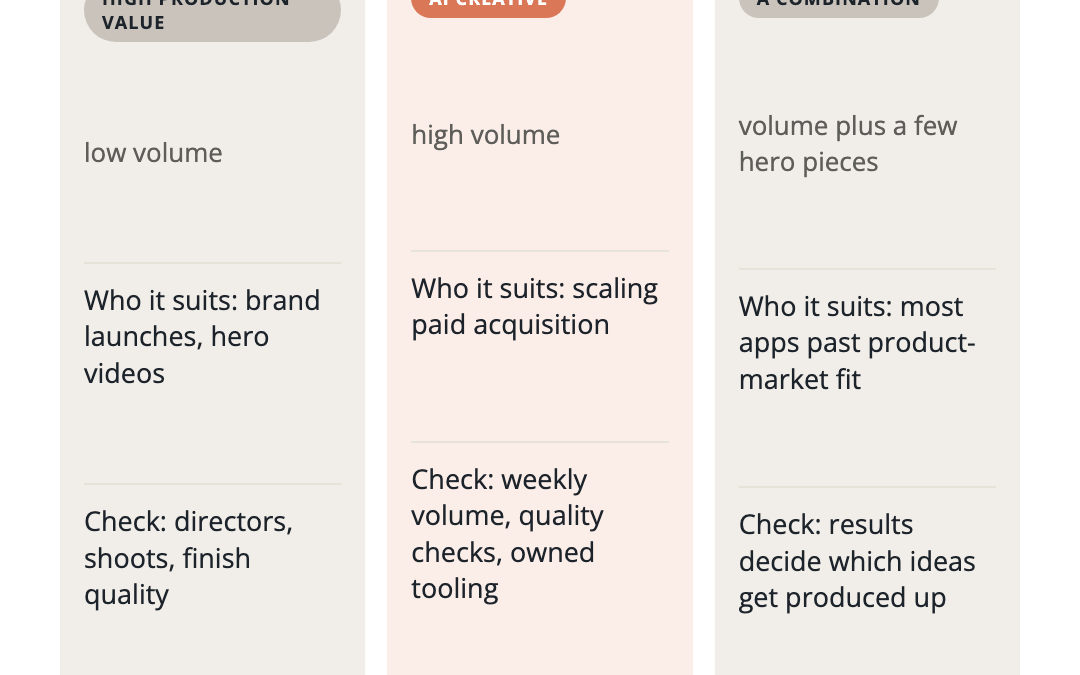
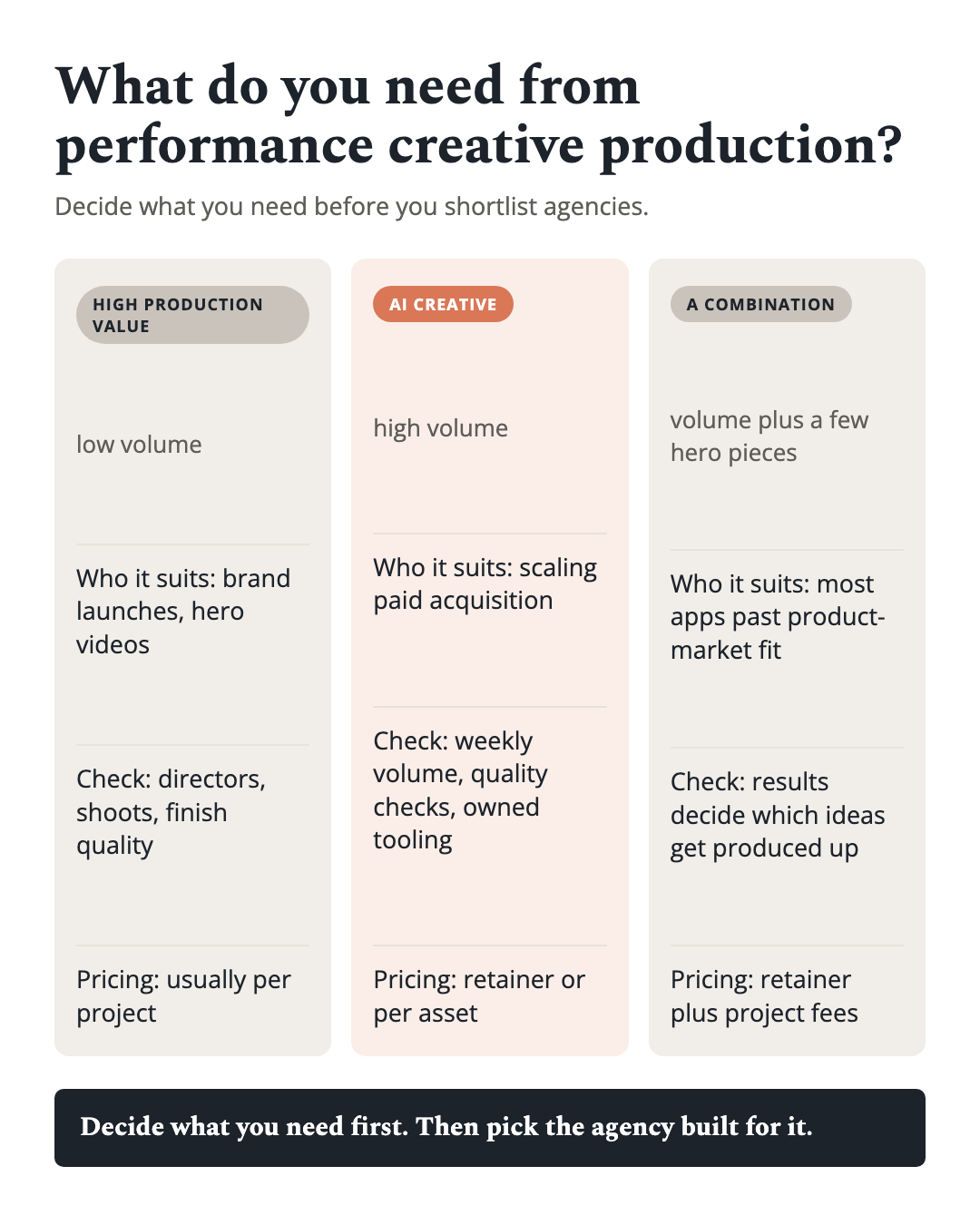
Short answer: the first decision is what you expect from performance creative production, because the right agency differs for each. There are three options. One is high production value at low volume: shoots and polished brand video, a few pieces at a time. Another is AI creative at high volume: many concepts and variants every week. The third is a combination, such as AI and UGC volume with some higher-production pieces. Decide what you need first, then check the agency on what matters for it: weekly volume, the balance of new concepts and variants of winners, formats, owned tooling rather than SaaS bills passed on, who checks quality, and how results feed the next week’s production.
Page Contents
What do you expect from performance creative production: high production value, AI volume, or both?
A performance creative production agency makes finished ads: scripts, footage, edits, statics, motion graphics and, for games, playables. It is not a marketing agency, which plans and buys media; the split is covered in creative agency vs media buying agency, and the wider checklist is in how to choose a UA creative agency. Before comparing agencies, decide which of the three you are buying. Agencies that excel at one are often weak at another.
High production value at low volume. A few polished pieces: a shoot with a real crew, a brand film, directed talent. This suits a launch, a hero video or an app whose look is part of the product.
AI creative at high volume. A steady stream of concepts and variants, fast enough that your accounts always have something new to test. After product-market fit, growth comes mostly from creative, and more distinct ads means more chances to find the ones that scale.
A combination. AI and UGC volume feeds testing, and some higher-production pieces go to the concepts that prove themselves. One team balances both, and volume results decide which ideas earn the expensive treatment.
How do you choose an agency for what you need?
High production value at low volume. Check the work itself. Ask for finished pieces in your category and who directed them, how many revision rounds are included, and how cut-downs for different placements are handled. Red flags: a reel with no clarity on who did what, and no plan for versions after the hero piece. Pricing is usually per project.
AI at high volume. Check the system, not the samples. Ask for the weekly output per client at scale and what stops weak or synthetic-looking output reaching your account. Red flags: a volume claim with no figure for a current client, no visible quality process, tool costs as extras. Pricing is usually a retainer for a defined volume, or per asset.
A combination. Check that one team runs both. Ask how volume results decide what gets higher production, and whether those pieces are made by people who see the performance data or handed to a separate vendor. Red flags: two disconnected teams, and polished pieces never tested against simpler versions. Pricing is often a retainer for volume plus project fees for larger pieces.
How much volume should you expect?
For high-volume work this is the first question. Ask for the weekly output per client at scale, not the maximum on a pitch slide. We do 50 to 100 creatives a week for our scaled clients. You will need it as you scale, and an agency that tops out at a handful of ads a week becomes your bottleneck when spend rises. For low-volume work, ask instead how many projects they run at once, so yours is not queued.
Does the agency balance new concepts with variants of winners?
The check most buyers skip. An agency can inflate output by cutting the same idea twenty ways, which extends a winner but will not find the next one. One that only chases new ideas never harvests what works. Ask how weekly output splits between new concepts and variants of the winners already running, and how that changes when a winner fatigues. The difference is explained in new ad concepts or variations.
Which formats should it cover?
Whatever your channels reward, made in-house or through a pipeline the agency controls: UGC, AI-generated (fast for variants, risky if it looks synthetic), motion and statics, shot or polished video (ask whether it is subcontracted), and playables for games. An agency strong in one format pushes every brief toward it.
Does the agency own its tooling, or pass on SaaS bills?
Some agencies assemble third-party subscriptions and pass the bills on, so your costs rise as their volume does. Others build in-house. Ask which tools the agency owns and whether anything on your invoice is a pass-through.
Who checks the quality of every ad?
At volume, “someone looked at it” is not a process. Look for two layers: people at the script, stills and finished-film stages, and a machine check on every ad for wrong text, artifacts, off-brand elements, safe-zone problems and policy risks. Ask to see a rejected ad and why. A fuller list is in the AI ad quality checklist.
How do performance results feed the next week’s production?
The useful loop is concept-level: which claim, hook or angle drove results, and what to make next. Ask how ads are tagged so results roll up to concepts, how the agency decides what to retire, extend or replace, and whether it sees your performance data directly. If it never does, it is guessing. This matters for all three, most for the combination. If your measurement is untrustworthy, fix that first; see how to pick a subscription app growth agency.
How do performance creative production agencies get paid?
Three structures, sometimes mixed: per asset or project (clear to compare, the norm for high-production work, but it can reward quantity over fit), a retainer (easier to budget, aligned to ongoing output), or a percentage of ad spend (typical of full-service agencies that also buy media; ask what it covers). Ask in writing what volume the fee covers and whether tool costs sit inside it, and compare quotes on cost per usable ad, not the headline fee.
When does in-house beat an agency?
When volume is low, creative depends on constant product access, or you have already built a studio. Based on your needs, keep media buying in-house and buy creative strategy and production, or keep the product in-house and buy UA plus creative strategy and production. See in-house UA vs agency.
Is RocketShip HQ a fit?
- Not the best fit: very low volume, high production value work. A production house built for a few polished, heavily directed pieces will serve you better.
- Best fit: you want production to account for performance feedback, with results read at the concept level and fed into the next round.
- Best fit: you want high-volume AI creative or UGC.
We have produced over 50,000 ads and ship 50 to 100 creatives a week for our scaled clients, as a balance of new concepts and variants of winners. The volume runs on BruteForce AI, the platform we built in-house. Use the questions above on us too.
Frequently asked questions
What is a performance creative production agency? An agency that makes finished ads: scripts, footage, edits, statics, motion graphics and, for games, playables. It is judged on output, quality and learning, and usually does not buy your media.
What is the difference between a creative agency and a marketing agency? A creative agency makes the ads. A marketing agency plans and runs campaigns across channels, usually including media buying.
How do creative agencies get paid? Usually per asset or project, on a retainer, or as a percentage of ad spend. Ask what volume the fee covers and whether tool costs are included.
Should I choose high production value or AI creative? It depends on what you expect. Choose high production value for a few polished pieces, such as a launch. Choose AI at high volume to test many concepts and variants every week. Many advertisers combine them: volume to find what works, higher production for the winners.
How many creatives should a production agency deliver each week? It depends on your stage and spend. At scale, we do 50 to 100 creatives a week for our scaled clients. Ask any agency for the weekly figure at a current client.
Should I hire a performance creative production agency or build an in-house team? Build in-house when volume is low or creative needs constant product access. Hire an agency when you need many concepts and formats every week, faster than you can hire for them.
Is RocketShip HQ a good fit for low-volume, high production value work? Not the best fit. We are strongest when you want high-volume AI creative or UGC, and production that accounts for performance feedback.
Does RocketShip HQ offer performance creative production? Yes. We make UGC, AI, motion and static ads and, for games, playables. BruteForce AI is the platform we built in-house to produce and check them.