I pulled 2,856 of Suno’s ads to roast their creative strategy

A text thread or handwritten note revealing Suno’s digital audio workstation (DAW) appeared three times among its top ten ads by impressions. Recent tests included musician workflow demos and statics, and about a quarter of the recent creative groups used the same Pro Plan feature list as copy. Their users describe a feeling; their ads describe a plan. I would test extensions of those high-impression ads and give the scripts the emotion their reviewers have already written for them. Impressions do not establish cost per conversion, and I do not have Suno’s account results.
By the numbers: 2,856 ads pulled | top 10 by impressions | 4 weeks of launches (31 August to 27 September 2026) | 379 new ads, grouped into 102 creatives | 7 pillars
Why look at Suno?
Suno is an AI music creation app. At the September 2026 snapshot it had 4.9 stars from about 360,000 ratings on the US App Store (382,000 on 26 October), around 760 ads running on 29 September, and had raised over $400 million in a Series D in June 2026 at a $5.4 billion post-money valuation. They are moving fast and aggressively, and I still think they are leaving a lot on the table.
I pulled 2,856 of their ads from Meta’s Ad Library. With our agent, BruteForce AI, I analyzed 379 ads launched from 31 August to 27 September 2026, grouped into 102 creatives across seven pillars. The totals below refer to creative groups, not individual ad IDs. I ranked the top ads by impressions; I don’t know their conversion results.
What is Suno betting on?
The high-impression idea. The reveal is a discovery: a text thread or a handwritten note revealing that Suno now has a DAW (their Suno Studio, launched in September 2025). It holds three of their top 10 by impressions (ranks one, four and five). In the four weeks studied it accounted for five of the 102 creative groups, and all five stopped at the reveal.
Where the volume went. Musician workflow demos took 29 of the 102 creative groups. Songs about your life, music for content creators, musician statics, brand films with artist endorsement, and plan and pricing statics make up most of the rest.
The copy. 27 of the 102 creative groups used the same Pro Plan feature list. Their users write about goosebumps, their daughters, and songs they never got to finish. Their ads say “Artist driven. AI-powered.”
What is holding the ads back?
- Visual clarity. The high-impression reveal looks blurred, like a low-resolution laptop screen, and several statics have print too small to read. I would test sharper versions with the same structure: a WhatsApp or Slack screen, a digital notepad, an AI-generated billboard.
- Entertaining, not persuasive. Many ads come across as funny, polished TikToks. My concern is that some leave the viewer without a concrete reason to download and use the product. I would test a clearer product reason rather than assume entertainment alone is enough. One top-10 ad is slick with no text overlay, no dialogue, nothing speaking to the user.
- No narrative in the demos. The musician workflow demos show the right audience, but most are voiceless, with no story of where the person started and where they ended up.
- Plan and pricing in the ad. I would test product-first versions against these pricing-led ads and leave the fuller plan explanation to onboarding. A price needs context: what is someone getting for it?
- Feature lists instead of lived experience. “Drop the beat, build the track” reads like a billboard. The subhead on the same ad, “I turned a rough idea into a full track in one session”, is better and should be the headline.
What would I do as their creative strategist?
- Extend the high-impression idea, one change at a time. Keep the reveal and fix the clarity: same copy, a sharper image. Then change what people discover, or who discovers it, and show what happens after the reveal. More on this in how to get dozens of ad variations from one winning ad.
- Mine the App Store reviews for people and moments. The songwriter with no producer. The parent making songs with a daughter. The reviewer who wrote: “At 83 years old I can change my own poetry to my own songs for my Great Grandchildren.” Each is a script for a 30 to 60 second story, not just a headline. How to turn customer reviews into ad hooks shows the method.
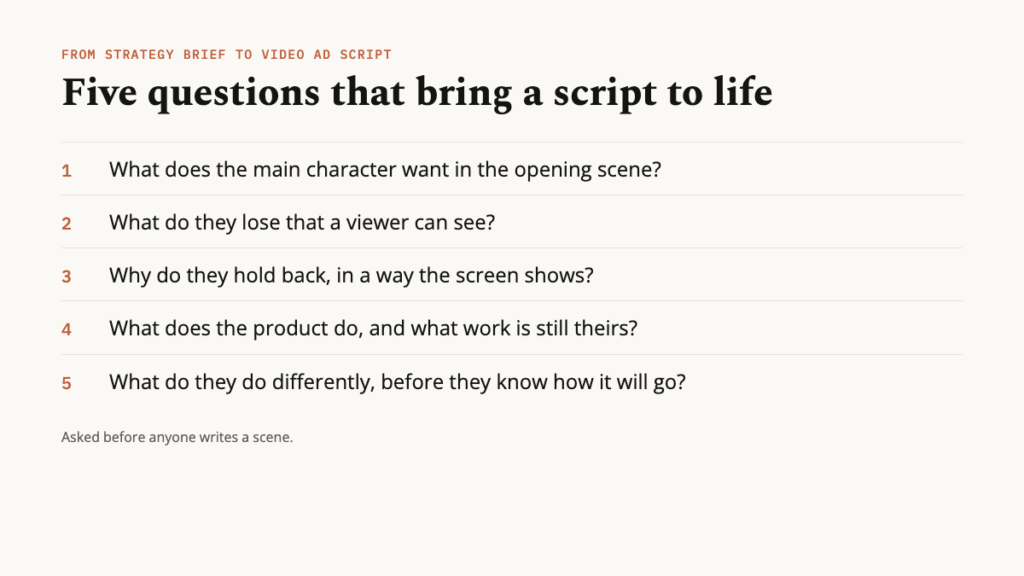
- Write for a feeling with enemy, dream and bridge. A possible script starts with an idea sitting in your notes app, or notebooks of song ideas accumulated over 30 years. The dream is performing in front of your grandkids, or at your favorite bar. The bridge is how the app gets you there.
None of this means discarding the existing ads. Use account results to identify the conversion winners, then test clearer versions and more specific stories.
What can you borrow for your own app?
Extend a winner by changing one thing at a time. Mine your reviews for the people and moments your ads leave out. And write for a feeling, not a feature list: what was wrong, what it feels like fixed, and how the product gets you there. For the same lens on other apps, see our Cal AI analysis and Facetune analysis.
The full deck, with every ad and the videos, is here.

Related reading
Frequently asked questions
How many ads does Suno run on Meta? About 760 were active on 29 September 2026, and we captured 2,856 ads in total. The 31 August to 27 September window contained 379 new ads, grouped into 102 creatives. These are dated sample counts.
Which Suno ads ranked highest by impressions? The DAW reveal, shown as a text thread or handwritten note, held ranks one, four and five in the sample. That ranking does not establish conversion performance.
Why would you test stories against Suno’s feature-list ads? Reviewers describe goosebumps and songs for their families. I would test those specific moments against the feature lists to see which gives people a stronger reason to act, then judge the conversion results.
What is the enemy, dream and bridge framework? A way to add emotional depth to any script: name what the user is fighting, show the outcome they want, and prove how the product gets them there.
Published