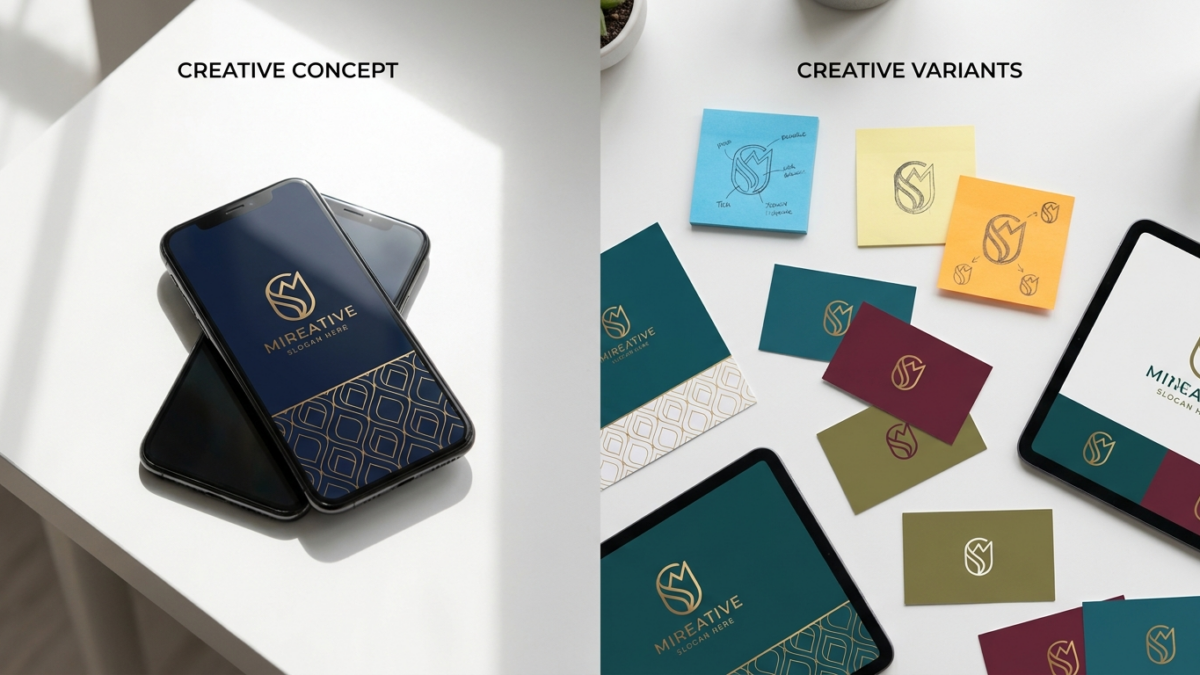
A creative concept is the strategic idea behind an ad: the audience, the angle, the emotional lever. A creative variant is a different execution of that same idea: swapping the hook, changing the visual style, or reformatting for a new placement. Confusing these two layers is the single most common reason mobile UA teams burn budget on 'testing' that teaches them nothing. According to AppsFlyer's 2024 State of Creative Optimization report, creative is the number one lever for campaign performance, yet most teams iterate variants without ever expanding their concept portfolio, hitting diminishing returns within weeks.
Page Contents
Creative Concept
A concept is the foundational strategic bet: who you're talking to, what problem or desire you're activating, and through what narrative frame. Think of it as the 'why someone would care' layer. For a meditation app, one concept might be 'sleep anxiety relief,' while a completely different concept targets 'productivity and focus.' According to research shared by Solsten's Bastian Bergmann, shifting Solitaire Klondike's concept from 'train your brain' to 'hardest solitaire game' based on player psychology improved IPM from 0.97 to 2.4. That's a concept-level change: same product, entirely different motivation being addressed.
Concepts map to audience segments. Each concept should speak to a distinct user psychographic or use case. When you launch a new concept, you're exploring whether an entirely new value proposition resonates with a viable audience at an acceptable cost.
RocketShip HQ's 3C Principle captures what makes a concept work: Context (who is this for?), Clarity (what is this about?), and Curiosity (what tension compels them to keep watching?). A concept missing any one of these three elements will underperform regardless of how polished the variant execution is.
Pros
- Opens entirely new audience segments, with potential CPI reductions of 30% or more per Solsten case studies
- Prevents creative fatigue at the strategic level, not just the visual level
- Builds a library of proven angles that compounds over time
- Drives differentiation in saturated ad auctions where competitors run similar hooks
Cons
- Higher risk per test: new concepts fail at roughly 70-80% rates according to common industry patterns
- Requires deeper strategic work and audience research before production begins
Best for: Concept development is essential when you're entering a new market, launching a new feature, seeing CPIs rise across all existing creatives simultaneously, or when your ad account has fewer than 3-4 proven angles. It's also the right move when creative diversity is declining and the algorithm is concentrating spend on a single ad.
Need help scaling your mobile app growth? Talk to RocketShip HQ about how we apply these strategies for apps spending $50K+/month on UA.
Creative Variant
A variant keeps the same core concept (audience, angle, emotional lever) but changes execution elements: a different opening hook, a new background color, an alternative CTA, live-action instead of animation, or a 15-second cut versus a 30-second version. Variants are how you optimize a proven concept toward its peak performance.
According to Meta's own Advantage+ creative documentation, even small execution changes like text overlay placement or aspect ratio can shift CTR by 10-25%. The 4-Layer Hook System we use at RocketShip HQ illustrates why: stacking visual pattern breaks, text overlays under 15 words, voiceover, and audio creates multiple levers to test without changing the underlying message.
Variant testing is lower risk because you're iterating on something already proven to work. But the upside is also capped. You're refining, not discovering.
Pros
- Lower failure rate: roughly 40-50% of variants of a proven concept show measurable signal
- Faster to produce since the strategic framework already exists
- Extends the lifespan of winning concepts by refreshing creative fatigue
- Enables systematic A/B isolation of specific creative elements like hooks or formats
Cons
- Cannot unlock new audience segments or value propositions
- Leads to local maxima if teams only iterate on past winners, a pitfall outlined in detail for AI-generated creatives
Best for: Variant production is the right call when you have 1-2 winning concepts and need to scale them, when you're analyzing performance data and see a concept with strong intent metrics but weak hook-through rates, or when preparing for seasonal pushes where proven angles just need fresh packaging.
Side-by-Side Comparison
| Dimension | Creative Concept | Creative Variant |
|---|---|---|
| Definition | New strategic angle, audience, or value proposition | Different execution of an existing concept |
| What changes | Core message, target psychographic, narrative frame | Hook, visuals, format, pacing, CTA, voiceover |
| Typical success rate | 20-30% produce a viable winner | 40-50% show measurable improvement |
| CPI impact when successful | Can reduce CPI by 30%+ (new audience unlocked) | Typically improves CPI by 5-15% (execution optimized) |
| Production time | 2-5 days including research and scripting | 0.5-2 days for execution changes |
| Risk level | High: most new concepts fail | Low: iterating on proven foundation |
| Testing budget required | Larger: $1,500-$3,000+ per concept to reach statistical significance | Smaller: $500-$1,500 per variant test |
| Creative fatigue timeline | Weeks to months before the angle itself fatigues | Days to weeks for individual executions |
| Algorithm impact | Expands audience exploration significantly | Refines delivery within existing audience pools |
| Strategic learning | Reveals which value propositions resonate with which segments | Reveals which execution elements drive engagement |
| Example: fitness app | Concept A: 'Visible abs in 90 days' vs Concept B: 'Reduce back pain at your desk' | Variant: Same 'abs' angle with UGC hook vs. animation vs. split-screen before/after |
| When to prioritize | Early-stage apps, new markets, stagnant accounts | Scaling phase, proven angles, pre-holiday refreshes |
Verdict
The right answer is never one or the other. It's a ratio that shifts depending on your stage. Early in a campaign's lifecycle, or when entering a new geo, allocate roughly 70% of creative output to new concepts and 30% to variants. Once you've identified 3-4 winning concepts, flip that ratio: 30% new concepts and 70% variant iterations to scale what works.
Choose concept development when your entire ad account is fatiguing simultaneously, when CPIs are rising across all ad sets, or when you've been running the same 2-3 angles for more than 6 weeks. As Gonzalo Fasanella of Tactile Games explained, Lily's Garden broke through by exploring sadness, anger, and anxiety when 90% of competitor ads relied on funny or cute emotions. That's a concept-level breakthrough, not a variant tweak.
Choose variant testing when you have a proven concept with strong D7 ROAS but suspect the hook or format isn't optimal. For instance, if a concept converts well on TikTok but underperforms on Meta Reels, testing different ad formats of the same angle is a variant play. Avoid the trap of asset stuffing, where you dump all variants into one ad set and prevent the algorithm from learning which audience each creative actually serves.
The teams that win in 2026 run a structured portfolio: always having new concepts in research, proven concepts in variant iteration, and fatigued concepts being retired. According to data.ai's State of Mobile report, top-grossing apps refresh creatives every 1-2 weeks. That cadence is only sustainable if you distinguish between the strategic work of concept creation and the production work of variant iteration.
Frequently Asked Questions
How many creative concepts should a mobile app test per month?
Most scaling apps should test 4-8 new concepts per month alongside 15-25 variants of proven winners, according to common patterns observed across subscription app growth teams. The exact number depends on budget: each concept needs roughly $1,500-$3,000 in test spend to reach reliable signal, per Meta's own learning phase guidance requiring approximately 50 conversion events per ad set per week.
Can AI tools reliably generate new creative concepts or just variants?
Current AI creative tools excel at producing variants (reskinning, reformatting, swapping hooks) but struggle with genuine concept origination. As discussed in an analysis of AI creative pitfalls, one key risk is hitting a local maximum by only iterating on past winners. AI can accelerate variant production, but human creative strategists remain essential for the audience research and psychological insight that drives new concepts.
How do you structure ad sets to test concepts separately from variants?
Give each concept its own ad set with 3-5 variants inside it. This lets the algorithm optimize within a concept while you compare across concepts at the ad set level. Mixing unrelated concepts in a single ad set is asset stuffing, which prevents the algorithm from matching the right creative to the right audience segment. Budget each concept ad set at $50-$100/day minimum to clear Meta's learning phase.
What metrics distinguish a failing concept from a failing variant?
If all variants of a concept show poor hold rates (under 15% video watch to 25%) and low IPM (below 1.0 on Meta), the concept itself isn't resonating. Kill the concept. If one variant shows strong engagement but weak conversion, the concept has potential but the execution needs work. Analyzing creative performance data at both levels prevents you from discarding good ideas due to poor execution.
Does the concept vs variant distinction apply to Apple Search Ads and Google UAC?
Yes, but differently. On Apple Search Ads, concepts map to Custom Product Pages (different value propositions shown to different keyword clusters), while variants are A/B tests of screenshot order or subtitle copy within those pages. Google's Performance Max similarly benefits from thematically grouped asset groups. The principle holds: separate the strategic angle from the execution detail.
How does creative-as-targeting relate to concepts and variants?
The creative-as-targeting strategy is fundamentally a concept-level strategy. Each concept self-selects its audience through the problem it highlights or the language it uses. A meditation app ad about 'falling asleep faster' attracts insomnia sufferers, while 'stay calm during meetings' attracts working professionals. These are different concepts reaching different people through the same broad targeting setup.
What's the fastest way to come up with new creative concepts?
Mine app store reviews, Reddit threads, and competitor ad libraries for language and pain points you haven't addressed yet. Strong hooks often emerge from user language, not marketing brainstorms. Solsten's player psychology approach, which improved Godzilla's CPI by 30% by repositioning around leadership traits, shows how psychographic research drives concept breakthroughs that pure performance data never reveals.
Should UGC creators receive concept briefs or variant briefs?
Always concept briefs. When briefing UGC creators, specify the target audience, the core problem being solved, and the emotional tone. Let them interpret the execution. Then your internal team produces variants: re-editing the footage with different hooks, adding text overlays, or cutting alternate lengths. This separates the creator's authentic delivery from your optimization layer.
Looking to scale your mobile app growth with performance creative that delivers results? Talk to RocketShip HQ to learn how our frameworks can work for your app.
Not ready yet? Get strategies and tips from the leading edge of mobile growth in a generative AI world: subscribe to our newsletter.
Related Reading