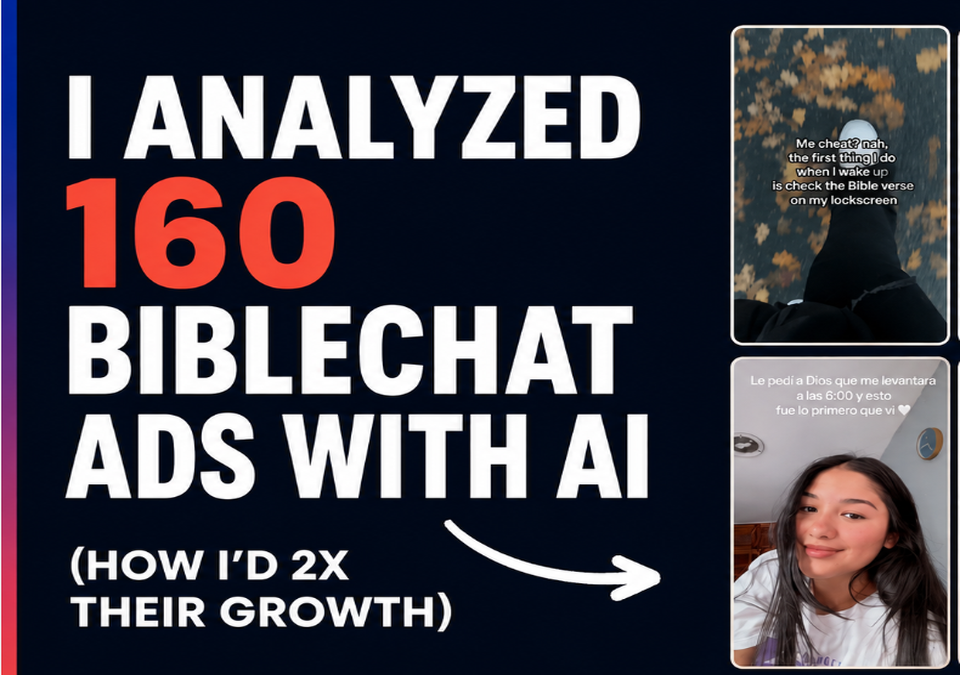
I deconstructed 1,000+ BibleChat App Store reviews and 160 of their top ad creatives.
BibleChat tests aggressively, hundreds of creatives across very different formats and message angles. The gap: their strongest message, lust and temptation, is also their least-tested one.
By The Numbers:
1,000+ reviews read | 160+ ad creatives analyzed | 10 distinct message angles tested in the last two weeks | 4 ads on lust/temptation, all in Spanish
The Plan:
1.Multiply the winner
The pattern: lust and temptation shows up across BibleChat’s top-performing ads (“Temptation,” “How Did You Beat Lust”) but only 4 of their last ~160 tests touch it, all in Spanish.
The fix: new hooks and visual treatments around the same core message. Different opening lines, different visual metaphors, same struggle.
2.Go one step over
The pattern: recent tests cover struggle broadly (numbness, prayer fatigue, marriage) but skip the territory one step from lust: faithfulness, addiction relapse (phone, alcohol), anger, breaking a cycle.
The fix: ask what else is true if lust is the top message. Test the adjacent battles users are already fighting.
3.Point the animation machine at the winner
The pattern: BibleChat already runs four distinct AI-animation styles (3D characters, pixel art, Lego-style CGI, claymation) but rarely points them at lust/temptation messaging.
The fix: repackage the highest-performing message in the visual formats they’re already producing, instead of building new concepts from scratch.
The Unlock:
BibleChat’s testing engine is not the problem. It’s aimed at the wrong ratio: broad message variety, but their strongest lane is barely tested.
ABOUT ROCKETSHIP HQ: Website | LinkedIn | Newsletter | Youtube | Podcast Website
FULL TRANSCRIPT BELOW
Here’s how Bible Chat can 2X their creative-led growth.
I deconstructed over 1,000 App Store reviews and over 160 top-performing ad creatives for Bible Chat, to understand what their top performers are and how they test creative. And I’ve come up with some recommendations on how they can 2X their creative-led growth.
If you aren’t familiar with it, Bible Chat is one of the fastest-growing religion and faith-based apps, and they test hundreds of creatives. They test very aggressively, in very different formats. And yet they could do better. They have a number of opportunities to unlock growth through better creative testing and better creative intelligence, which I’m going to show in this video.
So here’s what we’ve done. There are three parts to this. Number one, audit them, which means understanding what their top performers are. I reviewed the last two weeks of their tests and mined all their reviews to understand what users actually want. Then I synthesized the opportunities they’re sitting on. Then I put together a plan with three high-level recommendations they can use right away.
Let’s get into it.
Here’s what’s already winning. These are their best top performers, so let’s look at each of them.
Number one is the lock screen recording. You can see the flashing lock screen animation here. This one is a Spanish ad, a bit of a montage, and it also focuses on the lock screen experience. The first frame, I would guess, is an AI creator.
So the top three all showcase the lock screen experience, and they’re made with the help of AI. This one is also an AI creator. Here are some of the other top-performing ads, again on the widget experience and the lock screen experience.
One of the themes that keeps standing out is temptation. “We cheat.” “How did you beat lust?” A lot of the high performers do seem to be focused on lust.
So the big elements among the high performers are these. Number one, a real phone moment. Show the actual screen. Number two, show a struggle or a desire, whether that’s being too busy, wanting to get closer to God, wanting to be clear-headed in the morning, wanting to wake up and connect with God first thing, or the struggle of lust, sin, and temptation. And then you visually see the verses on the lock screen, in a fast transition that the ad portrays very visually.
Now, here’s what they’re testing most recently. These are their last two weeks of tests, and there are ten different angles in there.
The first is lock screen scripture, which we’ve already seen among the top performers, and they’re still testing it. Then prayer plans and technique. Let’s look at what each of these looks like so you can understand the different angles.
Here’s the lock screen work. The second one is also a lock screen static ad.
The third is plans and techniques. It says, essentially, “you’re doing this wrong, here’s the right way, here’s a plan, here’s the exact technique.” And then there are the struggles. You can see here, “I’ve been the strong one and I’m struggling.” “I’m just too tired to pray.” Prayer warrior is a phrase a number of ads use, and they’re testing it in very different framings.
Then there are ads targeted at married people, using a headline format of “if [blank] [blank], then [blank].”
Numbness is part of the struggle-based ads, but it’s framed very specifically: I feel nothing, I feel numb.
Another angle they seem to be testing quite a bit is Duolingo. Duolingo for Christians. There are a number of ads like this.
Then there are ads that frame the church as the enemy, which is very interesting. Those are essentially saying, “it’s not enough if you just go to church.”
Can’t sleep? Here’s what will help you sleep better. These are ads that target moms, so again, a very specific audience being targeted.
Those are the different messages they’re targeting, and it’s very interesting to see that variety.
Now let’s look at the formats, which are also interesting. In addition to the different types of messaging, there are very different formats here.
Let’s look at the types of AI animation they’re running. This one has 3D characters, all generated with AI. This is a pixel art game style. This is Lego-style CGI. And this is claymation. So those are the big styles of AI animation they’re running.
Here are some of the other formats. We’ve seen the lock screen widget as a format. There are faceless ads, and other faceless formats that use footage rather than text only. These are talking head videos. These are chat demos and social or native-style posts.
So those are the different formats they’re running right now. They’re testing a lot, and testing a lot of very different directions, which is interesting to see.
Now, here’s what I would do as a creative strategist to 2X their growth through creative.
Number one, lust is one of your top messages, and the tests don’t really double down on it. That’s a big opportunity: double down on lust in very different forms. They could run different hooks around lust and temptation. “Here’s how I conquered lust.” They could pair that with different visual hooks. They could do lust with AI animation. “I was tempted to feel lust, and here’s how I overcame lust.”
So that’s one of the most important messages they have, and yet only four ads in the last two weeks showed it, and all of those were in Spanish. Really double down on your top performer.
My next recommendation would be adjacent extensions. The question we ask ourselves is: if this is true, what else is true?
So if lust is what appeals to users as a key message, what are the other battles users fight that we can appeal to? Those could be faithfulness, temptation, relapsing from addiction, phone addiction, alcohol addiction, anger, sin. These are all one step away from lust, and I think they’re other angles to double down on.
If you look at the recent tests, there are ads about struggle, but there aren’t as many tested around addiction and really trying to break the cycle. That’s not a framing they seem to have tested, and I think they should, given that lust and temptation are among their top performers right now.
The third recommendation is to point the animation machine at some of their top performing ads. As I said, lust and temptation is an unexploited messaging lane, and they are testing a number of animated formats. They could point a lot of those at lust and temptation based messaging. That lets them repackage high-performing messaging in a very different visual format.
So in summary, they’re testing a wide variety of messages and a wide variety of visual formats, and yet they’re sitting on a ton of opportunity.
Number one, double down on what’s working really well.
Number two, go one step away from what’s working really well.
Number three, repackage some of the emerging formats to target what’s working well.
And of course, continue to explore new areas and new messaging directions as well.
That’s all we have for today. If you’d like us to deconstruct your brand or produce high-performing ads for you, please hit me up and we’d be happy to do this for you.
Want the deeper, scene-by-scene creative teardown? Get our full Biblechat deconstruction here.