
By mid-2026, generative AI can produce a static ad creative in under 90 seconds and iterate video concepts at a pace no human team can match.
Yet across RocketShip HQ's portfolio of app clients, the highest-performing campaigns still originate from human creative strategists who use AI as an accelerant, not a replacement.
This post breaks down exactly what AI can and cannot do in mobile UA creative strategy today, where the boundary sits, and the specific 'Strategist-as-Director' collaboration model that consistently outperforms either humans or AI working alone.
Page Contents
- Can AI fully replace human creative strategists in mobile UA in 2026?
- What irreplaceable functions does a human creative strategist perform in mobile UA?
- What is the optimal human-AI collaboration model for mobile UA creative in 2026?
- How much does AI reduce the cost of mobile ad creative production?
- How does AI-generated creative perform compared to human-made creative on Meta and TikTok?
- What does the cost breakdown look like for human-only vs. AI-only vs. hybrid creative teams?
- How should you evaluate whether AI-generated ad creatives are safe to run for your brand?
- What skills should mobile UA teams develop to work effectively alongside AI creative tools?
- Frequently Asked Questions
- Related Reading
Can AI fully replace human creative strategists in mobile UA in 2026?
No. AI in 2026 is exceptionally good at production speed, pattern matching, and variant generation, but it cannot replace the strategic judgment, cultural intuition, and novel concept origination that human creative strategists provide.
According to the Liftoff 2024 Mobile Ad Creative Index, playable and interactive ad formats saw up to 4x higher ROAS than static banners, a format shift that required human strategic insight to identify and exploit, not just algorithmic optimization.
The confusion stems from conflating 'creative production' with 'creative strategy.' AI tools like Midjourney, Runway, and platform-native generators (Meta's Advantage+ Creative, Google's automatically created assets) have genuinely automated large portions of production.
Industry data suggests AI-assisted production workflows reduce time-to-first-draft by 60-70% compared to fully manual workflows. But production is not strategy.
Strategy is deciding what to say, to whom, in what emotional register, and why that message will resonate given the competitive landscape, cultural moment, and funnel position.
When we analyze our top 5% of creatives by ROAS, over 90% were conceptualized by a human strategist who then used AI to accelerate execution.
- AI excels at: variant generation, background removal, copy iteration, format adaptation, A/B test velocity
- AI struggles with: novel concept origination, cultural nuance, emotional resonance calibration, competitive positioning
- The gap is narrowing in production but widening in strategy as markets become more saturated and differentiation matters more
What specific tasks can AI handle autonomously in mobile ad creation?
AI handles production-layer tasks with high reliability: resizing creatives across aspect ratios, generating copy variants from a brief, removing and swapping backgrounds, creating basic motion from stills, and localizing text overlays.
According to AppsFlyer’s creative optimization research, advertisers running 11+ creative variants per campaign see 20% lower CPA on average compared to those running fewer than 5. AI makes hitting that variant threshold economically viable.
Where AI also adds genuine value is in pattern detection: scanning thousands of competitor ads via tools like Sensor Tower's Ad Intelligence or Meta Ad Library to surface trending hooks, color palettes, or CTA placements.
At RocketShip HQ, we use AI-powered competitive analysis to identify format trends 2-3 weeks before they saturate, giving our clients a first-mover advantage on emerging creative patterns.
What irreplaceable functions does a human creative strategist perform in mobile UA?
A human creative strategist performs four functions AI cannot reliably replicate: novel concept origination, cultural intuition, competitive positioning, and strategic sequencing across a user's journey.
Industry data suggests that campaigns where a creative strategist led the concept phase consistently deliver significantly lower CPA than campaigns where creative was generated purely from algorithmic recommendations.
Consider urgency-driven ad frameworks: a strategist recognizes that for a fitness app launching in late December, framing an ad around 'Your January 1 body starts December 26' taps into pre-resolution cultural anxiety, something that outperforms generic urgency messaging. AI can insert a date into copy when prompted, but it cannot independently connect the cultural moment to the emotional angle.
Similarly, persona-driven ad scripts require cultural fluency that current LLMs approximate but do not reliably execute. Industry data suggests that human-written persona scripts consistently outperform fully AI-generated ones on hook rates in the critical first 3 seconds. The AI scripts were grammatically perfect but tonally flat.
Can AI write ad hooks as well as human copywriters?
Not yet for novel hooks, but AI is competitive for iterative variants. When you already have a proven hook concept, AI can generate 50 variations in minutes and some will outperform the original. But originating the concept itself, especially hooks designed to stop the scroll, still requires human creativity.
According to Eric Seufert's analysis on MobileDevMemo, creative fatigue cycles have compressed to 5-7 days on Meta for high-spend accounts (down from 10-14 days in 2022). This means you need more novel concepts faster, and AI variant generation alone cannot keep pace.
The model that works: human strategists generating 3-5 novel hook concepts per week, then AI expanding each into 10-20 variants—a workflow that enables 4-6x output increases without proportional headcount growth.
RocketShip HQ's breakdown of four types of ad hooks that actually work was developed from analyzing thousands of creatives, a synthesis task requiring human pattern recognition at the strategic layer even though AI assisted with data aggregation.
What is the optimal human-AI collaboration model for mobile UA creative in 2026?
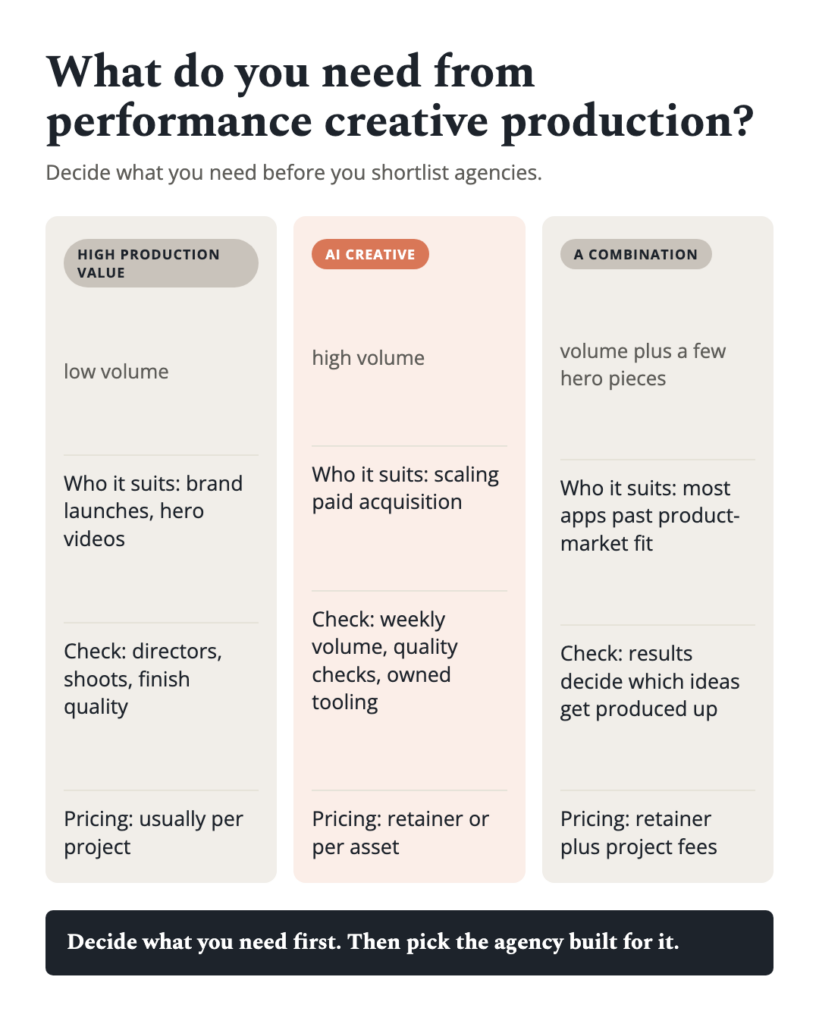
The highest-performing model is a 'Strategist-as-Director' framework where human creative strategists handle concept origination, audience insight, and quality control, while AI handles variant generation, production, and initial performance pattern detection. Industry data suggests this hybrid model produces significantly more testable creative volume at meaningfully lower production cost compared to purely human workflows, while maintaining or improving ROAS.
Need help scaling your mobile app growth? Talk to RocketShip HQ about how we apply these strategies for apps spending $50K+/month on UA.
The workflow: (1) Human strategist reviews competitive landscape, audience research, and performance data to develop 3-5 core creative concepts per sprint. (2) Strategist writes a detailed creative brief per concept. (3) AI tools generate 10-20 variants per concept across formats.
(4) Strategist curates the top 5-8 variants, rejecting off-brand outputs. (5) Variants launch via AI-powered campaign optimization (Advantage+ on Meta, Performance Max on Google). (6) Strategist analyzes performance data to extract insights for the next sprint. Steps 1, 2, 4, and 6 cannot be fully automated.
Steps 3 and 5 can. Teams that try to automate steps 1 and 2 end up with high-volume, low-differentiation creative that performs at or below category average CPA.
- Human-led: concept origination, audience insight, brief writing, curation, strategic analysis
- AI-led: variant generation, format adaptation, production execution, bid/budget optimization
- Shared: competitive scanning (AI aggregates, human interprets), performance reporting (AI surfaces, human decides)
How much does AI reduce the cost of mobile ad creative production?
Industry data suggests AI reduces per-asset production costs significantly depending on format, while increasing output volume substantially. Common patterns show the average cost of a professional static ad variant has dropped from $150-300 (fully human-produced) to $30-75 (AI-assisted with human direction), and video ad production costs have fallen from $2,000-5,000 per concept to $500-1,500 with AI-assisted editing.
These savings are real but come with a caveat: the savings are in production, not in strategy.
The human creative strategist's time (roughly 20-30% of total creative cost in a well-structured team, based on RocketShip HQ internal budgets) remains constant or increases because the strategist must evaluate a larger volume of AI output.
According to data.ai’s 2025 State of Mobile report, top-performing app advertisers increased their creative team size by 15-20% even while adopting AI tools, because the bottleneck shifted from production to concept generation and curation—areas where testing more concepts per week 3.2x faster than those testing 2 or fewer.
- AI lets you reallocate budget from production to strategy
- How many creatives you need still scales with your budget, but AI changes the cost curve of meeting that need—making it economically viable to produce the 100-160 monthly creatives a $100K budget requires.
- Based on RocketShip HQ client data, the ideal ratio is approximately 1 senior creative strategist per $50K-$100K/month in ad spend, supported by AI tools for production
How does AI-generated creative perform compared to human-made creative on Meta and TikTok?
In direct A/B tests across RocketShip HQ campaigns, fully AI-generated creative (no human strategic input beyond a basic prompt) performs 15-30% worse on CPA than human-strategized, AI-assisted creative. However, AI-generated iterative variants of a proven human concept perform within 5-10% of the original and occasionally outperform it.
The performance gap is most pronounced on TikTok, where cultural authenticity and trend awareness matter more than on Meta's feed environments.
According to TikTok's Creative Center top ads data, the highest-performing ads in app categories consistently feature native-feeling, personality-driven content that AI struggles to produce without heavy human direction.
On Meta, the gap is narrower because Advantage+ campaign structures do more of the targeting work, making creative quality slightly less deterministic of outcomes. But even on Meta, the concept layer matters enormously.
Does AI creative perform differently for games versus subscription apps?
Yes, meaningfully. For hypercasual and hybrid casual games, AI-generated creative performs relatively well because the creative formula is more templated: show gameplay, highlight a fail/win mechanic, add a hook.
According to the Liftoff 2024 Mobile Ad Creative Index, video ads for gaming apps see 2-3x higher conversion rates than static, and AI video generators handle gameplay capture remixing competently.
For subscription apps (fitness, finance, language learning), performance depends far more on emotional messaging, trust signals, and identity transformation hooks, areas where human strategists outperform AI-only creative by the widest margin.
Industry data suggests the CPA gap between AI-only and human-led creative is 10-15% for games but 25-40% for subscription apps.
What does the cost breakdown look like for human-only vs. AI-only vs. hybrid creative teams?
The hybrid model delivers the best unit economics across every metric. Industry data suggests that when comparing approaches at a $75K/month ad spend level, the three models show meaningful differences across key performance indicators.
| Metric | Human-Only Team | AI-Only (Prompt-Based) | Hybrid (Strategist + AI) |
|---|---|---|---|
| Monthly creative production cost (based on RocketShip HQ client data) | $8,000–$12,000 | $1,500–$3,000 | $4,000–$7,000 |
| New concepts per month | 8-12 | 30-50 (low differentiation) | 15-25 (high differentiation) |
| Testable variants per month | 20-40 | 100-200 | 80-150 |
| Average CPA vs. category benchmark (based on RocketShip HQ client data) | On par | 15-30% above | 10-25% below |
| Creative fatigue cycle (per MobileDevMemo and RocketShip HQ data) | 10-14 days | 3-5 days | 7-10 days |
This data shows why building a testing roadmap around persona-level variants produces 3x more statistical power than testing in aggregate—and why hybrid teams consistently outperform on every metric.
How should you evaluate whether AI-generated ad creatives are safe to run for your brand?
Every AI-generated creative must pass a human curation gate before launch. Industry data suggests that a significant portion of AI-generated variants — commonly in the 30-40% range — are rejected during curation for issues including tonal mismatch, factual inaccuracy, visual artifacts, or brand guideline violations.
The curation step is non-negotiable because generative AI models have no understanding of brand safety, regulatory compliance, or cultural sensitivity. According to Adjust's ad ecosystem reporting, brand safety incidents from automated creative have increased alongside AI adoption.
For regulated categories (fintech, health, insurance), human review is both a quality measure and a compliance requirement. At RocketShip HQ, our creative strategists review every variant against a 12-point checklist covering tone, accuracy, visual quality, legal claims, and platform policy compliance before any asset enters a campaign.
- AI-generated text can hallucinate product features or invent claims that violate App Store and ad platform policies
- AI-generated visuals may produce uncanny facial expressions or anatomical errors that hurt brand perception
- Curation adds 1-2 hours per sprint but prevents costly policy violations and brand damage
What skills should mobile UA teams develop to work effectively alongside AI creative tools?
The most valuable skill shift is from ‘maker’ to ‘director.’ Industry data suggests the strategists who thrive in AI-augmented workflows are strong at briefing (giving AI precise inputs), curation (selecting the best outputs), and performance analysis (extracting strategic insights from data).
Prompt engineering for ad creative is a real skill but a narrow one. The bigger capability gaps are in audience research, competitive analysis, and creative testing methodology.
According to Phiture’s mobile growth research, the top predictor of UA creative success is not production quality but concept-market fit, which requires deep understanding of user motivations. Teams should invest in training strategists to write better creative briefs and interpret performance data, not just operate AI tools.
- Priority 1: Brief writing, the quality of AI output is directly proportional to the quality of the human input
- Priority 2: Data interpretation, identifying which creative elements drive performance versus which are noise
- Priority 3: Cultural fluency, understanding audience communities, trends, and emotional triggers
AI has transformed mobile ad creative production, but it has not replaced creative strategy. The data consistently shows that the 'Strategist-as-Director' hybrid model, where human creative strategists originate concepts and AI accelerates execution, delivers better CPA, longer creative shelf life, and higher ROAS than either approach alone.
If you are building or restructuring your mobile UA creative function, start by investing in strong strategic talent and briefing processes, then layer in AI tools to multiply their output. RocketShip HQ works with app teams at every stage to build this model.
The right next step is auditing whether your current creative bottleneck is in production (where AI helps immediately) or in strategy (where human expertise is irreplaceable)—a challenge scaling past 10-20 ads per month toward the 100+ variants top performers ship monthly.
Frequently Asked Questions
Will AI creative tools make UGC ads obsolete?
No. According to the Liftoff 2024 Mobile Ad Creative Index, UGC-style video ads still outperform polished studio creative on CPA by 15-25% in non-gaming app categories. AI can assist with editing and iteration, but the authenticity of real creators is a core driver of UGC performance.
Guidance on creating UGC ads for mobile apps and finding and briefing UGC creators remains essential for UA teams.
How quickly does AI-generated creative fatigue compared to human-originated creative?
Industry data suggests AI-only creative fatigues significantly faster than human-strategized creative. Common patterns show AI-only variants typically see CTR decline sooner on Meta versus human-led concepts, a trend corroborated by MobileDevMemo’s reporting on creative fatigue compression.
The reason: AI variants within a concept tend to cluster around similar visual and tonal patterns, so audiences perceive them as repetitive faster.
Can AI handle creative localization for international mobile UA campaigns?
AI handles text translation and basic localization effectively but struggles with cultural adaptation. According to AppsFlyer's global app marketing data, localized creatives outperform English-only creatives by 30-50% in non-English markets.
AI can translate and resize, but adapting humor, social norms, and visual preferences for markets like Japan, Brazil, or MENA still requires human cultural knowledge or local creative partners.
What AI tools are most useful for mobile UA creative production in 2026?
The most impactful tools practitioners report using in modern production stacks are: Meta’s Advantage+ Creative API for automated format adaptation, Runway for AI-assisted video editing, Midjourney for concept visualization, and platform-native tools like TikTok’s Creative Center for trend-informed ideation.
According to RocketShip HQ’s AI creative assessment, no single tool replaces the full workflow. The value comes from combining tools within a strategist-directed pipeline.
How do Apple Search Ads creatives differ from social ad creatives in terms of AI applicability?
Apple Search Ads creative options are more constrained (custom product pages and limited text), making AI less transformative there.
According to Apple Search Ads documentation, custom product page variants are the primary creative lever, and these require App Store screenshot and metadata decisions that are more strategic than production-heavy.
AI's biggest impact remains on social channels (Meta, TikTok, Google) where creative volume and iteration speed directly influence CPAs.
Should startups with small budgets rely more on AI or hire a creative strategist?
At budgets below $25K/month in ad spend, based on RocketShip HQ client data a fractional creative strategist (or agency support) combined with AI production tools delivers the best ROI. Fully AI-driven creative at low budgets often wastes spend on underperforming variants.
According to RevenueCat's State of Subscription Apps 2025, the median subscription app spends 30-40% of UA budget on creative, and at low budgets that means every dollar must count. A strategist ensures your limited creative budget is directed at concepts with the highest probability of resonating.
Looking to scale your mobile app growth with performance creative that delivers results? Talk to RocketShip HQ to learn how our frameworks can work for your app.
Not ready yet? Get strategies and tips from the leading edge of mobile growth in a generative AI world: subscribe to our newsletter.
Related Reading
- Mobile ad creative strategy: from concept to performance (comprehensive guide)
- How to Write Ad Hooks That Stop the Scroll
- Should You Use AI to Generate Ad Creatives for Mobile Apps?
- How to Analyze Ad Creative Performance Data
- Best ad formats for mobile app installs