Advertising a social networking app in 2026 is one of the hardest problems in mobile user acquisition. Unlike a utility app or a game, your product has zero value to the first user and exponential value to the millionth.
According to data.ai's State of Mobile report, social networking apps see median Day 30 retention of just 4.5%, roughly half that of finance apps, because users who don't find their friends or a thriving community churn immediately.
This creates a unique chicken-and-egg problem: you need users to create value, but you need value to retain users.
In this guide, you'll learn exactly how to structure paid UA campaigns, engineer viral loops that compound your ad spend, choose the right channels and creative strategies, and hit the critical mass thresholds that make social networks self-sustaining.
We'll draw on RocketShip HQ's experience running campaigns for social and community apps, as well as benchmarks from AppsFlyer, Adjust, and Sensor Tower, to give you a concrete, data-rich playbook.
Prerequisites: Before you start spending on advertising, you need three things in place. First, a working viral or invite mechanic inside your app (even a simple share-to-invite flow).
Second, an MMP (AppsFlyer, Adjust, or Singular) integrated with SKAdNetwork/AdAttributionKit and your backend events so you can measure not just installs but downstream engagement like connections made, messages sent, and content posted. Third, a clear definition of your ‘activated user’: the in-app behavior that predicts long-term retention.
For most social apps, according to Adjust's State of App Growth report, users who complete 3+ social actions (friend adds, posts, or messages) within 48 hours of install retain at 3-5x the rate of passive installers. Define that activation event before you spend a dollar on ads.
Page Contents
Step 1: How do you define critical mass and set geographic targets for a social app?
Start by defining the minimum user density required for your app to deliver value in a given market. For location-based social apps (like dating or local community apps), this is typically 500-1,000 active users per city according to internal benchmarks shared by Andrew Chen's analysis of network-effect businesses.
For interest-based social networks (hobby communities, professional networks), the threshold is lower but still measurable: roughly 100-300 active users per niche topic area. You absolutely must resist the urge to launch ads in 20 countries simultaneously. Pick 1-3 cities or micro-markets, saturate them, prove retention, then expand.
Tinder famously started with college campuses. BeReal grew city by city in France before expanding globally.
Your paid UA should follow the same logic: hyper-concentrate spend geographically until the network effect kicks in, then use the organic momentum to expand.
Based on RocketShip HQ data across social app clients, campaigns geo-targeted to a single metro area delivered 40-60% higher Day 7 retention compared to broad national targeting, because users were more likely to find real connections nearby.
How do you calculate the right user density threshold?
Use your existing data (or beta data) to find the inflection point. Plot Day 30 retention against the number of active users in the same geography at the time of install.
You'll typically see a clear step function: below a certain density, retention is abysmal (under 5% Day 30), and above it, retention jumps 2-3x. For a dating app client we worked with at RocketShip HQ, that inflection point was approximately 800 weekly active users within a 25-mile radius.
Below that, Day 30 retention was 3.2%. Above it, 11.7%. That single insight determined the entire geographic rollout strategy.
How do you sequence your market launches?
Rank potential markets by three factors: (1) expected CPI (lower is better for initial density-building), (2) cultural fit for your app's use case, and (3) existing organic traction or waitlist signups.
According to AppsFlyer’s State of App Marketing report, social app CPIs in Southeast Asia and Latin America run 60-70% lower than in the US, making them attractive for density-building if your app’s value isn’t geography-locked.
Launch in your top market, spend aggressively for 4-6 weeks to hit critical mass, then reduce spend to maintenance levels and move to market two.
Create a simple dashboard that shows real-time active user density per target geography. When density crosses your threshold, shift 30-40% of that market's budget to the next city. Based on RocketShip HQ experience, this 'rolling thunder' approach cuts blended CPI by 15-25% compared to simultaneous multi-market launches.
Step 2: How should you structure your UA budget for a social networking app?
Allocate 60-70% of your budget to density-building campaigns in your priority markets, 15-20% to retargeting and re-engagement, and 10-20% to creative testing. This ratio is notably different from gaming apps, where creative testing often commands 30%+ of budget.
The reason: for social apps, the quality and geographic precision of your installs matters far more than creative volume in early stages. According to our UA budgeting framework, social apps should plan to spend $5-15 per truly activated user (not per install) in Tier 1 markets.
If your CPI is $2.50 and your install-to-activation rate is 25%, your effective cost per activated user is $10. Plan your budget backwards from the number of activated users needed to hit critical mass in each target market.
What CPI benchmarks should you expect for social apps in 2026?
According to Business of Apps' 2025 CPI data and RocketShip HQ's cross-client benchmarks, social networking app CPIs vary significantly by platform and region. On Meta (Facebook/Instagram), expect $1.80–$3.50 CPI in the US for broad social apps. TikTok Ads tend to run 15-30% cheaper at $1.40–$2.80 in the US.
Apple Search Ads for social category terms average $2.50–$4.00 CPI. In India and Southeast Asia, CPIs drop to $0.30–$0.80 across platforms. The key metric to watch isn't CPI though; it's cost per activated user, which typically runs 3-5x your raw CPI.
Reserve at least 10% of your budget as a 'density acceleration fund' that you can deploy rapidly when a market is close to critical mass. Spending an extra $5,000–$10,000 in a concentrated burst to push a city over the density threshold can be the difference between a self-sustaining market and a slowly dying one.
Step 3: Which paid channels work best for social networking app UA?
Meta (Facebook and Instagram) remains the single most effective paid channel for social app UA, followed closely by TikTok and then Google App Campaigns.
According to the AppsFlyer Performance Index, Meta ranks #1 for social app installs by volume in 17 of 20 measured markets, while TikTok leads in cost efficiency for users aged 18-24.
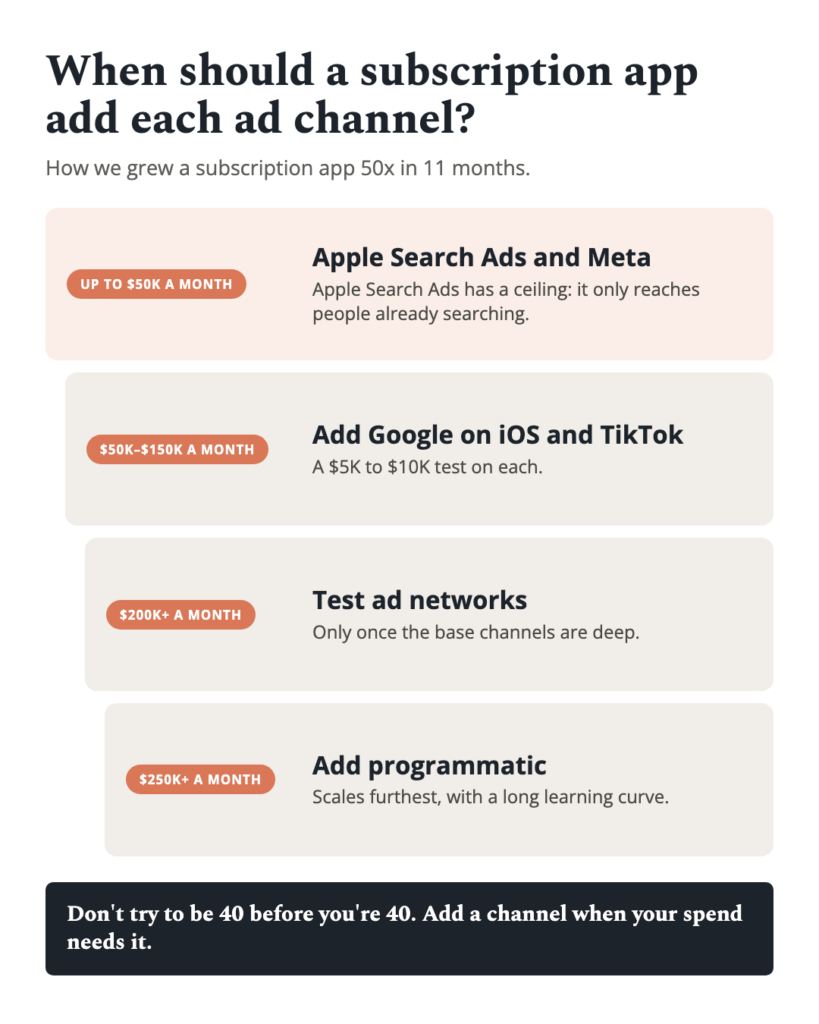
Apple Search Ads is a smaller but highly efficient channel, particularly for capturing high-intent users searching for social app alternatives. For a comprehensive breakdown of channel strengths and how to run multiple channels simultaneously without budget conflicts, see our running UA across multiple channels.
How do you use Meta Ads effectively for a social app?
Use Advantage+ App Campaigns (formerly AAA) as your primary campaign type, but layer in geographic restrictions to maintain density. Optimize for your activation event (not installs) using App Event Optimization (AEO) or Value Optimization (VO).
Based on RocketShip HQ campaigns, optimizing for 'friend added' events rather than installs increased Day 7 retention by 35% while only increasing CPI by 20%, a clear net positive on LTV.
Use lookalike audiences seeded from your highest-engagement users (top 5% by messages sent or content posted), and refresh these seeds every 2-3 weeks as your user base evolves. See Meta's App Events documentation for implementation details.
Is TikTok Ads a good fit for social app UA?
TikTok is excellent for social apps targeting users under 30, particularly if your app has a visual or content-sharing component. According to TikTok's own case studies, social apps see 20-40% lower CPIs on TikTok compared to Meta in the 18-24 demographic.
The challenge is that TikTok users tend to have slightly lower activation rates (based on RocketShip HQ data, 18-22% activation vs. 25-30% from Meta), so you need to evaluate on a cost-per-activated-user basis. Use TikTok's App Event Optimization to push past the install and find users who actually engage.
Should you invest in Apple Search Ads for social apps?
Yes, but with realistic volume expectations. Apple Search Ads captures users who are actively searching for social apps, making these installs extremely high quality. Based on RocketShip HQ data, Apple Search Ads installs for social apps show 40-50% higher Day 7 retention than Meta installs.
However, volume is limited: for most social apps, Apple Search Ads represents 5-12% of total paid installs. Bid aggressively on competitor brand terms (competitor app names) and category terms ('social app for [your niche]'). See Apple Search Ads documentation for campaign setup.
Don't sleep on Reddit Ads for niche social apps. If your social network targets a specific interest community (fitness, music, parenting), Reddit's interest-based targeting can deliver CPIs 30-50% below Meta with surprisingly strong engagement, though at much lower scale.
Step 4: How do you create ad creatives that work for social app UA?
The highest-performing social app creatives in 2026 show real social proof: actual conversations happening, real communities thriving, genuine connections being made.
According to RocketShip HQ's analysis of 2,000+ social app ad creatives, ads featuring 'real user' content (or realistic UGC-style content) outperform polished brand ads by 45-60% on CTR and 25-35% on conversion rate.
The core psychological hurdle you're overcoming is 'will anyone actually be there when I open this app?' Every creative should implicitly answer 'yes, and here's proof.'
What creative formats perform best for social apps?
Three formats dominate. First, UGC testimonial-style videos where a real user shows their phone screen and narrates their experience ('I joined [App] three weeks ago and already found my hiking group'). Second, 'day in the life' content showing how the app fits into someone's routine.
Third, split-screen or before/after creatives showing life without vs. with the community. For tips on the before-and-after format specifically, see our guide to before-and-after ad creatives, which applies the same principles.
Based on RocketShip HQ data, UGC testimonial videos consistently achieve 2-3x the install rate of animated explainer videos for social apps.
How do you handle the 'empty room problem' in your ads?
This is the biggest creative challenge for early-stage social apps. You can't show a thriving community if you don't have one yet. Three tactics work. First, show the specific niche or activity, not the app.
Advertise the interest ('Find people who actually want to play pickup basketball this Saturday') rather than the platform.
Second, use scarcity and exclusivity framing: 'Join the 2,000 [city] creatives already on [App]' performs better than 'Download our social app.' Third, lean into waitlist or invite-only positioning if you have the product mechanics to support it.
FOMO-driven creatives ('You're invited: 847 spots left for [City] launch') drove 2.5x higher CTR in a campaign we ran for a community app at RocketShip HQ.
Test creator-made TikTok content as ad creative on both TikTok and Meta (Reels placement). Per RocketShip HQ data, repurposing TikTok-native content to Meta Reels maintains 80-90% of its performance while cutting creative production costs in half.
Step 5: How do you engineer viral loops that multiply your paid UA spend?
Viral loops are non-optional for social app economics. Without them, you're paying full price for every single user forever, and no social app has achieved scale on paid UA alone. Your target viral coefficient (K-factor) should be at least 0.3-0.5 at launch, meaning every 10 users bring in 3-5 more.
According to Andrew Chen's viral growth framework, a K-factor above 0.7 makes paid UA dramatically more efficient, effectively cutting your cost per user by 50%+.
The key is designing invite mechanics that are genuinely useful (not just 'share this app'), then using paid UA to seed those loops in dense geographic clusters.
Need help scaling your mobile app growth? Talk to RocketShip HQ about how we apply these strategies for apps spending $50K+/month on UA.
What types of viral loops work for social apps?
There are three primary loop types. (1) Content loops: users create content in-app that gets shared externally (Instagram's early photo sharing, BeReal's daily posts shared to Stories). These have the highest K-factor potential (0.3-0.8) but require a strong content creation mechanic.
(2) Invite loops: users directly invite friends because the app is better with friends (WhatsApp's contact-book import, Clubhouse's invite system). These typically achieve K-factors of 0.2-0.5. (3) Network-bridge loops: the app connects to existing networks and pulls users over (early Facebook's college network strategy).
These are the hardest to build but can achieve K-factors above 1.0 in the right conditions.
How do you measure and optimize your viral coefficient?
Track three metrics religiously: invites sent per user, conversion rate on invites, and time-to-invite (how quickly after install a user sends their first invite). The formula is K = invites_per_user × conversion_rate. If each user sends 5 invites and 8% convert, your K-factor is 0.4.
Focus optimization on reducing friction in the invite flow (pre-populated messages, deep links that skip the app store when possible, instant value on the receiving end).
Based on RocketShip HQ data, adding a personalized deep link that opens directly to the inviter's profile increased invite conversion rates by 60-80% compared to generic app store links.
The single highest-leverage viral optimization we've seen at RocketShip HQ is timing the invite prompt. Triggering an invite prompt immediately after a user's first positive social interaction (receiving their first like, completing their first chat) increased invite send rates by 3x compared to prompting at a fixed time after install.
Step 6: How do you optimize for retention instead of just installs?
For social apps, optimizing UA for installs is essentially burning money. A user who installs and never connects with anyone has negative value (they take up server resources and potentially leave a bad review). You must optimize your campaigns for downstream engagement events.
According to the Adjust State of App Growth report, social apps that optimize for post-install engagement events see 2.5x higher 90-day retention compared to install-optimized campaigns, even though CPI increases by 30-50%.
What activation events should you optimize for?
Choose the event that most strongly predicts Day 30 retention. Common activation events for social apps include: profile completed + photo uploaded (weak predictor), first connection/friend added (moderate predictor), first message sent or content posted (strong predictor), 3+ sessions within 48 hours (strong predictor).
Run a correlation analysis between candidate events and Day 30 retention. Based on RocketShip HQ experience, 'first reciprocal interaction' (user sends a message AND receives a reply) is the strongest single predictor for social apps, with users who hit this event retaining at 8-12x the rate of those who don't.
How do you feed these events back to ad platforms?
Send your activation event as an App Event to Meta via the Conversions API (not just the SDK, since SKAdNetwork has limited event support). On Meta, use AEO campaigns optimized for your activation event. On Google, use tCPA campaigns targeting the event. On TikTok, use their App Event Optimization.
The critical technical detail: ensure your event fires server-side and is deduplicated properly. Per Meta's documentation, advertisers using Conversions API alongside SDK see 12-15% improvement in event match rates, which directly improves optimization quality.
Set up a 'fast activation' push notification sequence that fires within the first 2 hours of install. Based on RocketShip HQ data, users who receive a personalized push ('Sarah, 47 people near you are online right now') within 30 minutes of install are 2.2x more likely to complete their first social interaction.
Step 7: How do you use retargeting and re-engagement for social apps?
Retargeting is disproportionately important for social apps because the value proposition changes over time. A user who churned 3 months ago might re-engage successfully today if the local user base has grown 5x since they left. Allocate 15-20% of your UA budget to re-engagement campaigns cost less.
According to AppsFlyer’s analysis of re-engagement campaigns, reactivating a lapsed user costs 40-60% less than acquiring a new one, and reactivated users in social apps show 30% higher Day 30 retention than fresh installs (because they already have a profile and potentially dormant connections).
What triggers should activate re-engagement campaigns?
The most effective trigger for social app re-engagement is a real social event: 'Your friend Alex just joined [App]' or '3 people in your neighborhood posted today.' These notification-style retargeting ads achieve 2-4x the click-through rate of generic 'We miss you' messaging.
Build dynamic audiences based on: (1) users who installed but never activated (target within 3-7 days), (2) users who activated but churned (target at 14-30 days with 'here's what you missed' messaging), (3) users in markets that recently crossed the density threshold (target all lapsed users in that geography).
The single best re-engagement tactic for social apps: when a market crosses your critical mass threshold, run a burst re-engagement campaign to every churned user in that geography. At RocketShip HQ, we've seen this approach reactivate 8-12% of churned users at $0.50–$1.00 per reactivation, versus $2-4 CPI for new users.
Step 8: How do you handle privacy changes and measurement for social app UA?
iOS privacy changes (ATT, SKAdNetwork, and the newer AdAttributionKit) hit social apps harder than most categories because the network effects that drive value are inherently cross-user, making single-user attribution incomplete. layered measurement framework combining SKAdNetwork and MMPs has become essential for social app marketers.
According to AppsFlyer's data, social apps see ATT opt-in rates of 25-35%, slightly above the cross-category average of 25-30%, likely because users of social apps are somewhat more comfortable sharing data. But you still need a measurement strategy that works with 65-75% of users being untrackable.
How should you configure SKAdNetwork for social apps?
Use your conversion value schema to encode your activation event, not revenue. Most social apps are not directly monetized at install, so encoding purchase values is useless.
Instead, encode a composite score: bits 0-2 for session count in the first 24 hours, bits 3-4 for social actions completed, bit 5 for whether the user sent an invite. This gives ad networks the signal they need to optimize toward your best users.
With Apple's AdAttributionKit supporting multiple conversion windows in 2025-2026, you can encode early engagement in the first window and deeper activation in subsequent windows.
What incrementality framework should you use?
Run geo-based incrementality tests monthly. Hold out 1-2 comparable markets (similar demographics, similar density) from paid UA for 2-4 weeks and compare organic install rates and activation rates.
Based on RocketShip HQ experience, social apps with working viral loops typically see 30-50% of attributed installs are actually organic installs that would have happened anyway (due to viral spread being misattributed to the last ad touched).
This means your true CPI is higher than reported, but it also means your viral mechanics are working. Adjust your ROAS targets accordingly.
Build a media mix model (MMM) early, even a simple regression-based one. For social apps, MMMs that account for viral amplification consistently show 20-30% higher true ROAS than last-touch attribution suggests, because paid installs generate organic downstream installs that aren't credited to the campaign.
Step 9: How do you scale UA spend once you've hit critical mass in initial markets?
Scaling a social app follows a fundamentally different curve than scaling a game or utility app. Once a market reaches critical mass, you can reduce spend in that market by 40-60% while maintaining growth, because the network effect and viral loops sustain it.
Redirect that budget to your next target market. According to AppsFlyer’s State of App Marketing report, social apps that successfully scale beyond their initial market see a 25-35% decrease in blended CPI over 6 months as organic and viral channels compound.
What does a market-by-market scaling timeline look like?
Based on RocketShip HQ's work with social app clients, a typical timeline looks like this: Weeks 1-4, heavy spend ($20-50K+ depending on market size) in Market 1 to build density. Weeks 5-8, reduce Market 1 spend by 40%, launch Market 2 at full intensity.
Weeks 9-12, Market 1 at maintenance spend (20-30% of launch spend), Market 2 reducing, Market 3 launching. By month 6, you should have 4-6 markets at or above critical mass with declining per-market costs. The exact budget figures scale with your total budget, but the proportional pattern holds.
When should you go broad with national or global campaigns?
Only after you have at least 5-8 self-sustaining markets AND your viral coefficient is above 0.5. Premature broad campaigns waste budget on scattered installs that never reach density. The signal to go broad: organic installs exceed paid installs in at least 3 established markets.
At that point, broad campaigns serve more as an accelerant than as the primary growth driver. Common patterns across the category suggest the transition from geo-focused to broad campaigns typically happens at 500K-2M total users for most social apps, once the network effect is strong enough to retain new users regardless of local density.
When scaling internationally, consider whether your app needs localization beyond translation. According to State of Mobile global app performance data, social apps with localized onboarding flows (culturally relevant prompts, local examples) see 25-40% higher activation rates in non-English markets. This is worth the investment before you spend on UA in those markets.
Step 10: How do you build a growth team for a social networking app?
Social app growth teams need a different composition than gaming or ecommerce growth teams. You need someone who owns the viral loop mechanics (product/growth engineer), someone who owns paid acquisition (UA manager), someone who owns creative (performance creative strategist), and someone who owns community/retention.
According to our guide on building a mobile growth team, the most common mistake social app founders make is hiring a UA manager before they have a working viral mechanic. Fix the product-side growth loops first, then amplify with paid.
For early-stage teams that can't afford all four roles, many social apps successfully outsource UA management to an agency while keeping product growth and community management in-house.
What does the growth team look like at different stages?
Pre-launch to 50K users: 1 product/growth person (owns viral loops, onboarding, activation) + agency for paid UA. 50K-500K users: Add a dedicated UA manager and a creative strategist. 500K-2M users: Add a data analyst who can run incrementality tests, build MMMs, and optimize conversion value schemas.
2M+ users: Full team with channel specialists, creative team, data science, and community/retention leads. At the 100K-500K user stage, the single most impactful hire for a social app is widely considered to be a data analyst who can quantify the viral coefficient and identify the activation events that predict retention.
At RocketShip HQ, we've found that the best social app growth teams spend 50% of their time on product-side growth (viral mechanics, onboarding optimization, push notification strategy) and 50% on paid UA. If your team is spending 80%+ of its time on paid channels, you're underinvesting in the mechanics that make paid spend efficient.
Step 11: How do you handle compliance and content moderation in your ads?
Social app ads face unique compliance challenges because you're often showing user-generated content, real profiles, and social interactions that must comply with platform policies around authenticity, user safety, and data privacy.
According to Meta's advertising policies, ads for social apps that imply guaranteed connections ('Meet your soulmate tonight') or use misleading social proof ('1 million users near you' when that's not accurate) face rejection rates of 40-60%.
For apps in adjacent spaces like fintech-social hybrids, the regulatory requirements are even more complex. See our guide to ad compliance for fintech apps for additional compliance frameworks.
What are the most common ad rejection reasons for social apps?
Per Meta's Advertising Policies and Google's Ads policies: (1) Implying guaranteed outcomes ('You WILL find friends') gets flagged under misleading claims policies. (2) Using real user photos without proper model releases or permission. (3) Targeting or creative that implies age, gender, or relationship-status based discrimination.
(4) Claims about user counts that can't be substantiated. (5) For dating-adjacent social apps, any sexual or suggestive content triggers immediate rejection on Meta and Google. Build a compliance review checklist and run every creative through it before submission. This saves 2-3 days of back-and-forth with platform review teams.
Maintain a 'pre-approved creative library' of 10-15 ad variations that have passed review on all major platforms. When you need to launch in a new market quickly, adapt these proven-compliant templates rather than creating from scratch. This reduces launch time from 5-7 days to 1-2 days.
Step 12: What benchmarks should you track to know if your social app UA is working?
Track these benchmarks weekly and compare against industry standards. The table below shows key metrics for social app UA based on aggregated data from RocketShip HQ clients and industry reports from our mobile app acquisition cost analysis, AppsFlyer, and Adjust.
What does a healthy social app funnel look like?
| Metric | Poor | Average | Strong | Source |
|---|---|---|---|---|
| CPI (US, Meta) | >$4.00 | $2.00–$3.50 | <$2.00 | RocketShip HQ data, 2025-2026 |
| Install-to-Activation Rate | <15% | 20-30% | >35% | Adjust State of App Growth 2026 |
| Day 1 Retention | <20% | 25-35% | >40% | data.ai State of Mobile |
| Day 7 Retention | <8% | 10-18% | >20% | data.ai State of Mobile |
| Day 30 Retention | <3% | 4.5-8% | >10% | data.ai State of Mobile |
| Viral Coefficient (K-factor) | <0.1 | 0.2-0.4 | >0.5 | Andrew Chen benchmarks |
| Cost per Activated User (US) | >$15 | $6–$12 | <$6 | RocketShip HQ data, 2025-2026 |
| Organic-to-Paid Install Ratio | <0.5:1 | 1:1-2:1 | >3:1 | AppsFlyer State of App Marketing |
How often should you review these metrics?
Review CPI and spend daily. Review activation rate and Day 1 retention every 2-3 days (you need enough data for statistical significance). Review Day 7 and K-factor weekly. Review Day 30 retention and organic-to-paid ratio monthly.
The most important leading indicator is your organic-to-paid ratio: if it's rising, your viral mechanics are working and your paid spend is seeding growth efficiently. If it's flat or declining despite increasing spend, your viral loops need product-side optimization before you scale further.
Set up automated alerts when any key metric drops below the 'Average' threshold for 3+ consecutive days. Early detection of metric degradation saves thousands in wasted spend. Per RocketShip HQ experience, creative fatigue (which tanks CTR and raises CPI) typically hits 10-14 days into a campaign for social apps, faster than the 21-30 day cycle common in gaming.
Common Mistakes to Avoid
- Launching in too many markets simultaneously: This is the #1 killer of social app UA budgets. Based on RocketShip HQ data, social apps that spread their initial $50K-$100K budget across 5+ countries achieved critical mass in zero markets, while those that concentrated the same budget in 1-2 cities achieved critical mass and sustainable growth in both. The math is unforgiving: 10,000 users scattered across 50 cities gives you 200 users per city, which is below the density threshold for virtually any social app.
- Optimizing for installs instead of activation events: Social apps that optimize Meta campaigns for installs instead of downstream events (like ‘first friend added’) see 35-50% lower Day 30 retention, per RocketShip HQ data. Yes, CPI is lower when optimizing for installs, but cost per retained user is dramatically higher. This is the single easiest UA optimization to make, and Advantage+ App Campaigns for mobile apps when properly configured.
- Neglecting the onboarding-to-connection flow: According to Adjust's State of App Growth report, 65-70% of social app users who fail to make their first connection within the first session never return. Yet many social apps spend millions on UA while leaving their onboarding flow untested. Before scaling paid spend, A/B test your onboarding until at least 30% of installers complete a first social action within session one.
- Running generic brand creatives instead of social proof creatives: Polished 'brand anthem' videos consistently underperform UGC-style social proof creatives by 40-60% on install rate for social apps, based on RocketShip HQ's creative testing data across 15+ social app clients. Users don't want to see your brand values; they want to see that real people are using your app and having genuine interactions.
- Ignoring the viral coefficient and overspending on paid UA: If your K-factor is below 0.1, every $1 in paid UA generates roughly $1.10 in total value (accounting for minimal viral spread). If you improve K to 0.5, that same $1 generates approximately $2 in value. Yet most social app teams allocate 0% of their budget to viral loop optimization and 100% to paid channels. Redirect at least 20-30% of effort toward product-side viral mechanics.
- Failing to re-engage churned users after density improvements: Social apps leave enormous value on the table by never re-engaging users who churned before critical mass was reached. Based on RocketShip HQ campaigns, re-engagement campaigns targeting users who churned pre-critical-mass in a market that has since crossed the density threshold achieve 8-12% reactivation rates at $0.50–$1.00 per reactivation. That's 3-5x more efficient than acquiring new users.
- Not building server-side event tracking from day one: Relying solely on SDK-based event tracking means losing 30-40% of your conversion data due to ATT opt-out rates. This degraded signal makes platform optimization algorithms significantly less effective. According to Meta's own documentation, advertisers using Conversions API see 12-15% better event match rates. Set this up before you spend your first dollar on ads.
Advertising a social networking app requires a fundamentally different approach than advertising any other app category.
The network effect means your product's value is directly tied to the density and engagement of your user base, which makes geographic concentration, activation optimization, and viral loop engineering just as important as your paid UA campaigns. Start by defining your critical mass threshold and concentrating spend in 1-3 markets.
Optimize campaigns for activation events, not installs. Build viral mechanics that give every paid install a K-factor multiplier. Re-engage churned users as markets mature. And build measurement systems that account for the unique cross-user value creation in social networks.
If you follow this playbook, here's a realistic timeline: Months 1-2, achieve critical mass in your first market and prove retention benchmarks. Months 3-4, expand to 2-3 additional markets while reducing spend in Market 1. Months 5-6, begin seeing organic installs exceed paid installs in your strongest markets.
By month 6-9, your blended cost per activated user should be declining quarter over quarter as viral loops compound. If you need help executing this strategy, RocketShip HQ specializes in building and scaling UA programs for social and community apps, from initial market launches through global scale.
Frequently Asked Questions
How much should a social app spend to reach critical mass in one city?
Based on RocketShip HQ data, reaching 500-1,000 weekly active users in a mid-size US city (population 500K-2M) typically requires $15,000–$40,000 in concentrated paid spend over 4-6 weeks, assuming a $2.50 CPI and 25% activation rate. Smaller or international markets can be 50-70% cheaper. The key is spending this budget in a compressed timeframe rather than spreading it over months.
Can you advertise a social app with no users yet?
Yes, but your creative strategy must change. Use interest-based and activity-based messaging ('Find your hiking crew in Austin') rather than social proof. Run a waitlist campaign first to collect 1,000-2,000 signups in your launch city, then do a coordinated launch where all waitlist users join simultaneously.
According to RocketShip HQ data, waitlist-to-launch campaigns achieve 3x higher Day 1 retention than cold launches because users arrive to a populated app.
How do influencer partnerships compare to paid ads for social app growth?
Influencer campaigns can be extremely effective for social app launches, but they function differently than paid ads.
Based on RocketShip HQ's cross-channel analysis, micro-influencer campaigns (10K-100K followers) deliver CPIs of $1.00–$2.50 with 15-25% higher Day 7 retention than paid social ads, because the implicit endorsement from a trusted creator drives stronger activation.
However, influencer campaigns are harder to scale predictably and require 2-4 weeks of lead time, making them better as launch amplifiers than as ongoing UA channels.
Should social apps use incentivized installs or reward-based ads?
Almost never. Incentivized installs (where users get a reward for downloading) produce the lowest-quality users for social apps. Based on RocketShip HQ data, incentivized installs for social apps show Day 1 retention of 5-8%, compared to 25-35% for standard paid installs.
These users have zero intrinsic interest in your community, which means they don't make connections, don't create content, and actively dilute the experience for genuine users. The only exception is if you're running a referral program where existing activated users earn rewards for inviting friends they actually know.
How does ASO (App Store Optimization) interact with paid UA for social apps?
ASO and paid UA are synergistic for social apps. According to Phiture's mobile growth framework, strong ASO typically lifts paid conversion rates by 15-25% because users who click an ad and arrive at a well-optimized store listing convert at higher rates.
Focus ASO efforts on: screenshot sequences showing real social interactions, a first screenshot that communicates community size or activity level, and keyword optimization for your niche ('fitness community app' rather than generic 'social network').
Social apps with ratings below 4.0 see 30-40% higher CPIs on Apple Search Ads, per RocketShip HQ data, making review management a direct UA lever.
What role does web-to-app advertising play for social apps in 2026?
Web-to-app flows are increasingly important for social apps because they bypass some ATT measurement limitations. Run ads that drive users to a mobile web landing page where they can preview community content, then deep-link into the app.
According to AppsFlyer data, web-to-app flows show 10-20% higher attributed conversion rates because the web session provides first-party data that improves attribution. For social apps specifically, showing a web preview of active community content before the install prompt can increase install-to-activation rates by 15-25%, per RocketShip HQ testing.
How do you prevent bots and fake accounts from inflating your UA metrics?
Fraud is a real concern for social apps because fraudsters know social networks pay for engagement events, not just installs. According to AppsFlyer's fraud data, social apps experience fraud rates of 10-15% on some ad networks, above the cross-category average of 8-12%.
Use your MMP's fraud detection tools (AppsFlyer Protect360, Adjust's fraud suite), implement server-side install validation, and flag accounts that hit engagement milestones suspiciously quickly (e.g., adding 50 friends within 10 minutes of install). Set up post-attribution fraud reconciliation with your ad networks to claw back spend on fraudulent installs.
When is the right time to start monetizing a social app, and how does it affect UA?
Most successful social apps delay direct monetization until they've achieved self-sustaining growth in at least 3-5 markets, typically at 1-5M MAU. Premature monetization (ads, paywalls) increases churn by 15-30% according to data.ai benchmarks, which destroys the network effects you've spent heavily to build.
From a UA perspective, the introduction of monetization enables you to shift from CPA-based campaign optimization to ROAS-based optimization, which typically improves UA efficiency by 20-40% because ad platforms can optimize toward revenue-generating users rather than proxy engagement events.
Looking to scale your mobile app growth with performance creative that delivers results? Talk to RocketShip HQ to learn how our frameworks can work for your app.
Not ready yet? Get strategies and tips from the leading edge of mobile growth in a generative AI world: subscribe to our newsletter.
Related Reading
- The complete guide to mobile user acquisition (comprehensive guide)
- (This unit doesn’t exist in the provided editable units)
- Adjust State of App Growth Report
- AppsFlyer eCommerce App Marketing Report
- AppsFlyer Performance Index: Top Ad Networks Ranked for Mobile Apps (2026)