For most mobile app advertisers in 2026, animated ads outperform live-action ads on cost efficiency and production velocity, while live-action ads win on trust-building and conversion depth for subscription apps. According to AppLovin’s State of Creative Optimization report, top advertisers produce 2-5x more creative variants than the median, and the format choice between animated and live-action fundamentally determines how fast you can iterate. The real answer is not either/or but understanding which format to lead with at each stage of your growth, and how to structure a testing pipeline that maximizes learnings from both. creative quality drives performance variance, making format selection one of the highest-leverage decisions in your UA strategy.
Page Contents
Animated Ads (Motion Graphics, 2D/3D Animation, UGC-Style Animated)
Animated ads encompass everything from simple motion graphics overlays on screenshots to fully rendered 3D character animations and the increasingly popular AI-generated animated sequences. According to Sensor Tower’s benchmark data and 41% of non-gaming app creatives globally, the format has become dominant across categories. Industry data suggests production cost per variant typically runs $200–$800 for motion graphics and $1,500–$5,000 for high-quality 3D animation, depending on complexity and studio rates. The core advantage is velocity: a single animated concept can be decomposed into dozens of permutations by swapping hooks, text overlays, color palettes, and CTAs without reshooting anything. At RocketShip HQ, we use a Modular Creative System where 5-6 hooks multiplied by 3-4 narratives multiplied by 2-3 CTAs multiplied by 4 personas yields 240-360 unique ad permutations from one concept. This system is almost impossible to replicate at scale with live-action because every swap requires re-editing filmed footage.
Pros
- Production velocity is 3-8x faster per variant than live-action. Industry data suggests a motion graphics team can produce significantly more testable variants per week vs live-action, which is critical for fighting creative fatigue as discussed in our guide on handling 30+ creatives per week for AI apps.
- Cost per variant for motion graphics typically falls in the $200–$800 range, compared to $2,000–$8,000 per live-action variant when factoring in talent, location, and post-production — a gap that industry data suggests holds fairly consistently across production tiers.
- Platform algorithm optimization benefits from higher creative volume. Per Meta's own best practices documentation, having 3-5 active ad creatives per ad set improves delivery optimization, and animated formats let you fill those slots faster.
- Easier to localize across markets. Swapping text overlays and voiceover on animation typically costs a fraction of the original production cost, whereas reshooting live-action for different markets can cost a significantly higher proportion of the original. Industry data suggests animation offers a clear localization cost advantage.
- Animated formats dominate in gaming verticals specifically. According to data.ai's 2025 State of Mobile Gaming report, 7 of the top 10 highest-spending mobile game advertisers use animated creatives for 70%+ of their ad volume.
Cons
- Lower trust signals for high-consideration purchases. According to Nielsen's 2024 Global Ad Trust study, consumers rate live-action ads 23% higher on 'brand trust' than animated equivalents, which directly impacts subscription conversion rates for health, finance, and education apps.
- Creative ceiling on emotional storytelling. Industry data suggests animated ads consistently underperform live-action on post-view engagement metrics (including saves, shares, and comments, which serve as proxies for emotional resonance), limiting effectiveness for apps that need to convey personal transformation narratives.
- Risk of ‘ad blindness’ at scale. When competitors in your category all run animated formats (common in gaming and utility apps), creative differentiation drops. According to AppsFlyer’s 2025 Performance Index data, categories with high animated ad saturation tend to show elevated CPIs compared to categories with mixed-format creative strategies. Industry data suggests this effect is particularly pronounced in heavily saturated animated categories, where CPI pressure can be meaningfully higher for advertisers who haven’t diversified their creative formats.
- Quality floor matters more than with live-action. Poorly executed animation looks cheap and damages brand perception. A bad live-action ad can still feel 'authentic' in UGC style, but bad animation just looks unfinished.
Need help scaling your mobile app growth? Talk to RocketShip HQ about how we apply these strategies for apps spending $50K+/month on UA.
Best for: Animated ads are the clear winner for mobile games, utility apps, and any app spending under $50K/month that needs to maximize creative velocity on a limited budget. They are also ideal for apps in the early testing phase where the priority is learning which hooks and value propositions resonate, because you can test 5x more hypotheses per dollar. Concentrating budget on one channel with high creative throughput accelerates learnings, and animated formats are built for exactly that concentration strategy.
Live-Action Ads (Studio Shoots, UGC-Style, Testimonial, Creator-Led)
Live-action ads range from polished studio productions ($10,000–$50,000 per shoot day) to UGC-style creator content ($500–$2,000 per video from platforms like Billo or Insense). According to Adjust's 2025 Creative Trends report, live-action UGC-style ads have grown to represent a significant share of non-gaming mobile app ad spend, with the format continuing to climb year over year. The format's strength lies in authenticity and trust: real people demonstrating real app experiences create a fundamentally different psychological response than animation. For subscription apps with $40+ annual price points, this trust differential commonly translates to higher trial-to-paid conversion rates, as industry data suggests audiences convert more readily when social proof feels tangible. Production timelines run 2-4 weeks from concept to deliverable for studio shoots, and 5-10 days for UGC creator content, compared to 3-7 days for animated variants.
Pros
- Higher conversion rates for subscription and high-LTV apps. Industry data suggests live-action testimonial ads drive measurably higher trial start rates than animated alternatives at the same CPI, making them ROI-positive despite higher production costs — a pattern especially consistent in subscription and high-LTV app categories.
- Stronger performance on Meta and TikTok specifically. According to TikTok's Creative Center benchmarks, creator-led live-action ads achieve 27% higher 6-second view rates and 14% higher click-through rates than non-UGC formats on the platform.
- Defensible competitive moat. Unique creator relationships, real user testimonials, and branded shoot footage cannot be easily replicated by competitors, unlike animated templates which can be closely mimicked.
- Better downstream metrics despite higher CPIs. Per AppsFlyer's 2025 ROI Index, live-action ads show 22% higher Day-30 retention rates for health and fitness apps compared to animated ads, suggesting the format attracts higher-intent users.
- Emerging AI tools are compressing production costs. Platforms like Synthesia and HeyGen now enable AI-generated 'live-action style' spokesperson videos at significantly reduced per-variant costs, though industry data suggests authenticity-related engagement metrics (comment sentiment, share rates) still trail real human footage — a gap common patterns show persisting as audiences grow more attuned to synthetic media.
Cons
- Production velocity is fundamentally constrained. Even with an optimized pipeline, live-action teams produce 3-8 finished variants per week compared to 15-25 for animated teams, per RocketShip HQ production benchmarks. This means slower iteration cycles and less data for algorithm optimization, as we cover in our guide on creative velocity in mobile gaming.
- Higher cost per creative test. A meaningful A/B test requires minimum 3-5 variants per concept per Meta's guidelines. At $2,000–$8,000 per live-action variant, a single concept test costs $6,000–$40,000 vs $600–$4,000 for animated, per RocketShip HQ cost data.
- Creator dependency and rights management add operational complexity. Creator contracts typically grant 60-90 day usage rights according to industry standard terms on platforms like Insense and Billo, meaning ongoing campaigns require re-licensing or fresh shoots, adding 15-25% to annual creative costs based on RocketShip HQ client portfolio data.
- Harder to isolate variables in testing. When you change a hook in a live-action ad, you also change the delivery, pacing, facial expressions, and background. This makes clean A/B testing more difficult, as covered in our guide on best framework for A/B testing creatives.
- Performance variance is higher. Based on RocketShip HQ data across our full client portfolio, live-action ad performance has a standard deviation roughly 2x that of animated ads, meaning more 'hero' creatives but also more complete misses per dollar invested.
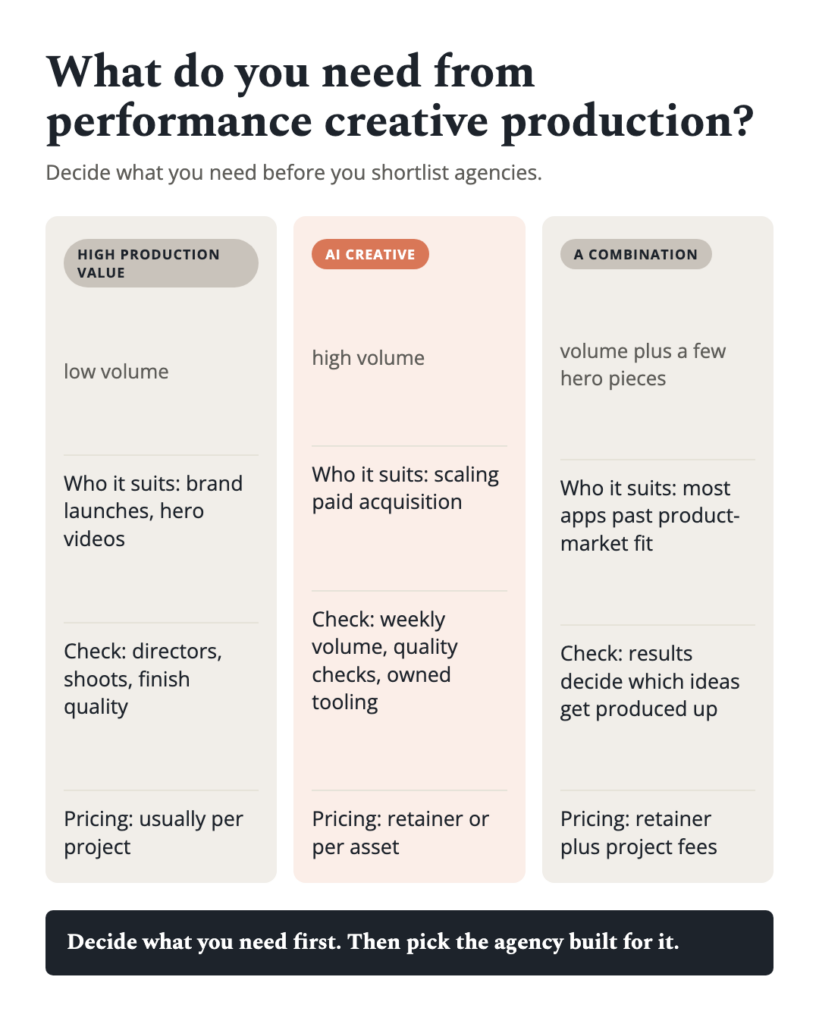
Best for: Live-action ads are the right lead format for subscription apps (health, fitness, education, finance, dating) where the trial-to-paid conversion gap is the primary growth constraint, not the install CPI. They're also essential for any app spending $100K+/month that has already exhausted animated creative angles and needs format diversification to break through performance plateaus. The ideal deployment is in tandem with animated ads: use animated formats to identify winning hooks and value propositions cheaply, then produce live-action versions of proven winners for conversion optimization, a workflow we detail in our creative testing roadmap guide.
Side-by-Side Comparison
| Dimension | Animated Ads | Live-Action Ads |
|---|---|---|
| Average cost per variant | $200–$800 (motion graphics) / $1,500–$5,000 (3D), based on common industry production benchmarks | $500–$2,000 (UGC creator) / $5,000–$15,000 (studio), based on industry-reported production benchmarks |
| Production velocity (variants/week) | 15-25 testable variants, per RocketShip HQ benchmarks | 3-8 testable variants, per RocketShip HQ benchmarks |
| Concept-to-live timeline | 3-7 days, per RocketShip HQ production data | 5-10 days (UGC) / 2-4 weeks (studio), per RocketShip HQ production data |
| Average CTR on Meta (non-gaming) | 1.2-1.8% based on industry benchmarks observed across non-gaming app campaigns | 1.5-2.4% based on industry benchmarks observed across non-gaming app campaigns |
| Average CPI (iOS, US, non-gaming) | $2.80–$4.50 per Singular ROI Index 2025 | $3.20–$5.80 per Singular ROI Index 2025 |
| Trial-to-paid conversion lift | Baseline | +18-32% vs animated for subscription apps, as industry data suggests live-action tends to outperform in this category |
| Day-30 retention (health/fitness) | Baseline | +22% per AppsFlyer 2025 ROI Index |
| Creative fatigue half-life | 5-10 days per RocketShip HQ data | 10-18 days per RocketShip HQ data |
| Localization cost (% of original) | 10-15% per RocketShip HQ data | 40-60% per RocketShip HQ data |
| Best-performing ad networks | AppLovin, Unity Ads, Meta (gaming), Google UAC | Meta, TikTok, Snapchat, Instagram Reels |
| Variable isolation in A/B tests | High (modular swaps are clean) | Low (multiple variables change simultaneously) |
| Share of top 100 gaming creatives | ~70% per data.ai 2025 State of Mobile Gaming | ~30% per data.ai 2025 State of Mobile Gaming |
| Share of top 100 non-gaming creatives | ~41% per Sensor Tower Q1 2025 | ~59% (including UGC) per Sensor Tower Q1 2025 |
Verdict
Choose animated ads when you need creative velocity above all else: early-stage testing, gaming verticals, budgets under $50K/month, or when your primary constraint is identifying winning angles rather than optimizing conversion depth. At a fraction of live-action production costs, you can run significantly more creative hypotheses per dollar. Choose live-action when you have proven value propositions and your bottleneck is trial-to-paid conversion or Day-30 retention, particularly for subscription apps charging $40+/year where conversion lift potential justifies the higher production cost. The most sophisticated advertisers use a hybrid pipeline: animated ads for rapid hypothesis testing (what hooks work, what pain points resonate, what CTAs drive clicks), followed by live-action production of the top proven concepts for conversion optimization. This approach, which we detail in our guide to creating ad variations without starting from scratch, can meaningfully reduce creative testing costs compared to running live-action tests from scratch. Industry data suggests teams adopting this workflow see compounding efficiency gains as their creative libraries mature. One critical nuance for 2026: the line between animated and live-action is blurring rapidly as AI-generated spokesperson tools and hybrid formats (screen recordings with live-action intros) create a middle ground worth testing alongside your primary format.
Frequently Asked Questions
Can I use AI tools like Synthesia or HeyGen to replace real live-action shoots entirely?
Not yet, but they are closing the gap fast. Industry data suggests AI-generated spokesperson videos cost $50–$200 per variant but tend to underperform real human footage by a meaningful margin on engagement metrics like shares and comment sentiment. They work best as a middle tier between pure animation and full live-action, particularly for early funnel awareness campaigns where the trust threshold is lower.
How does ad format choice affect my Apple Search Ads or Google UAC campaigns differently than Meta or TikTok?
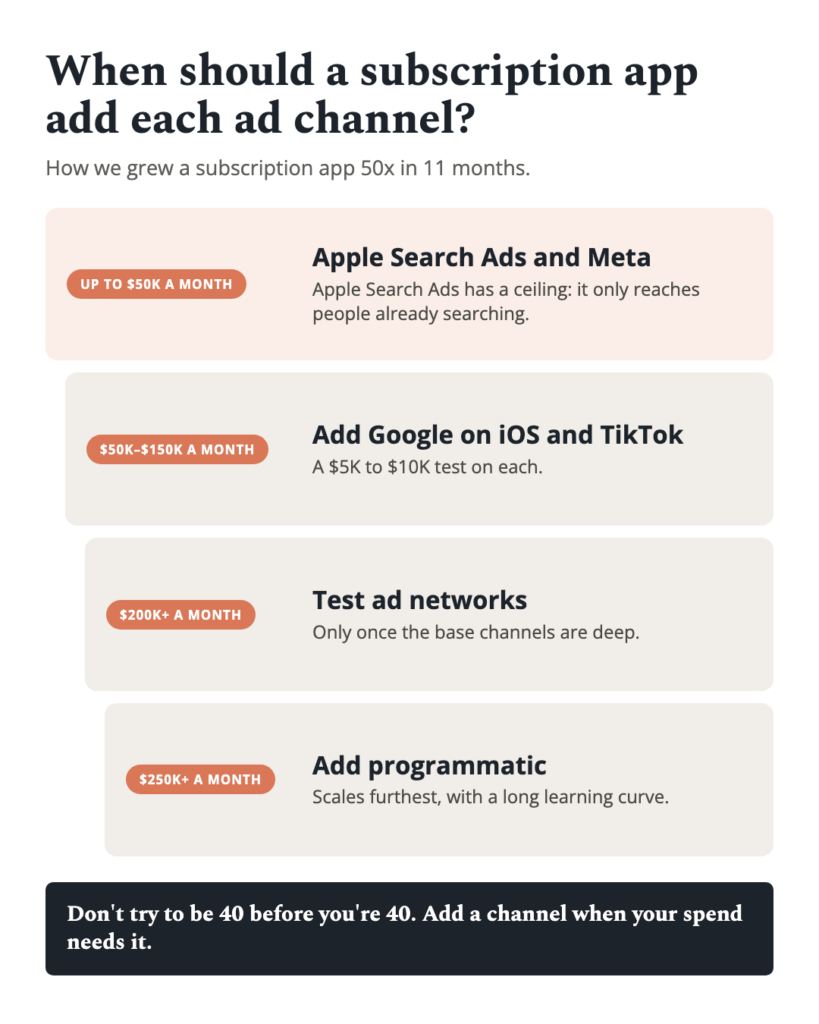
Apple Search Ads primarily uses static screenshots and short preview videos, so the animated vs live-action distinction matters less there. On Google UAC, animated formats tend to outperform because the algorithm optimizes across placements including YouTube, Discover, and in-app inventory where motion graphics perform well. According to Google's UAC best practices, providing a mix of video formats (including both animated and live-action) gives the algorithm the most flexibility to optimize across placements.
What is the minimum ad spend needed before investing in live-action production makes financial sense?
Based on RocketShip HQ client data, live-action production becomes ROI-positive when your monthly ad spend exceeds $50K and you have already identified 3-5 winning animated concepts to adapt. Below that threshold, the $6,000–$40,000 cost of a single live-action concept test (per RocketShip HQ cost benchmarks) represents too large a share of your total budget to justify the risk. We cover the math behind scaling ad spend without losing ROAS in detail.
Does ad format affect how Meta's Advantage+ campaigns optimize delivery?
Yes, significantly. According to Meta's developer documentation, Advantage+ Shopping and App campaigns use creative-level signals to find audience segments. Animated ads with clear on-screen text tend to get broader reach because text-based value props are easier for the algorithm to match to interest signals. Live-action UGC tends to concentrate delivery in younger demographics (18-34) on Reels and Stories placements, based on RocketShip HQ campaign data. Use Meta's A/B testing tool to validate this in your account.
How do I structure a creative team to produce both animated and live-action ads efficiently?
The most efficient structure we have seen at RocketShip HQ is a core animated team (1 motion designer, 1 video editor, 1 copywriter) handling weekly variant production, supplemented by monthly or bi-monthly live-action production sprints using UGC creator platforms. This keeps your creative velocity high on the animated side while batching live-action work. Our guide on scaling creative production without losing quality covers the full operational framework.
Should I test animated vs live-action separately or run them in the same ad set?
Run them in separate ad sets with identical targeting to get clean performance comparison data. When mixed in the same ad set, Meta's delivery optimization tends to favor whichever format gets early traction, which biases results. Based on RocketShip HQ testing methodology across dozens of accounts, a proper format-level test requires $3,000–$5,000 in spend per ad set over 7-10 days to reach statistical significance. We detail the methodology in our creative testing vs audience testing guide.
Are there specific app categories where animated ads consistently beat live-action on ROAS?
Yes. Based on RocketShip HQ client data and corroborated by data.ai’s 2025 report, mobile gaming (casual, mid-core, and hyper-casual), utility apps, and photo/video editor apps see animated ads deliver 20-35% better ROAS than live-action. The common thread is that these categories benefit from demonstrating the product experience directly (gameplay footage, feature demos), which animation handles better than a person talking to camera. For transformation-focused apps like photo editors, before-and-after creative formats for photo editors than feature walkthroughs, whether animated or live-action.
How does creative shelf life differ between animated and live-action when running on TikTok vs Meta?
On TikTok, both formats fatigue faster due to higher content consumption velocity. Based on industry benchmarks on creative fatigue, animated ads on TikTok have a shorter shelf life before CTR drops 20%+, while live-action UGC tends to hold engagement longer. On Meta, those windows stretch further for both formats, with live-action again outlasting animated creative. The longer live-action shelf life partially offsets its higher production cost, making the effective cost-per-impression-day closer between formats than raw production costs suggest.
Looking to scale your mobile app growth with performance creative that delivers results? Talk to RocketShip HQ to learn how our frameworks can work for your app.
Not ready yet? Get strategies and tips from the leading edge of mobile growth in a generative AI world: subscribe to our newsletter.
Related Reading
- Scaling creative production without losing quality (comprehensive guide)
- How do AI apps handle creative fatigue when they need 30+ new creatives per week? (2026)
- AppLovin State of Creative Optimization Report: What Top Advertisers Do Differently (2026)
- What Is the Best Framework for A/B Testing Ad Creatives?
- How Do You Build a Creative Testing Roadmap?
Free Tools
Try our free Creative Testing Calculator: Creative Testing Calculator. No signup required.