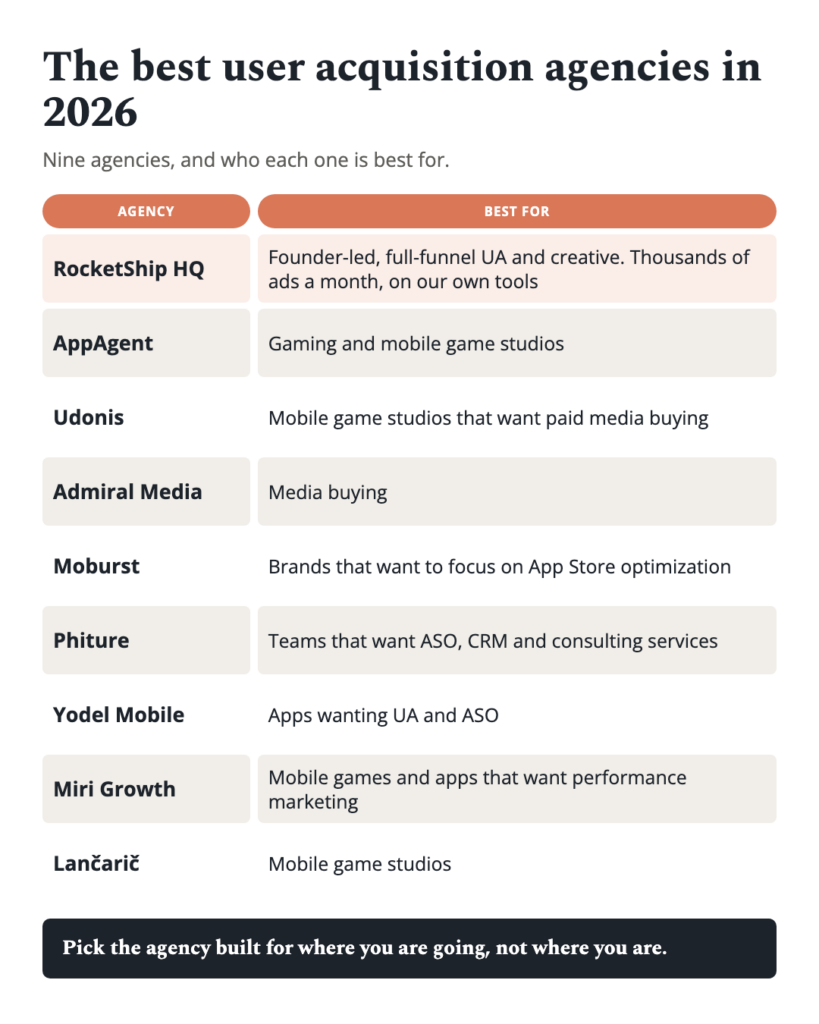
Mobile user acquisition is the lifeblood of app growth, but it's also where most apps fail. After managing over $100M in mobile ad spend across 50+ B2C apps at RocketShip HQ, I've seen brilliant apps with exceptional products struggle to scale because they treated user acquisition as a tactical checklist rather than a strategic discipline. The reality is that successful mobile UA requires mastering multiple paid channels simultaneously, understanding the nuanced relationship between creative and targeting, managing complex attribution models, and making decisions based on cohort economics rather than vanity metrics. The stakes are higher than ever. With iOS 14.5+ privacy changes fragmenting attribution, CPMs rising 40-60% year-over-year on major platforms, and organic discovery becoming increasingly difficult in crowded app stores, mobile user acquisition has evolved from a growth accelerator to a survival imperative. Apps that acquire users efficiently at scale win their categories. Those that don't disappear quietly, regardless of product quality. This guide distills hundreds of campaigns, millions in ad spend, and countless optimization cycles into a comprehensive framework for building and scaling mobile user acquisition. Whether you're launching your first campaign with a $10K monthly budget or scaling to $500K+ per month, this guide covers everything: channel selection and budget allocation, creative production systems, bidding strategies, attribution setup, performance monitoring using frameworks like Weighted Anomaly Scoring, and the critical decision of building in-house teams versus partnering with specialized agencies. Let's start with the fundamentals that separate winning UA strategies from expensive experiments.
Page Contents
- Understanding Mobile User Acquisition Fundamentals
- Paid User Acquisition Channels: A Comparative Analysis
- Creative Strategy: The 60-70% Performance Variable
- Attribution, Analytics, and Performance Measurement
- Budget Allocation and Scaling Strategies
- Organic User Acquisition and App Store Optimization
- CPI, CPA, and ROAS Benchmarks Across Categories
- Building In-House Teams vs Agency Partnerships
- Advanced Optimization: Predictive Models and Automation
- Frequently Asked Questions
Understanding Mobile User Acquisition Fundamentals
Mobile user acquisition is the process of attracting and converting users to install and engage with your mobile application through paid marketing channels, organic discovery, and retention mechanisms. Unlike web marketing where users can sample products through browsers, mobile UA requires users to commit to an install before experiencing value, making every touchpoint in the conversion funnel critical. The fundamental equation is deceptively simple: you spend money to acquire users, and those users generate revenue over their lifetime. Profitability occurs when lifetime value (LTV) exceeds customer acquisition cost (CAC) by a sustainable margin, typically 3:1 or higher for venture-backed apps.
The complexity emerges in execution. Mobile UA operates across 6-8 major paid channels (Facebook, Google UAC, TikTok, Apple Search Ads, Snapchat, Unity Ads, ironSource, AppLovin), each with distinct targeting capabilities, creative requirements, attribution models, and user quality profiles. A user acquired through Apple Search Ads at $3.50 CPI might generate $15 LTV over 180 days, while a user from TikTok at $2.20 CPI might generate only $4.50 LTV. The winning strategy isn't finding the cheapest CPI, it's optimizing for the highest LTV:CAC ratio at the scale your business requires.
Successful mobile UA requires three foundational capabilities: robust attribution and analytics infrastructure to measure user quality accurately, systematic creative production to test 50-100+ ad variations monthly, and economic modeling that connects acquisition costs to downstream revenue. Apps that lack any of these three pillars consistently overspend on low-quality users or underinvest in high-performing channels. At RocketShip HQ, we've found that apps with mature UA operations typically allocate 35-45% of their total budget to creative production and testing, not just media spend, because creative variance explains 60-70% of performance differences within channels.
The Mobile UA Ecosystem in 2024
The mobile user acquisition landscape has fragmented significantly since Apple's ATT framework launched in 2021. iOS campaigns now operate with 30-50% attribution visibility compared to 90%+ pre-ATT, forcing advertisers to rely on modeled conversions, SKAdNetwork data, and incrementality testing. Android maintains better attribution but faces its own challenges with Google's Privacy Sandbox rolling out through 2024-2025. This fragmentation means successful UA strategies require channel diversification, probabilistic measurement models, and longer optimization windows. Where you could previously optimize campaigns daily with confidence, you now need 7-14 day windows to accumulate statistically significant signal, especially on iOS where SKAdNetwork provides delayed, aggregated data rather than user-level attribution.
Key Performance Indicators That Actually Matter
Vanity metrics destroy UA budgets. CPI (cost per install) and install volume look impressive in board decks but tell you nothing about profitability. The metrics that determine success are D1/D7/D30 retention rates (indicating product-market fit), Day 7 and Day 30 ROAS (return on ad spend), payback period (time to recover CAC), and contribution margin per cohort (revenue minus variable costs and CAC). A gaming app with 45% D1 retention, 18% D7 retention, and $0.85 Day 7 ROAS at $2.80 CPI is exponentially more valuable than one with 35% D1, 12% D7, and $0.40 Day 7 ROAS at $1.90 CPI, even though the second has lower acquisition costs. The first app will scale profitably, the second will burn cash at any scale.
- Mobile UA success is defined by LTV:CAC ratio, not CPI alone, with 3:1 being the minimum threshold for sustainable growth
- Attribution fragmentation post-iOS 14.5 requires 7-14 day optimization windows instead of daily adjustments
- Creative production accounts for 35-45% of effective UA budgets at mature apps
- Retention metrics (D1/D7/D30) are leading indicators of unit economics before revenue data matures
Paid User Acquisition Channels: A Comparative Analysis
Each paid UA channel delivers distinct user profiles, requires different creative formats, and operates under unique algorithmic optimization systems. The most common mistake in channel strategy is treating all channels identically or concentrating spend in a single channel because it worked initially. In our management of $100M+ in mobile ad spend, we've consistently found that apps scaling past $100K monthly spend require at least 3-4 active channels to mitigate platform risk, access sufficient inventory, and maintain negotiating leverage. Channel concentration creates catastrophic risk when iOS updates, policy changes, or algorithm shifts occur, which happens 2-3 times annually on major platforms.
Facebook (Meta) and Instagram remain the largest performance channels for most B2C apps, typically commanding 35-50% of total paid budgets. Facebook's Advantage+ campaigns use sophisticated machine learning to optimize across placements, but performance has become more volatile post-ATT with 40-60% longer learning phases. Google App Campaigns (UAC) excel for apps with strong search intent and typically deliver 20-30% higher retention than social channels, though at 15-25% higher CPIs. TikTok has emerged as the fastest-growing channel, particularly effective for apps targeting users under 35, with CPIs 10-30% below Facebook but requiring distinct creative approaches focused on authentic, entertainment-first content rather than polished ads.
Apple Search Ads deserves special attention because it captures high-intent users actively searching for solutions, delivering the highest average retention and LTV of any channel. ASA typically represents 10-15% of budget but can drive 25-30% of profitable user volume. The challenge is scale: most apps exhaust high-intent keywords at $5K-$15K monthly spend. Programmatic networks (Unity, ironSource, AppLovin, Vungle) are essential for gaming apps and can drive massive volume at lower CPIs, but user quality varies significantly and requires aggressive fraud monitoring.
Facebook and Instagram: The Volume Powerhouse
Facebook's Advantage+ App Campaigns (formerly App Install Campaigns) automate much of the optimization process, consolidating audience targeting, placement selection, and creative optimization into a single campaign structure. For apps with $50K+ monthly budgets, this typically outperforms manual campaigns by 15-25% on efficiency metrics. However, Facebook requires continuous creative refresh, you need to launch 8-12 new ad variations weekly to maintain performance as creative fatigue sets in after 7-14 days at scale. Budget allocation should use Campaign Budget Optimization (CBO) with 5-7 ad sets testing different audience signals and creative angles. Benchmark CPIs range from $1.80-$4.50 for casual gaming, $2.50-$6.00 for lifestyle apps, and $4.00-$12.00 for fintech, with significant variation by geography.
Google App Campaigns: Intent-Driven Acquisition
Google UAC operates as a black box compared to Facebook, automatically generating ad combinations from your assets and distributing them across Google Search, Display Network, YouTube, and Google Play. The key to UAC success is asset diversity: provide 10-15 different headlines, 8-10 descriptions, 15-20 images, and 5-8 videos to give the algorithm maximum combinatorial testing capacity. UAC campaigns require larger budgets to exit learning phases, typically $300-$500 daily minimum for optimal performance. Target CPA bidding works better than target ROAS for apps with longer monetization cycles. One critical advantage: UAC delivers significantly better retention than social channels for utility apps, productivity apps, and any category where users have explicit search intent rather than discovering the app through entertainment browsing.
TikTok: The Creative-First Channel
TikTok user acquisition differs fundamentally from other channels because ads that look like ads fail catastrophically. Successful TikTok creatives are native-first: user-generated content style, vertical video optimized for sound-on viewing, and entertainment value that would work as organic content. Apps running polished, studio-produced ads on TikTok typically see CPIs 2-3x higher than those using authentic, creator-style content. TikTok's algorithm requires patience, campaigns need 5-7 days and $500-$1,000 spend to exit learning phases, but once optimized can deliver 20-40% lower CPIs than Facebook for the right apps. The platform skews younger (60% of users under 30) so works exceptionally well for social apps, casual games, and lifestyle categories but struggles with B2B, fintech, or products targeting users over 45.
Apple Search Ads: High-Intent, High-Value Users
Apple Search Ads captures users at the moment of highest intent, when they're actively searching the App Store for solutions. This intent premium translates to 30-50% higher D30 retention and 40-70% higher LTV compared to users from discovery-based channels. ASA operates on a second-price auction model with keyword bidding, requiring continuous optimization of keyword portfolios (200-500 keywords for most apps), negative keyword management, and Creative Set testing. The platform provides exceptional attribution visibility through Search Ads Attribution API, making it your most measurable channel post-ATT. Budget scaling limitations are the primary constraint: most apps hit diminishing returns at $10K-$25K monthly spend as they exhaust category and competitor keywords, though games and highly searched categories can scale to $50K-$100K+.
- Channel diversification across 3-4 platforms is essential for apps scaling beyond $100K monthly spend
- Facebook requires 8-12 new creative variations weekly to combat creative fatigue at scale
- Google UAC delivers 30-50% higher retention for intent-driven app categories
- TikTok creative must be native-first and entertainment-focused, not traditional ads
- Apple Search Ads provides highest LTV users but limited scale for most apps
- Benchmark CPIs vary 3-5x across channels for the same app category
Creative Strategy: The 60-70% Performance Variable
After analyzing thousands of campaigns across 50+ apps, the data is unambiguous: creative accounts for 60-70% of performance variance within channels, while targeting and bidding combined explain only 30-40%. Two campaigns targeting identical audiences with identical budgets and bidding strategies routinely show 3-5x CPI differences based solely on creative execution. Yet most apps allocate 90% of their UA resources to media buying and only 10% to creative production, inverting the actual impact relationship. This misallocation stems from treating creative as a one-time asset production problem rather than an ongoing testing and optimization system.
Successful creative operations produce 20-50 new ad variations monthly for apps spending $50K-$200K, and 50-100+ variations for apps at $500K+ monthly spend. This volume requirement isn't arbitrary, it reflects the mathematical reality of testing. If you need to find 5-8 winning creatives monthly to maintain performance (as creative fatigue retires existing winners), and your hit rate is 15-20% (typical for mature creative operations), you need to produce 30-40 new concepts monthly just to maintain baseline performance. The apps that scale successfully build creative production systems, not one-off campaigns.
Creative strategy must be channel-specific. Facebook performs best with thumb-stopping first frames, clear value propositions in the first 3 seconds, and problem-solution narratives. TikTok requires entertainment-first content that delivers value before revealing it's an ad, often using creator partnerships rather than branded content. Google UAC needs asset diversity with 15-20 image variations and 5-8 video concepts to feed the algorithm's combinatorial testing. Apple Search Ads creative focuses on custom product pages and screenshots optimized for keyword-specific value propositions. At RocketShip HQ, we've produced 10,000+ ad creatives and consistently find that apps running channel-specific creative strategies outperform those repurposing identical assets across platforms by 40-80% on efficiency metrics.
Creative Testing Frameworks and Velocity
Systematic creative testing requires structured frameworks, not random iteration. We use a hypothesis-driven approach testing specific variables: hooks (first 3 seconds), value propositions, social proof elements, call-to-action framing, and visual styles. Each test should isolate one primary variable while controlling others. Launch 3-4 variations of each concept with $200-$500 spend each (depending on your CPI) to reach statistical significance, typically 50-100 installs per variation. Creative winners are defined not by CPI alone but by blended metrics: CPI, D7 retention, and Day 7 ROAS. A creative with 20% higher CPI but 35% higher D7 retention will drive superior long-term profitability. Testing velocity matters enormously: apps testing 8-12 new concepts weekly learn 4-5x faster than those testing monthly, compounding into exponential performance advantages over 6-12 months.
User-Generated Content and Creator Partnerships
User-generated content (UGC) and creator partnerships have become essential creative strategies, particularly on TikTok and Instagram Reels where authentic content outperforms polished ads by 40-70% on engagement and conversion metrics. UGC works because it provides social proof and reduces perceived advertising friction. Effective UGC strategies involve recruiting 10-20 creators monthly, providing loose creative briefs that preserve authentic voice while ensuring key value propositions are communicated, and rapid testing of output. Most creator partnerships produce 2-4 usable ads per creator, so volume is essential. Budget $200-$500 per creator for content rights and production, significantly less expensive than studio production while often delivering better performance. The key is rapid iteration: test creator content within 48 hours, scale winners immediately, and continuously refresh your creator pool to avoid style fatigue.
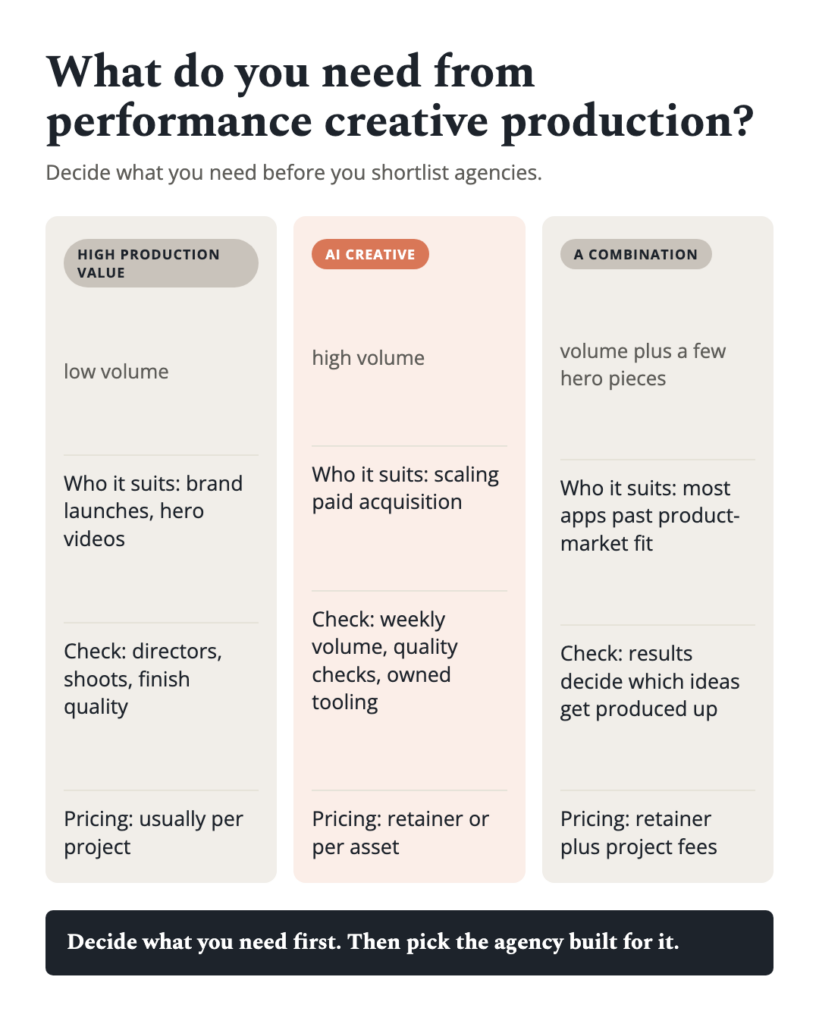
Performance Creative Production Systems
Scaling creative production from 10 ads monthly to 50-100+ requires systems, not heroic efforts. Successful creative operations use templated production workflows: standardized aspect ratios (9:16 for Stories/TikTok, 1:1 for Feed, 4:5 for mobile-optimized Feed), modular asset libraries where elements can be recombined, and clear creative briefs that balance strategic direction with creator freedom. In-house production works well up to 20-30 variations monthly but typically becomes a bottleneck beyond that scale. Hybrid models combining in-house strategy with external production partners (like RocketShip HQ) allow apps to maintain creative velocity while preserving brand control. Tool stack matters: motion graphics (After Effects), video editing (Premiere, Final Cut), collaboration (Frame.io, Notion), and creator platforms (Trend, Insense) should be integrated into efficient workflows. Budget 35-45% of your total UA spend on creative production and testing when operating at scale.
- Creative explains 60-70% of performance variance, yet most apps under-invest in production
- Mature creative operations produce 20-50 new variations monthly at $50K-$200K spend levels
- Channel-specific creative strategies outperform repurposed assets by 40-80%
- UGC and creator content outperforms studio ads by 40-70% on TikTok and Reels
- Creative testing requires $200-$500 spend per variation for statistical significance
- Allocate 35-45% of UA budget to creative production at scale
Attribution, Analytics, and Performance Measurement
Attribution is the foundation of profitable user acquisition, yet it's the area where most apps have critical blind spots. The iOS 14.5+ privacy changes didn't just reduce attribution accuracy, they fundamentally changed what's measurable and how optimization must occur. Apps that haven't adapted their measurement frameworks are making decisions based on incomplete or misleading data, consistently over-allocating budget to channels that appear performant on last-click attribution but deliver poor incrementality. Successful attribution strategies in 2024 combine multiple measurement approaches: deterministic attribution where available, probabilistic modeling for the attribution gap, SKAdNetwork data for iOS campaigns, and incrementality testing to validate overall channel efficiency.
Mobile Measurement Partners (MMPs) like AppsFlyer, Adjust, and Singular provide the infrastructure for attribution, but the MMP is just plumbing. What matters is how you configure conversion events, set up postback optimization, structure cohort analysis, and integrate data into your business intelligence systems. The most common configuration mistake is optimizing campaigns toward install events rather than downstream value events. Campaigns optimized for Day 7 retention or Day 7 purchase events consistently deliver 30-50% better LTV:CAC ratios than install-optimized campaigns, even though they show higher CPIs. This requires proper event instrumentation, sending quality events back to ad platforms via postback, and having the patience to let algorithms optimize toward longer-window events.
Performance monitoring at scale requires systematic anomaly detection. At RocketShip HQ, we use Weighted Anomaly Scoring to identify when campaign performance deviates from expected ranges, triggering investigation before significant budget is wasted. Standard dashboards show what happened, anomaly detection systems show what's abnormal and requires action. This becomes critical when managing 20-40 active campaigns across 4-6 channels. Manual review catches obvious problems but misses subtle degradation: a campaign's CPI increasing 18% over 5 days while install volume decreases 12% signals early creative fatigue, but won't trigger alerts in standard dashboards. Automated monitoring systems catch these patterns and enable proactive optimization rather than reactive firefighting.
Configuring Conversion Events for Optimization
The events you optimize toward determine the users you acquire. Apps optimizing for installs get users who install, those optimizing for registrations get users who register, and those optimizing for Day 7 retention or purchase events get users who engage long-term. Platform algorithms are extraordinarily good at delivering what you ask for, the challenge is asking for the right thing. For apps with clear monetization within 7 days (casual games, subscription apps), optimize toward Day 7 purchase or subscription events. For apps with longer monetization cycles (marketplace apps, social apps), optimize toward proxy events that correlate with long-term value: account completion, first core action completion, or D3/D7 retention. Configure these events in your MMP, enable postback optimization to send signals back to ad platforms, and accept that CPIs will be 30-50% higher initially. The payback comes in LTV: users acquired through value-optimized campaigns consistently show 40-80% higher LTV than install-optimized users.
Cohort Analysis and Economic Modeling
Cohort analysis is how you connect daily acquisition metrics to long-term profitability. Every day's acquired users represent a cohort, and you track that cohort's behavior over time: retention curves, revenue curves, and engagement metrics. Build cohort dashboards tracking daily cohorts across 7, 14, 30, 60, 90, and 180-day windows. This reveals the true economics of acquisition: you might see that February cohorts have 25% higher D30 retention than January cohorts, or that users acquired from TikTok monetize 40% slower than Apple Search Ads users but ultimately reach similar LTV by Day 90. Economic models project LTV curves using early data, allowing optimization decisions before full payback occurs. Most apps can accurately predict Day 180 LTV using Day 30 data with 70-85% confidence through predictive modeling, enabling much faster iteration cycles than waiting for full revenue maturity.
Incrementality Testing and Media Mix Modeling
Attribution shows correlation, incrementality testing reveals causation. Just because a channel attributes conversions doesn't mean it's driving incremental value. Users might have installed organically if the ad hadn't shown, or might have converted through a different channel. Incrementality testing uses holdout groups and geo-based experiments to measure the true lift from advertising spend. Run quarterly incrementality tests allocating 5-10% of budget: split geos into test and control groups, pause campaigns in control geos for 2-4 weeks, and measure the difference in organic install volume. True incrementality is typically 60-85% of attributed conversions, meaning 15-40% of attributed installs would have occurred anyway. This doesn't invalidate channels, it calibrates expectations and reveals which channels drive genuine new demand versus capturing existing demand. Media mix modeling (MMM) complements attribution by analyzing statistical relationships between spend and outcomes across all channels, providing portfolio-level optimization insights that user-level attribution misses.
- Optimize campaigns toward Day 7 retention or value events, not installs, for 30-50% better LTV:CAC
- iOS campaigns require 7-14 day optimization windows due to SKAdNetwork delays and aggregation
- Cohort analysis tracking daily cohorts across 30-180 day windows reveals true acquisition economics
- Incrementality testing reveals that 60-85% of attributed conversions are truly incremental
- Weighted Anomaly Scoring enables proactive performance monitoring across 20-40 campaigns
- Predictive LTV modeling using Day 30 data accelerates optimization with 70-85% accuracy
Budget Allocation and Scaling Strategies
Budget allocation is the strategic layer above channel tactics, determining where capital flows to maximize portfolio-level returns. The most common allocation mistake is splitting budgets evenly across channels or allocating based on historical performance without considering marginal returns. Optimal allocation follows efficiency frontiers: each channel delivers strong returns up to a scale threshold, then shows diminishing returns as you exhaust high-quality inventory. A channel delivering $4 LTV at $1 CPI (4:1 ratio) at $10K monthly spend might deliver $3.50 LTV at $1.20 CPI (2.9:1 ratio) at $30K spend as you expand beyond core audiences. Meanwhile, another channel might be delivering 2.5:1 at $5K spend but could scale to $15K while maintaining 2.8:1. Strategic allocation shifts budget to maximize the total portfolio return, not individual channel returns.
Budget allocation should be dynamic, rebalancing monthly based on channel efficiency curves and competitive dynamics. We recommend 60-70% of budget in proven channels showing consistent performance, 20-30% in growth channels where you're actively scaling and testing audience expansion, and 10-20% in experimental channels or tactics. This 60/20/20 framework balances reliable volume with systematic innovation. Apps that allocate 100% to proven channels hit scale ceilings and miss emerging opportunities. Those allocating too much to experimental channels sacrifice near-term efficiency for uncertain future gains. The balance shifts based on growth stage: early-stage apps (pre-product-market-fit) should run 50/30/20, heavily weighted toward experimentation to find what works. Scale-stage apps ($250K+ monthly budgets) should run 70/20/10, maximizing efficiency of proven channels while maintaining innovation pipelines.
Scaling budgets requires understanding the difference between linear scaling (increasing budget proportionally while maintaining efficiency) and step-function scaling (expanding into new audiences, geographies, or tactics that initially show lower efficiency but access new inventory). Linear scaling works within existing targeting parameters: if your core Facebook campaigns deliver 3.2:1 LTV:CAC at $30K monthly, you can typically scale to $45-60K maintaining 2.8-3.0:1 by increasing budgets 15-20% weekly and accepting slightly longer learning periods. Step-function scaling requires strategic patience: expanding from US to UK, Canada, and Australia might show 30-40% lower efficiency initially as creative is localized and audiences are learned, but provides the inventory to scale from $100K to $250K monthly. Plan these expansions as 90-day initiatives with efficiency improvement curves, not instant optimizations.
The Weekly Optimization Cycle
Successful budget management operates on weekly optimization cycles, balancing platform learning requirements with responsiveness to performance shifts. Monday through Wednesday are analysis days: review previous week's cohort performance, identify winning campaigns and creatives, and flag underperformers. Thursday and Friday are action days: implement budget reallocations, launch new creative tests, pause underperformers, and set strategic direction for the following week. This rhythm prevents over-optimization (daily changes that disrupt platform learning) while maintaining responsiveness. Budget reallocation should follow the 20% rule: shift no more than 20% of a campaign's budget in a single change to avoid resetting learning phases. If a campaign needs 50% budget reduction, do it across 3 weeks in 20% decrements rather than a single dramatic cut.
Geographic Expansion Strategy
Geographic expansion is the primary scaling lever for apps that have exhausted core market budgets. Tier 1 markets (US, UK, Canada, Australia) offer highest LTVs but also highest CPIs and competition. Tier 2 markets (Western Europe, Japan, South Korea) deliver 60-75% of Tier 1 LTVs at 50-70% of CPIs, often providing better initial efficiency. Tier 3 markets (Latin America, Eastern Europe, Southeast Asia) show 30-50% of Tier 1 LTVs at 25-40% of CPIs, excellent for volume but requiring localized creative and payment methods. Expand geographically in phases: master one market completely before expansion, allocate 3-6 months for new market development, and accept 20-30% lower efficiency in months 1-2 while creative and targeting optimize. Most apps find optimal global portfolios allocate 50-60% of budget to Tier 1 markets, 25-35% to Tier 2, and 10-15% to Tier 3 for volume.
- Optimal allocation follows efficiency frontiers, maximizing portfolio returns not individual channel returns
- Use 60/20/20 budget allocation: 60% proven channels, 20% growth, 20% experimental
- Scale budgets 15-20% weekly for linear scaling while maintaining platform learning
- Geographic expansion should be phased: master one market before expanding to next tier
- Weekly optimization cycles balance platform learning requirements with performance responsiveness
- Step-function scaling (new audiences, geos) requires 90-day efficiency improvement curves
Organic User Acquisition and App Store Optimization
Organic user acquisition represents 30-60% of total installs for most successful apps, yet receives a fraction of the strategic attention compared to paid channels. This is backwards. Organic installs typically show 20-40% higher retention and 30-50% higher LTV than paid installs because users discovered the app through genuine need or referral rather than interruption advertising. The two primary organic drivers are App Store Optimization (ASO) for discovery within app stores, and viral/referral mechanics that turn existing users into acquisition channels. Mature apps should allocate 15-20% of their UA resources to ASO and organic growth initiatives, not as an afterthought but as a strategic priority.
App Store Optimization focuses on maximizing visibility in app store search results and browse features, then converting impressions to installs. ASO operates on two dimensions: metadata optimization (app title, subtitle, keyword field, description) affects search ranking, while creative optimization (icon, screenshots, preview videos) affects conversion rate. The iOS App Store indexes approximately 100 characters of keyword content: your app name (30 chars), subtitle (30 chars), and keyword field (100 chars). Every character must be strategic, incorporating high-volume search terms while maintaining brand clarity. Android's Google Play allows 4,000 characters in the description, providing much more keyword optimization opportunity. Most apps under-optimize metadata, missing 40-60% of relevant search traffic through poor keyword research and prioritization.
Conversion rate optimization of creative assets often delivers bigger gains than ranking improvements. An app ranking #3 for a keyword with 8% conversion rate generates more installs than one ranking #1 with 4% conversion. Test icon designs quarterly, screenshot sequences monthly, and preview videos every 2-3 months. Custom Product Pages on iOS allow up to 35 variations per app, enabling keyword-specific landing pages that significantly improve conversion rates. An app promoting through Apple Search Ads should create custom product pages for each major keyword category, improving conversion rates 15-35% compared to default product pages. At scale, ASO optimization typically drives 20-40% organic install growth annually through systematic testing and optimization.
Keyword Strategy and Search Ranking
Effective keyword strategy balances search volume, relevance, and competition. Use App Store Connect Search Ads keyword data, third-party ASO tools (Sensor Tower, App Radar, AppTweak), and competitive analysis to build keyword portfolios of 200-400 target terms. Prioritize keywords by search popularity scores and current ranking position, focusing optimization efforts on terms where you rank #8-#25 (opportunity to move into top results) rather than #1-#3 (already maximized) or #50+ (requires unrealistic optimization to reach meaningful positions). Incorporate high-priority keywords in app title (most weighted for ranking), subtitle (secondary weight), and keyword field. Update metadata strategically: iOS allows updates with each app version, but dramatic changes can temporarily disrupt rankings during re-indexing. Plan keyword optimizations around major app updates, implementing 2-3 meaningful changes per update rather than constant small tweaks.
Viral Mechanics and Referral Programs
The best organic acquisition channel is your existing users. Apps with strong viral loops or referral programs consistently acquire 20-50% of new users through existing user activity, dramatically reducing blended CAC. Viral mechanics work through inherent product usage: social apps where inviting friends creates value for both parties, productivity apps with collaboration features, or games with multiplayer components. Referral programs incentivize sharing through rewards: give both referrer and referred user benefits ($10 credits, premium features, in-game currency). Successful referral programs convert 8-15% of active users to referrers and generate 0.3-0.8 new users per active user annually, essentially 30-80% organic uplift on your user base. Design referral programs with balanced incentives (too generous erodes economics, too stingy reduces participation), frictionless sharing (deep links that attribute properly), and strategic positioning (prompt after positive experiences, not at random times).
- Organic installs show 20-40% higher retention and 30-50% higher LTV than paid installs
- ASO optimization drives 20-40% organic growth annually through systematic testing
- iOS app title, subtitle, and keyword field provide ~100 optimized characters for search ranking
- Custom Product Pages improve conversion rates 15-35% for keyword-specific landing experiences
- Successful referral programs generate 0.3-0.8 new users per active user annually
- Allocate 15-20% of UA resources to ASO and organic growth initiatives
CPI, CPA, and ROAS Benchmarks Across Categories
Understanding category-specific benchmarks is essential for setting realistic performance targets and identifying when your metrics indicate strategic problems versus normal variance. Benchmarks vary enormously by app category, geography, platform (iOS vs Android), and monetization model. These ranges represent typical performance for competently-executed campaigns in Tier 1 markets (US, UK, Canada, Australia) during 2024. Your actual metrics will vary based on product quality, creative execution, and competitive dynamics, but significant deviations from these ranges signal opportunities or problems requiring investigation.
For gaming apps, casual games typically show CPIs of $1.80-$3.50 on iOS and $1.20-$2.50 on Android, with D1 retention of 35-45% and Day 7 ROAS of $0.40-$0.80. Mid-core and strategy games show higher CPIs ($3.50-$6.50 iOS, $2.00-$4.00 Android) but stronger monetization with Day 7 ROAS of $0.80-$1.50 and significantly higher long-term LTV. Hyper-casual games operate at the lowest CPIs ($0.60-$1.80) but with very weak retention (D1 of 20-30%) and monetize almost entirely through ads rather than IAP. For lifestyle and utility apps, CPIs range from $2.50-$5.00 on iOS and $1.80-$3.50 on Android, with retention patterns varying widely based on habit formation and utility depth.
Subscription apps (meditation, fitness, productivity) face higher acquisition costs ($4.00-$12.00 CPIs) but target longer payback periods and higher LTVs. These apps optimize toward subscription conversion rather than install volume, often showing Day 7 subscription rates of 3-8% and requiring 60-90 day payback periods. E-commerce and marketplace apps show CPIs of $3.00-$8.00 and optimize toward first purchase events, targeting Day 30 ROAS of 60-120% with full payback by Day 90-180. Fintech apps face the highest acquisition costs ($8.00-$25.00 CPIs) due to regulatory restrictions on targeting and creative, stringent quality requirements, and intense competition, but also deliver highest LTVs ($80-$300+) justifying the investment for apps that can execute quality user experiences and retention.
Platform Differences: iOS vs Android Economics
iOS and Android show consistent economic differences across categories. iOS CPIs run 30-50% higher than Android CPIs due to higher competition and user income demographics, but iOS users also deliver 40-70% higher LTV, resulting in similar or better LTV:CAC ratios. iOS users show 15-25% higher retention rates across most categories and 50-100% higher payment rates in monetization. This means apps should target different efficiency thresholds by platform: an iOS campaign at $4.00 CPI might be equivalently efficient to an Android campaign at $2.20 CPI when LTV is factored in. Don't compare platform metrics directly, compare platform LTV:CAC ratios. Apps that under-invest in iOS due to higher CPIs consistently miss significant profitable volume.
How Benchmarks Should Inform Strategy
Use benchmarks as diagnostic tools, not targets. If your gaming app shows $6.50 iOS CPI when benchmarks suggest $2.50-$4.00, the problem is likely creative execution, targeting strategy, or fundamental product-market-fit issues requiring investigation. Conversely, if you're achieving $2.00 CPI when benchmarks suggest $4.00-$6.00, you've likely found an underpriced channel or audience that warrants aggressive scaling before competition discovers it. Benchmarks evolve quarterly as competition, platform policies, and creative trends shift. What worked in Q4 2023 often shows 20-30% efficiency degradation by Q2 2024. Maintain relationships with agencies like RocketShip HQ or industry peers to calibrate your performance against current market conditions, not outdated benchmarks.
- Casual gaming: $1.80-$3.50 CPI iOS, $1.20-$2.50 Android, 35-45% D1 retention, $0.40-$0.80 Day 7 ROAS
- Subscription apps: $4.00-$12.00 CPI, 3-8% Day 7 subscription rate, 60-90 day payback periods
- E-commerce/marketplace: $3.00-$8.00 CPI, target 60-120% Day 30 ROAS, 90-180 day full payback
- Fintech: $8.00-$25.00 CPI, $80-$300+ LTV, highest quality requirements and longest optimization cycles
- iOS CPIs are 30-50% higher but deliver 40-70% higher LTV, resulting in similar LTV:CAC ratios
- Use benchmarks diagnostically to identify outlier performance requiring investigation
Building In-House Teams vs Agency Partnerships
The build-versus-buy decision for user acquisition capabilities is one of the most consequential strategic choices for growth-stage apps. In-house teams provide control, institutional knowledge, and tight integration with product and data teams. Specialized agencies like RocketShip HQ provide depth of channel expertise, creative production systems, and cross-client learning that individual apps can't replicate. The reality is that the optimal model for most apps is hybrid: in-house strategic leadership with agency execution partnership, combining the benefits of both approaches while mitigating their weaknesses.
In-house teams make sense when you have the scale to justify specialized roles (typically $200K+ monthly UA spend), need daily coordination with product development, and have unique technical requirements or proprietary systems. Building a competent in-house UA team requires a UA manager ($120-180K salary), 2-3 channel specialists ($90-140K each), a creative producer ($100-150K), and analytics support (shared resource). All-in cost including tools and overhead runs $600-900K annually. This team can effectively manage $2-4M in annual ad spend, suggesting a 25-30% team cost as percentage of media spend. Below this scale threshold, agencies typically deliver better results at lower total cost.
Agency partnerships excel at providing depth of channel expertise, creative production velocity, and flexible scaling. Specialized mobile UA agencies manage dozens of apps simultaneously, learning what works across categories and channels, then applying those learnings to each client. At RocketShip HQ, our management of $100M+ in ad spend across 50+ apps means we've tested thousands of tactics and can immediately implement proven strategies for new clients, compressing learning curves from 12 months to 2-3 months. Agency economics typically run 15-20% of media spend, dramatically lower than in-house teams at the same spend levels. The trade-off is less day-to-day control and potential conflicts if the agency manages competitors, though reputable agencies implement strict conflict policies.
The Hybrid Model: Best of Both Approaches
The highest-performing UA organizations use hybrid models: a lean in-house team (1-2 people) focused on strategy, analytics, and product integration, partnered with specialized agencies handling execution, creative production, and channel management. This combines strategic control with execution excellence. The in-house team owns economic models, sets target metrics, defines testing roadmaps, and ensures tight integration with product, analytics, and business intelligence systems. The agency owns campaign execution, creative production, channel optimization, and tactical decision-making within the strategic framework. This model works exceptionally well from $100K to $2M+ monthly spend, providing agency expertise without sacrificing strategic control. Clear role definition is critical: decision rights, approval authorities, and communication rhythms must be explicit to avoid coordination friction.
Evaluating Agency Partners
Selecting agency partners requires evaluating depth of channel expertise, creative production capabilities, technology infrastructure, and category experience. Ask potential agencies: How many B2C apps do you currently manage? What's your total mobile ad spend under management? What proprietary technology or frameworks do you use? Can you share case studies in my category? What's your team structure and who will directly manage my account? Red flags include agencies that won't disclose client lists or spend under management, lack category experience, or can't articulate clear optimization frameworks. Agencies should demonstrate systematic approaches to creative testing, channel optimization, and performance monitoring, not just promises to 'optimize campaigns.' Trial engagements work well: 60-90 day projects managing one channel or a defined budget segment, with clear success metrics and decision criteria for expansion.
- In-house teams require $200K+ monthly spend to justify full-time specialized roles
- In-house UA team costs run $600-900K annually, suggesting 25-30% of media spend
- Agency partnerships cost 15-20% of media spend, delivering better economics below $2-3M annual spend
- Hybrid models combine in-house strategy with agency execution for optimal results
- Specialized agencies compress learning curves from 12 months to 2-3 months through cross-client insights
- Agency evaluation should focus on spend under management, category experience, and proprietary frameworks
Advanced Optimization: Predictive Models and Automation
Advanced user acquisition optimization leverages predictive modeling, machine learning, and systematic automation to make faster, more accurate decisions than manual campaign management. As campaigns scale to 30-50+ active campaigns across multiple channels, human bandwidth becomes the constraint. Apps managing $500K+ monthly spend need systematic approaches to monitoring performance, identifying anomalies, predicting outcomes, and implementing optimizations, or they'll consistently miss opportunities and overspend on underperforming campaigns. Advanced optimization doesn't replace strategic thinking, it amplifies it by handling tactical execution and monitoring while surfacing insights that require human judgment.
Predictive LTV modeling is the foundation of advanced optimization. Rather than waiting 90-180 days for LTV to fully mature, build models that predict Day 180 LTV using Day 7, 14, and 30 behavioral data: retention patterns, engagement depth, early monetization signals, and cohort characteristics. Machine learning models (gradient boosted trees, neural networks) trained on historical cohorts can predict long-term LTV with 75-85% accuracy using only 30 days of data, enabling optimization cycles that are 3-6x faster than waiting for full revenue maturity. This acceleration compounds: making correct optimization decisions in week 4 instead of week 16 prevents 12 weeks of misdirected spend, potentially saving hundreds of thousands of dollars annually at scale.
Weighted Anomaly Scoring, a framework we use at RocketShip HQ for performance monitoring, identifies when campaign metrics deviate from expected ranges by calculating z-scores across multiple dimensions (CPI, install volume, retention rate, conversion rate) and weighting them by business impact. A campaign showing CPI increase of 1.2 standard deviations plus install volume decrease of 0.8 standard deviations triggers investigation, even though neither metric alone crossed alert thresholds. This multivariate approach catches subtle performance degradation that univariate alerts miss, reducing time-to-detection from days to hours. Automated monitoring systems should generate three alert levels: yellow flags (investigate within 24 hours), orange flags (investigate within 4 hours), and red flags (immediate action required), calibrated to your organization's response capacity.
Budget Reallocation Algorithms
Algorithmic budget reallocation automatically shifts spend toward highest-performing campaigns based on efficiency metrics and strategic constraints. The algorithm evaluates each active campaign's LTV:CAC ratio, applies diminishing returns curves to estimate marginal efficiency at higher budgets, and proposes optimal allocation across the portfolio. Constraints include minimum spend thresholds (campaigns need $200-500 daily to maintain learning), maximum allocation limits (no campaign exceeds 30% of total budget to mitigate concentration risk), and strategic reserves (20% held for new tests). Run reallocation weekly, implementing recommended changes that fall within platform learning preservation guidelines (no more than 20% budget change per campaign per week). Apps using algorithmic reallocation typically achieve 15-25% better portfolio-level efficiency than manual management because algorithms optimize across all campaigns simultaneously rather than sequentially.
Creative Fatigue Prediction
Creative fatigue occurs when ad frequency increases cause engagement and conversion rates to decline as audiences see the same creative repeatedly. Predicting fatigue before it severely impacts performance enables proactive creative refresh rather than reactive damage control. Track creative-level metrics daily: impressions, frequency, CTR, and conversion rate. When CTR declines 20% from peak while frequency increases above 2.5-3.0, fatigue is beginning. Build alerts that trigger when CTR decline plus frequency increase crosses combined thresholds, typically 5-7 days before performance catastrophically degrades. This provides time to launch replacement creatives into testing while fatigued creatives still deliver acceptable performance, avoiding the gap period where you've paused underperformers but haven't yet identified replacements. Most creatives fatigue within 7-21 days at scale, requiring continuous replacement to maintain performance.
- Predictive LTV models using Day 30 data achieve 75-85% accuracy for Day 180 LTV predictions
- Weighted Anomaly Scoring monitors multivariate performance across CPI, volume, retention simultaneously
- Algorithmic budget reallocation improves portfolio efficiency 15-25% versus manual management
- Creative fatigue prediction enables proactive refresh 5-7 days before catastrophic performance decline
- Advanced optimization amplifies strategic thinking by handling tactical execution and monitoring
- Apps at $500K+ monthly spend require systematic automation to avoid human bandwidth constraints
Frequently Asked Questions
What's a realistic CPI for my app category?
CPIs vary dramatically by category. Casual games: $1.80-$3.50 iOS. Lifestyle apps: $2.50-$5.00. Subscription apps: $4-$12. Fintech: $8-$25. Android runs 30-50% lower. These are Tier 1 market benchmarks, your actual CPI depends on creative quality, targeting strategy, and competition.
How much should I spend monthly to see meaningful results?
Minimum $5K-10K monthly across 2-3 channels to gather statistically significant data and exit platform learning phases. Optimal starting point is $20-30K monthly allowing meaningful testing. Below $5K, you're likely underfunding campaigns and getting misleading signal.
Should I build an in-house UA team or hire an agency?
Agencies deliver better results below $200K monthly spend due to cross-client expertise and lower overhead. In-house teams make sense at $200K+ monthly when you can justify specialized roles. Hybrid models work best: lean in-house strategy team partnered with agency execution, combining control with expertise.
How long until I see positive ROAS from UA campaigns?
Day 7 ROAS of 60-80% is typical for performing campaigns, reaching 100% by Day 30-60 for most categories. Full payback typically occurs by Day 90-180 depending on monetization model. Subscription apps may require 60-90 days, e-commerce 90-120 days, casual games 30-60 days.
What's more important: lowering CPI or improving retention?
Retention improvements almost always deliver superior ROI. A 10% retention improvement typically generates 40-60% LTV increase, while a 10% CPI reduction generates only 10% LTV:CAC improvement. Optimize creative and targeting for retention metrics, not just CPI. High-retention users at higher CPI outperform low-retention users at lower CPI.
How many creative variations should I test monthly?
At $50K-100K monthly spend, test 15-25 new creatives. At $200K+, test 40-60+. Creative testing velocity directly correlates with performance: apps testing weekly find winners 4-5x faster than those testing monthly. Budget 35-45% of UA spend toward creative production at scale.
Mobile user acquisition has evolved from a tactical marketing function to a strategic discipline that determines which apps win their categories and which disappear despite strong products. Success requires mastering multiple interconnected domains: channel-specific optimization across 4-6 platforms, systematic creative production generating 20-50+ variations monthly, sophisticated attribution and analytics infrastructure, strategic budget allocation following efficiency curves, and organizational models that combine strategic control with execution excellence. Apps that treat UA as a checklist of tactics consistently underperform those that build systematic optimization capabilities. The path forward depends on your current scale and sophistication. If you're spending under $50K monthly, focus on fundamentals: implement robust attribution, master 1-2 core channels completely, and build systematic creative testing processes. If you're at $100-300K monthly, the priority is scaling proven channels, expanding geographically, and deciding whether to build in-house teams or partner with specialized agencies like RocketShip HQ. At $500K+ monthly spend, advanced optimization becomes critical: predictive modeling, automated monitoring using frameworks like Weighted Anomaly Scoring, and algorithmic budget reallocation separate top-performing UA operations from those that plateau. Wherever you are in this journey, the fundamental principle remains constant: mobile UA is won through systematic optimization, not lucky campaigns. Build the systems, and the results will compound over time.
Looking to scale your mobile app growth with performance creative that delivers results? Talk to RocketShip HQ to learn how our frameworks can work for your app.
Further Reading
- Why Early-Stage Apps Shouldn’t Diversify Their Ad Spend – Early-stage founders should concentrate ad budgets on one or two self-attributing networks (SANs) rather than spreadi…
- How to scale UA like a hypercasual game – Broad targeting keeps CPIs as low as $0.
- What’s working post ATT/iOS 14.5: 6 opportunities – Based on 15+ accounts: install-optimized campaigns show stronger downstream CPAs post-ATT.