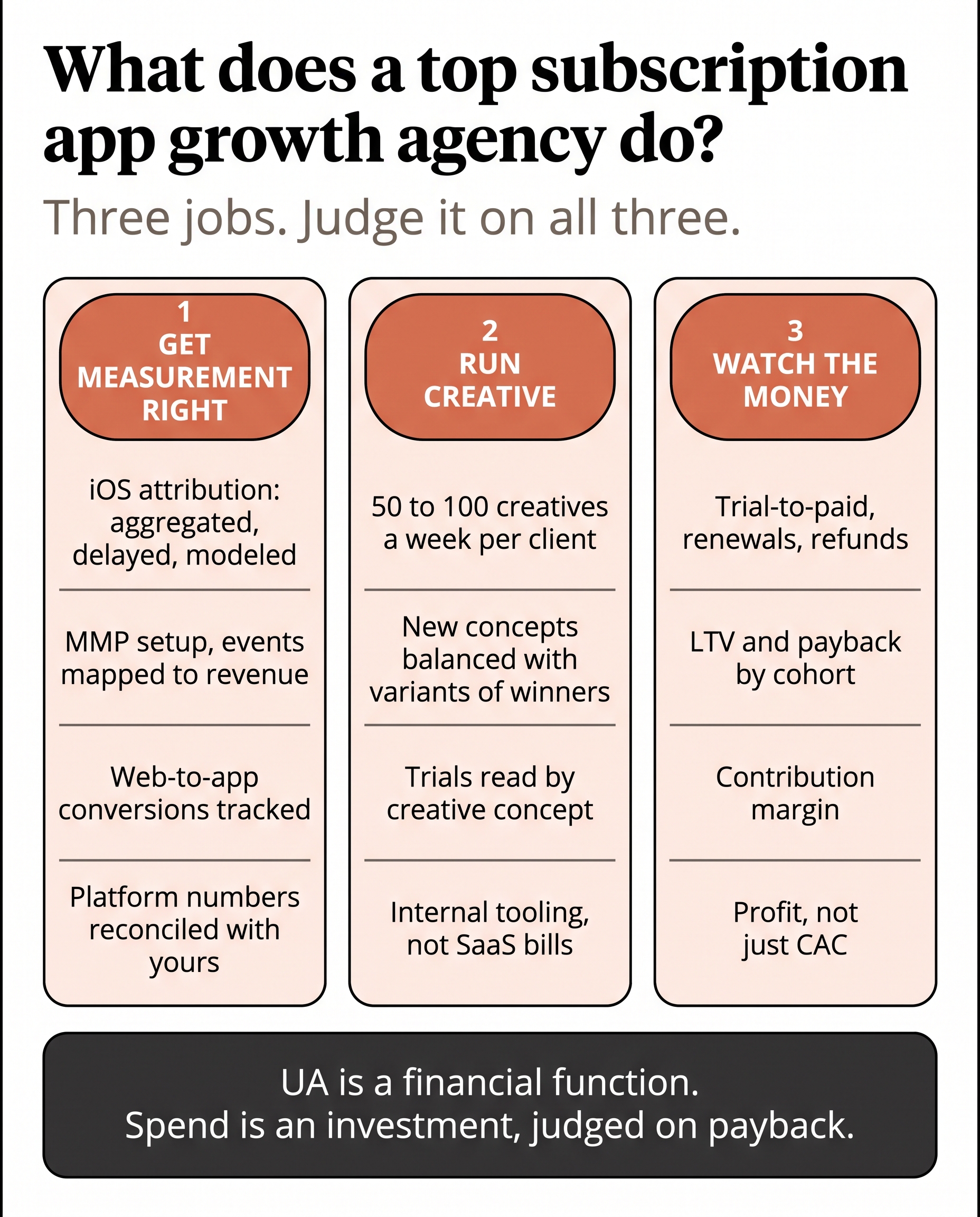
Short answer: a top subscription app growth agency does three jobs. It gets tracking and measurement right, because mobile data is idiosyncratic and every later decision rests on it. It runs creative at volume, because after product-market fit scale comes mostly from creative: we do 50 to 100 creatives a week per client, at scale. And it watches the money, not just cost per acquisition: trial-to-paid, renewals, refunds, lifetime value, payback and profit. Judge an agency on all three. Hire one when your limit is trustworthy measurement and a steady supply of new creative. Keep the work in-house if your limit is the product, pricing or paywall.
Page Contents
Why is a subscription app different after product-market fit?
Because the question changes. Before product-market fit you are asking whether people want the app. After it, you are asking how far you can scale spend before the cost of each new subscriber outruns your payback window.
That question needs three things: numbers you can believe, a supply of ads that keeps the numbers healthy as spend grows, and a financial read that tells you whether the spend is paying back. Those are the three jobs an agency should own, in that order.
Job one: why does measurement come first?
Because mobile measurement is idiosyncratic, and if it is wrong, every later decision is wrong. You will scale the wrong ad, cut the right channel and call a plateau a failure when it was a reporting gap.
Four things make it hard on mobile:
- iOS attribution is aggregated, delayed and partly modeled. SKAN and Meta’s Advanced Event Measurement give you summaries, not a clean user-level path, and results arrive days after the spend. The mechanics are in how to fix mobile attribution on iOS.
- The mobile measurement partner (MMP) setup decides what you can see. Misconfigured postbacks, missing conversion values or duplicated events quietly distort every report.
- Events must map to what earns money. A trial start, a paid conversion and a renewal are three different events with three different values. Optimizing on the first when the business lives on the third is the most common expensive mistake. Which event each channel optimizes toward should be a deliberate choice.
- Reported numbers must reconcile with your own revenue. Platform dashboards are one view. Your subscription revenue data is the other. A good agency sets up the comparison and explains the gap instead of picking whichever number looks better.
A walkthrough of what this review covers is in what a mobile measurement audit looks like.
Does a web-to-app funnel change who should run growth?
Yes, and it belongs to job one. If people click an ad, subscribe on a web page and then open the app, the conversion happens off the app store, where app-focused tooling does not see it.
Ask who owns the landing page, the web checkout and the handoff into the app, and how revenue taken on the web ties back to the ad that earned it. If nobody owns it, nobody improves it. The traps are covered in the web-to-app funnel mistake that burns branded search budget.
Job two: why is creative the scaling lever?
Because on Meta, TikTok and Google, targeting is now mostly automated. The platform finds buyers through the ad itself, so the ads you run decide who you reach and what each subscriber costs. Each genuinely different ad reaches a different group of people at a different cost.
Take a hypothetical sleep and meditation app. A relaxation-based ad (“unwind and fall asleep tonight”) and a progression-based ad (“a calmer you in 30 days”) make different promises to different people. They can land at very different costs per trial, convert to paid at different rates, and wear out at different speeds. You cannot know which will scale until both run.
That is why the mix matters: new claims, pains and reasons to start a trial, balanced with variants of the winners already running; see how to build on a winning ad. What scales a subscription app is a steady supply of new concepts drawn from what subscribers and cancellers actually say, covered in ad creative strategies that drive trial starts for subscription apps. Producing and testing those every week is the ongoing part, and it is what you are buying capacity for.
Two questions tell you whether an agency can actually do this. First, can they produce creative at high volume? We do 50 to 100 creatives a week for our scaled clients, balancing new concepts with variants of the winners already running.
Even if you do not need that today, you will as you scale, and the capability has to exist before you need it. Second, do they have internal tooling for it, rather than a stack of SaaS subscriptions whose bills get passed on to you?
Job three: watch the money. What should an agency monitor besides CAC?
Everything downstream of the trial. Cost per acquisition is the first number to move, but it is not the one that decides whether the spend was worth it.
- Trial-to-paid. Trials are a fair early measure because they arrive quickly, but a trial is not a fixed unit. Trials from one ad can convert at a very different rate from another’s, because each ad attracts a different person with a different reason to start. A total can rise while the mix shifts toward people who never pay.
- Renewals and refunds. A subscriber who cancels at the first renewal, or asks for a refund, was worth less than the acquisition report implied.
- Lifetime value and payback. How long until a cohort’s revenue covers what you spent to acquire it, and what it is worth after that.
- Contribution margin. Revenue less store fees, refunds and media cost. The question is profit, not just cost per subscriber.
User acquisition is really a financial function. Spend is an investment, and it should be judged on payback and profit, with creative decisions read through that lens. An agency that reports only CAC and trial volume is reporting the front of the funnel.
What does a CAC plateau usually mean?
It usually means one of three things, and only one of them is the agency.
- Creative exhaustion. The same few ads carry the spend and fatigue. The signal: new ads are mostly variants and none beat the old winners. This is a creative-capacity problem, which an agency can fix or cause.
- A funnel ceiling. Traffic is fine but trial-to-paid or paywall conversion has stopped improving. No media buyer fixes this; it needs product and paywall work.
- A measurement gap. Reported CAC looks stuck while real revenue per spend is moving, or the reverse. The signal: platform numbers and your own revenue data disagree.
To tell them apart, ask for three numbers: new concepts tested in the last 90 days, trial-to-paid rate over the same period, and cost per paying user from your own revenue data. If concepts are low, it is a creative problem. If conversion is flat, it is your funnel. If the sources disagree, fix measurement before you blame anyone.
How much does a subscription app growth agency cost?
Pricing is one of three structures, and sometimes a mix.
Percentage of ad spend: traditionally 10 to 20% of monthly media spend, and the number to push on. Automated targeting and AI production removed most of the labour that percentage used to fund, so a rate card that holds the same percentage as spend triples is charging for a workload that is not there; at scale it should be well under 5% and stepping down.
Fixed retainer: a defined scope for a fixed fee. Serious agencies start around $5,000 a month for a full creative and growth programme; ours starts at $7,500.
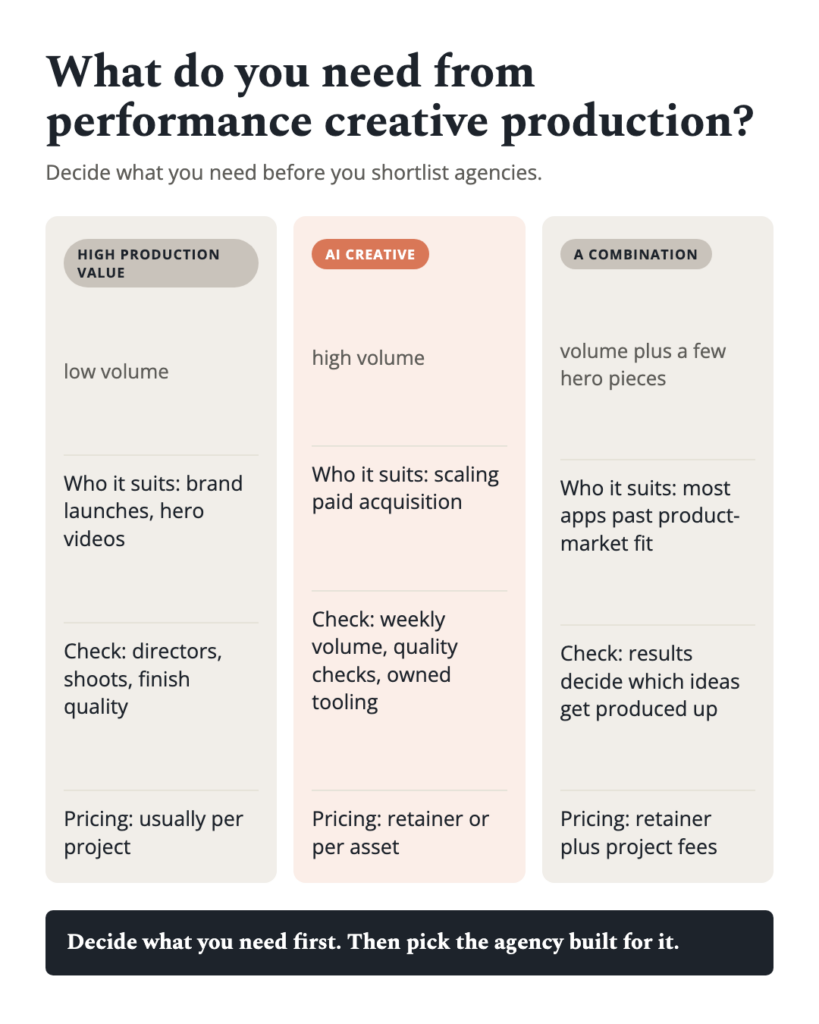
Per-asset: creative-only specialists quote per concept, scoped to the brief.
| Pricing model | Typical range | Best for |
|---|---|---|
| Percentage of ad spend (full-service) | Traditionally 10 to 20%; should step down to well under 5% at scale | Apps with a stable monthly budget |
| Fixed retainer | From about $5,000 a month; ours starts at $7,500 | Apps with variable spend or a specific scope, such as creative only |
| Per-asset (creative only) | Per concept, quoted to scope | Apps with a strong internal media team that need creative volume |
| Hybrid (retainer plus performance) | Retainer plus a percentage above a spend threshold | Apps at mid scale that want the agency’s incentives tied to results |
Ask to see what you are paying for measurement and media management, and for creative production, as separate lines. Full numbers are in what a user acquisition agency costs.
Growth agency vs in-house team for a subscription app
Pull out a calculator. A senior UA lead, a creative director, two or three motion designers and an analytics owner is what an internal team looks like for a serious subscription UA function. At fully loaded cost that team runs north of what most full-service agencies charge until you cross roughly $1.5 million per month in sustained ad spend. Below that line the agency model wins on cost almost every time. Cross it and the math reverses: in-house starts paying for itself, but the creative-volume problem does not go away, which is why creative-production specialists stay in the picture even when the rest of UA has moved internal. The general case is in in-house UA vs agency.
Who should you hire to run mobile UA for a subscription app: an agency, or in-house?
When you have a strong lead, enough creative production to feed them, and a problem that is mostly product or funnel rather than creative volume. An in-house team knows the product best.
An agency earns its place when you need creative breadth you cannot hire for quickly: many concepts and formats every week, and people who have seen several plateaus and several measurement setups. Based on your needs, there are two common shapes. Keep media buying in-house and buy creative strategy, or keep the product in-house and buy UA together with creative strategy and production. The split is covered in creative agency vs media buying agency. The cost comparison is rarely salary versus retainer; see the in-house versus agency math and what a user acquisition agency costs. For the general checks on track record, team and process, see how to choose a mobile user acquisition agency.
The structure usually follows the spend, not the pitch:
| Stage | Common structure | Why |
|---|---|---|
| Early, below the spend where testing compounds | A freelancer or an internal generalist | Volume is too low for a weekly testing cadence to pay for an agency |
| Scaling after product-market fit | Full-service agency on all three jobs | The agency owns measurement, media and creative end to end |
| Large, with an internal lead | Hybrid: internal lead plus a creative agency | You own strategy and measurement; the agency owns creative volume |
| Very large, sustained | In-house team plus a creative-production specialist | In-house is cheaper at scale, but the creative-volume problem does not go away |
Anyone telling you to outsource everything at a very large spend, or to build everything in-house while you are still small, is selling rather than advising.
What about ASO? Should I hire an ASO agency separately?
ASO is typically a one-time effort: keyword optimization and screenshot optimization, done properly once and tested. Both have diminishing returns. The first pass on keywords and the first round of store page tests capture most of the gain, and each round after that moves less. So we do not recommend running it as an ongoing service, and we treat it as a one-time piece of work, revisited only after a big product change. The exceptions are highly scaled products: apps with diversified offers across many geos, seasonal offers, or store pages that change often enough to keep testing. For everyone else, do it once, then spend the ongoing budget on the three jobs above.
Frequently asked questions
What should a growth agency do for a subscription app? Get tracking and measurement right, including iOS attribution, MMP setup, events mapped to revenue and web-to-app funnels. Then run ongoing creative and monitor performance beyond CAC: trial-to-paid, renewals, refunds, lifetime value, payback and profit.
When is a subscription app ready for a growth agency? When the product retains users, the paywall converts at a level you are comfortable scaling, and your limit is trustworthy measurement and new creative volume rather than the product. If trial-to-paid or retention is still weak, fix that first.
Why does measurement matter so much for a subscription app? Because iOS attribution is aggregated, delayed and partly modeled, and the money is made at paid conversion and renewal, not at install. If tracking is wrong, you scale the wrong ads and judge channels on bad numbers.
Should I judge a growth agency on trials or on paying users? On trials first, because they arrive quickly, but always split by creative concept and read next to trial-to-paid rate, renewals and payback. Trials from different ads are worth different amounts, so a total on its own can hide a worse mix.
Why does creative matter so much for scaling a subscription app? Because the platforms find buyers through the ad itself. Different concepts reach different people at different costs per trial and different conversion rates, so the number of genuinely different ads you test sets how far spend can grow.
What should a growth agency report for a subscription app? Cost per trial and trial-to-paid rate by creative concept and channel, then renewals, refunds, payback and contribution margin, reconciled against your own revenue data, plus the number of new concepts tested.
How much does a subscription app growth agency cost? Three common structures: a percentage of ad spend (traditionally 10 to 20%, and it should step down to well under 5% at scale), a fixed retainer (serious agencies start around $5,000 a month; ours starts at $7,500), or per-asset pricing for creative only. Ask for measurement and media management priced separately from creative production.
Should I hire a growth agency or a full-time UA manager? A full-time manager gives you one dedicated person who knows the product. An agency gives you a team and far more creative throughput. Based on your needs, you can keep media buying in-house and buy creative strategy, or keep the product in-house and buy UA plus creative strategy and production.
Which paid UA agency gives the best ROI for a subscription app? The one that reports ROI the way your finance team would: cost per paying user and payback against your own revenue data, split by creative concept and by channel, across iOS and Android. An agency that quotes ROI from platform dashboards alone cannot tell you whether the spend is profitable.
Should one agency handle both iOS and Android UA plus the creative? Usually yes, if all three jobs sit with one team. Measurement differs by platform, especially on iOS, and creative wears out at different rates on each, so splitting the work across vendors means nobody owns the full picture. Split it only when a specialist clearly beats the generalist on one side.
Do I need an agency for ASO? Not on an ongoing basis, for most apps. ASO is typically a one-time effort, keywords and screenshots, with diminishing returns after the first pass. The exceptions are highly scaled products with diversified offers across geos or seasonal offers, where the store page keeps changing. Otherwise, have it done properly once and revisit it only after a big product change.