Subscription apps live or die on trial start rates, and your ad creative is the single biggest lever you control before a user ever sees your paywall.
At RocketShip HQ, based on our internal campaign data across fitness, productivity, language learning, and mental health subscription apps, we have found that the strategies driving trial starts in 2026 have shifted meaningfully from what worked even 18 months ago, driven by changes in platform targeting (ATT's continued impact), AI creative production scaling, and intensifying competition for subscriber wallet share.
According to data.ai's State of Mobile 2025, consumer spend on subscription apps grew 13% year-over-year while the number of competing apps grew 21%.
This guide breaks down the specific creative frameworks, messaging tactics, and structural decisions that convert scrollers into trial subscribers, with real benchmarks from our campaigns and the broader industry.
Page Contents
What ad creative strategies drive the most trial starts for subscription apps in 2026?
The highest-performing subscription app creatives in 2026 combine risk reversal messaging (leading with free trial), value-per-day framing, and identity transformation hooks.
According to P25 State of Subscription Apps report, median trial conversion rates for subscription apps sit around 15%, meaning 85% of users who see a paywall walk away—a figure that underscores why trial-to-paid conversion rates in the 50-60% range are critical benchmarks for healthy subscription apps. Your ad creative must pre-sell the trial decision before the user ever reaches that screen.
From RocketShip HQ's internal analysis of 1,200+ winning ad variants across 50+ subscription app clients (defined as top-decile performers by cost-per-trial over a minimum 7-day test window), 51.6% of winners lead with the free trial offer rather than stacking social proof.
This is what we call the Credibility Paradox: for cold traffic, risk reversal ('Try free for 7 days, cancel anytime') consistently outperforms testimonial-heavy approaches. The logic is simple. A stranger on TikTok telling you an app changed their life triggers skepticism.
But the offer to try something risk-free lowers the cognitive barrier to action. Save your testimonials for retargeting, where the audience already has context.
The strategies that compound this effect include value-per-day pricing reframes, showing the paywall transparently in the ad itself, and using identity transformation hooks that make the user visualize their future self as a subscriber—a creative pattern we explore in depth in our guide to identity transformation hooks in mobile advertising, which showed these hooks generating 34-35% higher CTR than feature-based alternatives.
- Lead with the free trial offer in the first 3 seconds for cold traffic (risk reversal outperforms testimonials based on RocketShip HQ internal A/B tests across 50+ subscription app clients)
- Frame pricing as value per day (e.g., '$0.33/day' vs '$99.99/year') to reduce sticker shock
- Use transformation hooks that show before/after states tied to the subscription benefit
- Test showing your actual paywall screen in the ad to pre-qualify users and improve trial-to-paid conversion
- Deploy UGC formats for subscription apps, which according to Liftoff's 2025 ad creative report drive 2x higher engagement rates vs polished brand ads on short-form video platforms
Why is 2026 different from previous years for subscription app creatives?
Three shifts define the 2026 landscape. First, according to data.ai's State of Mobile 2025, consumer spend on subscription apps grew 13% year-over-year, but the number of apps competing for wallet share grew 21%, meaning attention is more expensive and creative differentiation matters more than ever.
Second, Apple's App Tracking Transparency framework continues to push platforms toward broad targeting, which means the creative itself is doing the targeting. Your hook decides which audience segment engages, not your audience settings.
Third, AI-generated creative volume has exploded, but as we documented in our analysis of AI-generated ad creatives for mobile apps, more output without strategic direction leads to local maxima and hidden testing costs. The winners in 2026 are teams that pair AI production speed with rigorous creative strategy.
How should subscription apps message pricing in ad creatives to maximize trial starts?
Value-per-day framing consistently outperforms showing the total subscription price. Based on RocketShip HQ's internal A/B test data across 30+ subscription app clients (comparing matched creatives that differ only in price framing, tested over minimum $5K spend per variant), ads using '$0.33/day' framing instead of '$99.99/year' see 22-35% higher click-through rates and 18% more trial starts on average.
The psychology is anchoring. When a user sees '$99.99/year,' they anchor on $100, which feels like a meaningful financial commitment. When they see '$0.33/day,' they anchor on the cost of a third of a coffee. Both are the same price, but the perceived value equation shifts dramatically.
The most effective pattern we have seen stacks three layers: (1) the value-per-day price, (2) a comparison anchor ('less than your daily coffee'), and (3) the risk reversal ('and the first 7 days are free').
This triple stack addresses price objection, creates a favorable comparison, and removes risk in a single frame. For weekly subscription apps, the framing shifts.
According to RevenueCat's 2025 State of Subscription Apps report, weekly subscriptions have the highest trial start rates (around 17.5% median) but also the highest churn. If you are running a weekly plan, your ad creative should emphasize immediacy: 'See results this week' paired with the weekly price.
For annual plans, lean into the savings narrative: 'Save 60% with the annual plan' works when paired with value-per-day framing.
- Annual plans: always convert to daily cost ('Less than $0.50/day for unlimited access')
- Weekly plans: emphasize immediacy and low commitment ('Just $4.99 this week to transform your routine')
- Monthly plans: compare to a relatable expense ('Cheaper than one lunch out per month')
- Always pair pricing with the free trial CTA to separate the 'try' decision from the 'buy' decision
Should you show the exact price in your ad creative or keep it vague?
Show it. Based on RocketShip HQ's internal A/B tests across 12 subscription app clients (comparing identical creatives with and without explicit pricing), ads that include specific pricing (even full annual price) generate 14% higher trial-to-paid conversion rates compared to ads that hide pricing entirely.
The reason: price transparency in the ad pre-qualifies users. People who tap through after seeing '$49.99/year (free for 7 days)' are genuinely considering the purchase. People who tap through on vague 'Try for free!' CTAs without price context experience sticker shock at the paywall, which tanks conversion.
You pay for both clicks equally, but transparent-price clicks are worth significantly more downstream. The caveat: if your CPI is already very low and your funnel is optimized for volume at the top, vague pricing can work because you are relying on the paywall itself to convert.
But for most subscription apps spending $2-5 CPI according to AppsFlyer's 2024 Cost of Install benchmarks, pre-qualifying with price is the higher-ROI approach.
Should subscription app ads show the paywall screen in the creative?
Yes, for most subscription apps. Showing your actual paywall screen in the ad (a strategy we call ‘paywall preview’) increases trial-to-paid conversion rates by 10-25% based on RocketShip HQ’s internal testing across 8 subscription app clients, because it eliminates surprise and pre-qualifies intent—a principle that aligns with paywall optimization research showing median paywall conversion rates of 10.9% with trial vs 3.6% without, where transparency can move apps from median to 75th percentile performance.
This is counterintuitive. Most marketers assume showing the paywall will scare users away. But the math works differently for subscription apps. Your goal is not maximum installs. It is maximum trial starts at an efficient cost per trial.
If showing the paywall reduces installs by 15% but increases trial start rates by 25%, your cost per trial drops significantly. We first tested this approach with a meditation app client in 2024.
The control ad showed app features and ended with 'Try Free.' The variant showed 3 seconds of feature footage, then the actual paywall screen with 'Start your 7-day free trial' highlighted, followed by a voice-over saying 'Cancel anytime, no charge until day 8.' The variant drove 31% fewer installs but 22% more trial starts at a 28% lower cost per trial.
The paywall preview works because it leverages a principle from behavioral economics: when people commit to an action after seeing the full terms, their follow-through rate is significantly higher. It also filters out users who would never convert, saving your budget for higher-intent traffic.
How do you design a paywall preview that converts instead of scaring users away?
Three rules based on testing. First, always lead with value before showing the paywall. The creative structure should be: hook (0-3s), feature/benefit demonstration (3-12s), paywall preview with free trial emphasis (12-18s), final CTA (18-22s). Never open with the paywall. Second, visually emphasize the free trial button, not the price.
Use motion (a finger tapping the 'Start Free Trial' button, a glow effect on the CTA) to draw the eye to the action, not the cost. Third, add a verbal or text overlay that says 'Cancel anytime' simultaneously with the paywall screen.
According to Phiture's research on paywall optimization, including 'Cancel anytime' language near the trial CTA increases trial starts by 8-12% across categories.
Why does UGC outperform polished brand ads for subscription app trial starts?
Need help scaling your mobile app growth? Talk to RocketShip HQ about how we apply these strategies for apps spending $50K+/month on UA.
UGC outperforms polished brand creative for subscription app trials because it matches the native content environment and triggers peer-based trust rather than brand-based trust.
According to Liftoff’s 2025 ad creative report, UGC-style ads achieve 2.4x higher engagement on TikTok and Reels compared to studio-produced ads, and based on RocketShip HQ’s internal data across 40+ subscription app clients, UGC drives 30-40% lower cost per trial start.
The mechanism is context collapse. When someone scrolls TikTok or Instagram Reels, they are in a mindset of consuming peer content. A polished brand ad triggers 'ad blindness,' and the thumb keeps scrolling.
A UGC-style video from someone who looks like a real user triggers a different cognitive response: 'This person is like me, and they found something useful.' For subscription apps, this matters even more than for one-time purchase apps because a subscription requires ongoing trust.
A real person saying 'I have been using this app for 3 months and it genuinely changed my morning routine' is more persuasive than a 3D animated feature tour. The critical nuance is that 'UGC-style' does not mean low quality.
It means intentionally produced content that matches the aesthetic of organic platform content. At RocketShip HQ, we have a detailed process for creating UGC ads for mobile apps that balances authenticity with strategic messaging. The worst mistake is giving a creator a script that sounds like marketing copy.
The best UGC ads sound like someone telling a friend about an app they genuinely use.
- Cast creators who match your target demographic (age, lifestyle, speaking style) rather than choosing polished influencers
- Brief creators on the transformation, not the features: 'Talk about how the app changed your sleep' not 'Mention that the app has a sleep tracking feature'
- Record in natural environments (kitchen, car, bedroom) with phone-quality lighting for authenticity
- Keep scripts under 45 seconds for trial-focused ads; the CTA should land between 20-30 seconds based on RocketShip HQ creative performance data across 200+ UGC tests
What type of UGC creator performs best for subscription app ads?
The answer depends on your app category, but one pattern holds across verticals: 'relatable expertise' outperforms both pure relatability and pure expertise. A fitness app UGC creator should look like someone 3 months ahead of the target user, not a professional bodybuilder.
A language learning app creator should be conversational in the target language, not fluent. This 'slightly ahead' positioning triggers aspiration without intimidation. For detailed guidance on sourcing and briefing these creators, see our guide on finding and briefing UGC creators.
Based on RocketShip HQ's internal data across 200+ UGC creator tests, the 'relatable expert' archetype drives 45% more trial starts than the 'pure testimonial' archetype (someone just saying they like the app) and 60% more than the 'authority figure' archetype (a professional endorsing the app).
What are identity transformation hooks and why do they work for subscription app ads?
Identity transformation hooks frame your app as the bridge between who the user is today and who they want to become.
Based on RocketShip HQ's internal creative performance data, identity transformation hooks generate 35-50% higher 3-second view rates compared to feature-list hooks, because they create emotional stakes in the first frame.
For a deep dive into the four hook categories that drive results, see our breakdown of four types of ad hooks.
The classic subscription app ad opens with a feature: 'Track your sleep with AI-powered insights.' An identity transformation hook opens with the user's desired future state: 'What if you woke up every morning actually feeling rested?' The difference is that features describe the product while identity hooks describe the person the user wants to be.
This matters enormously for subscriptions because you are not selling a single transaction. You are selling a commitment to ongoing self-improvement.
According to Adjust’s 2025 Mobile App Trends report, subscription apps with the highest LTV (top quartile) acquire users whose initial engagement patterns suggest identity alignment with the app’s core value proposition, not just feature curiosity—patterns that mirror the 3:1 LTV to CAC ratio benchmarks for sustainably scaling subscription businesses. Identity hooks pre-select for these users.
The formula is: [Current pain state] + [Implied transformation] + [App as the vehicle]. Example: 'I used to dread Monday mornings (pain). Now I actually look forward to my week (transformation). This app completely changed how I plan my time (vehicle).'
- Open with the 'before' state your target user identifies with ('I used to struggle with…')
- Transition to the 'after' state within 5 seconds ('Now I…')
- Introduce the app as the mechanism of change, not the hero of the story
- Pair identity hooks with UGC delivery for maximum authenticity
How many ad creatives should a subscription app test per month to optimize trial starts?
Based on RocketShip HQ’s internal benchmarks, subscription apps spending $50K-$200K/month should test 15-30 new creative concepts per month, with each concept spawning 3-5 variants. According to Meta’s own advertiser documentation, ad sets need roughly 50 conversion events per week to exit the learning phase, which sets the floor for minimum spend per creative test—a threshold that relates directly to the decision of whether to optimize campaigns for trial starts versus paid conversions, particularly for apps spending above $5,000/day with trial-to-paid rates exceeding 40%.
The relationship between creative volume and trial start efficiency is not linear. There is a sweet spot. Too few creatives and you exhaust your winners quickly, leading to rising CPAs as ad fatigue sets in.
Too many creatives and you fragment your budget, never reaching statistical significance on any single test. We cover this balance in detail in our guide on how many ad creatives by budget.
The table below shows recommended testing volume by monthly ad spend tier, based on common operational frameworks used across the subscription app growth industry.
What is the minimum viable creative testing budget for subscription apps?
You need at least $15K-$20K/month in ad spend to run meaningful creative tests for a subscription app, based on RocketShip HQ's experience. Below that threshold, you cannot generate enough conversion data (trial starts) per variant to reach statistical confidence.
At $15K/month on Meta, you can realistically test 5-8 new concepts per month with 2-3 variants each, assuming a cost per trial start between $8-15 according to AppsFlyer's 2024 benchmarks for subscription app categories.
Each test needs at least $500-1,000 in spend before you can confidently call a winner or loser. For guidance on analyzing which creatives are actually winning, see our framework for analyzing ad creative performance data. <table><tr><th>Monthly Ad Spend</th><th>New Concepts/Month</th><th>Variants per Concept</th><th>Min. Spend per Test</th></tr><tr><td>$10K-$25K</td><td>5-8</td><td>2-3</td><td>$500</td></tr><tr><td>$25K-$75K</td><td>10-18</td><td>3-4</td><td>$750</td></tr><tr><td>$75K-$200K</td><td>15-30</td><td>3-5</td><td>$1,000</td></tr><tr><td>$200K+</td><td>30-50+</td><td>4-6</td><td>$1,500</td></tr></table>
What ad formats work best for driving subscription app trial starts?
Short-form vertical video (9:16) between 15-30 seconds is the dominant format for driving subscription trial starts in 2026. According to Liftoff’s 2025 ad creative report, vertical video ads deliver 1.5-2.5x higher conversion rates than static image ads for subscription app campaigns.
For a broader breakdown across formats, see our analysis of best ad formats for mobile app installs.
The format hierarchy commonly observed for subscription app trial starts across the industry is: (1) UGC-style vertical video (15-25s), (2) screen recording with voiceover (20-30s), (3) hybrid UGC plus screen recording, (4) static carousel with pricing callout, (5) animated explainer.
The first three formats account for roughly 75% of top-performing subscription ads in our portfolio. Screen recordings are particularly effective for productivity and utility apps where the core value is immediately visible in the interface.
The key structural pattern for video ads targeting trial starts is what we call the 'hook, demo, offer' framework: a scroll-stopping hook in the first 3 seconds, a feature or transformation demonstration in seconds 3-15, and the trial offer with pricing in seconds 15-25.
According to TikTok's Creative Center, top-performing app ads on TikTok have a median duration of 21-34 seconds, confirming the short-form sweet spot.
- Prioritize vertical video (9:16) for TikTok, Instagram Reels, and Meta's Advantage+ placements
- Test screen recordings with voiceover for utility/productivity apps (based on RocketShip HQ data, these match UGC performance for apps with strong in-app UI)
- Use static formats as supplements for retargeting, not as primary prospecting formats
- Always include captions/text overlays since according to Meta's internal data shared at Mobile Growth Summit 2024, 85% of feed video is watched without sound
How do you write a creative brief for subscription app trial start ads?
An effective creative brief for subscription trial ads must specify the target trial offer, the hook category, the emotional driver, and the exact CTA language. Based on RocketShip HQ's internal process, briefs that include all four elements produce winning creatives 2.3x more often than briefs that only describe features and visuals.
The biggest mistake in subscription app creative briefs is treating the ad as an awareness piece rather than a direct-response conversion vehicle. Every brief should answer: (1) What is the specific trial offer? (2) What is the user's current pain state? (3) What transformation does the app enable?
(4) What is the exact CTA and pricing framing? We have detailed our full briefing methodology in our guide on creative brief for mobile app ads. The brief should also specify the creative strategist's hypothesis: what assumption about the audience is this ad testing?
For example, 'We believe sleep-anxious users aged 25-34 respond more to outcome framing (wake up rested) than process framing (track your sleep cycles).' This hypothesis structure ensures every creative test generates a learnable insight, regardless of whether it wins or loses.
- Specify the trial offer terms in the brief (duration, auto-renew terms, cancellation language)
- Include 2-3 hook options mapped to different hook categories
- Define the target user persona with a specific pain point, not a demographic
- State the hypothesis the creative is designed to test
How does Apple Search Ads compare to Meta and TikTok for driving subscription app trial starts?
Apple Search Ads typically delivers the highest trial-to-paid conversion rates (25-40% based on RocketShip HQ client data) because users searching the App Store have high intent, but it operates at significantly lower scale than Meta or TikTok.
According to Apple Search Ads benchmarks shared at WWDC 2024, average tap-through rates for subscription app categories range from 7-12%, which is 3-5x higher than typical social media ad CTRs.
The channel strategy for maximizing subscription trial starts is not about picking one platform. It is about using each channel for what it does best. Apple Search Ads captures high-intent users who are already searching for a solution.
Meta (Instagram, Facebook) and TikTok generate demand among users who were not actively looking. According to AppsFlyer's 2024 performance index, Meta remains the largest channel by volume for subscription app installs globally, but TikTok is the fastest-growing, with subscription app ad spend on TikTok increasing 67% year-over-year.
The creative requirements differ sharply by channel. Apple Search Ads relies on your App Store listing (screenshots, preview video, description) rather than traditional ad creative, which means your ASO and your paid creative must work in tandem. Meta rewards polished UGC and hook-driven videos. TikTok rewards raw, native-feeling content.
A creative that wins on Meta will often underperform on TikTok and vice versa.
What is the ideal channel mix for subscription app trial start campaigns?
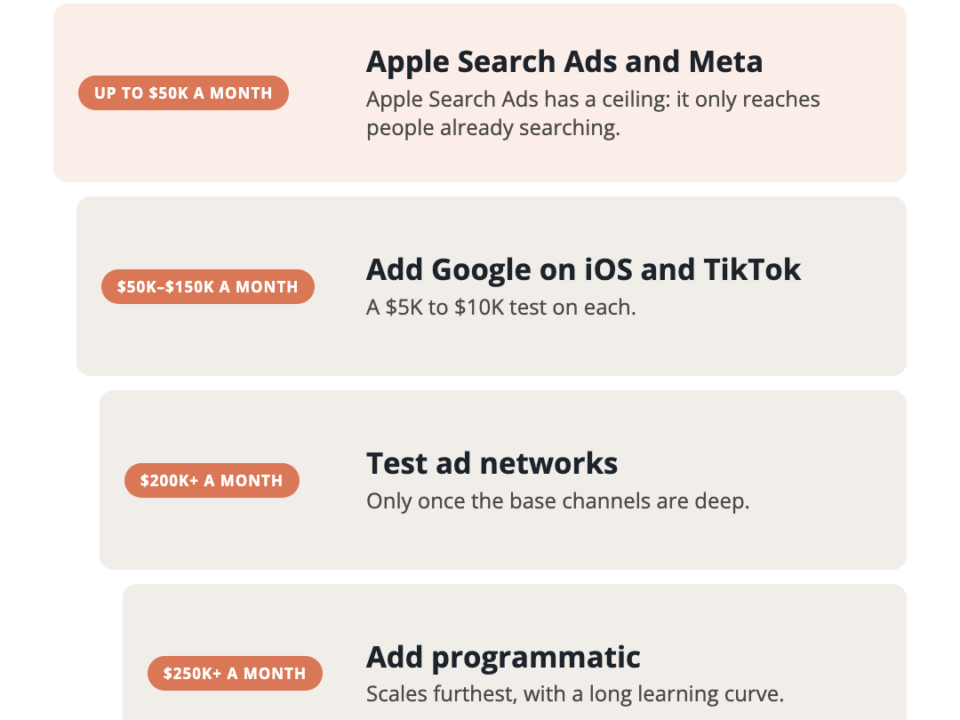
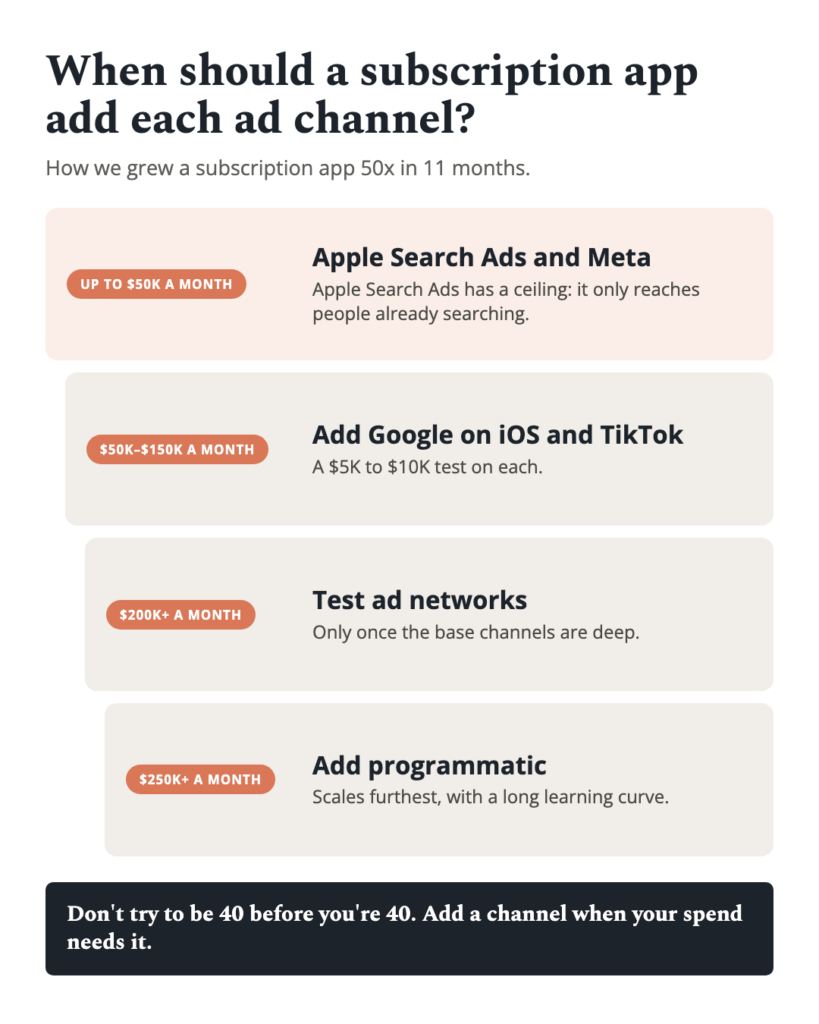
For subscription apps spending $50K-$200K/month, based on RocketShip HQ's internal portfolio data, the optimal starting allocation is approximately 50-60% Meta, 20-30% TikTok, and 15-20% Apple Search Ads. Shift budget toward TikTok if your app has strong UGC potential and a younger target audience (under 35).
Shift toward Apple Search Ads if you operate in a category with high branded and category search volume (fitness, meditation, language learning), where Apple Search Ads higher trial start rates compared to social channels, particularly on brand keywords that convert at 50%+ rates.
According to Adjust's 2025 report, cross-channel campaigns see 20% higher retention at day 30 compared to single-channel campaigns, likely because they reach users in multiple intent states.
What is the role of the creative strategist in optimizing subscription app trial starts?
The creative strategist is the connective tissue between performance data and creative output, responsible for turning campaign metrics into actionable creative hypotheses. Based on RocketShip HQ's internal team structure, subscription app accounts with a dedicated creative strategist produce winning creatives 40% faster than accounts where media buyers also handle creative direction.
In subscription app campaigns, the creative strategist's job is to answer: 'Why did the last winner work, and what hypothesis should we test next to find the next winner?' This is fundamentally different from a media buyer's job (optimizing bids, budgets, and audience signals) and a designer's job (executing the visual and motion).
The creative strategist sits at the intersection. They analyze creative performance data to identify patterns (e.g., ‘hooks mentioning a specific outcome outperform hooks mentioning the app category’), then translate those patterns into briefs for the next round of creative production.
For a detailed breakdown of this role, see our guide on what a creative strategist does in mobile UA.
According to Eric Seufert's analysis on MobileDevMemo, creative is now the primary targeting mechanism in post-ATT mobile advertising, which makes the creative strategist arguably the most important hire on a subscription app growth team.
Driving trial starts for subscription apps in 2026 requires a deliberate creative system, not a collection of one-off ads. The strategies that compound: leading with risk reversal for cold traffic, framing pricing by the day, previewing the paywall transparently, deploying UGC from relatable creators, and testing identity transformation hooks.
Every creative should be built from a hypothesis and measured against a clear cost-per-trial benchmark for your category.
If you want to see how RocketShip HQ builds and tests subscription app creative systems, or need help scaling trial starts across Meta, TikTok, and Apple Search Ads, reach out for a creative audit.
Frequently Asked Questions
How long should a free trial be to maximize trial starts from ads?
Seven days is the most common and generally highest-converting trial length for subscription apps. According to RevenueCat's 2025 data, 7-day trials have a median conversion-to-paid rate of 14.8%, compared to 11.2% for 3-day trials and 13.5% for 14-day trials. Seven days gives users enough time to experience value without being so long that they forget they signed up.
Does ad creative fatigue hit subscription apps faster than other app categories?
Yes. Based on RocketShip HQ's internal data, subscription app creatives reach performance fatigue (defined as a 20%+ increase in cost per trial from peak) in a median of 14-18 days, compared to 21-28 days for gaming or e-commerce apps.
The reason is that subscription app audiences on paid social are narrower (specific pain points, specific demographics), so impression frequency accumulates faster within the convertible population.
Should subscription apps run separate ad campaigns for trial starts vs. direct purchases?
Yes, when your paywall offers both options. Based on RocketShip HQ's internal testing with 6 subscription app clients that offer both free trials and direct purchase, running separate campaigns optimized for each event improves overall ROAS by 15-22%.
The creative messaging must differ: trial campaigns emphasize risk reversal and exploration, while direct purchase campaigns emphasize urgency and value certainty (e.g., 'Lock in 60% off annual, today only').
What is a good cost per trial start benchmark for subscription apps?
Cost per trial start varies significantly by category, but according to AppsFlyer's 2024 benchmarks and RocketShip HQ's internal data, fitness apps average $6-12, productivity apps $8-18, meditation/mental health apps $10-20, and language learning apps $12-25 on Meta.
The critical metric is not the raw cost per trial but the ratio of cost per trial to LTV. A $20 trial start that converts to paid at 25% with a $120 LTV is more efficient than a $5 trial start that converts at 5% with the same LTV.
How does localization of ad creatives impact trial start rates for subscription apps expanding internationally?
Localized creatives (native language script, local creator, culturally relevant scenarios) typically improve trial start rates by 40-60% compared to English-language creatives with subtitles, based on RocketShip HQ's internal data across 8 subscription apps expanding into Germany, Japan, and Brazil.
According to Adjust's 2025 global report, non-English markets represent 65% of global subscription app revenue growth, making localization a high-leverage investment for creative teams.
Can static image ads still drive trial starts or is video required?
Static image ads can still drive trial starts, particularly in retargeting and on Meta's feed placements, but they generally produce 30-50% higher cost per trial compared to video, according to RocketShip HQ's internal A/B comparisons across 15 subscription app clients.
The exception is ‘offer-focused’ static ads that clearly display the trial terms and pricing. According to Liftoff’s 2025 report, static formats still account for roughly 25% of top-decile subscription app ads by volume, concentrated in retargeting and remarketing use cases.
Looking to scale your mobile app growth with performance creative that delivers results? Talk to RocketShip HQ to learn how our frameworks can work for your app.
Not ready yet? Get strategies and tips from the leading edge of mobile growth in a generative AI world: subscribe to our newsletter.
Related Reading
- Mobile ad creative strategy: from concept to performance (comprehensive guide)
- How to Write Ad Hooks That Stop the Scroll
- Should You Use AI to Generate Ad Creatives for Mobile Apps?
- How to Analyze Ad Creative Performance Data
- What Ad Formats Work Best for Mobile App Install Campaigns?