After managing tens of millions in ad spend across both Meta and TikTok at RocketShip HQ, we can say definitively: the platforms reward fundamentally different creative approaches. What wins on Meta often dies on TikTok, and vice versa. The differences go far deeper than aspect ratio. They extend to pacing, audio strategy, narrative structure, and shelf life. Understanding these differences is the difference between scaling profitably on TikTok and burning budget on repurposed Meta ads that feel out of place.
Page Contents
How does TikTok ad creative strategy differ from Meta ads?
TikTok is a sound-on, full-screen, trend-driven environment where content must feel native to the feed within the first 0.3 seconds or get swiped. Meta is more forgiving of polished, direct-response creative that can succeed even with sound off. The core strategic differences span five dimensions: audio, pacing, hook structure, shelf life, and production style.
On Meta, the majority of video is watched with sound off, so text overlays carry the message. On TikTok, the majority of users have sound on, which means voiceover, music, and audio cues are primary storytelling tools, not afterthoughts. This single difference reshapes your entire creative architecture.
- Sound: TikTok is sound-on first; Meta is sound-off first. Your audio layer on TikTok IS the ad.
- Pacing: TikTok top performers average 21-34 seconds with scene changes every 1.5-2.5 seconds. Meta ads can run 45-90 seconds with slower builds.
- Hook window: TikTok gives you 0.3-0.8 seconds before a swipe. Meta's thumb-stop window is slightly more forgiving at 1-2 seconds.
- Shelf life: In our experience, TikTok creatives fatigue meaningfully faster than Meta creatives, with TikTok concepts often losing momentum within one to two weeks compared to several weeks on Meta.
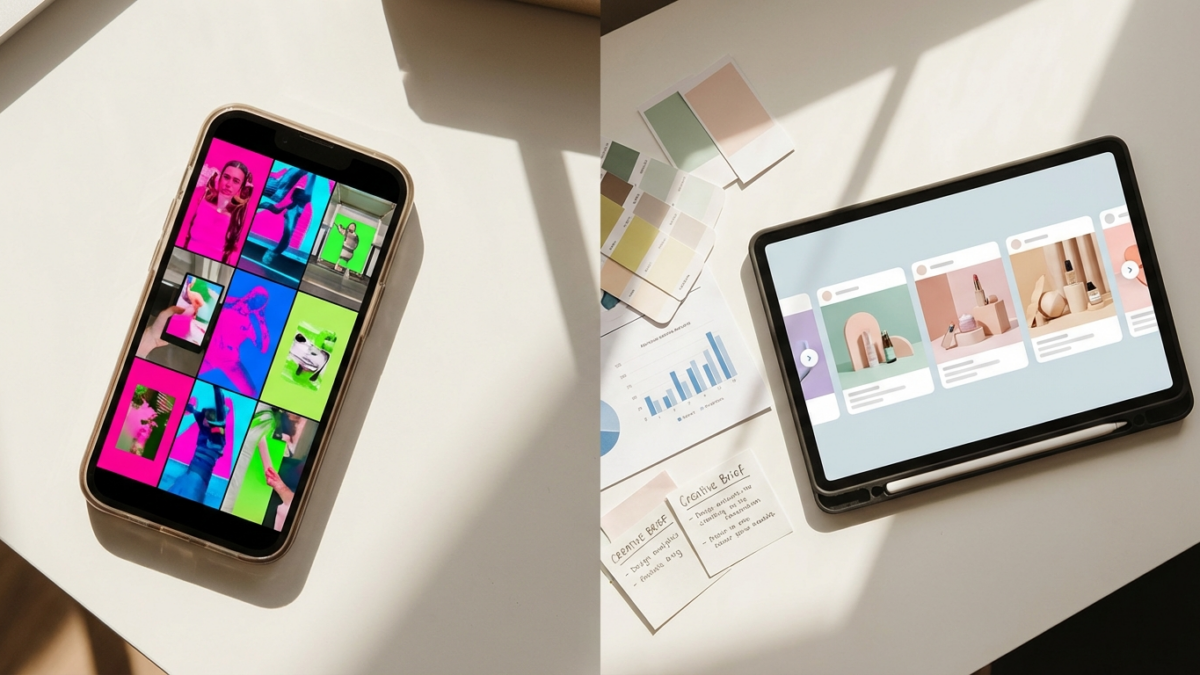
- Production style: TikTok rewards UGC and lo-fi content that blends into organic feeds. Meta still rewards higher-production assets alongside UGC.
Why do Meta ad winners fail when repurposed directly on TikTok?
Direct repurposing fails because Meta and TikTok have different native content languages. Meta video ad creative differences, slow build, and text-heavy overlay feels like an interruption on TikTok, where the feed is fast, raw, and creator-driven. In our experience, teams that simply resize Meta winners to 9:16 and push them to TikTok without adaptation consistently see CPIs climb sharply compared to properly native TikTok creative.
The failure usually starts at the hook. On Meta, you might open with a product shot or a bold claim overlaid on footage. On TikTok, that same opening triggers an instant swipe because it screams 'ad' in an environment where users expect creator-style content. As Gonzalo Fasanella from Tactile Games explained, their research found users scroll away from ads within 30 seconds, which makes the emotional resonance and native feel of the first moments critical. On TikTok, that window is even shorter.
The 'Ad Smell' Problem
TikTok users have developed a finely tuned radar for content that doesn't belong. Branded lower-thirds, studio lighting, scripted-sounding dialogue, and clean transitions all trigger what we call 'ad smell.' The creative needs to pass a 0.5-second sniff test: could this have been posted by a creator I follow? If the answer is no, you lose.
Narrative Structure Mismatch
Meta ads often follow a problem-agitate-solve structure over 30-60 seconds. TikTok rewards Narrative Compression, where top-performing mobile ads skip awareness entirely and lead with the offer or payoff. On TikTok, this compression is even more extreme. You might open with the transformation or result, then briefly flash the mechanism (the app), then close with a CTA. The entire arc happens in 15-25 seconds. Writing TikTok ad scripts that convert requires front-loading the payoff where 80% of performance is determined by the hook.
How should you adapt the hook strategy for TikTok versus Meta?
On TikTok, hooks must work across all four sensory layers simultaneously in the first 0.5 seconds. On Meta, visual and text overlays do most of the heavy lifting because of sound-off viewing. RocketShip HQ's 4-Layer Hook System (Visual, Text overlay, Verbal/voiceover, Audio/music) was actually designed with TikTok in mind, where all four layers firing together creates the pattern break needed to override the swipe reflex.
- Visual layer: Use a 0.3-0.8 second zoom, a jarring visual, or a face close to camera. On Meta, product shots can work. On TikTok, human faces outperform product shots in hook rate.
- Text overlay: Keep it under 10 words on TikTok (vs. 15 on Meta). Position it center-screen to avoid being covered by the TikTok UI elements.
- Verbal layer: On TikTok, start talking immediately. Dead air in the first second is a death sentence. On Meta, voiceover is a nice-to-have bonus.
- Audio layer: TikTok trending sounds can meaningfully boost hook rates. On Meta, background music is largely irrelevant for performance.
Applying the 3C Principle on TikTok
RocketShip HQ’s 3C Principle (Context, Clarity, Curiosity) applies to both platforms, but on TikTok the execution differs. Context (‘who is this for?’) should feel like a creator talking to their people, not a brand defining a target audience. Instead of ‘Attention busy professionals,’ try ‘okay so I literally cannot stop playing this.’ Clarity must be instant because you have half the time. Curiosity gaps need to feel organic, like a story that’s unfolding, not a marketing hook. Think ‘I wasn’t gonna post this but…’ versus ‘Discover the #1 rated app for…’
How does creative testing differ between TikTok and Meta?
In our experience, TikTok requires significantly more creative volume than Meta due to faster fatigue cycles, often demanding a multiple of the monthly creative output you would run on Meta to maintain performance. The testing structure also differs: on TikTok, you need tighter thematic separation to avoid what the industry calls asset stuffing.
Asset stuffing, where you load all creatives into a single ad group without thematic separation, is particularly damaging on TikTok because the algorithm struggles to identify which audience segments match which creative concepts. The solution is to separate creatives thematically by audience or creative type into distinct ad groups.
- Test budget ratio: Allocate a larger share of TikTok spend to creative testing than you would on Meta, reflecting the higher volume of concepts the platform requires.
- Kill criteria: On TikTok, judge creatives quickly—within the first few days—before fatigue distorts the signal. Meta generally allows a longer evaluation window.
- Winner iteration: On TikTok, iterate winners faster. A winning concept needs 3-5 variations within the first week before fatigue hits.
- Format testing: TikTok's Spark Ads (boosted organic posts) commonly outperform standard in-feed ads and should be part of every test matrix.
What role does audio and music play in TikTok ads compared to Meta?
Audio is the single biggest strategic differentiator between the two platforms. On TikTok, audio is the primary engagement driver, not a supplement. Trending sounds drive higher completion rates, and in our experience voiceover-led ads consistently outperform text-only ads in conversion rate on TikTok. On Meta, audio is largely decorative since most users never hear it.
This is why we tell clients at RocketShip HQ to build TikTok ads audio-first. Write the voiceover script before storyboarding the visuals. Choose or create the audio track before shooting. The visual edit should be cut to the audio rhythm, not the other way around. For a deeper dive into building native-feeling TikTok content, check out our guide on creating TikTok ads that feel native and convert.
TikTok Audio Best Practices
Use trending sounds within their first 7-10 days of virality for maximum algorithmic boost. Layer a conversational voiceover on top of the trending sound at 70/30 volume split. Avoid licensed commercial music that signals 'brand ad.' ASMR-style audio (tapping, clicking, satisfying sounds) works surprisingly well for app ads, particularly for gaming and utility categories.
How do you handle the shorter creative shelf life on TikTok?
TikTok creatives typically fatigue in a matter of weeks—often sooner than equivalent Meta creative. This means you need a creative production pipeline capable of regularly delivering fresh concepts at scale. The key is building a modular creative system where you can swap hooks, bodies, and CTAs independently rather than producing entirely new ads each time.
We've found that the hook is what fatigues fastest on TikTok. The body and CTA can often be reused 2-3 times with a fresh hook before the entire concept needs replacing. This is why we produce hooks in batches of 5-10 for each winning body concept. It's also worth noting that AI-generated creative volume comes with hidden costs. More creative output requires proportionally larger test budgets, so producing 100 AI-generated TikTok variants is pointless if you don't have the budget to test them properly.
- Track creative health daily using frequency and CTR decay as leading indicators.
- Have 2-3 weeks of creative backlog ready at all times.
- Use modular production: film 10 hooks, 3 body segments, and 3 CTAs, then mix and match for 90 potential combinations.
- Refresh winning concepts by changing the creator, not the script. In our experience, the same message delivered by a different face can meaningfully extend shelf life.
Should you use different emotional angles on TikTok versus Meta?
Yes. TikTok skews toward raw, relatable, and surprising emotions. Meta's audience is more receptive to aspirational, polished emotional narratives. In our experience, the emotional palette that works on TikTok is broader and edgier. Top-performing TikTok ads frequently address the viewer directly with familiar language ('Sis,' 'bestie,' 'bro') to create instant intimacy, something that feels natural on TikTok but awkward on Meta.
Tactile Games discovered something similar when developing ads for Lily's Garden. They found that exploring emotions like sadness, anger, and anxiety outperformed the funny or cute angles that 90% of competitors relied on. On TikTok, this kind of emotional range is even more effective because the platform's culture rewards vulnerability and authenticity. The psychological profiling approach described by Bastian Bergmann from Solsten is particularly relevant here. Understanding player psychology helped shift copy from generic 'train your brain' messaging to 'hardest solitaire game,' improving IPM from 0.97 to 2.4. On TikTok, this kind of psychological precision matters even more because you have less time to resonate.
What is a step-by-step process for adapting a Meta winner to TikTok?
Don't resize. Rebuild. The goal is to extract the winning concept from your Meta ad and re-express it in TikTok's native language. Here's the process we use at RocketShip HQ when clients have proven Meta winners they want to bring to TikTok.
For a comprehensive walkthrough of TikTok-specific strategies including targeting, bidding, and measurement alongside creative, see our complete TikTok ads for app growth guide.
- Step 1: Identify the core concept. Strip away execution and ask: what is the winning insight? (e.g., 'time scarcity motivates downloads' or 'social proof from a specific demographic converts')
- Step 2: Rewrite the hook for TikTok using the 4-Layer system. Add a trending sound, creator-style voiceover, and a 0.3s visual pattern break.
- Step 3: Compress the narrative. TikTok demands a significantly shorter runtime than Meta—aim to communicate the same core message in roughly half the time or less.
- Step 4: Replace polished footage with UGC-style content. Film on a phone, use natural lighting, show the real app experience.
- Step 5: Apply Narrative Compression by leading with the transformation or offer instead of building up to it.
- Step 6: Produce 3-5 hook variations for the adapted concept and test them in separate ad groups.
- Step 7: Monitor for 3-5 days. If a variation hits your CPI target, immediately produce 3 more variations with different creators.
The platforms share the same goal (profitable user acquisition) but demand different creative executions. Treat TikTok as its own creative channel with its own production pipeline, emotional palette, and testing cadence. The advertisers who win on TikTok aren't the ones with the biggest budgets. They're the ones who build native-feeling content at the volume the platform demands while maintaining strategic rigor in their testing structure. In our experience, clients who stop the resize-and-repost approach and build TikTok-native creative from the ground up consistently see meaningful CPI improvements.
Looking to scale your mobile app growth with performance creative that delivers results? Talk to RocketShip HQ to learn how our frameworks can work for your app.
Not ready yet? Get strategies and tips from the leading edge of mobile growth in a generative AI world: subscribe to our newsletter.
Related Reading
- TikTok Ads for app growth: the complete guide (comprehensive guide)
- TikTok Ads for app growth: the complete guide
- How to Create TikTok Ads That Feel Native and Convert
Free Tools
Try our free TikTok Ad Preview Tool: TikTok Ad Preview Tool. No signup required.