Native, creator-style TikTok ads tend to convert better than polished, studio-produced ones because they belong in the feed instead of interrupting it. TikTok is a place people go to watch other people, not to watch commercials. The moment an ad announces itself as an ad (slick lighting, a logo sting, a corporate voiceover) it gives the viewer permission to scroll. An ad shot like a real post earns the next second of attention, and on TikTok the next second is everything.
TikTok’s own guidance to advertisers is “Don’t make ads, make TikToks.” That is not a style preference, it is a distribution reality: the feed is built to keep people watching native content, and anything that breaks the native pattern reads as an interruption. This piece covers why creator-style beats polished, what actually makes a video read as native, and why the craft fundamentals (the 3C Principle and a layered hook) still apply. For the wider creative system this sits inside, see our mobile ad creative strategy guide.
Page Contents
Why does native creative beat polished creative on TikTok?
Because the viewer’s first job, before they decide whether to care, is to categorize what they are looking at. If their brain instantly tags your video as “an ad,” the scroll is reflexive. If it tags it as “a person talking to me,” they stay long enough to find out what you have to say.
Polished production works against you here in a specific way: high-end lighting, graded color, and broadcast transitions are exactly the signals people have learned to associate with being sold to. A creator filming in their kitchen carries the opposite signal: this is a real person, sharing something real. That perceived authenticity is not a vibe, it is what buys you the attention you need to make your case. Production value is not the lever. Belonging in the feed is.
What makes a TikTok ad read as native?
“Native” is a set of concrete craft choices, not a mood. These are the elements we build into creator-style ads:
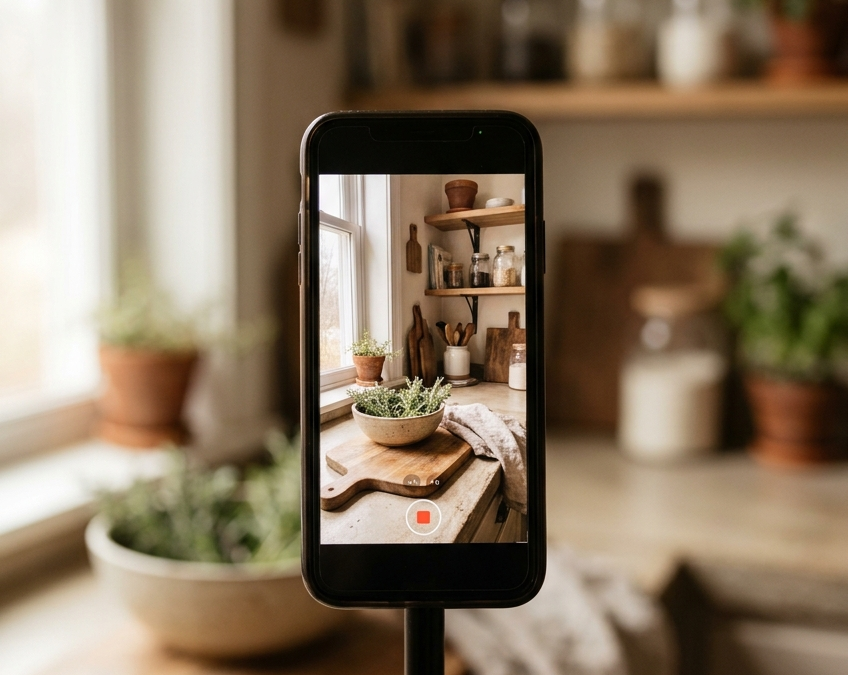
- Filmed on a phone, in portrait. Shoot vertically at 9:16 so the video fills the screen the way organic posts do. A current smartphone is the right camera, not a DSLR.
- Natural lighting and a real setting. A window, a bedroom, a kitchen counter, a car. Environments the viewer actually lives in read as real. The subject should face the light, with nothing bright directly behind them.
- Quick cuts. Cut each line of dialogue into its own clip and stitch them together so the edit feels fast and casual rather than one static take. Asking creators for multiple takes makes this natural.
- Sound-on by default. TikTok is watched with sound on. A voice that starts immediately, plus an unobtrusive music bed under the dialogue, is part of what makes content feel like it belongs.
- Stickers, emojis, and text overlays. On-screen text and native stickers add context and emphasis the way organic creators use them. Use the platform’s native fonts, not after-effects templates.
- A green-screen or screen-recording walkthrough. When you need to show the app, a creator reacting over a green-screen background or a clean screen recording keeps the product woven into the story instead of turning the ad into a product demo.
None of this requires a set or a crew. It requires intention about the signals each choice sends. For more on what separates a strong mobile video ad from a weak one, see what makes a good video ad for mobile apps.
Does “native” mean low-effort?
No. This is the trap. “Looks unpolished” is not the same as “is unconsidered.” The aesthetic is casual on purpose, but the craft underneath is deliberate. The two non-negotiables stay exactly the same as any other strong creative.
The 3C Principle. Every hook still has to deliver three things in the opening moment:
- Context: who this is for and what problem space it sits in, so the brain can categorize it instantly.
- Clarity: what the video is actually about and why it is worth watching.
- Curiosity: an open loop, a tension or contrarian angle that the viewer needs to keep watching to resolve.
The layered hook. The strongest openings stack four layers at once in the first few seconds: a visual that interrupts the scroll (movement, a quick zoom, an unexpected object), a text overlay that orients the viewer with a curiosity gap, a verbal line that starts immediately and conversationally, and an audio cue that amplifies the emotion. A native ad that nails the casual look but skips the hook will still get scrolled past. The look gets you considered; the 3C hook gets you watched.
How do you keep an ad native while still asking for the install?
The body of the ad should follow one clear narrative rather than a feature list: a setup (the situation or problem), a shift (what changes when the app appears), a piece of specific proof (a real screen or moment), and a payoff. Brief creators loosely around that arc rather than handing them a rigid script, because over-scripted delivery reads as fake and viewers catch it instantly.
The call to action matters most here. It still has to be a direct-response ad, so there must be a CTA, but it cannot feel pushy. A natural spoken line, a light end-card, or a brief overlay works. A hard-sell CTA banner running the whole video, or an actor who suddenly switches into salesperson mode, breaks the native illusion and undoes the work the rest of the ad did. For the platform-specific picture, see our TikTok ads for app growth guide.
Related reading
- How to make effective YouTube ads for mobile app installs
- How to repurpose organic content into paid ads (without killing the native feel)
- How to write TikTok ad scripts that convert: a framework
Frequently Asked Questions
Should I ever use polished, studio creative on TikTok?
It is rarely the safe default. Some categories and concepts can carry a more produced look, but on a platform built around organic, creator-made content, polish is the thing most likely to read as “ad.” Start native, and treat heavy production as the exception you have to justify, not the baseline.
Do I need famous influencers for creator-style ads?
No. The creator does not need a large following. What matters is that they feel like a real person and that they authentically match your app’s core user. A relatable creator who fits the demographic and context usually connects better than a generic “engaging personality” from outside it.
Can I just reuse my Meta or Instagram ad on TikTok?
It is risky. The platform cultures differ, and creative that works on one feed often reads as out of place on TikTok, where rawness, speed, and trend participation are the native language. Build for the platform rather than repurposing across it.
How long should a native TikTok ad be?
Long enough to set up the story and pay it off, and no longer. Lead with the hook in the first three seconds, keep the app on screen only as long as the story needs it, and end on a high note rather than a drawn-out pitch.
Methodology note: this article is qualitative. It reflects RocketShip HQ’s creative frameworks (the 3C Principle, the layered hook, and our UGC production playbook) and our hands-on experience producing creator-style ads for mobile apps. It deliberately contains no performance statistics, benchmarks, or comparative metrics.
Want creator-style TikTok creative built on these frameworks? Talk to RocketShip HQ.
Not ready yet? Get strategies from the leading edge of mobile growth in a generative AI world: subscribe to our newsletter.