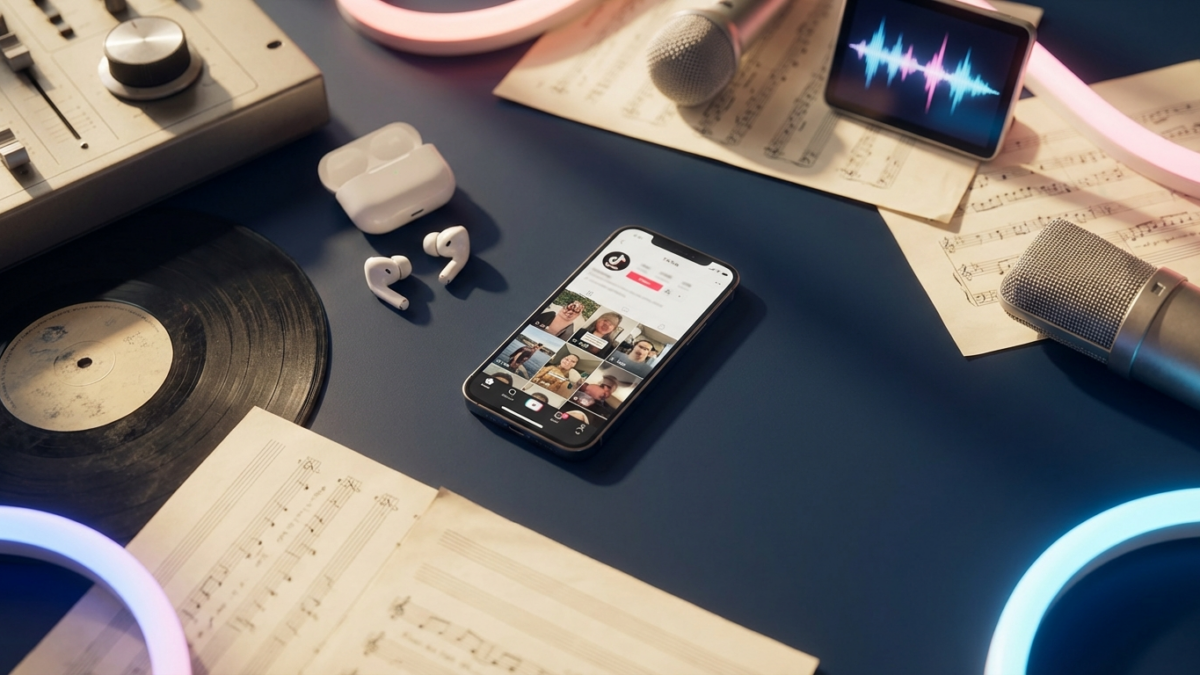
Sound isn't a nice-to-have on TikTok. It's the platform's defining feature. Unlike Facebook or Instagram where the majority of users scroll with sound off, TikTok reports that 88% of its users consider sound essential to their experience.
In our experience, the right audio strategy can be the difference between a mediocre and a strong CTR on app install campaigns. If you're running TikTok ads without a deliberate sound strategy, you're leaving performance on the table.
Page Contents
How important is sound in TikTok ads compared to other platforms?
Sound is arguably the single most important differentiator on TikTok. While TikTok vs Meta sound strategy differences: 88% of users say sound is essential to their experience. This means your audio layer isn’t supplementary, it IS the content.
In our experience, ads with intentional sound design (trending audio, voiceover, or music that matches the visual pacing) consistently outperform silent or generic-audio versions on both hook rate and click-through rate.
This aligns with what we call the 4th layer of RocketShip HQ's 4-Layer Hook System: Audio/music amplifies emotion and completes the pattern break that stops the scroll.
- 88% of TikTok users say sound is essential to their experience
- Ads with optimized sound consistently see higher hook rates in our experience
- Sound-off optimization (captions, text overlays) is still important as a safety net, but sound-on is the primary design target
- TikTok's algorithm reportedly factors in audio engagement signals when determining ad distribution
Should I use trending sounds or original audio in my TikTok ads?
Both can work, but they serve different purposes. Trending sounds give you an immediate familiarity boost and can piggyback on algorithmic momentum. Original audio gives you more creative control and avoids the risk of your ad feeling dated when a trend passes.
When to use trending sounds
Trending sounds work best for top-of-funnel awareness campaigns where you want to blend into the For You Page and feel native. When a sound is trending, TikTok's algorithm is already distributing content using that audio more aggressively.
We've observed that ads leveraging sounds during their peak trending window can see meaningful CPM improvements. The catch: trending sounds have a limited shelf life, so you need to move fast and plan for creative refresh cycles.
This is one reason we recommend having a pipeline of creatives ready to go, as we outline in our guide on how many creatives per ad group.
When to use original audio
Original audio (custom voiceovers, branded music, or sound design) is better for mid-to-lower funnel campaigns where you need to communicate specific value propositions. It also gives you full licensing control and longevity. Some of our best-performing evergreen creatives at RocketShip HQ use original voiceover combined with royalty-free background music.
In our experience, these evergreen creatives tend to run significantly longer before fatigue sets in compared to trend-based audio, which typically needs to be refreshed much sooner.
How do I use TikTok's Commercial Music Library for ads?
TikTok's Commercial Music Library (CML) provides pre-cleared tracks that are licensed specifically for advertising use. You can access it directly within TikTok Ads Manager when building your creative, or browse it at the TikTok Commercial Music Library website. Every track in the CML is cleared for commercial use, so you won't face copyright strikes or takedowns.
The library contains hundreds of thousands of tracks across genres, moods, and tempos. You can filter by mood (energetic, calm, dramatic), genre, duration, and even BPM. The quality has improved significantly since launch, though you still won't find major label hits here.
For app install campaigns, we typically filter by 'energetic' or 'inspiring' moods and match the BPM to the pacing of our visual cuts.
- Access CML through TikTok Ads Manager or ads.tiktok.com/business/creativecenter/music
- All tracks are pre-cleared for paid advertising use globally
- Filter by mood, genre, theme, and duration to find the right fit
- You can layer CML music under voiceover for a polished, professional feel
- New tracks are added regularly, so check back when refreshing creatives
What are the risks of using unlicensed music in TikTok ads?
Using unlicensed music in TikTok ads can get your ad rejected, your account flagged, or worse, result in a legal claim from the rights holder. TikTok's organic side allows broad music use, but the advertising side has strict licensing requirements. This is one of the most common mistakes we see from teams new to TikTok advertising.
Even if a sound is trending organically on TikTok, that doesn't mean it's cleared for commercial use in ads. The organic music library and the commercial music library are completely separate.
We've seen advertisers lose entire ad accounts because they used a popular song in a Spark Ad that was later flagged. Your options for legal audio in ads are: TikTok's Commercial Music Library, music you've licensed directly from a rights holder, or original audio you've created or commissioned.
How does sound strategy fit into the overall creative hook for TikTok ads?
Sound is the 4th and often most underestimated layer of a high-performing TikTok ad hook. At RocketShip HQ, we use a 4-Layer Hook System for TikTok ads in the first 0.5-1.5 seconds to create a pattern break that stops the scroll.
Here's how the layers stack in practice. The Visual layer (a 0.3-0.8 second zoom or unexpected visual) grabs peripheral attention. The Text overlay (under 15 words) orients the viewer on what they're about to see. The Verbal layer (a voiceover or spoken hook) builds personal connection.
And the Audio layer (a beat drop, satisfying sound effect, or trending audio cue) amplifies the emotional response and signals to the viewer’s brain that this content is worth engaging with. Given that creative quality drives performance variance, getting this audio layer right is essential.
Practical audio hook techniques we've tested
Some of the highest-performing audio hooks we've deployed include: a 'record scratch' or abrupt silence in the first 0.3 seconds to create curiosity, a bass drop timed to a visual reveal, ASMR-style sounds that trigger a sensory response, and voiceover hooks that start mid-sentence ('…and that's when I realized this app changed everything').
The key insight is that the audio hook should feel slightly unexpected. Predictable audio gets filtered out by the brain, just like predictable visuals. For more on optimizing the full creative structure, check out our breakdown of ideal TikTok ad length for app installs.
Does sound optimization matter differently for early-stage apps vs scaled advertisers?
Yes, and the difference is mostly about resource allocation. Early-stage apps spending $100-200/day should focus sound strategy on one or two proven patterns rather than testing dozens of audio variants. As discussed on the Mobile User Acquisition Show, concentrating efforts on fewer channels and creative approaches accelerates learning.
The same principle applies to sound: pick one audio strategy (e.g., proven script structure for ads) and optimize it before diversifying.
Scaled advertisers with larger budgets can and should run structured audio A/B tests. At RocketShip HQ, we run tests for higher-spend clients where we isolate the audio variable across otherwise identical creatives. Common test axes include: trending sound vs. original voiceover, male vs. female voiceover, high-energy music vs.
calm/ambient, and sound effects vs. no sound effects. For teams building more sophisticated decisioning around these variables, EA's approach to building a bidding decision engine offers a useful framework for thinking about how creative variables (including audio) feed into performance optimization at scale.
What are the biggest sound mistakes in TikTok ads?
The three mistakes we see most often are: using generic stock music that signals 'this is an ad' within 0.2 seconds, ignoring audio entirely and relying only on text overlays, and using music that's wildly mismatched to the visual energy of the creative. Any of these can tank your hook rate before the viewer even processes your message.
- Generic stock music: Corporate-sounding guitar or piano loops immediately break the native feel. TikTok users can detect 'ad audio' instantly, and it triggers scroll-past behavior.
- No sound strategy at all: Uploading a video with whatever background noise was captured during filming. This is surprisingly common and wastes the most powerful engagement channel on the platform.
- Energy mismatch: Pairing high-energy visuals with mellow music (or vice versa) creates cognitive dissonance that tanks watch-through rates.
- Volume issues: Audio that's too quiet gets lost in the feed. Audio that's too loud or distorted causes immediate skips. Test your ads with headphones AND phone speakers before publishing.
- Ignoring audio in iteration: Teams will test 10 visual variants with the same audio track. Flipping this (same visual, 3-4 audio variants) often yields bigger performance swings.
Can great sound strategy alone drive organic reach for TikTok ads?
Sound alone won't replace a paid strategy, but it can dramatically amplify organic distribution on top of paid spend. DirtyBit famously achieved 100 million installs without paid UA, partly by mastering platform-native content that leveraged trending audio and viral mechanics.
While that's an exceptional case, the principle applies: ads that feel native (including their audio) get shared more, commented on more, and receive algorithmic boosts through higher engagement rates.
In our experience, TikTok Spark Ads with native-feeling audio can meaningfully amplify organic impressions on top of paid reach, compared to ads with obviously 'produced' audio. The algorithm rewards content that generates genuine engagement, and sound is the fastest signal of whether content belongs on the platform or feels foreign to it.
Sound is TikTok's superpower, and it should be yours too. Treat audio as a first-class creative variable, not an afterthought.
Use TikTok's Commercial Music Library to stay legally safe, test trending sounds against original voiceover to find what resonates with your audience, and stack your audio with the other three hook layers (visual, text, verbal) to create the pattern breaks that stop the scroll.
If you need help building a sound-first creative strategy for your app's TikTok campaigns, RocketShip HQ can help you move from generic audio to performance-tested sound design that drives measurable results.
Looking to scale your mobile app growth with performance creative that delivers results? Talk to RocketShip HQ to learn how our frameworks can work for your app.
Not ready yet? Get strategies and tips from the leading edge of mobile growth in a generative AI world: subscribe to our newsletter.
Related Reading
- TikTok Ads for app growth: the complete guide (comprehensive guide)
- How Many Creatives Do You Need Per TikTok Ad Group?
- What Is the Ideal TikTok Ad Length for App Installs?
- TikTok Ads for app growth: the complete guide
- Creating TikTok Ads That Convert Natively