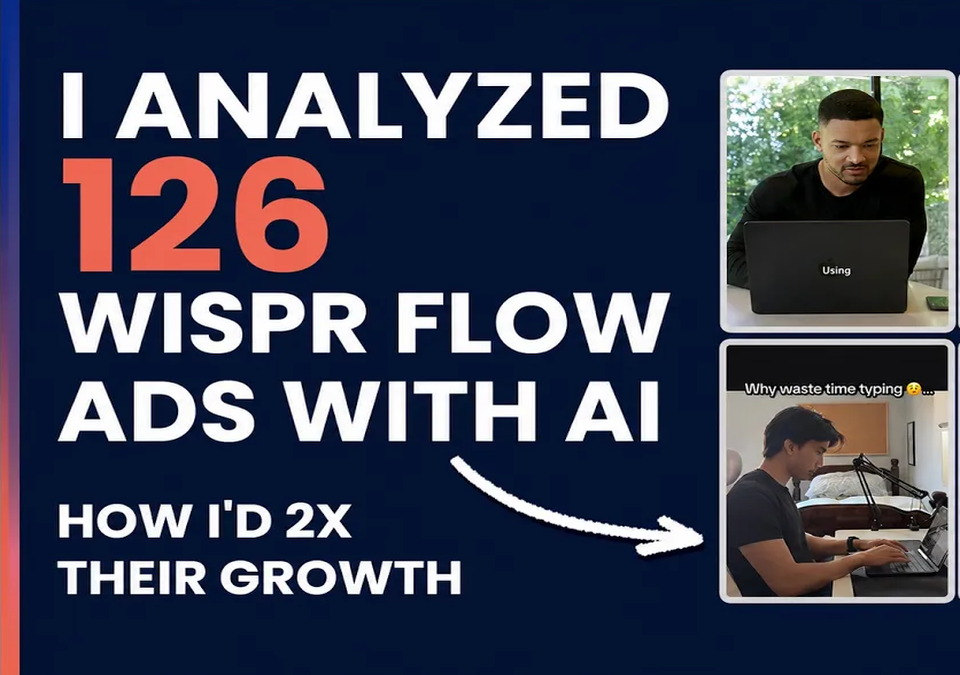
I analyzed 126 Wispr Flow ads and 1,025 reviews.
Wispr Flow ships fast: ~50 ads a week, median lifespan 16 days. The velocity is real. The gap is that winners rarely get rebuilt on, and the stories users tell in reviews barely show up in the ads.
By The Numbers:
126 ads analyzed | 1,025 reviews read | 54% of recent creatives are workflow demos
Page Contents
The Four Opportunities:
1.Build on your winners
The pattern: “One voice. Every AI.” is the #1 ad by impressions and workflow demos are 54% of recent output, but neither gets rebuilt on. Net-new every week.
The fix: Multiple versions per winner. Hold the shell, vary one variable at a time: the tool, the task, or the layout.
2.Extend adjacent
The pattern: The workflow demo works, but it only ever stars devs and founders at a desk.
The fix: Same demo shell, one step removed. New roles (writers, students, marketers), new contexts (email, weekly planning in Notion), new founder stories.
3.Open the lanes your reviews beg for
The pattern: Accessibility (hand surgery, ADHD, dyslexia) and accuracy are everywhere in reviews and nearly absent in ads. 48 reviews praise accuracy, about one ad demonstrates it.
The fix: Lead with the moment typing failed someone. Show accuracy beating native dictation on names and accents. Don’t just claim it.
4.Sell the emotional reality
The pattern: every scaled ad asserts speed but never names the enemy or shows the mechanism behind the accuracy.
The fix: name the enemy (Siri butchering your name), paint the dream (perfect text in your own voice), prove the bridge (it learns your style as you speak).
The Unlock:
Wispr has proven winners but chases net-new every week. Build on the winners, and aim them at what users already say they value.
ABOUT ROCKETSHIP HQ: Website | LinkedIn | Newsletter | Youtube | Podcast Website
FULL TRANSCRIPT BELOW
So really, as I said, the number one would be, can you widen a proven winner?
If something’s performing really well, how can you widen it, right?
So can you build on something that’s winning?
You could basically have the same ad go to a different audience, go to different emotions, different contexts, different hooks, or different formats.
I would start with hooks and formats because those are the easiest reskins while maintaining the essence of what’s winning.
So you have one voice every AI. This is your proven, uh, ad with the highest number of impressions.
You could use different headlines.
Stop retyping into seven, seven tools.
Use alternate layouts.
Use grid infographics, flowcharts with the same headline, and alternately have headlines that reflect the lived experience of every user.
Like I said, one would be stop retyping, but also would be, you know, an AI that finally gets your name right in every single tool.
The next one would, again, it’s the workflow demo.
I would also start by showing the screen of Wispr Flow on the, the Wispr Flow interface, because right now in the wor- workflow demo, you actually see the app downstream in the video.
You don’t see it first up.
I would try to show the app really on the first frame and the first screen because that’s when most of the users catch it.
With the founder story, keep the same founder story and use different hooks, different visual hooks.
Again, show the product experience first up.
I think that could be a great opportunity.
Recommendation two is adjacent extensions.
Now, take the same proven mechanic Have it be one step removed so you can target, you can speak to writers, students, marketers, other demographics while maintaining the narrative spine of the high performers.
Next would be show new context, both for the display ads and the videos you can show, “Hey, here are the tools where I use this,” right?
“Here’s how I type email every day. Here’s my week in Notion. Here’s me doing my project management in Trello or Asana.”
And again, with the founder video, you can show different founder stories, how I get more done, how I raise funding, how I work across different time zones.
And these are, are different user stories which are one step removed from the high performer, but is an, is an extension of your ad.
Now you can see here, right?
So a lot this alone should be the vast majority of their testing.
And you can see they’re not really leaning into what’s working in their tests at this point of time.
And there is a time and place for new ideas, but I think there is also a structure that they need to have the new ideas follow.
And here are what some of the new idea directions are that I would recommend.
Again, these are right out of their reviews.
When you wanna understand what new directions you wanna explore, get into their reviews, right?
So number one would be hand surgery, tendonitis, ADHD, dyslexia.
These are people who really need this, right?
So someone’s like, “Hey, I have tendonitis. My doctor said, you know, go easy on typing.”
That’s a big use case, and I can tell you that was one of my use cases when I had tendonitis a, a year or so ago.
Accuracy as proof, right?
Thick accent, a Non-Western culture, a name, and it gets those names right.
Again, email inbox log.
Again, these are right out of their reviews.
Speak your own language.
You don’t have to talk just in English.
Can you talk in Hindi, Serbian, whatever language you want to talk in, you know?
And how it’s better than any other voice dictation tool.
You talk about comparables, and I think that’s really how you wanna look at this.
Uh, recommendation number four is to get into emotional specifics in every single one of their ads because when you say something like one voice every AI, that sounds like a billboard.
It’s something which we call a billboard test on our team because if it belongs on a billboard, it speaks to everyone and no one, and you really wanna have an emotional reality to your ads.
And here’s the framework we look at internally for making sure every ad is emotionally grounded: enemy, dream, and bridge.
You wanna talk about talk through the enemy.
What is the enemy of the user, right?
It’s voice tools that butcher your words, Siri mangles your name, and you’re just deciding to give up on dictation and just type instead.
And really, you wanna drill down on the enemy in your hooks, in your headlines, in your ads.
The dream, it is you being able to talk in Hindi, in Spanish and Italian with no errors.
It’s this is magic, and you wanna paint, paint a picture of the dream.
You wanna talk about the bridge, about how Whisper does it.
It doesn’t have to be a technical explanation.
It listens to all your past transcripts and learns how you speak and cleans up as you speak.
That’s really how it works.
And that, I think, is the big foundation underlying all of this.
So if I had to summarize, the big ones would be build on winners, change headlines, change layouts, build on winners first.
Extend concepts that are adjacent to winners.
Open new lanes.
Sell the emotional reality in every single ads ad that you make.
And if they do these, I’m very, very confident with their existing weekly process, with their discipline of killing ads, they will be able to 2X their creative led growth.
Yep.
And if you would like to explore a similar deconstruction, or analysis of your own ads, or if you’d like for us to build ads like these for your own product, uh, hit me up – [email protected], [email protected].
Look at our website if you’d like to.
Thank you.
Want the deeper, scene-by-scene creative teardown? Get our full Wispr Flow decosntruction here.