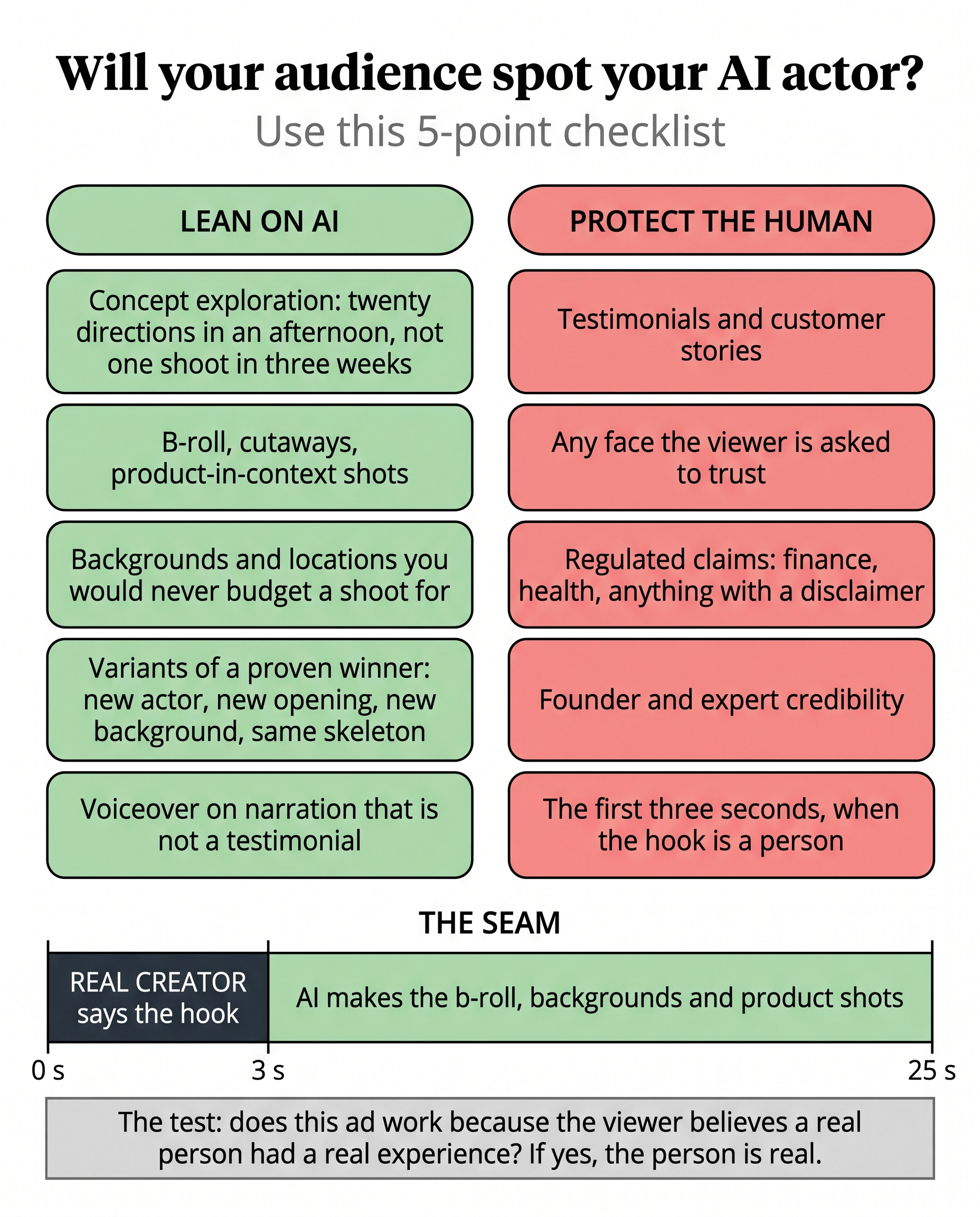
Short answer: use AI wherever authenticity is not the product, and a real person wherever it is. The test for any single ad is whether it works because the viewer believes a real person had a real experience. If it does, the person is real. The strongest structure is a seam: a real creator delivers the opening line, and AI builds everything after it.
The question teams ask is whether AI is good enough yet. That is the wrong question, because the answer changes every few months and the decision does not. What stays constant is what each ad is selling, and whether that depends on someone being real.
Page Contents
When should you use AI instead of a real creator?
When the ad does not depend on anyone being real. These are the jobs where generation is the better trade:
- Concept exploration. Twenty visual directions in an afternoon instead of one shoot in three weeks. A bad idea now costs almost nothing.
- B-roll, cutaways and product-in-context shots. The connective tissue of an ad.
- Backgrounds and locations you would never budget a shoot for.
- Variants of a proven winner. New actor, new opening, new background, same skeleton. See how to build on a winning ad.
- Voiceover on narration that is not a testimonial.
When should you keep a real person in the ad?
When the ad works because the viewer believes it really happened.
- Testimonials and customer stories. If the proof is that it happened, a generated version is a screenshot waiting to happen.
- Any face the viewer is asked to trust.
- Regulated claims. Finance, health, anything that carries a disclaimer.
- Founder and expert credibility.
- The first three seconds, when the hook is a person.
What is the best way to combine AI and real creators?
The seam. A real creator delivers the opening line to camera, the part that has to land as human. AI fills everything after it: the b-roll, the backgrounds, the product shots, the angles nobody filmed.
You pay for authenticity in the three seconds that decide the swipe, and for speed in the twenty seconds nobody scrutinises. It also stops the question being ideological. You are not choosing a side, you are deciding where human capital is actually load-bearing and spending cheap generation everywhere else.
Who should write the script, a person or the model?
A person writes the original. In one comparison run by the CEO of an AI video platform, scripts a human wrote first performed three to four times better on backend results than scripts the model wrote first. His split is the one worth copying: humans own the concept and the first script, and AI multiplies the actor and the hook against it. We go deeper in should AI write your ad scripts.
How do you decide, ad by ad?
- Name the bet first. If you cannot say what the ad claims, the production method is irrelevant.
- Ask what is load-bearing. Where does the credibility come from? If a person, that person is real.
- Check the category. Finance, health and anything with a disclaimer keep the human.
- Default to the seam. Real hook, generated everything else, unless you have a reason not to.
- Check it on a phone. Most tells only show at full size; see what to check before an AI ad goes live.
For the full workflow behind these calls, read our guide to AI ads that don’t look like AI and the Ultimate Guide to AI-Driven Creatives, and for what this does to team size, see does AI let you cut your creative team. To tell a new idea from a variant of an old one, see creative concept vs creative variant.
Frequently asked questions
Can you use AI for UGC content? Yes, where authenticity is not the product: variants, b-roll, backgrounds and narration. A testimonial or any face the viewer is asked to trust should stay real.
Do AI-generated ads actually work? They fail for identifiable reasons: no strategic bet behind them, tells that read as synthetic, a hook and body that do not agree, and endless variants of one winner. When those are handled, AI is a production method, not a performance penalty.
Are AI UGC ads legal? Using AI is not the issue, but realistic AI-generated or altered content needs disclosure on the major platforms. Meta and TikTok each ask advertisers to label it, and undisclosed content can be rejected. The rules change often, so check the live policy before you launch, and keep a real person for regulated claims.
Are AI actors as good as real UGC creators? Neither is better in general. AI is better where authenticity is not the product, such as variants, backgrounds and narration. A real creator is better where the viewer is asked to believe a real person had a real experience.
Can you use AI for testimonials? No. If the ad works because a customer’s words and face are the proof, a synthetic version is not a shortcut. The realness was the asset.
What is the AI and real creator seam? A real creator delivers the opening line to camera and AI produces the rest of the ad: b-roll, backgrounds and product shots. It buys authenticity for the seconds that decide the swipe and speed for the rest.
Should AI write the script too? Not the original. In one direct comparison, human-first scripts did three to four times better on the backend than model-first ones. Use AI to multiply the actor and the hook against a human-written script.