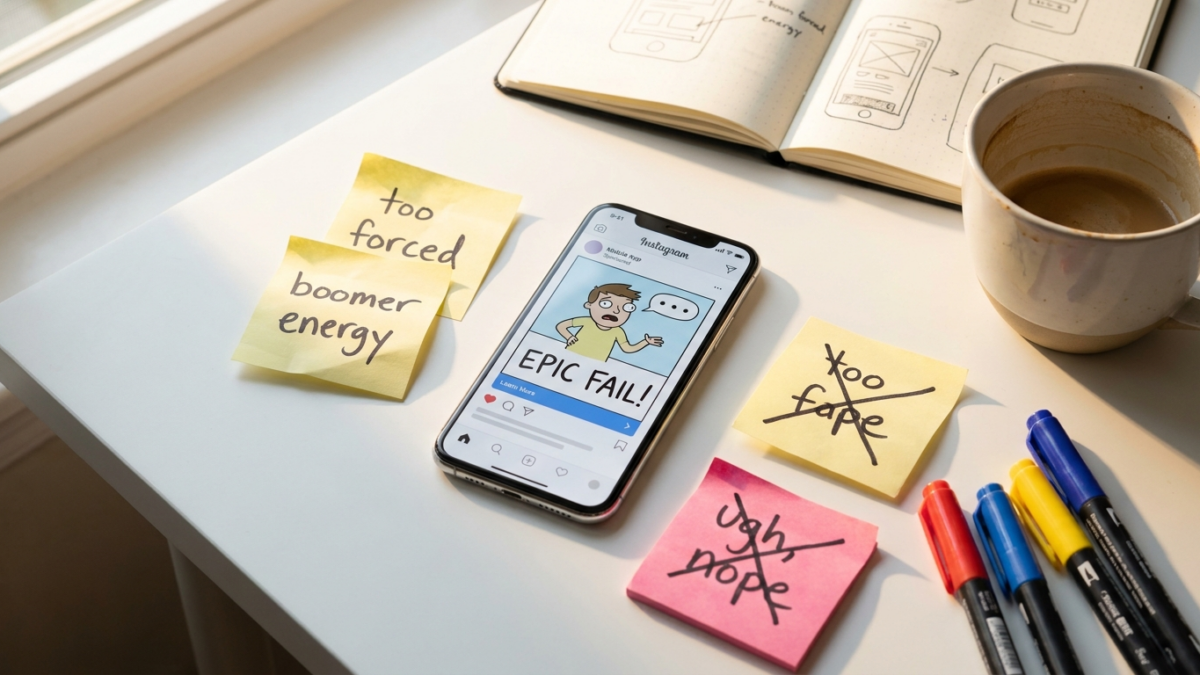
A humor-driven UGC ad for a casual puzzle game hit a $0.38 CPI on TikTok while the brand's polished, straight-to-feature creative sat at $1.92 CPI for the same audience. The funny ad wasn't random. It followed a specific structure: relatable setup, exaggerated fail, product payoff. According to TikTok's 2024 research with Kantar, ads that use humor are 15% more likely to be watched to completion and drive 24% higher creative recall. But humor is a double-edged sword in performance marketing. Get the tone wrong, and you don't just waste budget, you actively damage brand perception and tank conversion rates. This guide breaks down exactly when humor works, when it backfires, and how to produce funny mobile app ads that actually convert across cultures and categories.
Page Contents
The Problem
Most performance creative teams avoid humor because the downside feels asymmetric: a boring ad wastes impressions, but a cringe ad generates negative sentiment.
According to the AppsFlyer State of App Marketing report, creative fatigue now sets in 40-60% faster than it did pre-ATT, meaning teams need higher creative volume and more format diversity.
Humor is one of the few levers that reliably extends creative lifespan because entertaining content gets rewatched and shared organically.
Yet the failure rate is high. According to Ipsos Creative Excellence data, roughly 1 in 3 humor attempts in advertising fail to land, either because the joke overshadows the product, the cultural context doesn't translate, or the tone mismatches the audience's emotional state.
Need help scaling your mobile app growth? Talk to RocketShip HQ about how we apply these strategies for apps spending $50K+/month on UA.
In sensitive verticals like fintech and health, a poorly timed joke can trigger compliance violations or erode trust.
The core tension: algorithms on Meta, TikTok, and Google reward engagement signals (watch time, shares, saves), and humor generates those signals at scale. But if the humor doesn't connect to the product value proposition, you get high engagement with low conversion, the worst possible outcome for a performance campaign.
The challenge is building a repeatable system for humor that converts, not just entertains.
The Approach
- Map humor viability by app category using audience emotional state and regulatory constraints, then select from three proven humor archetypes
- Build humor creatives using a 3-beat structure (relatable pain, comedic escalation, product resolution) that keeps the product as the punchline
- Localize humor across markets using cultural calibration frameworks rather than direct translation, testing regionalized concepts against universal slapstick baselines
The Results
- Humor-driven creatives in casual gaming and entertainment categories consistently achieve 30-45% lower CPIs compared to feature-demo formats, per Liftoff's 2024 Creative Insights report
- According to TikTok's Creative Center benchmarks, comedy-format ads average 1.8x higher 6-second view rates than non-humor creatives in the same auction
- Relatable-humor UGC formats show 2.1x longer creative lifespan before fatigue compared to standard testimonials, based on industry patterns observed across subscription app campaigns
Key Takeaways
- Takeaway 1: Humor works best when the product is the punchline, not a footnote. If you can remove the product and the joke still lands, the creative will entertain but not convert. Structure every humor ad so the resolution requires the app.
- Takeaway 2: Casual games and entertainment apps see the highest humor ROI, with CPIs dropping 30-45% according to Liftoff benchmarks. Finance and health apps should use situational wit (light irony about everyday frustrations) rather than jokes, keeping humor below 30% of the ad's emotional weight.
- Takeaway 3: The 3-beat structure (pain, escalation, product payoff) is the most reliable humor format for performance ads. It mirrors TikTok and Reels native content, which means the algorithm treats it as organic-adjacent and rewards it with cheaper reach.
- Takeaway 4: Never translate jokes. Localize the concept. Slapstick and visual humor travel globally with minimal adaptation. Wordplay, sarcasm, and cultural references need full regional rebuilds. According to Kantar's Global Ad Testing Database, visual comedy scores 89% consistency across markets versus 41% for verbal humor.
- Takeaway 5: Test humor creatives at $50-100/day minimum per ad set on a single self-attributing network before scaling. Humor ads have higher variance in early performance. You need at least 50 conversions before judging a humor creative, compared to roughly 30 for a standard demo ad.
- Takeaway 6: Cringe is almost always caused by inauthenticity, not by the joke itself. If the humor doesn't match the creator's natural voice, the platform's native tone, or the audience's self-image, it triggers rejection. Cast real users or comedians who already speak to your target demo.
- Takeaway 7: Humor extends creative lifespan by 50-100% in engagement-driven auctions (TikTok, Reels, Shorts) because entertaining content accumulates organic shares that supplement paid distribution. Budget accordingly: invest more production effort per humor concept since each one will run longer before fatiguing.
Humor is one of the most underleveraged tools in performance creative because teams fear the downside more than they pursue the upside. The data tells a clear story: when structured correctly, humor lowers CPIs by 30-45% in compatible categories, extends creative lifespan dramatically, and generates organic amplification that subsidizes paid reach.
Start by auditing your app category against the humor viability matrix in this guide. If you're in casual gaming, entertainment, social, or lifestyle, humor should be 25-30% of your creative volume immediately. If you're in fintech or health, limit humor to situational wit in UGC formats and never let the comedy overshadow the trust signals.
This week, brief one humor creative using the 3-beat structure: relatable pain, comedic escalation, product payoff. Test it on TikTok or Meta Reels at $50-75/day against your current best-performing ad. Give it 50 conversions before judging. That single test will tell you more about humor's viability for your app than any amount of theorizing. For deeper guidance on choosing the right paid channels for your humor creative tests, match the format to the platform where your audience already consumes comedy content natively.
Frequently Asked Questions
Does humor in ads actually improve conversion rates or just engagement?
It depends entirely on structure. Humor that resolves with the product (the app is the punchline) improves both. According to TikTok and Kantar's joint research, humor ads that maintain brand linkage achieve 24% higher creative recall and comparable or better conversion rates. Humor that exists purely for entertainment drives views but depresses install rates because users enjoy the content without connecting it to the product.
What types of humor work best on TikTok vs Meta vs Google?
TikTok rewards trend-native humor (trending sounds, duet-style reactions, exaggerated POV formats) and penalizes anything that feels like a traditional ad. Meta performs best with relatable-scenario UGC, especially on Reels, where conversational humor in the first 2 seconds drives hook rates. Google UAC is the hardest platform for humor because the system distributes across inventory types (Search, Display, YouTube), and visual comedy optimized for YouTube may underperform in Display. For Google, asset diversity is critical, so include humor as one variant alongside feature-led creatives.
How do you A/B test humor ads without wasting budget on bad jokes?
Run humor concepts as one of 3-4 variants in an ad set with at least $50/day budget on a single channel. According to Mobile User Acquisition Show guidance on concentrated spending, algorithms need sufficient conversion data to learn. Give each humor creative at least 50 installs before evaluating. If the creative has high CTR but low install rate after 50+ clicks, the humor is working as entertainment but failing as an ad.
Is self-deprecating humor safe for brand ads?
Self-deprecating humor is one of the safest formats because it positions the brand as approachable and confident. According to Ipsos Creative Excellence norms, self-aware humor scores in the top quartile for brand likability across demographics. The risk only emerges if the self-deprecation inadvertently highlights a real product weakness. A dating app joking about awkward first dates works. A banking app joking about losing your money does not.
How do you avoid cultural insensitivity when running humor ads globally?
Build creative briefs at the concept level, not the script level, and hire local creators to execute. Visual slapstick, reaction humor, and universal frustrations (slow WiFi, phone dying, cooking fails) translate across markets. According to Kantar's global testing database, visual comedy maintains 89% consistency in audience response across 30+ markets. Avoid religion, politics, gender stereotypes, and any humor rooted in local idioms unless a native speaker is writing and performing it.
Can humor work for subscription app ads or does it cheapen the product?
Humor works well for subscription apps when paired with a clear value demonstration. The key is using humor in the hook (first 2-3 seconds) to stop the scroll, then transitioning to a product demo or benefit statement. According to Adjust's State of App Growth data, subscription apps with diverse creative strategies (including humor) show stronger retention metrics because they attract users who genuinely relate to the problem being solved, not just deal-seekers.
What's the biggest mistake brands make with humor ads?
Trying to be funny instead of trying to be relatable. The best-performing humor ads don't require comedic talent. They require acute audience observation. A fail ad for a mobile game works because every player has experienced frustration, not because the script is clever. Build humor from your users' real pain points and language, not from a writer's room brainstorm disconnected from the audience.
How many humor creatives should be in my testing rotation?
Humor should represent 20-30% of your total creative mix, not the majority. For a typical testing sprint of 10-15 new concepts per week, 3-4 should use humor archetypes. This ratio ensures you capture the upside of humor (lower CPIs, longer lifespan) without over-indexing on a format that has higher variance. If a humor concept wins, iterate on that specific joke structure 3-5 times before moving to a new comedic angle.
Looking to scale your mobile app growth with performance creative that delivers results? Talk to RocketShip HQ to learn how our frameworks can work for your app.
Not ready yet? Get strategies and tips from the leading edge of mobile growth in a generative AI world: subscribe to our newsletter.
Related Reading