How to scale a Meta ads budget for app campaigns


Copy prompt instead

Increase a Meta app campaign’s budget only while mature conversion costs, customer value and cash requirements remain affordable. Our playbook considers roughly 20% daily decisions or 50% to 100% weekly steps, earned separately rather than compounded automatically. Keep new creative funded, but investigate auction prices, delivery mix, funnel changes and measurement as well as fatigue when results deteriorate. An underdelivered ad or low-volume cohort needs a slower read.
Page Contents
How much should you increase a Meta budget when scaling?
When something is working really well, add 50% to 100% a week.
Choose between smaller daily decisions and a larger weekly decision. Do not treat 20% every day as a slower equivalent of 50% to 100% per week: seven consecutive 20% increases raise the budget by about 258%. Our guidance is to earn each step from results, not compound daily increases automatically. Either way, the step is earned by results: a campaign holding its cost per conversion at twice the spend has earned the next step. A campaign whose cost per conversion is climbing has not earned any step, however small.
Then read it over the week. Did cost per conversion hold against the target your own economics allow while spend went up? If yes, keep stepping: another 20% a day, or another 50% to 100% next week. If it held but only just, take the smaller end. If it got worse, don’t add more until you know why.
A big jump can make results wobble for a few days while Meta finds more people to spend on, so judge on the week, not the day after the change.
How do you know a campaign is ready to scale?
Two things: cost per conversion is holding, and there are enough conversions to trust that it is.
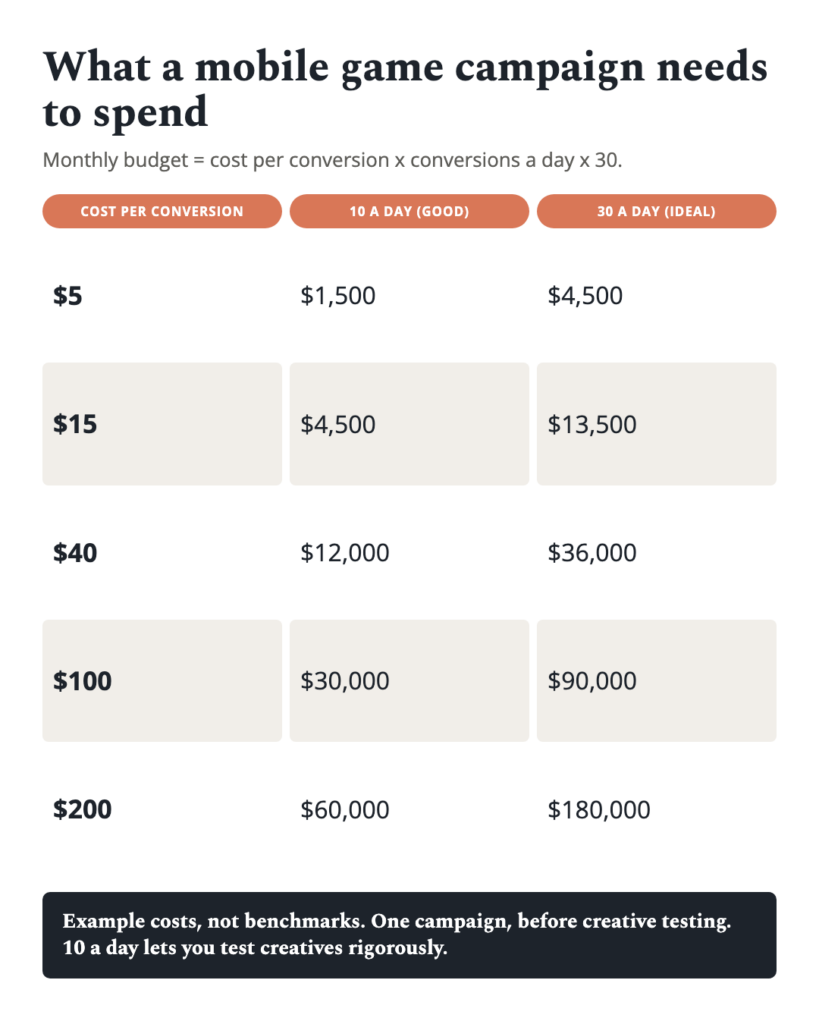
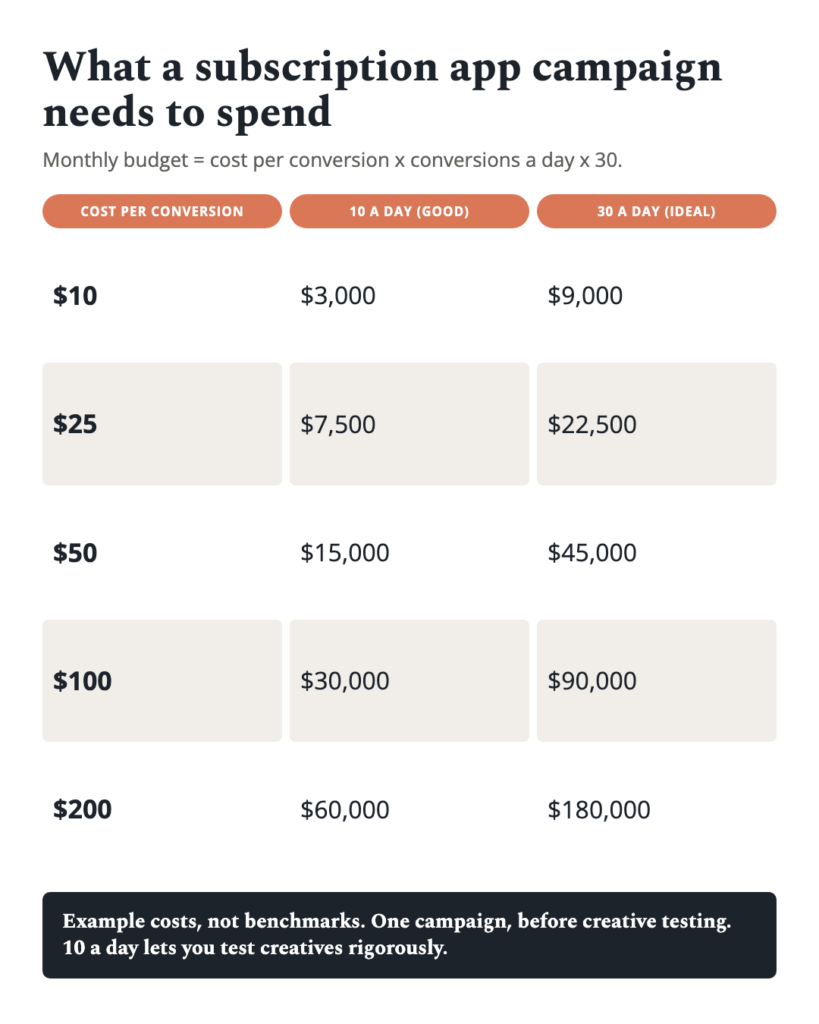
Our campaign planning guide is ideally 30 conversions a day, with 10 a useful operating level. These figures help estimate funding; they do not guarantee platform learning or distinguish a real trend from noise. Check cohort maturity, conversion variability and how large a change would matter economically before adding spend.
You can run a campaign on 1 or 2 conversions a day, and on a small budget we would not spend more just to hit a benchmark. Results at that volume are noisier, so you read them over longer windows and scale more cautiously. But if you want to test creative rigorously and unlock scale, 10 a day is what makes the numbers worth acting on. How to turn that into a dollar figure is in how much a subscription app should spend on marketing and how much a mobile game should spend.
The roughly 50 optimization events in seven days figure concerns Meta’s ad-set learning phase. It is not a mandatory wait for each creative, a campaign viability test or statistical proof. Ad-set learning versus creative decisions explains the distinction.
What is the difference between vertical and horizontal scaling?
Vertical scaling means adding budget to what is already running. Horizontal scaling means adding new things to spend on: new creatives, new campaigns, new countries.
Vertical scaling is simpler, and it is where the 50% to 100% a week applies. But every campaign reaches a point where more money buys less.
With broad targeting, horizontal scaling is mostly a creative job. Different ads give the delivery system different messages to evaluate. A talking-head video and a product demo can reach overlapping people, so confirm the actual delivery rather than assuming each format creates a new audience. That is why Meta rewards a varied mix of ads, and why it is worth measuring the creative diversity in your account before you assume you have run out of audience.
Why does performance drop when you scale?
A budget increase can change auction prices, audience mix and the amount of repeat exposure. Creative fatigue is one explanation, but the increase itself can also buy less efficient marginal conversions. First check measurement and whether the cohort has matured, then separate acquisition costs from conversion and revenue changes.
For example, using matched mature cohorts, $10 CPM, 1% click-through and 20% click-to-install imply a $5 CPI: $10 ÷ (1,000 × 0.01 × 0.20). If CPM rises to $15 with both rates unchanged, CPI becomes $7.50. If instead CPM and click-through hold but click-to-install falls to 10%, CPI becomes $10. These are hypothetical arithmetic cases, not unique diagnoses. In the second case, inspect store conversion and the quality of the clicks; a changed delivery mix can contribute too.
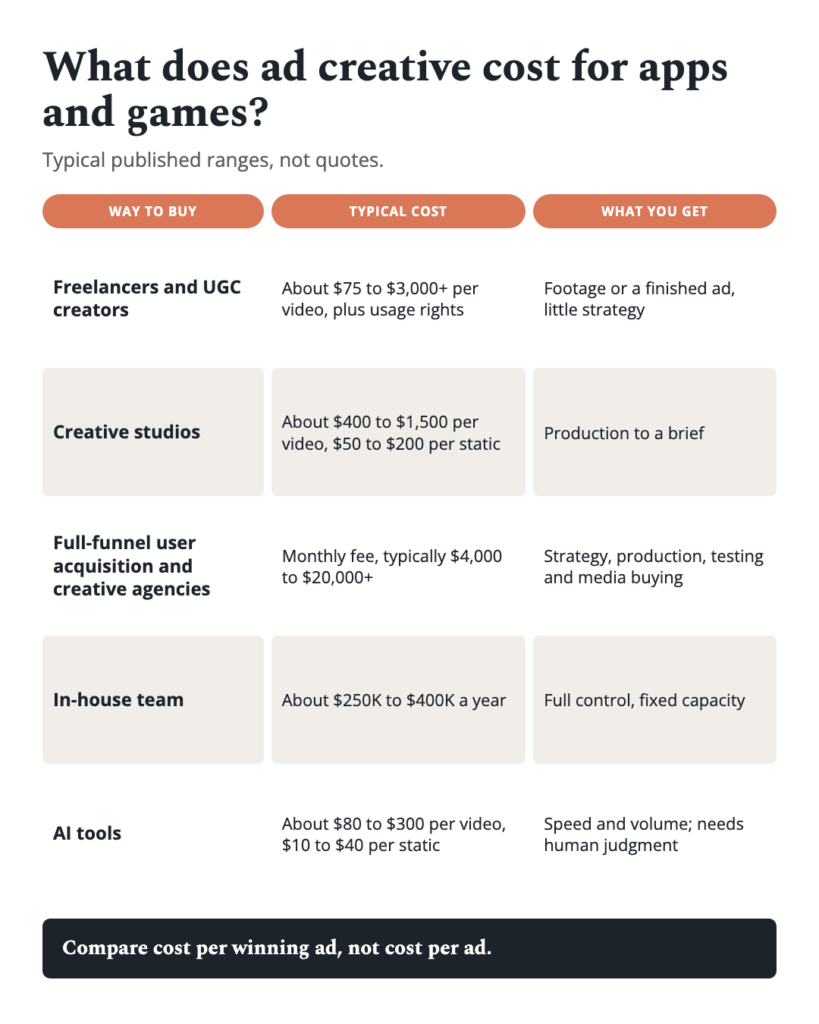
When the evidence supports fatigue, test new creative alongside useful variants of the winner: your winning ad is dying covers the production order. If costs are already outside your affordable range, hold or reduce exposure while diagnosing it. New creative is a hypothesis to test, not a reason to keep overspending until a replacement wins.
Before you blame creative, rule out the other causes:
- Costs per impression up across the whole account. If they rose roughly in step with cost per conversion, the pressure may be the market (a seasonal peak, more advertisers bidding) rather than your scaling. Hold the budget and watch.
- Top ads tiring. Rising frequency with falling click-through rate on your biggest spenders points at creative.
- Clicks steady, conversions down. Check store, onboarding, paywall and tracking changes, and whether delivery now brings a different mix of visitors. Steady click volume alone does not prove that the campaign is healthy.
If you scaled too far and cost per conversion has jumped, don’t slash the budget back to where it was. Pull back part of the way, give it a few days, and get new creative into testing.
How do you budget for creative testing while scaling?
Separately, on top of what the scaling campaign needs.
Your main campaign needs its 10 to 30 conversions a day. Test new creatives inside it and the proven ads take most of the budget, so the new ones never get a fair read. So run testing in its own campaign, with its own budget, and move winners into the scaling campaign once they have shown they hold up.
There is no fixed share to give testing. Size it by how many new ads you need to judge each week and what it costs to get each to a decision. How to structure creative tests for Meta ads covers how to set the tests up and read them.
Should you use CBO or ABO when scaling?
Use campaign budget optimization (CBO, now called Advantage campaign budget) for the campaign you scale, and ad set budgets (ABO) where you need control, usually for tests.
CBO lets Meta move budget between ad sets toward whatever gets conversions most cheaply. For a scaling campaign full of proven ads, that is what you want: you raise one budget and Meta decides where it goes.
ABO assigns a budget to each ad set; it does not guarantee that the budget will spend. That suits tests, because in a CBO campaign a new ad set can get almost nothing if the established ones look better early.
A few practical points:
- In CBO, don’t add a crowd of new ad sets at once. The established ones keep the budget and the new ones starve.
- Use ad set spend limits sparingly. Each one stops Meta moving money to where it works.
- If an ad set in CBO gets almost no spend for days, move it to your testing campaign rather than forcing budget to it.
How many ad sets should you run when scaling?
There is no fixed rule. What matters is that each ad set has enough to work with: enough conversions a day for you to read it, and enough ads for Meta to choose between. We typically recommend at least about 8 ads per ad set.
If each of your ad sets is getting only a handful of conversions a day, you have more ad sets than your conversions can feed, and every read is noisy. Combine them so each one gets more. When you want to scale a winner, add budget to the ad set it lives in, and make anything new genuinely different, such as new creative or a new country.
How do you know a campaign has hit its ceiling?
When you add budget and each step buys fewer extra conversions than the last, at a cost per conversion your economics can’t carry. Rising frequency, rising costs per impression without better conversion rates, and tiring top ads usually show up together.
At that point the way forward is horizontal: new creative directions, new countries or a new channel. Here is the checklist we use.
| Signal | Action |
|---|---|
| Cost per conversion holds as spend rises, 10+ conversions a day | Add 50% to 100% next week |
| Cost per conversion holds, under 10 conversions a day | Combine ad sets so each gets more; read over a longer window |
| Cost per conversion rises and your top ads are tiring | Test new creative; hold or reduce exposure if mature costs exceed the affordable limit |
| Cost per conversion rises and costs per impression are up account-wide | Hold the budget; don’t cut in a panic |
| Clicks steady, conversions down | Check the store page and onboarding |
| One ad carries most of the spend | Extend it and test new concepts now |
Frequently asked questions
What is the 20% rule on Facebook ads? It is advice to consider a roughly 20% daily increase. We also use 50% to 100% weekly steps when results support them. These schedules compound differently: seven daily 20% increases would add about 258%. Judge each step on mature cost per conversion rather than increasing automatically.
How do you scale Meta ads? Add budget to campaigns whose cost per conversion holds as spend rises, by 50% to 100% a week when they are working really well. Keep new creative coming through a separate testing campaign, and add new creatives, countries or channels when a campaign stops taking more budget profitably.
What is CBO and ABO in Facebook ads? CBO (Advantage campaign budget) sets one budget for the campaign and lets Meta split it across ad sets. ABO sets a budget on each ad set. CBO suits the campaign you scale; ABO suits tests where you want control of each ad set’s assigned budget; actual delivery still needs checking.
Is $10 a day enough for Facebook ads? For an app, only if your cost per conversion is very low. The number that matters is conversions a day per campaign: ideally 30, and 10 is good. Divide your daily budget by your cost per conversion to see where you are.
Why are my Facebook ads not spending my full budget? Often because of a cost or bid cap that Meta can’t meet at that budget, or ads Meta doesn’t expect to convert. If you use a cap, check whether it is below what conversions currently cost. If not, the ads themselves are the usual limit: try new creative.
Published