How much should a subscription app spend on user acquisition?


Copy prompt instead

Don’t start from a budget number. Start from a conversion number. A campaign you want to scale ideally gets 30 conversions a day; 10 a day is good. If your cost per conversion is extremely high, $400 or $500, you make do with 2 or 3 a day. If you want to test creatives rigorously to unlock scale, aim for 10 a day. Your budget is your cost per conversion, times the conversions a day you need, times 30. At a $50 cost per conversion, that is $15,000 a month at 10 a day and $45,000 a month at 30 a day, for one campaign, before creative testing.
Page Contents
Why is “how much should I spend on user acquisition” the wrong first question?
Because a dollar figure on its own tells you nothing about whether the ads can work. $10,000 a month is plenty for an app that pays $5 for a conversion and nowhere near enough for one that pays $150.
What decides whether paid acquisition works is how many conversions you feed the platform each day: whether the algorithm has enough to learn from, and whether you can tell your good ads from your bad ones. The budget is just what those conversions cost.
How many conversions a day does a subscription app need?
Ideally 30 a day per campaign you want to scale. 10 a day is good. At the bare minimum, 2 or 3 a day, and only when your cost per conversion is extremely high, around $400 or $500, so that 10 a day is out of reach.
You can absolutely run a campaign on 1 or 2 conversions a day. If you have a small budget, we certainly don’t recommend spending more just to hit a conversion benchmark, especially if you are an early-stage company with unproven performance. If you want to rigorously test ad creative to unlock scale, we strongly recommend getting to 10 conversions a day, so that you get enough insights from sufficiently varied creatives: different directions, angles, hooks and formats.
Why 10 is good. The delivery algorithm finds buyers by looking at who converted and showing ads to more people like them. With a handful of conversions a day it is guessing from a tiny sample, so cost per conversion jumps around for reasons that have nothing to do with your ads.
Why 30 is the ideal. At 30 a day the algorithm has enough signal to settle down and find more of the right people, and decisions you make on a week of data hold up the following week. Past 30, things keep improving.
When 2 or 3 a day has to do. Some apps pay $400 or $500 for a conversion. At that price 10 a day is $120,000 to $150,000 a month for one campaign, so you make do with 2 or 3 a day. Results are noisier, so judge them over longer windows and change less at once.
You may also have heard that you need 50 conversions a week. That is really old guidance, and we would avoid it: why the 50-conversions-a-week rule is dated.
What is the formula for an app marketing budget?
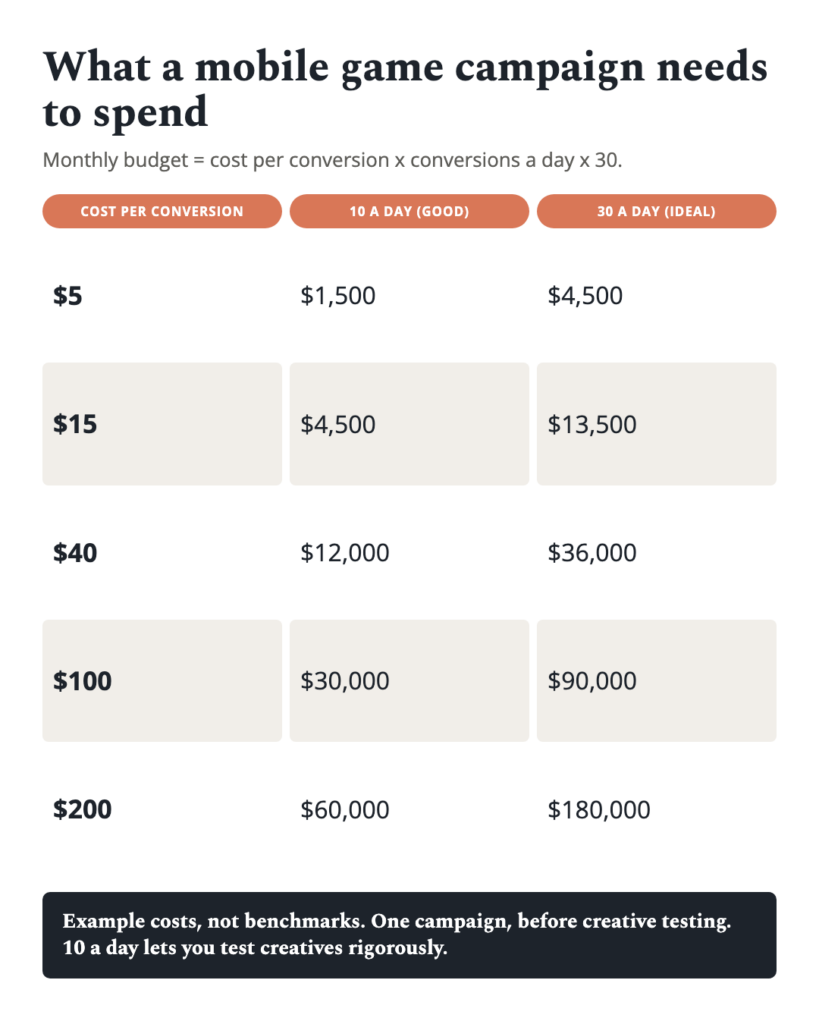
Monthly budget = cost per conversion x conversions per day x 30.
Here is what that looks like at a few example costs per conversion. These are examples, not benchmarks. Your own cost per conversion is the only number that matters in the formula.
| Example cost per conversion | 10 a day: daily | 10 a day: monthly | 30 a day: daily | 30 a day: monthly |
|---|---|---|---|---|
| $10 | $100 | $3,000 | $300 | $9,000 |
| $25 | $250 | $7,500 | $750 | $22,500 |
| $50 | $500 | $15,000 | $1,500 | $45,000 |
| $100 | $1,000 | $30,000 | $3,000 | $90,000 |
| $200 | $2,000 | $60,000 | $6,000 | $180,000 |
The 10-a-day column is what it takes for one campaign to be readable; the 30-a-day column is what it takes to learn well and scale. At $400 to $500 per conversion, 2 or 3 a day works out to roughly $24,000 to $45,000 a month, the bare minimum for one campaign. If you don’t yet know your cost per conversion, run a short test first and come back with a real number, not a hopeful one.
Why does creative testing need conversions on top?
Because ads don’t perform equally, and you only find out which ones work by giving each enough conversions to judge.
Take one creative direction: a single idea about why someone should download your app. You don’t make one ad for it. Within each direction you test several creatives, built on different angles, hooks and formats, and you test several directions side by side. Some of those creatives work really well. Some work poorly.
To tell which is which, each ad needs enough conversions to give you a statistically significant result rather than noise. Three conversions against five means nothing; it could flip tomorrow. Spread too few conversions across too many ads and you end up cutting winners and keeping losers.
That is why creative testing needs its own budget on top of the budget for your main campaign. The campaign you scale needs its 10 to 30 a day. The ads you are testing need enough conversions each to reach a decision. The mechanics of setting those tests up are in how to structure creative tests for Meta ads, and why platforms reward a varied mix of ads is in how to measure creative diversity on Meta.
To see how many ads a given budget can actually test, use our free creative volume calculator. To check whether a test has run long enough to call, use the creative testing calculator.
Does adding a platform or a campaign change the budget?
Yes. The conversion target applies per campaign you want to scale.
Add a second platform and it needs its own 10 to 30 conversions a day; conversions on one platform don’t teach the other. Split spend into a separate campaign, say for a new country, and that campaign needs its own conversions too.
Many subscription apps spread a budget that could fund one campaign properly across three platforms and five campaigns, so every one is starved of conversions and nothing scales. One well-fed campaign beats five starved ones. When to add each platform is covered in how to pick ad channels for a subscription app.
Why do agencies set a minimum ad spend?
Because of the same arithmetic. Add up one campaign at a healthy conversion rate, creative testing on top of it with several creatives per direction across angles, hooks and formats, and room to scale the winners, and at the costs per conversion most subscription apps see, the total lands in the tens of thousands of dollars a month.
That is why agencies like ours set a $50,000-a-month minimum in ad spend. Below it, a creative programme can’t produce readable results. The full working is in what is the minimum ad spend to work with a performance creative agency. What the agency itself costs on top of spend is in how much does a user acquisition agency cost.
Is RocketShip HQ a fit?
If your conversion arithmetic lands at $50,000 a month or more in ad spend, we can help. RocketShip HQ runs user acquisition and creative together for subscription apps and games, and the testing budget above is where most of our work goes: several creatives per direction, across angles, hooks and formats, until the winners show. Engagements start at $7,500 a month for creative plus growth marketing. For what to expect from a partner at this stage, see what a subscription app growth agency should do, and whoever you talk to, use the questions to ask any user acquisition agency.
Frequently asked questions
How much should I spend on app ads? Enough to reach ideally 30 conversions a day on each campaign you want to scale; 10 a day is good, and 2 or 3 a day is the bare minimum if each conversion costs $400 or more. Multiply your cost per conversion by the conversions a day you need, then by 30, for the monthly budget. Add creative testing on top.
Is $10 a day enough for Facebook ads? For a subscription app, almost never. $10 a day only reaches 10 conversions a day if each conversion costs $1. At more typical costs, $10 a day buys a conversion or less, which is too little for the algorithm to learn from or for you to read.
Is $50 a day good for Meta ads? Only if your cost per conversion is $5 or less. Divide $50 by your cost per conversion: if the answer is well below 10, the campaign is starved and its results will mostly be noise.
What is the recommended budget for Meta ads? There is no single number. The useful recommendation is a conversion target: 30 a day per campaign ideally, 10 a day is good, and 2 or 3 a day at the bare minimum for very high costs per conversion. Your budget is that target times your cost per conversion.
How much should I spend on Meta ads per month? Cost per conversion x conversions per day x 30. At an example $50 cost per conversion, that is $15,000 a month for 10 a day and $45,000 a month for 30 a day, for one campaign before creative testing.
Is $1,000 enough for Facebook ads? As a monthly budget, only if your cost per conversion is about $3 or less, since 10 conversions a day for 30 days is 300 conversions. As a one-off test it can tell you roughly what a conversion costs, which is the number you need to set a real budget.
How much does app marketing typically cost? It depends on your cost per conversion and how many campaigns and platforms you run. One campaign at 10 to 30 conversions a day can range from a few thousand dollars a month to six figures, with agency fees on top.
Published