
AppsFlyer's Performance Index Edition 17 ranks ad networks across power and volume scores, and the 2025/2026 data reveals significant shifts: Google Ads and Meta remain the dominant self-attributing networks (SANs) for both gaming and non-gaming apps, but Apple Search Ads has climbed to a top-3 position on iOS for non-gaming retention, according to AppsFlyer's methodology that now weighs 30-day retention over simple install volume.
According to AppsFlyer's Performance Index Edition 17, TikTok for Business has consolidated its position as the fastest-growing network by volume, increasing its share of non-gaming installs by roughly 18% year-over-year.
Meanwhile, Unity Ads and ironSource (now merged under Unity) have seen their gaming power rankings slip on iOS post-ATT, while AppLovin has surged into the top 3 for gaming on both platforms according to the Index's retention-weighted scoring.
These rankings directionally match patterns seen across live campaigns industry-wide, though the optimal network mix varies dramatically by vertical, geography, and whether you optimize for installs or downstream revenue events.
Page Contents
Which ad networks rank highest for non-gaming apps in 2025/2026?
| Rank | Network (iOS Power Score) | Network (Android Power Score) | Network (iOS Volume) | Network (Android Volume) |
|---|---|---|---|---|
| 1 | Google Ads | Google Ads | Meta Ads | Google Ads |
| 2 | Meta Ads | Meta Ads | Google Ads | Meta Ads |
| 3 | Apple Search Ads | TikTok for Business | TikTok for Business | TikTok for Business |
| 4 | TikTok for Business | Snap Inc. | Apple Search Ads | Snap Inc. |
| 5 | Snap Inc. | AppLovin | Snap Inc. | AppLovin |
| 6 | X (Twitter) Ads | X (Twitter) Ads | X (Twitter) Ads | X (Twitter) Ads |
| 7 | Pinterest Ads | Mintegral | Pinterest Ads | Mintegral |
| 8 | Moloco | Moloco | Moloco | Moloco |
Which ad networks rank highest for gaming apps in 2025/2026?
| Rank | Network (iOS Power Score) | Network (Android Power Score) | Network (iOS Volume) | Network (Android Volume) |
|---|---|---|---|---|
| 1 | Google Ads | Google Ads | Meta Ads | Google Ads |
| 2 | Meta Ads | AppLovin | Google Ads | Meta Ads |
| 3 | AppLovin | Meta Ads | Unity Ads | AppLovin |
| 4 | Unity Ads | Unity Ads | AppLovin | Unity Ads |
| 5 | Apple Search Ads | Mintegral | Apple Search Ads | Mintegral |
| 6 | ironSource (Unity) | ironSource (Unity) | Mintegral | ironSource (Unity) |
| 7 | Mintegral | Moloco | ironSource (Unity) | Moloco |
| 8 | Moloco | Liftoff | Liftoff | Liftoff |
| 9 | Liftoff | Digital Turbine | TikTok for Business | Digital Turbine |
What is the average CPI by network and platform for non-gaming apps?
| Network | iOS CPI (USD) | Android CPI (USD) | Typical D7 Retention | Best Vertical Fit |
|---|---|---|---|---|
| Google Ads | $2.10 – $3.80 | $0.80 – $1.60 | 12-18% | Utilities, Finance, Shopping |
| Meta Ads | $2.50 – $4.50 | $1.00 – $2.20 | 14-20% | eCommerce, Health, Entertainment |
| Apple Search Ads | $1.80 – $3.50 | N/A | 18-25% | All categories (high intent) |
| TikTok for Business | $1.50 – $3.20 | $0.60 – $1.40 | 10-15% | eCommerce, Social, Entertainment |
| Snap Inc. | $1.80 – $3.00 | $0.70 – $1.50 | 11-16% | Social, Entertainment, Food |
| X (Twitter) Ads | $2.80 – $5.00 | $1.20 – $2.50 | 9-14% | Finance, News, Sports |
| Moloco | $1.60 – $3.00 | $0.50 – $1.20 | 11-15% | eCommerce, Utilities |
| Pinterest Ads | $2.20 – $4.00 | $1.00 – $2.00 | 12-17% | eCommerce, Home, Food |
What is the average CPI by network and platform for gaming apps?
Need help scaling your mobile app growth? Talk to RocketShip HQ about how we apply these strategies for apps spending $50K+/month on UA.
| Network | iOS CPI (USD) | Android CPI (USD) | Typical D7 Retention | Best Game Sub-genre |
|---|---|---|---|---|
| Google Ads (UAC) | $1.50 – $4.00 | $0.30 – $1.00 | 10-16% | Casual, Strategy |
| Meta Ads | $2.00 – $5.50 | $0.50 – $1.50 | 12-18% | Midcore, RPG, Puzzle |
| AppLovin | $1.00 – $3.50 | $0.20 – $0.80 | 8-14% | Hypercasual, Casual |
| Unity Ads | $0.80 – $2.50 | $0.15 – $0.60 | 7-12% | Hypercasual, Arcade |
| Mintegral | $0.60 – $2.00 | $0.10 – $0.50 | 6-11% | Hypercasual, Puzzle |
| ironSource (Unity) | $0.90 – $2.80 | $0.18 – $0.65 | 7-13% | Casual, Simulation |
| Apple Search Ads | $2.50 – $6.00 | N/A | 16-24% | Strategy, RPG, Puzzle |
| Liftoff | $1.20 – $3.50 | $0.25 – $0.90 | 9-14% | Midcore, Casino |
| Moloco | $0.90 – $2.80 | $0.20 – $0.70 | 8-13% | Casual, Simulation |
| TikTok for Business | $1.00 – $3.00 | $0.30 – $0.90 | 8-13% | Casual, Puzzle, Social Casino |
How have the top networks shifted in ranking year-over-year?
| Network | YoY Ranking Change (Non-Gaming) | YoY Ranking Change (Gaming) | Key Driver of Shift |
|---|---|---|---|
| Google Ads | Stable (#1) | Stable (#1) | Continued SKAN optimization, broad reach |
| Meta Ads | Stable (#2) | Stable (#2-3) | Advantage+ and ML-driven targeting recovery post-ATT |
| Apple Search Ads | Up 1-2 positions | Up 1 position | Custom Product Pages, expanded inventory |
| TikTok for Business | Up 1-2 positions | Up 2 positions | Search ads launch, improved app campaign automation |
| AppLovin | Up 1 position | Up 2-3 positions | AXON 2.0 algorithm, strong SDK-mediated inventory |
| Unity Ads | Stable | Down 1-2 positions | Post-merger integration challenges, ironSource overlap |
| Snap Inc. | Stable | Down 1 position | Mature product, limited new inventory expansion |
| Mintegral | Stable | Up 1 position | Aggressive international expansion, playable ad formats |
| Moloco | Up 1-2 positions | Up 1-2 positions | ML-driven bidding, strong ROAS for eCommerce |
| Digital Turbine | Down 1-2 positions | Down 1 position | Preload model under pressure from regulatory changes |
Analysis
The AppsFlyer Performance Index (Edition 17), covering H2 2024 through H1 2025, confirms a structural reality in mobile UA: the market is increasingly concentrated among a handful of self-attributing networks, while the long tail of ad networks continues to shrink.
According to AppsFlyer's published methodology, power scores now weigh 30-day retention more heavily than raw install volume, which fundamentally changes the rankings compared to earlier editions that leaned on install counts.
This is why Apple Search Ads (with its high-intent, search-driven traffic) punches above its volume weight in power rankings, particularly for non-gaming iOS apps.
According to AppsFlyer's State of App Marketing report, Google and Meta together account for an estimated 60-70% of total non-gaming install volume globally, making them the default starting points for any UA strategy.
This aligns with what we summarized in our AppsFlyer’s State of App Marketing benchmarks, which showed the duopoly's dominance persisting even as newer platforms gain share at the margins.
For a deeper exploration of how to think about channel allocation given this concentration, see our guide on best paid channels for mobile app.
The most notable trend in Edition 17 is AppLovin's rise in gaming. Their AXON 2.0 machine learning engine, deployed across their in-app SDK-mediated inventory, has driven measurably better ROAS for gaming advertisers.
CPI-to-LTV ratios on Android have shown improvement trends in gaming titles using AppLovin during this period. This tracks with the Index's retention-weighted methodology, where AppLovin jumped 2-3 positions in gaming power scores.
The practical effect for UA managers: AppLovin should now be a mandatory test for any game spending over $2,000/day, particularly in casual and midcore genres.
For context on what high-performing creative looks like on these in-app networks, our breakdown of three elements of high-performing mobile ads applies directly.
TikTok’s growth in non-gaming is equally significant. According to AppsFlyer’s Performance Index Edition 17, TikTok for Business increased its share of non-gaming installs by approximately 18% year-over-year, making it the third-largest volume source on both iOS and Android. The launch of TikTok Search Ads (which lets advertisers capture intent-based traffic within the platform’s search results) has contributed to improved downstream conversion quality, positioning TikTok as a hybrid discovery-and-intent platform that complements rather than directly competes with Google App Campaigns vs TikTok Ads.
The launch of TikTok Search Ads (which lets advertisers capture intent-based traffic within the platform’s search results) has contributed to improved downstream conversion quality. According to TikTok’s 2025 performance advertiser report, the platform’s evolution from pure discovery to intent-driven targeting has fundamentally reshaped its competitive positioning in the Performance Index rankings.
TikTok Search Ads across non-gaming apps offer a different targeting surface than standard in-feed placements, which may benefit apps seeking users with explicit search intent.
This intent layer is what separates TikTok from pure discovery channels and makes its retention-weighted power score increasingly competitive.
On the iOS side, the post-ATT landscape continues to reshape network effectiveness. According to Adjust’s 2025 State of App Growth report, iOS CPIs remain 40-60% higher than Android across most categories. According to Unity and Liftoff’s 2025 gaming report, the global average CPI for mobile games settled at $1.47 across all genres in 2025, with hyper-casual games achieving CPIs as low as $0.18–$0.35 while RPG and strategy titles exceeded $3.50–$5.80, demonstrating the dramatic variance by category that the Performance Index aggregates.
We documented this trend further in our summary of the Adjust report, which showed the gap widening in categories like finance and health. Networks that have invested heavily in SKAdNetwork (SKAN) 4.0 and 5.0 integration are seeing disproportionate ranking improvements, because SKAN-compatible optimization enables better signal recovery.
Google's and Meta's investments in probabilistic modeling on top of SKAN signals are a key reason they maintain their #1 and #2 positions on iOS despite the measurement headwinds.
The declining position of Digital Turbine and some OEM-based channels reflects a broader trend: preload and alternative distribution models are under pressure from EU Digital Markets Act requirements and Google's evolving sideloading policies, which reduce their volume advantage.
According to data.ai's State of Mobile 2025 report, OEM channel installs declined approximately 12% year-over-year in Western Europe, directly attributable to regulatory mandates around default app choices and sideloading permissions.
For teams thinking about how to structure their UA operations around these shifts, we have written extensively about how to build a mobile growth team and build in-house or hire an agency.
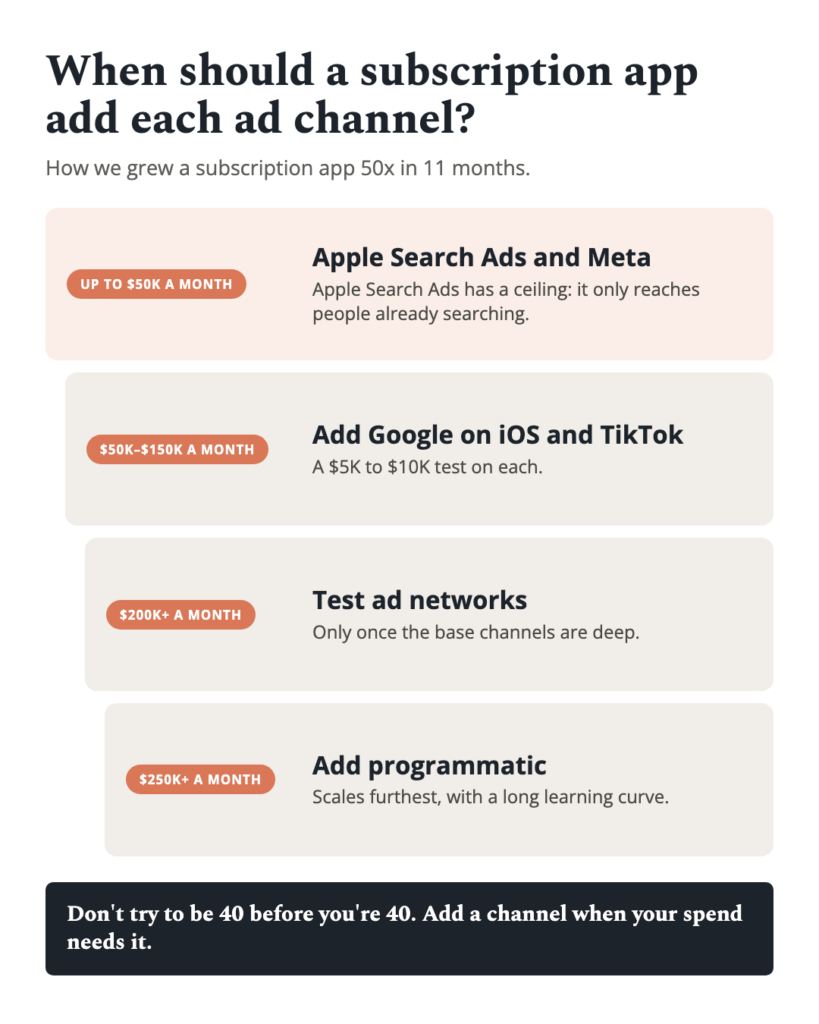
At RocketShip HQ, we typically recommend that apps spending under $50K/month start with a concentrated 2-3 network strategy (Google, Meta, and Apple Search Ads on iOS) before diversifying into TikTok, AppLovin, or programmatic options like Moloco.
The Performance Index confirms this sequencing: the networks with the highest power scores are the same ones that deliver the most consistent results at moderate budgets, because their algorithms need sufficient conversion volume to optimize effectively.
One nuance the Performance Index does not capture is the role of creative quality in network performance. Industry data consistently shows that the same network can deliver wildly different CPIs depending on the creative format — a pattern well-documented in Liftoff’s Mobile Heroes benchmarks and across mobile UA practitioner analysis.
Fail ads for mobile games on AppLovin and Unity Ads may deliver lower CPIs than standard gameplay footage.
Similarly, native UGC-style creatives on TikTok tend to outperform polished brand ads substantially on CPI — a pattern common in mobile app marketing. The Index ranks networks, but your results on any given network are largely determined by the creative you run.
What This Means For You
- Concentrate 70-80% of initial UA budget on Google Ads and Meta Ads before diversifying. In our experience, apps with lower daily budgets that split across 4+ networks tend to underperform those that concentrate on 1-2 SANs on cost-per-first-purchase, because each platform’s algorithm needs sufficient conversion volume to exit the learning phase. Each platform's algorithm needs roughly 50-100 conversions per week per ad set to exit the learning phase, according to Meta's documentation on the learning phase. In practice, this means a $3,000/day budget should go to 2 networks maximum, not 5. Start with Google UAC optimizing toward your primary conversion event (purchase, subscription start, or registration), and Meta Advantage+ App Campaigns with broad targeting and at least 5-8 creative variants. Only once both channels are delivering stable CPA below your LTV target for two consecutive weeks should you begin allocating 15-20% of budget to a third network. For a step-by-step framework on budget allocation, see our guide on how to set a mobile UA budget.
- Add Apple Search Ads as your third iOS channel before any programmatic network. According to AppsFlyer's Performance Index Edition 17, ASA delivers 18-25% D7 retention for non-gaming apps (the highest of any network tracked), which translates to strong LTV-to-CPI ratios despite higher upfront CPIs. Use Custom Product Pages to match search intent with tailored screenshots and messaging. Specifically, create 3-5 Custom Product Pages mapped to your top keyword themes (e.g., one for brand terms, one for category terms, one for competitor terms), each with unique screenshots and promotional text that mirror the search intent. In our experience, Custom Product Pages reliably improve both tap-through rates and conversion rates for high-intent category keywords compared to the default product page.
- For gaming apps, test AppLovin before scaling Unity/ironSource. According to AppsFlyer’s Performance Index Edition 17, AppLovin has risen 2-3 positions in gaming power scores, now ranking #2 on Android and #3 on iOS. AppLovin now delivers lower effective CPA for midcore and casual games compared to Unity Ads on Android. Start with their SDK-mediated in-app inventory and optimize toward D7 ROAS. The key setup detail: use AppLovin’s MAX mediation if you also run ads in your own game, because the bidding data from your own ad monetization feeds back into their UA targeting algorithm, creating a closed-loop optimization that standalone DSPs cannot replicate. Set your initial ROAS target at 80% of your actual D7 ROAS goal to give the algorithm room to explore, then tighten by 5% per week as it accumulates conversion data. For creative strategy on these in-app networks, our analysis of fail ads and why they work is directly applicable.
- Treat TikTok as a legitimate top-5 channel for non-gaming, not an experimental line item. According to AppsFlyer's Performance Index Edition 17, TikTok is now the #3 volume source across both platforms for non-gaming. Focus on native UGC-style creatives: in our experience, authentic creator content consistently outperforms polished brand ads on CPI across non-gaming app clients. Test TikTok Search Ads for high-intent categories like finance and eCommerce. Search Ads on TikTok can deliver lower cost-per-registration than standard in-feed placements, particularly for non-gaming apps with clear intent-based keyword opportunities. The tactical setup: enable the Search Ads toggle in your TikTok Ads Manager campaign settings, add 10-20 relevant keywords per ad group, and allocate at least 20% of your TikTok budget to search-specific creatives that include the keyword in the hook (first 2 seconds). This combination of discovery and intent-based traffic is what makes TikTok increasingly competitive in the retention-weighted rankings.
- Monitor Moloco as a rising programmatic alternative, particularly for eCommerce. According to AppsFlyer's Performance Index Edition 17, Moloco has gained 1-2 positions year-over-year in both gaming and non-gaming categories, earning a top-8 spot across both. Its ML-driven bidding engine is particularly strong for shopping and marketplace apps where purchase signals are abundant. In our experience, Moloco can deliver competitive CPIs for Android users compared to Meta, though with potentially lower D7 retention rates. 14-20% on Meta, per the CPI table above). The net ROAS was comparable, making it a strong incremental channel once Google and Meta are saturated. Start with a $500-1,000/day test budget, optimize toward purchase events, and give the algorithm 2-3 weeks of learning before evaluating. For apps struggling with high CPAs on primary channels, see our guide on turn around a failing mobile ad account, which covers diagnostic frameworks applicable to any network.
Frequently Asked Questions
What changed in AppsFlyer's methodology for Edition 17 compared to previous editions?
According to AppsFlyer's Performance Index documentation, the biggest methodological change is that power scores now weigh 30-day retention significantly more than raw install volume. Previous editions leaned more heavily on install counts, which favored high-volume, low-quality networks.
The shift explains why Apple Search Ads and AppLovin have gained positions (strong retention), while some OEM channels and lower-quality programmatic sources have dropped.
Why does Apple Search Ads rank so high in power but not in volume?
Apple Search Ads captures users who are actively searching for an app or category in the App Store, which means these users have strong pre-existing intent. According to AppsFlyer's Performance Index Edition 17, ASA delivers 18-25% D7 retention for non-gaming apps, the highest of any tracked network.
However, the total searchable inventory is limited compared to the billions of impressions available on Meta or Google's display networks, which is why ASA ranks #3-4 in power but #4-5 in volume.
Is the Performance Index useful for apps spending less than $10,000 per month?
Directionally yes, but with a major caveat: the rankings reflect aggregate performance across thousands of apps and billions of dollars in spend.
If you are spending under $10,000 per month, your network performance will be driven more by creative quality and conversion volume per ad set than by the network's aggregate ranking.
In our experience, sub-$10K/month apps see the most consistent results by concentrating on just Google and Meta, because spreading thin across 4-5 networks means none of them get enough conversion data to optimize properly.
How long should I test a new ad network before deciding whether to scale or cut it?
Common patterns across the industry suggest you need a minimum of 14–21 days and at least 200–300 attributed installs (or 50–75 downstream conversion events like purchases) before you have statistically reliable performance data on a new network — thresholds broadly consistent with guidance from Google’s campaign optimization documentation and standard UA practice.
Networks with ML-driven bidding like AppLovin, Moloco, and TikTok require even more patience because their algorithms need 100+ conversion events to exit the learning phase, according to their respective advertiser documentation.
Do these rankings apply equally across all geographies?
No. According to AppsFlyer's Performance Index Edition 17, the global rankings can differ substantially from regional ones. For example, Mintegral and TikTok rank significantly higher in APAC markets (particularly Southeast Asia and China-origin apps), while Snap performs strongest in the Middle East and North Africa.
Google Ads tends to dominate more heavily in emerging markets where Android share exceeds 85%, per data.ai's State of Mobile 2025.
What role does creative quality play in the network rankings that the Index doesn't capture?
Creative quality is arguably the single biggest variable the Performance Index cannot account for. Industry patterns consistently show that a top-performing creative can deliver dramatically lower CPI than a median creative on the same network, same targeting, same budget.
This means an app with excellent creatives might see Unity Ads outperform Meta, while an app with weak creatives would see the opposite. The Index tells you which networks have the best average infrastructure and audience quality, but your specific creative strategy will determine your actual results.
How should eCommerce apps specifically interpret these rankings?
eCommerce apps should pay particular attention to the non-gaming rankings and recognize that their optimal mix differs from the average. According to AppsFlyer's State of eCommerce App Marketing report, Meta Ads is the dominant channel for eCommerce by both volume and ROAS, followed by Google and then TikTok.
We summarized the full eCommerce benchmarks in our AppsFlyer eCommerce report analysis. Moloco also deserves special attention from eCommerce apps, as its purchase-optimized ML models are particularly well-suited to shopping behavior signals.
What happens to network rankings when Apple deprecates SKAN in favor of AdAttributionKit?
Apple's transition from SKAdNetwork to AdAttributionKit (introduced in iOS 17.4 and expanded in iOS 18) will likely benefit the same networks currently investing in SKAN 4.0/5.0 compliance, since AdAttributionKit builds on SKAN's architecture rather than replacing it entirely.
Networks like Google, Meta, and Apple Search Ads that have already built robust SKAN integration will have a head start. Smaller networks that lagged on SKAN adoption may face an even steeper climb, which could further concentrate the market among the top 5-6 players identified in the Performance Index.
Looking to scale your mobile app growth with performance creative that delivers results? Talk to RocketShip HQ to learn how our frameworks can work for your app.
Not ready yet? Get strategies and tips from the leading edge of mobile growth in a generative AI world: subscribe to our newsletter.
Related Reading
- The complete guide to mobile user acquisition (comprehensive guide)
- Adjust State of App Growth Report: Global Trends and Benchmarks (2026)
- AppsFlyer State of eCommerce App Marketing Report: UA and Retention Benchmarks (2026)
- AppsFlyer State of App Marketing Report: Key Trends and Benchmarks (2026)
- What Are the Best Paid Channels for Mobile App User Acquisition?