
With hands-on experience managing mobile ad spend across TikTok, Meta, and Google, we've developed a nuanced view of how these platforms compare on pricing. The short answer is that TikTok often looks cheaper on a CPM basis, but cost alone is a dangerously incomplete way to evaluate channel allocation. What actually matters is the cost to acquire a user who retains, subscribes, or makes a purchase, and that picture is far more complex than headline CPM numbers suggest.
Page Contents
How does TikTok ad pricing compare to Meta and Google in 2024?
TikTok CPMs typically run $10 to $15, Meta falls in the $15 to $20 range, and Google varies wildly from $5 for display to $30+ for high-intent search. However, these CPM benchmarks only tell you the cost of impressions, not the cost of outcomes.
Here's what we see across our portfolio at RocketShip HQ. TikTok's lower CPMs translate to cheaper top-of-funnel metrics (video views, clicks), but Meta consistently delivers stronger downstream conversion rates for most subscription app verticals. Google Search captures the highest intent but at the highest cost per click, while Google's app campaigns blend inventory across YouTube, Display, and Search at varying quality levels.
- TikTok CPMs: $10–$15 average, with some verticals (gaming, entertainment) running as low as $6–$8
- Meta CPMs: $15–$20 average, though this varies significantly by placement. Reels inventory tends cheaper than Feed
- Google App Campaigns: $8–$25 CPM depending on inventory mix, with Search components driving the highest quality
- CPI benchmarks: TikTok $1.50–$4, Meta $2–$6, Google $1.50–$5 (highly vertical-dependent). These ranges are broad because Google App Campaigns reach 3 billion devices globally across Search, YouTube, Display, and Play Store, creating massive inventory quality variance within a single campaign type.
CPI comparison by vertical
In gaming, TikTok and Google often deliver the cheapest installs ($1–$2.50), while Meta runs $2–$4. For health and fitness subscription apps, Meta typically wins on CPI ($3–$5) because its optimization algorithm has richer signal from purchase events. Finance apps see the tightest spread, with all three platforms clustering around $4–$8 CPI. The vertical matters enormously because each platform’s audience composition and optimization capabilities differ. For detailed Meta CPI benchmarks across mobile app verticals, including iOS vs Android splits, these ranges align with industry medians showing iOS CPIs running 35-60% higher than Android.
When is TikTok advertising actually cheaper than Meta?
TikTok is genuinely cheaper than Meta in three specific scenarios: when you're targeting Gen Z or young millennial demographics, when your product has a strong visual or entertainment hook, and when you're in the early scaling phase before hitting frequency saturation.
In our experience, TikTok tends to deliver meaningfully lower CPIs than Meta for entertainment and casual gaming apps targeting 18-to-34-year-olds. The platform's younger user base means less advertiser competition for that demographic compared to Meta, where every DTC brand is bidding for the same audience. But this advantage narrows significantly for apps targeting users over 35, where Meta's Facebook Feed placement dominates. As we've discussed in our analysis of how Meta's placement mix affects audience demographics, Facebook Feeds skew older while Instagram Reels skew younger, so even within Meta you can find cost-efficient younger audiences if you customize creative by placement. These TikTok’s lower CPIs for younger demographics are consistent with broader industry benchmarks showing TikTok’s pricing advantage for Gen Z-focused apps.
The creative cost factor most people ignore
TikTok's ad creative has a shorter shelf life than Meta's. In our experience, TikTok creatives tend to fatigue noticeably faster than equivalent Meta creatives. That means your effective creative production cost per conversion is higher on TikTok even when the media cost is lower. At RocketShip HQ, we factor in creative production velocity when calculating true channel economics. A platform that looks 20% cheaper on CPM but requires 2x the creative volume isn't actually cheaper.
Why doesn't the cheapest CPM always mean the best platform for mobile user acquisition?
CPM measures the cost of eyeballs, not the cost of valuable users. A platform with $10 CPMs but 0.5% conversion rate costs you more per install than one with $20 CPMs and 1.5% conversion rate. The metric that matters is cost per retained user or cost per subscriber, and that's where the math gets interesting.
We use a framework at RocketShip HQ that we call 'unit economics stacking.' You multiply CPM by click-through rate, then by install rate, then by Day 7 retention, then by conversion-to-paid rate. When you run that full funnel calculation, Meta often wins despite higher CPMs because its Bayesian Bandit optimization algorithm is exceptional at finding users who convert downstream. Meta's algorithm has years of purchase event data that TikTok simply hasn't accumulated yet.
- A $12 TikTok CPM with 0.8% CTR and 40% install rate = $3.75 CPI
- A $18 Meta CPM with 1.2% CTR and 55% install rate = $2.73 CPI
- Factor in Day 30 retention, which industry patterns suggest tends to be lower for TikTok-acquired users, and the gap widens further
- In our experience, Meta-acquired users tend to convert to subscriptions at a higher rate than TikTok-acquired users, reflecting Meta's stronger downstream optimization signal
How should I split my mobile app ad budget between TikTok, Meta, and Google?
For most B2C apps, we recommend starting with 60-70% on Meta, 15-25% on TikTok, and 10-20% on Google. This isn’t because Meta is always cheapest. It’s because Meta’s optimization engine is the most mature, and you need a strong foundation before diversifying. When expanding mobile UA across multiple channels simultaneously, apps commonly see meaningful blended CPA improvement as diversification reduces dependence on any single platform's auction dynamics.
The reason is practical: Meta gives you the richest signal to learn from. You discover which creative concepts, audiences, and value propositions work, then adapt those learnings to TikTok and Google. At RocketShip HQ, we follow a core/test ad set strategy where 90%+ of budget runs on proven creative in core ad sets, with 5-10% testing new concepts. Once a concept wins on Meta, we adapt it for TikTok (more native, faster-paced, UGC-style) and Google (shorter cuts for YouTube, static for Display).
When to shift budget toward TikTok
Increase TikTok allocation when: your Meta CPAs have plateaued and you're hitting frequency walls, your target audience is under 30, your product lends itself to demonstration or transformation content, or you've built a creative production pipeline that can sustain 10-15 new TikTok creatives per week. We've seen apps scale TikTok to a significant share of total spend successfully, but only after establishing repeatable creative processes.
Google's unique role in the mix
Google occupies a different position because it captures intent (Search) alongside discovery (YouTube, Display). For apps with strong branded search volume or category search demand, Google can deliver the highest-quality users at a mid-range CPI. The challenge is that Google App Campaigns offer limited creative control and transparency, making it harder to iterate. Think of Google as your 'always-on' baseline channel rather than your primary scaling lever.
How does creative strategy differ for TikTok ads versus Meta ads in terms of cost efficiency?
TikTok rewards raw, native-feeling content while Meta's algorithm is more format-agnostic, which means your creative production approach directly impacts your cost efficiency on each platform. The same ad running on both platforms will almost always underperform a platform-native version.
At RocketShip HQ, we apply our 4-Layer Hook System differently for each platform. On Meta, all four layers (visual pattern break, text overlay, voiceover, and audio) can work together in a polished format. On TikTok, the verbal and visual layers carry more weight, and overproduced text overlays can actually hurt performance by signaling ‘this is an ad’ to users who are scrolling for entertainment. The TikTok vs Meta creative strategy are significant: TikTok’s 0.3-0.8 second window versus Meta’s 1-2 seconds means you need fundamentally different opening techniques to stop the scroll on each platform.
- TikTok top-performing ads: creator-led, single-camera, trending audio, 15-25 seconds optimal
- Meta top-performing ads: can be polished or UGC, carousel and static still work, 15-30 seconds for video
- Using the right number of creatives per ad set is critical on Meta (8-10 per core ad set) to give the algorithm enough options
- TikTok Spark Ads (boosting organic posts) often deliver meaningfully lower CPMs than standard in-feed ads, making them worth testing as part of any TikTok creative mix
What are the hidden costs of running TikTok ads compared to Meta?
Beyond media spend, TikTok has three hidden costs that inflate your true acquisition expense: higher creative production volume requirements, weaker attribution and measurement, and less sophisticated optimization leading to lower downstream conversion rates.
The attribution gap is particularly significant. Post-ATT, all platforms face measurement challenges, but Meta's Conversions API and modeled conversions have matured faster than TikTok's equivalents. In our experience, TikTok tends to over-report conversions more substantially compared to MMP data than Meta does, meaning TikTok's apparent CPA advantage can be partially or fully illusory.
- Creative volume: TikTok requires 2-3x the creative output of Meta due to faster fatigue cycles. The top-performing advertisers understand that creative velocity in mobile gaming and app marketing is a competitive advantage—studios shipping 50-100+ new creatives weekly sustain scale while those producing only 5-10 variants per week hit efficiency ceilings quickly.
- Attribution accuracy: TikTok's Events API is improving but still trails Meta's signal quality
- Optimization maturity: TikTok's algorithm for purchase or subscription optimization is 2-3 years behind Meta's
- Audience quality: In our experience, Day 7 retention on TikTok-acquired users tends to run meaningfully below Meta-acquired users across app portfolios
How do I evaluate which platform gives the best ROAS for my specific app?
Run a 4-week incrementality test with holdout groups, not a simple A/B comparison of reported metrics. Platform-reported ROAS is unreliable for cross-channel comparison because each platform uses different attribution windows and modeling assumptions.
At RocketShip HQ, we use blended metrics (total revenue divided by total spend) as the source of truth, then layer in platform-level analysis using our Weighted Anomaly Scoring approach. We weight metric changes by business impact: a 15% ROAS drop on a channel spending $5K/day scores much higher in our alerting system than a 40% drop on a channel spending $200/day. This prevents teams from overreacting to TikTok volatility (which is normal) while missing meaningful Meta degradation that affects real revenue.
A practical ROAS comparison framework
Start by running each platform for at least 3 weeks at minimum $200/day spend with platform-native creative. Use your MMP (AppsFlyer, Adjust, or Branch) as a consistent measurement layer across all three. Compare Day 7 ROAS cohorts rather than same-day metrics, since TikTok users often convert later in the funnel. Also factor in organic uplift: TikTok tends to drive more organic discovery and word-of-mouth than Meta, which is real value that doesn't show up in attributed ROAS. For apps using broad targeting on Meta, you'll often see Meta's algorithm find high-value users efficiently enough to offset its higher CPMs.
Is TikTok or Meta better for subscription app user acquisition?
Meta is the stronger platform for subscription apps in most cases. Its optimization for purchase and subscription events is more mature, and we commonly observe higher trial-to-paid conversion rates from Meta-acquired users versus TikTok-acquired users.
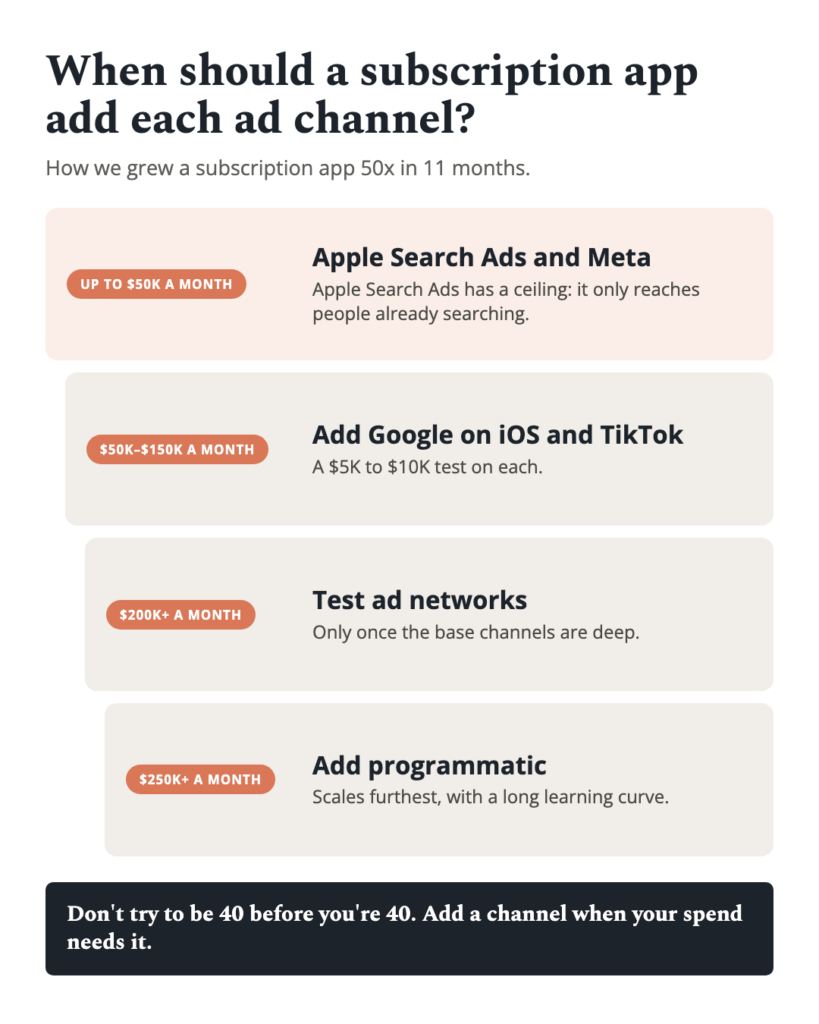
This connects to what we call the Credibility Paradox at RocketShip HQ. For cold traffic on both platforms, risk reversal messaging (highlighting the free trial) outperforms stacking social proof. In our experience working with top-performing subscription app ads, the free trial offer tends to be the dominant creative hook rather than testimonials. This principle holds on both TikTok and Meta, but Meta's ability to optimize toward the actual subscription event (not just install) means the users who respond to that free trial CTA are more likely to convert. TikTok is catching up, but for subscription apps spending over $50K/month, Meta should still be your primary channel.
The cheapest platform isn't always the most profitable one. TikTok offers genuinely lower CPMs and can be a powerful scaling channel, especially for younger demographics and entertainment-forward products. But when you factor in creative production costs, attribution accuracy, optimization maturity, and downstream user quality, Meta remains the strongest foundation for most B2C app advertisers. At RocketShip HQ, we help apps build multi-channel strategies that allocate budget based on true unit economics, not headline CPMs. Start with Meta, prove your creative concepts, then expand to TikTok and Google with platform-native adaptations.
Looking to scale your mobile app growth with performance creative that delivers results? Talk to RocketShip HQ to learn how our frameworks can work for your app.
Not ready yet? Get strategies and tips from the leading edge of mobile growth in a generative AI world: subscribe to our newsletter.
Related Reading
- Meta Ads for mobile apps: the complete playbook (comprehensive guide)
- Does Broad Targeting Outperform Interest Targeting on Meta?
- Custom Product Pages and Meta Ad Performance
- How Many Creatives Should You Run Per Meta Ad Set?
- How Meta’s Ad Auction Works
Free Tools
Try our free TikTok Ad Preview Tool: TikTok Ad Preview Tool. No signup required.