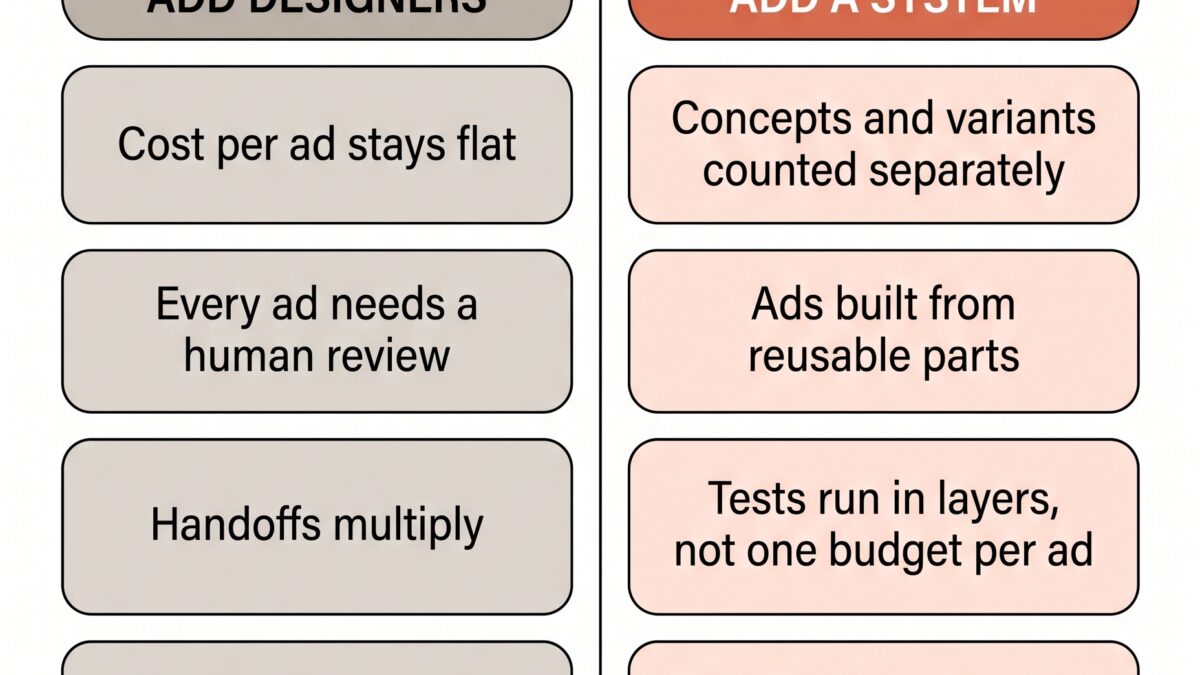
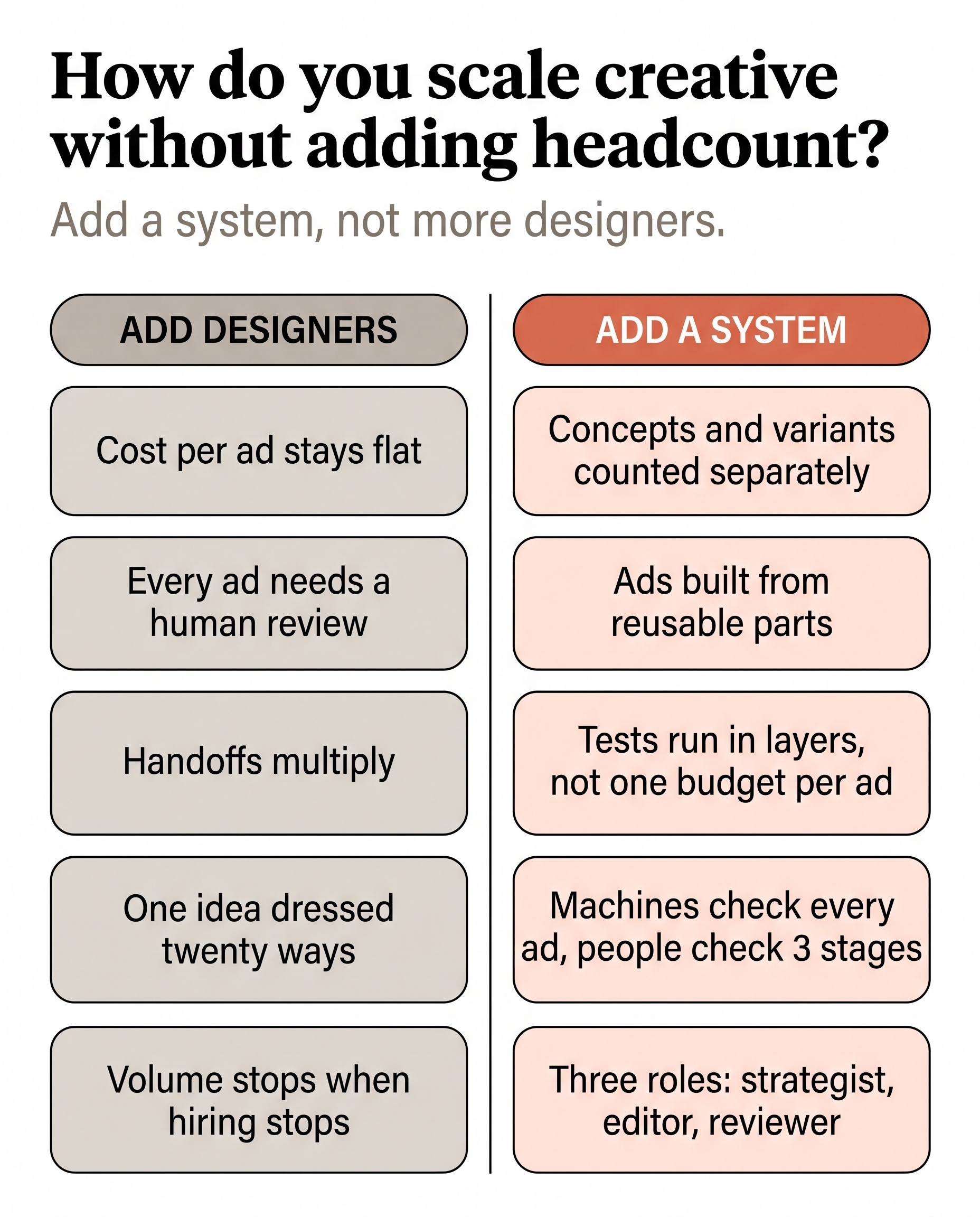
Short answer: volume comes from the system around your designers, not from the number of designers. Make five changes. Count new concepts and variants separately, because only concepts find new winners. Build ads from reusable parts, so a new hook or format does not restart production. Test in layers, so a hundred ads do not need a hundred separate budgets. Use AI for the variants and the new formats, and let machines check every ad for the things people miss at volume, with people checking the brief, the script and the finished ad. Then split the work into three roles: a strategist who decides what to test, an editor who builds it, and a reviewer who signs it off. We ship 100+ ads a week for clients, and the order of those changes is what made that possible.
 Page contents: why hiring stops working; where volume comes from; concepts or variants; modular production; building the system; velocity metrics; testing frameworks; competitive intelligence; team structure; AI; people and machines; cost per ad; performance analysis; what breaks first; FAQ.
Page Contents
Why does hiring more designers stop working?
Traditional creative production works like bespoke manufacturing. Each ad is conceptualised, storyboarded, produced and edited as a standalone piece. That works until you need volume. At 10 ads a month, one creative lead and two designers can manage the load. Somewhere between 10 and 20 ads a month most teams hit a wall: the best concepts are used up, revisions pile up, approvals stretch into weeks, and quality becomes inconsistent.
The arithmetic is unforgiving. If an ad takes eight hours from concept to final render, 100 ads a month is 800 hours, or five people doing nothing but execution, with no time left for strategy, analysis or iteration. Most teams respond by hiring, and hiring brings its own cost: every new person is another handoff, another brief, another opinion to reconcile. Output goes up, but so does the cost of each ad, and the person who knows what good looks like becomes the bottleneck.
The second problem is quieter. More ads from the same people tend to be more of the same idea. If the extra volume is one claim in different clothes, you have not scaled testing; you have scaled one test. The real issue is not capacity. It is architecture. High-performing ads share underlying structures, and the teams that scale are the ones that find those structures and build from them, instead of treating every ad as a snowflake.
Where does traditional production break down?
Three bottlenecks kill creative velocity, usually in this order.
- Concept exhaustion. Teams burn through their best ideas in the first 20 or so ads, then struggle to find fresh angles.
- Decision paralysis. Without a framework, every ad becomes a referendum on whether it is good enough, and approvals gridlock.
- Testing inefficiency. Fifty ads made at random produce data you cannot read, because too many variables changed at once. You learn nothing about what drives performance.
Does volume lower creative quality?
The common assumption is that more ads means worse ads. In our experience it is the other way around: low quality comes from poor systems, not high volume. A team that has to judge every ad from scratch, with no agreed success criteria, produces inconsistent work at any volume. A modular system improves quality by forcing the team to identify and preserve the elements that drive performance, while varying the secondary ones on purpose. Teams that narrow their success criteria to a couple of metrics also tend to make better decisions than teams tracking fifteen. And volume helps with a problem every account has: creative fatigue, where performance erodes as the same audience sees the same ad again and again. A steady supply of fresh work is the cure, as long as it is not the same idea repeated.
Where does creative volume actually come from?
From three places, and only one of them is people.
- More concepts. A concept is the idea an ad is betting on: a claim, a pain the viewer recognises, or a reason to install today. These come from research, not from production capacity.
- More variants of what works. The same concept with a new hook, new on-screen text or a different visual treatment. These come from production capacity, and this is where a system pays off.
- New formats. The same concept told as a talking head, a skit, a voice-over or an animation. Formats are how an account stops looking like one ad.
Most teams that feel they cannot scale are short on the first and third, and are already drowning in the second.
Should you make more new concepts or more variants?
Both, counted separately. Variants get more out of an ad that is already working; only new concepts can find your next winner. If most of last week’s batch was variants, make more concepts. Our guide to new ad concepts or variations shows how to count them. For the variant side, see how to get dozens of ad variations from one winning ad.
This changes what “scaling” means. Scale the number of distinct claims you test, and let the variants follow. It also changes the target. “100 ads a month” is a production number; “how many new claims did we test this month, and how many variants did the winners get” is a learning number, and it is the one that predicts results.
How does modular production work?
Modular production treats creative the way software engineering treats code. Instead of building each ad as a monolith, you build reusable components and combine them in many configurations. An ad is a set of parts that can be swapped: hook, narrative, call to action, persona, plus the voice, the on-screen text and the format. Each part has several versions, and the versions combine to produce many ads from one concept.
The multiplication is simple. Take a hypothetical puzzle game with a proven concept: “this is harder than it looks.” Write five hooks (“Can you solve this?”, “Only 2% pass level one”, “The hardest puzzle you will play today”, “A million players are stuck here”, “A quick IQ check”). Build four narrative structures: a fail-state, a player testimonial, a before and after, and a speed challenge. Write three calls to action. Apply the lot to four personas, such as the determined problem-solver, the casual brain trainer, the competitive achiever and the stress reliever. That is 5 x 4 x 3 x 4 = 240 combinations from one concept.
Two cautions come with that number, and the second matters more.
- Combinations are variants, not new tests. Two hundred and forty ads that all argue “this is harder than it looks” are useful, but they are one bet. Treat the 240 as a way to get more out of the concept, not as 240 ideas.
- Not every combination should ship. The point of the matrix is a menu of parts that have each earned a place. You pick the strongest handful of combinations for each test, rather than launching all 240.
The production benefit is real. A modular batch built from recorded hooks, template narratives and layer-based persona swaps can take minutes per ad at the editing stage, against a working day for a bespoke ad, because the editor is changing a layer instead of rebuilding an ad. The sections below take each component in turn.
Component 1: What should a hook do in the first three seconds?
The hook decides whether a viewer scrolls past or stays. Effective hooks lean on a small set of psychological triggers: challenge (“Only 1% can solve this”), social proof (“Ten million players tried it”), curiosity (“What happens next?”), loss aversion (“You are doing it wrong”) and status (“Only for the top scorers”). Presentation matters as much as wording. Motion, such as a quick zoom paired with a text overlay, can decide early attention as much as the line itself; our guide to what makes a good video ad for mobile apps goes through the mechanics.
The practical lesson is that a hook has to match the motivation of the people you want, not a generic idea of “engagement”. A hook that frames a puzzle game as a brain workout and one that frames it as the hardest puzzle you will meet are two different bets on who the player is, and they will not perform alike. Develop five or six hooks per concept by mapping each to a different motivation in your audience. This is also where the account gets its edge: creative variation tends to move results more than audience variation, as we argue in why “who should we target?” is the wrong question. Hook work pays more than targeting tweaks.
Component 2: How should the narrative pay off the hook?
The narrative is how the hook pays off over the rest of the ad. Four structures cover most of what works: a demonstration (show the core loop or the product doing its job), a transformation (before and after), social validation (testimonials or community) and aspiration (the outcome the user wants). An emotional story can beat a plain product demo when it connects to a feeling the viewer already has, because the story creates a reason to care that footage of the product alone rarely does. Build three or four narrative templates that can accept different hooks and personas, so that swapping the first three seconds does not mean rewriting the rest.
Component 3: Do call-to-action variations matter?
They sound minor, but a call to action can move conversion meaningfully. Generic lines (“Download now”, “Play free”) tend to lose to outcome-focused ones (“Start training your brain”, “Test your IQ now”). The best call to action reinforces the hook’s promise and the narrative’s payoff. After a challenge hook, a line that stresses difficulty or exclusivity (“Try to beat level one”) fits. After a social-proof narrative, a community line (“Join the players already in”) fits. Keep two or three versions per concept, aligned to your hook categories.
Component 4: How does a persona change an ad?
The same concept lands differently with different segments. A brain-training angle appeals to improvement-minded users and can put off casual players who want to unwind. Define three or four personas from your real audience, often achievement-oriented, social, immersion-seeking and casual or stress-relief. Then apply each hook, narrative and call-to-action combination across the personas through character choice, visual style, voice-over tone or setting. Done as layer changes rather than full rebuilds, this multiplies output several times over for little extra production.
How do you build a creative production system?
Moving from bespoke to modular production is a project, not a switch. Do it in this order.
Audit first. Take your top ten ads from the last 90 days and take each apart. What hook grabbed attention? What narrative held it? Which call to action drove the install? Which segment responded? This forensic pass shows patterns that were invisible when each ad was made.
Build the component library. Document the parts that have worked: roughly eight to ten hooks, five or six narratives, four or five calls to action and four or five personas. Each part gets a success criterion: a hook is judged on its early attention metric, a narrative on engagement, a call to action on conversion. A new part earns its place in the library only after it shows performance. Keep the library short and current. A library that only grows becomes a list of everything you have ever tried.
Produce in batches. Instead of making ads one at a time, produce all the variants of one concept in a single sprint. Record every hook in one session. Build narrative templates that accept swappable hooks. Treat persona versions as layer changes. Have the voice-over talent record every line in one booking, and apply motion graphics as templates across the whole batch. This is where the economies of scale come from.
How do you decide which parts stay in the library?
Not every part deserves a permanent place, so set a bar for each type. In our experience the bar should be a measurable lift over your own baseline: a hook should show a meaningful early-attention gain over your average, a narrative a measurable engagement lift, and a call to action should prove a conversion gain across more than one concept. As planning figures, teams often start with something like a 20% lift for hooks, 15% for narratives and 10% for calls to action, then tighten them from their own data. A persona has to show clear spend concentration over a defined window. These bars keep the library from bloating and make sure it holds elements that actually perform. Review and prune it every quarter: retire parts that stopped working and promote new winners.
What does a production workflow look like?
Optimise the workflow for batches, on a four-week rhythm.
- Week 1: concept and selection. Pick the winning concept and choose five or six hooks, three or four narratives, two or three calls to action and four personas from the validated library.
- Week 2: asset production. Record all hooks, build the narrative templates and render the persona versions. For a framework on creating many ads from a single idea, see our post on how to build on a winning ad.
- Week 3: assembly and checks. Combine the parts programmatically, run quality checks and export the finals.
- Week 4: launch and early monitoring. Ship the batch and watch early signals.
A cycle like this can yield a couple of hundred ads from one concept. Teams that overlap cycles, with several concepts at different stages at once, keep monthly output high without a bigger team. The detail that makes overlap work is that each stage has one owner, which is the subject of the team section below.
What is high velocity creative production, and which metrics matter?
The common metrics, ads produced per week and production hours per ad, measure activity, not results. Velocity metrics should connect production to performance. Four are worth tracking.
- Time to performance data. How many days pass from concept to a result you can act on? Strong teams get there in about a week to ten days. Slow teams need a month or more, burning budget on long learning cycles.
- Variant efficiency. What share of the ads you produce reach your minimum performance bar? A typical account sees roughly a fifth to a third of its ads clear it. Modular systems tend to do better, perhaps 40 to 50%, because component validation filters out weak parts before they consume test budget.
- Concept leverage. How many usable ads does each concept produce? Bespoke production gives one concept, one ad. A modular system can turn one concept into 200 or more usable variants.
- Iteration cycle time. How fast can you make generation two from generation one’s learnings? Strong teams do it in five to seven days. Average teams take three or four weeks. The gap compounds: four improvement cycles a month against one means twelve learning cycles a quarter against three, and a gap that large is hard to close.
How do you set velocity benchmarks?
Measure before you change anything. Track all four metrics for 30 days to find your real bottleneck. Most teams discover that their slowest step is approval (often five to ten days) or asset production (often seven to fourteen), not ideation. Then set targets that are aggressive but reachable: cut time to performance data by 40%, lift variant efficiency toward 45%, reach a concept leverage of 150 or more, and bring iteration to seven days. Review weekly, and aim at removing the biggest bottleneck rather than improving everything a little.
Does more creative volume need a bigger testing budget?
Yes, and this surprises many teams. More ads mean more tests, and each test needs enough spend to reach a decision. If you double output from 50 to 100 ads a month and test every ad individually, your testing budget doubles with it. The answer is not to make fewer ads. It is to raise variant efficiency, so a larger share of what you make justifies its test spend, and to test in layers, which the next section covers. Modular systems help because they concentrate testing on combinations of parts that have already earned their place, instead of sending every novel concept through the full test.
What testing framework works at 100+ ads a month?
Producing 100 ads a month without a testing method wastes budget and produces noise. Traditional A/B testing collapses at scale: testing 100 ads one at a time takes two to three months and six-figure budgets, and by the time you are done the concepts are stale and the platform has moved on.
The answer is hierarchical testing, which isolates one variable at a time.
- Validate concepts. Test three to five ads per new concept, with roughly $500 to $1,000 of spend each over two or three days. A concept that clears your bar, for example a meaningfully higher install rate per impression than your account benchmark, graduates.
- Validate components. Within winning concepts, test your five or six hooks against each other with a few hundred dollars each. Keep the top two or three.
- Validate narratives and calls to action inside the winning hooks.
- Apply the validated parts across personas.
This cuts the cost sharply. Testing 240 variants one by one at $500 each would cost about $120,000. Testing five concepts ($5,000), six hooks ($3,000), four narratives ($2,000), three calls to action ($1,500) and four personas ($2,000) costs about $13,500, and the learning is cleaner because each test changed one thing. These are planning figures, not guarantees; replace them with your own cost per decision. The savings fund more concept exploration, which is where the next winner comes from.
How do you avoid asset stuffing?
Putting every ad into one ad set with no thematic separation stops the platform from matching ads to the right segments. Asset stuffing is tempting at volume because it is operationally easy, but it hurts delivery. Group ads by hook category or narrative type into separate ad sets, with challenge hooks together, social-proof hooks together and transformation narratives together. That structure helps the algorithm learn which audiences respond to which themes, which improves delivery and lowers cost per install. Stay near the sensible number of ads per set; the optimal number of creatives per Meta ad set shows how overloading an ad set inflates costs.
How long should you wait before a keep or kill decision?
The temptation at volume is to judge each ad after a handful of installs. That produces false positives: at small counts the confidence interval around a conversion rate is so wide that you cannot tell a genuinely strong ad from a weak one. Give each test enough spend over two or three days to reach a decision before making a keep or kill call on conversion. That takes patience and budget, but premature decisions waste more money than disciplined ones. Use early attention data, which becomes readable well before conversion data does, to kill obvious losers quickly, and let promising ads accumulate enough conversion data to judge properly.
How do you use competitor ad data to guide your own creative production?
Scaling to 100+ ads a month needs a steady supply of ideas, and the best free source is your competitors’ ads. Most teams do this casually: a scroll through the ad library now and then, a few mental notes, nothing recorded. Systematic competitive intelligence has three parts: organised collection, pattern analysis and an adaptation method.
Collect in one place. Keep a swipe file, whatever the tool, organised by format, geography and theme. Pay particular attention to the longest-running ads (30 days or more), since an ad that keeps running is usually one that is working. Review the collection weekly, not whenever you remember.
Analyse the patterns. Individual ads teach little; clusters teach a lot. If six of your top ten competitors have recently moved to challenge-based hooks, that signals a shift in audience taste or in what the platform rewards. If story-driven formats suddenly dominate after months of plain demos, find out why. Keep a competitive trends log and update it weekly with observations and hypotheses.
How do you adapt a competitor’s idea without copying it?
Intelligence without adaptation is wasted time. When you spot a high-performing pattern, do not copy it. Adapt the structure to your product and audience. If a competitor’s “hardest puzzle ever” hook performs, ask which trigger it uses (challenge, status, achievement) and build your own hook that pulls the same trigger through your product’s own mechanics or theme. Copying creates fatigue and a me-too account; adapting captures the driver without the duplication.
What is the local maximum trap?
The biggest risk in scaling production is iterating only on past winners and never exploring new ground. Variant 200 may beat variant 199 by a couple of percent, while a completely different approach could do much better. Reserve roughly a fifth to a third of monthly output for exploratory concepts that break from your library. Most will fail. The occasional breakout refreshes the whole library. One rich source of exploratory ideas is repurposing organic content for paid ads, because organic posts show you what real viewers respond to before you commit paid budget.
What team structure scales?
Traditional creative teams organise around roles: designers, copywriters, editors, motion artists. That works for bespoke production and creates bottlenecks at scale, because every handoff between roles adds a day or two of latency. An ad that passes through four specialists can spend four to eight days in transitions even if the actual work takes eight hours.
High-velocity teams organise around concepts instead. A small group owns a concept end to end: someone who decides what to test, someone who builds it and someone who checks it. At larger scale you run several of these groups in parallel, often with an analyst alongside. The group works from the validated library, makes decisions without external sign-off, and answers for production speed and variant performance.
Whatever the headcount, three roles need an owner.
- Strategist. Decides what to test. Owns the list of claims, pains and reasons to install, and the split between new concepts and variants. Reads the results.
- Editor or producer. Builds the ads from parts, runs the AI tools, and owns the pipeline that turns a brief into files.
- Reviewer. Signs off on claims, brand and quality before anything goes live, using the machine checks as input.
One person can hold two of these at small scale. What matters is that someone owns each job, and that the strategist is not also the person waiting for files.
Does this mean you never add people?
No, and we should be straight about it. The honest version of “scale without adding headcount” is that output should not need to grow in step with headcount. AI changes what the people do more than how many you need. One studio we wrote about tripled its creative headcount after adopting AI rather than cutting it; see does AI let you cut your creative team?. The pattern in both stories is the same: the work moves from making each file to deciding what to make and checking what was made, and the roles follow the work.
Why do broader skills beat narrow ones?
The concept-based group asks for people with broader, shallower skills rather than narrow, deep ones. An editor who can also write a passable line and handle basic motion will move faster than a master editor who waits for copy. So invest in cross-training: designers learn basic video editing, writers learn the fundamentals of motion, and everyone learns to read performance data. Expect two to three months of deliberate cross-training before a group reaches full speed. The trade-off is depth, so keep a specialist available for the hardest work and the final polish.
How do you remove the approval bottleneck?
Approval kills velocity. A traditional workflow needs the creative director, the brand team and sometimes an executive before launch, and each layer adds two to five days. High-velocity teams remove most of that with two mechanisms. First, a validated library pre-approves the building blocks: if the hooks, narratives, calls to action and personas have already proven themselves and passed brand and legal review, their combinations do not need re-approval. Second, the group has launch authority inside defined guardrails (brand guidelines, legal limits). The creative director moves from gatekeeper to coach, reviewing work after launch and feeding learnings back into the library.
Where should AI fit?
AI tools promise unlimited creative scaling, but most teams misapply them. The fantasy is uploading a brief and receiving 100 finished, high-performing ads. The reality is that AI amplifies the system you already have. Without a strong creative foundation it produces polished work that misses the point. With a clear system it speeds production considerably; teams commonly describe a several-fold gain on the production steps themselves.
AI is best at the two jobs that used to eat the most hours.
- Variants. New hooks, text and visual treatments on a concept that is already proven. This is now nearly free, which is exactly why batches drift toward it. Once a hook structure is validated, ask for ten versions that keep its logic. Feed a top-performing narrative in and ask for variations that keep the same emotional arc.
- New formats. Skits and talking characters, which used to need actors, a location and a crew. Making them believable at volume is a checking problem, covered in the next section. We cover the production side in how to make AI videos with talking characters for ads.
AI also takes on the mechanical production work: background removal, colour grading, motion tracking, sound design. Those uses preserve human judgment while automating execution. Video generation is useful for persona variants: once the hero ad exists with the primary persona, AI can adapt it to secondary personas through character swaps, new settings or style shifts, at far lower cost than reshooting. Image generation is useful for early concept validation, producing rough test assets before you commit to full production.
AI is weaker at deciding which claim is worth betting on. That stays with a person who has read the reviews, the support tickets and the cancellation reasons. For the full playbook on running AI across a whole account, see how to scale your creative strategy to thousands of ads.
What is the garbage-in, garbage-out problem?
AI generation without audience and format thinking produces sophisticated-looking ads that perform poorly, and the algorithm cannot make up for a strategy mismatch. Before you deploy AI, validate the strategy by hand. Test the concept. Validate the hooks. Confirm the fit between audience and narrative. Then use AI to scale what is proven. Teams that follow this order tend to see real acceleration with quality intact; teams that skip it test expensive AI ads that look professional and miss the fundamentals, and often abandon the tools.
How do humans and AI split the work?
Humans are good at concepts, emotional resonance, cultural context and reading results. AI is good at fast iteration, technical execution, variants and tireless production. So humans develop concepts, choose the parts and analyse performance, while AI generates variants, handles technical production and works at scale. Done well, this changes what each person spends their week on rather than simply shrinking the team, which is the same point the headcount section makes.
Where do people check, and where do machines check?
This is the part that decides whether quality survives volume. At 10 ads a week one person can watch everything. At 100 they cannot, and pretending they can is how weak ads ship.
People check where judgment matters. – The brief: is this a new bet or a variant, and is the claim true? – The script and storyboard, before the expensive step. – The finished ad: is it actually good, and does it read as real?
Machines check every ad, for consistency. – Did the spoken line match the approved script? – Does the right voice come from the right face? – Did the product name, the claim and the legal line come through as approved? – Did anything change between scenes: clothes, seats, props?
People are good at taste and bad at checking item 37 of 50. Machines are the reverse. Put each where it is strong. The detail of this split, with the failures it catches, is in the talking-characters article.
What does a cost per ad look like, and why does routing matter?
Volume is only affordable if you can see what each ad costs. A credit balance tells you what you spent. A cost per ad tells you what each concept, variant and test cost, and that is the number that lets you compare a new bet with a variant on equal terms.
When your team generates ads with AI, the route to the model changes the bill. In our own price table, the same model costs from 36% more to three times as much depending on the route, and no single route is cheapest for every model. Own the connection layer, pick the route per model, and record the cost against every ad. The numbers and a worked example are in how much AI video generation costs.
How do you analyse performance across 100+ ads?
Analysing 100+ ads a month needs different methods from analysing ten. With a small number you can review each ad and build intuition. At volume that is impossible, so you need analysis that surfaces patterns, shows how each component performs and guides what to make next. Use three layers.
- Cohort analysis. Group ads by shared attributes (same hook, same narrative, same persona) and compare cohorts. If every ad with hook A beats hook B by a wide margin whatever else changes, hook A is a winning component.
- Time-series analysis. Track how performance decays. Most ads peak in the first several days and then fall as the platform exhausts the available audience. Learn your own curve and flag the ads that break from it.
- Cross-dimensional analysis. Look at how components interact. Hook A may work well with narrative C and poorly with narrative D. Interactions like this never show up in single-variable views.
Design the dashboard for patterns, not for individual ads. Do not show 100 rows of ad metrics. Show component summaries: average early-attention rate for hook A against hook B, engagement by narrative, cost per install by persona. Update daily while a batch is launching and weekly for mature campaigns. Our guides on how to analyze ad creative performance cover the wider method.
Why build a creative performance database?
A team producing hundreds of ads a month collects thousands of data points a year, and that dataset becomes a competitive advantage that lower-volume competitors cannot copy. Tag every ad with its components (which hook, which narrative, which call to action, which persona) and with its concept and variant label, then query the table. Which hooks work best for casual personas? Do transformation narratives beat social proof for achievement-oriented users? Does the call-to-action type affect retention? Set a minimum spend before you draw any conclusion, for example around $100 or three times your target cost per install per ad, so the numbers mean something. The database turns from a cost into a strategic asset once it holds several hundred ads with performance attached.
When should you retire or refresh a component?
Components decay as audiences see them repeatedly. A hook that delivered a strong early-attention rate in January may slip noticeably by April. Review component trends monthly, and when a previously strong component drops by around a fifth across several concepts, rest it. Refresh the library each quarter by testing ten to fifteen new candidates and promoting three to five winners. That keeps the library from going stale without churning it every week.
What breaks first when you scale?
In roughly this order, and the order is the point.
- Distinct ideas run out. The batch gets bigger and the number of claims stays at three.
- Naming and tracking. With hundreds of ads, nobody can say which concept a winner belongs to. Name every ad by its concept first and its variant second.
- Review. One person approving every ad becomes the queue. Move routine checks to machines and keep people on the three stages above.
- Cost visibility. Spend rolls up per account, not per ad, so nobody knows what a test cost.
- Lost files. Generated outputs on many routes expire. If you did not save a copy, the winner is gone.
- Testing budget. More concepts need more test spend. More variants of one concept do not need much more.
Fix them in that order. Most teams start at 6 and never reach 1.
What are the main challenges in scaling creative production?
Beyond the ordered list, three mistakes recur on the road from 10 to 100+ ads a month.
Premature scaling. Teams see the promise of modular production and immediately try for 200 ads a month before the library or the workflow exists. It collapses. Start with one concept and 50 variants, refine the process, then scale. Scaling a system that is not ready only wastes budget faster.
Weak testing discipline. With 100+ ads, the pull is to launch everything and let the algorithm sort it out. That burns budget and teaches nothing. Validate concepts before scaling them, test components in order and wait for enough data. Discipline costs time early and saves money later.
Creative drift. As volume rises, quality slips in small ways. Hooks lose their edge, narratives lose their punch, calls to action revert to defaults. Counter it with a weekly review where each group shows its best work and the hardest problems. Senior creative leads should also sample ten to fifteen random ads a week and give direct feedback, so standards hold.
How does high volume change your relationship with the platform algorithm?
With 10 ads a month the algorithm learns slowly about who responds. With 100+ it gets much richer data, but it can also get confused if the ads lack thematic coherence. The fix is thematic ad set organisation with enough budget per theme. Do not spread 100 ads across 50 micro-budget ad sets. Concentrate 20 to 30 related ads in each ad set with a daily budget of $500 or more, so the platform has both the signal and the money to optimise.
How do you scale production internationally?
Localisation adds complexity but follows the same logic. A modular system that yields 240 variants in one language could yield about 960 across four, which sounds daunting. Build and validate the library in your primary market first. Then localise only the proven components, not the whole library: a hook that fails in one language rarely wins in another. Selective localisation often means translating perhaps a third of the components, not all of them, which cuts cost while keeping quality in each market.
Frequently asked questions
How many people do you need to produce 100+ ads a month? Fewer roles than you expect, and clearer ones. A strategist, an editor and a reviewer can run a lot of volume when ads are built from reusable parts and checked by machines. The count depends on how many new concepts you want per week, not on the total number of ads. Headcount may still grow as you add accounts; the aim is that output does not have to grow in step with it. We ship 100+ ads a week for clients.
What are the main challenges in scaling creative production? Running out of distinct ideas, losing track of which concept each ad belongs to, a single reviewer becoming the queue, not knowing the cost of each ad, losing generated files, and testing without a method. Design software helps with production but none of these. They are system problems: naming, roles, checks, records and test design.
Does scaling creative production lower quality? Not by itself. Quality drops when the checking depends on one person, or when volume is mostly one idea repeated. Split the checks between people and machines, keep new concepts in every week’s batch, and run a weekly sample review to catch drift. We have produced over 50,000 ads and the pattern holds: weak ads come from weak systems, not from volume.
How do mobile game studios scale ad creative production? The same way: separate concepts from variants, build from parts, test in layers, and make new formats the place where AI earns its keep. Game studios add a hard constraint, which is that fatigue arrives fast and the account needs a steady supply of new concepts. For a game-specific view, see why “how do I make better creatives?” is the wrong question for mobile game UA teams.
How do you scale creative production with AI? Use AI for variants and new formats, keep people on the brief, the script and the final watch, and add machine checks for every ad. Do not use AI to decide which claim to test, and validate the strategy by hand before you automate it. The longer version is in how to scale your creative strategy to thousands of ads.
How much testing budget do you need for 100 ads a month? It grows with the number of new concepts you test, not with the number of files. Each new concept needs enough spend over two or three days to reach a decision; variants of a concept that has already earned its place need much less. Testing in layers, concepts first, then hooks, then narratives and calls to action, keeps the bill far below testing every ad alone. Set the budget from how many new concepts you want to prove each week, then let the layers below it ride on that spend.
How do you prevent creative fatigue with a modular system? Watch component performance monthly. When a part drops by around a fifth across several concepts, rest it. Refresh the library each quarter, testing ten to fifteen candidates and promoting three to five. Keep a fifth to a third of output for exploratory concepts that sit outside the library, and never let a batch be mostly variants of one claim. More on the fatigue cycle is in what creative fatigue is and how to refresh ads.
How do you cut creative production costs without cutting output? Separate concepts from variants and stop paying full production cost for variants: build them from reusable parts and generate them, then route each generation to the cheapest provider for that model. Most teams can take a large share out of the cost per ad this way before touching headcount. See the cost per ad section above and what AI video generation costs by route.
Can creative testing software predict a winner before you spend? Not reliably. Pre-testing tools score attention and recall, which filters out obvious losers, but the winner is decided by the platform auction and by who converts to paying users. Use pre-tests to cull, then let a structured live test with real spend pick the winner.
How many creatives should you test per week? Enough to keep a balance between new concepts and variants of the winners already running. New concepts are how you find the next winner; variants are how you extend the current one. A week of only variants runs the winners into the ground, and a week of only new concepts never compounds what works. Set the mix from how fast your winners fatigue, not from production capacity.
When is it worth building a modular system? When you notice the same pieces being rebuilt every week: the same intro, the same end card, the same voice. Below roughly 30 ads a month the overhead probably outweighs the gain, and returns begin at around 50 a month. If every ad is a one-off and you make a few a month, hand-making them is fine. Build the system when production, not ideas, is the constraint.
How long does it take to implement a modular system? Plan on eight to twelve weeks. Weeks 1 and 2: audit existing ads and build the first library. Weeks 3 and 4: test the first modular concept with 50 to 100 variants. Weeks 5 to 8: refine the process and run a second concept. Weeks 9 to 12: scale to full production. Teams that rush it tend to hit quality problems.