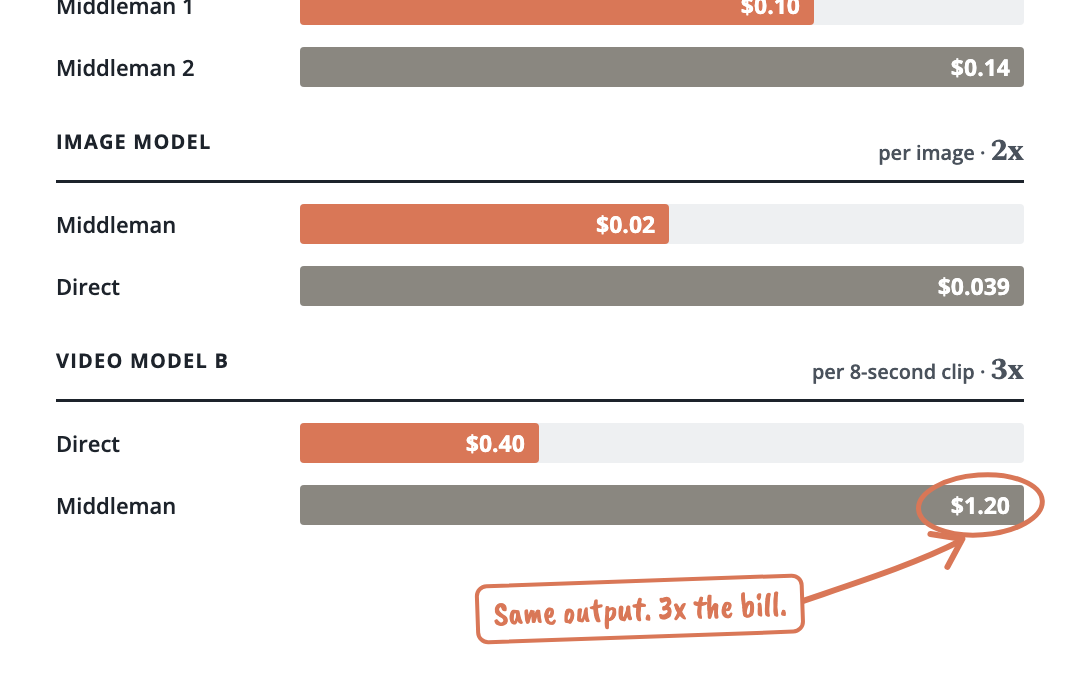
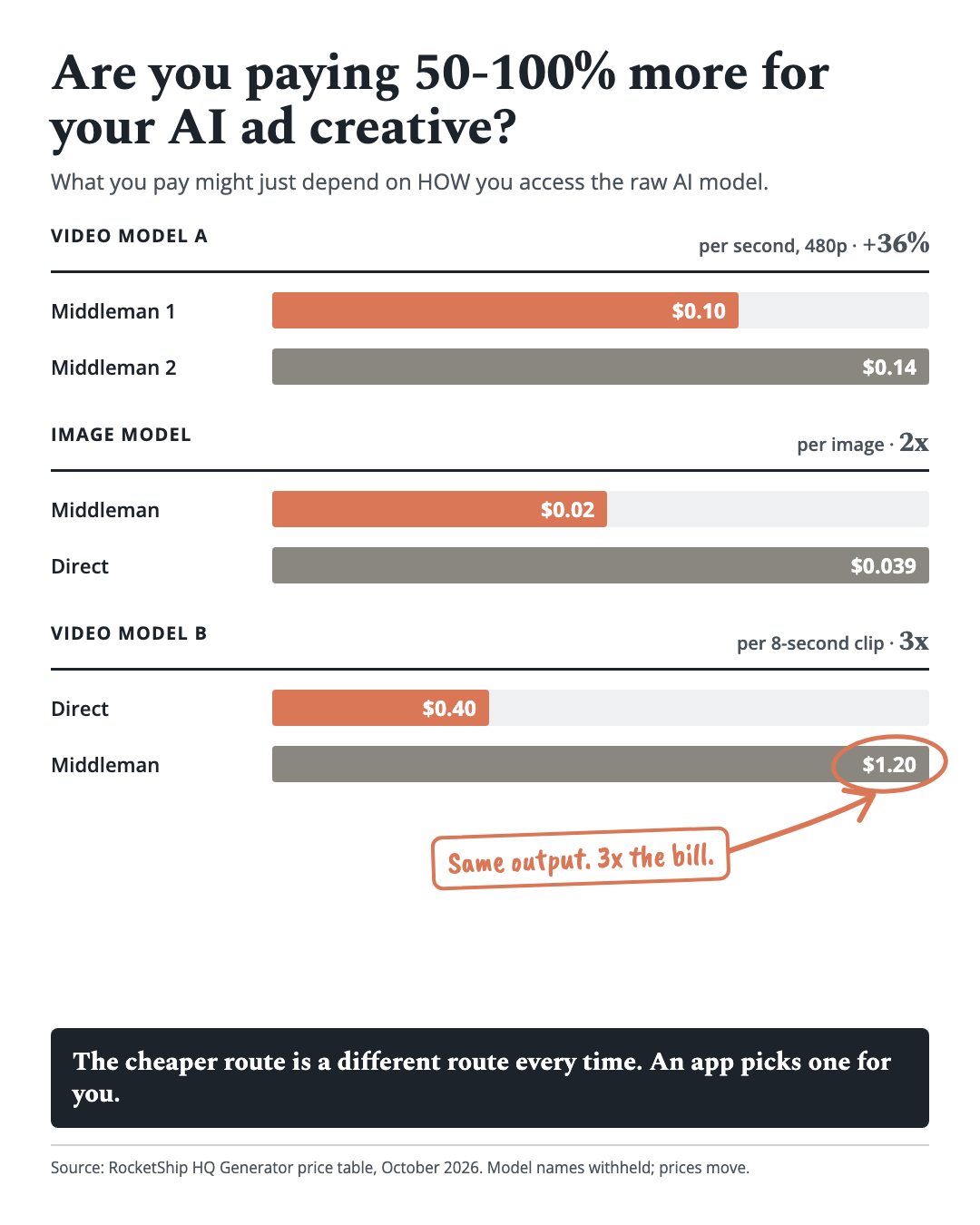
Short answer: an AI video model does not have one price. It has a price per route: the app you use it in, the API middleman you call it through, or the model maker’s own API. In our own price table, for identical output, one video model costs 36% more per second through one middleman than another, one image model costs about twice as much direct as through a middleman, and another video model costs three times as much through a middleman as direct. No single route is cheapest, so the cheapest way to run AI video models is to choose the route model by model and switch when prices move.
If your team generates thousands of AI ads a week, the route can mean paying 50 to 100% more than you needed to for the same files.
Page Contents
What are the three ways to reach an AI video model?
The app is not the model. It is a storefront in front of the model, and there are two other doors into the same building.
Apps, such as Higgsfield. A polished interface with presets, templates and a gallery. – You gain speed to first result, no code, good defaults, and a tool the whole creative team can use. – You give up control: the settings it exposes, the price it charges, its queue, and new models only when it adds them.
API middlemen, such as Kie, Replicate and fal. One account and one key that reach many models from many makers. – You gain pay-per-generation pricing, scriptable runs, and the freedom to switch models without a new contract. – You give up directness: a layer with its own rules, limits and sometimes safety checks.
Direct API from the model maker. The maker’s own endpoint. – You gain the newest features first, the fullest set of controls, and often, though not always, the lowest price. – You give up convenience: one integration per maker, which you maintain.
Same model, three different bills. The route also decides which controls you get, which matters for AI ads that don’t look like AI.
How much does the same model cost through different routes?
Here are three examples from our own Generator price table, October 2026. Same model, same output, different door.
 | Model | Cheaper route | Dearer route | Gap |
|—|—|—|—|
| Video model A, 480p | $0.10 per second (middleman) | $0.14 per second (a different middleman) | 36% more |
| Image model | $0.02 per image (middleman) | $0.039 per image (direct) | about 2x |
| Video model B, 8-second clip | $0.40 per clip (direct) | $1.20 per clip (middleman) | 3x |
Look at which side wins in each row: middleman against middleman, middleman over direct, direct over middleman. We have left the model names out on purpose; the names will date before the pattern does.
Why is there no single cheapest route?
Because every route prices each model on its own terms. A middleman may get volume pricing on one model and mark up another. A maker may price one model aggressively and leave another at list. Apps fold it all into credits, so the per-generation price is hard to see at all.
So the cheapest door changes model by model. It also changes month by month: new models launch at introductory rates and routes reprice. A route that was right in the spring can be the expensive one by autumn, and nobody sends you a notice.
“Always go direct” is wrong for the image model above; “always use a middleman” is wrong for video model B. Check per model, and keep checking.
Why does resolution matter so much for AI video cost?
Video is priced per second, and the price per second climbs with resolution. Video model A costs $0.10 or $0.14 per second at 480p, depending on the middleman. At 720p, the same model costs $0.23 or $0.32 per second.
So two levers stack. Resolution sets the size of the number; the route sets the gap on top of it. Test at low resolution, and pay for full quality only on the ads that earn it.
What should a team making 1,000+ ads a week do?
Own the connection layer: the part of your pipeline that decides which door each model goes through.
- Route each model to its cheapest door. Not one door for everything. A per-model choice, made from current prices.
- Switch when prices move. With routes behind one internal interface, switching is a setting, not a project.
- Record the cost of every ad. A credit balance tells you what you spent. A cost per ad tells you what each concept, variant and test actually cost, which is the number a CMO can use. It is also how you see whether the budget went to new concepts or to variations.
- Keep apps for exploring. They are still the fastest place to try a new model. Production runs belong underneath, on routes you choose.
An app picks the door for you, at its price. At a handful of ads a week, that is a fair trade for convenience. At 1,000+ ads a week, that difference is a line item.
What does the connection layer need to include?
Routing is the visible part. The rest keeps the bill and the work under control once you leave the app.
- Cost per job. Every generation carries its price, so you can roll it up per ad, per batch and per concept.
- A record per generation. The prompt, the model, the route, the seed, the reference images, the cost and the output, stored together. Without it you cannot reproduce a winner or explain an invoice.
- Your own copy of every output. Generated files on most routes expire. If you did not save it, it is gone, usually the week the ad starts winning.
- A check for “complete” jobs with no output. A job that comes back marked complete with no media in it is usually a filtered result, not a finished one. If your pipeline cannot tell the difference, you pay for it and ship nothing. And a cheaper generation still has to pass a quality check before it goes live.
We built our own connection layer for exactly these reasons: one internal pipeline that calls each model through whichever route is cheapest for it, switches when prices move, and shows the cost of every ad instead of a credit balance. Building systems like this is part of creative work now.
How do you estimate what you are overpaying?
A short worked calculation. The volume here is hypothetical; the per-second prices are the real ones from the table above.
Say your team renders 1,000 clips a week on video model A, each 8 seconds long. That is 8,000 seconds of video a week.
- At 480p: $800 a week through the cheaper middleman ($0.10 per second), $1,120 through the dearer one ($0.14). The gap is $320 a week.
- At 720p: $1,840 a week through the cheaper middleman ($0.23 per second), $2,560 through the dearer one ($0.32). The gap is $720 a week.
That is one model, at one resolution, on one route decision. On video model B, the same 1,000 clips cost $400 direct against $1,200 through a middleman: $800 a week for identical files.
For your own number: seconds rendered per week for each model, times the per-second price on your route, compared with the cheapest route for that model today. Do it per model.
Frequently asked questions
How much does AI video generation cost per minute? Video is billed per second, so multiply by 60. At the per-second prices in our table, video model A runs about $6 a minute at 480p and about $14 to $19 a minute at 720p, depending on the route. Higher-end models and generated audio cost more.
Does Higgsfield have an API? Yes. Higgsfield runs a self-serve, pay-as-you-go API: you fund a prepaid balance (minimum $5), one key reaches 50+ video and image models, video is priced per second and images per image, and only successful generations are charged. Requests are asynchronous with webhooks, and output files are kept for at least 7 days, so store your own copies. The API’s model list can differ from the app’s, so check that the model you use in the app is there before you move production. Docs are at docs.higgsfield.ai.
Kie AI vs Higgsfield: which is cheaper? Neither across the board. Both sell per-generation access to many models, and the cheaper one changes by model and by month. Compare the per-second rate for the exact model and resolution you use, then check again, because promotional rates come and go.
How does Replicate price video models? Most public models on Replicate are billed by the time they run. Many video models are billed per second of output video instead, at a rate that rises with resolution: on its public pricing page, 720p costs roughly two and a half to three times 480p for the same model.
Does Arcads have an API? Yes, on its higher plans. Arcads offers an API for its AI video and lip-sync generation, priced through its sales team rather than a public rate card. Arcads is built around creator-style AI actors for UGC ads, and it also hosts third-party video models, billed in plan credits. Compare the effective price per second after your plan’s credit rate before you move volume there.
Is the direct API always the cheapest way to run AI models? No. In our own price table, an image model costs $0.02 per image through a middleman and $0.039 direct, about twice as much. For another model, a video model, the direct route is three times cheaper than the middleman. Direct often wins, but you have to check model by model.
Why does resolution matter so much for AI video cost? Video is billed per second, and the per-second price rises with resolution: the same model costs $0.10 per second at 480p and $0.23 at 720p through the same middleman. The most expensive mistake is a full-resolution batch on the dearer route.
How often do AI video prices change? Often enough that a route choice should be treated as a current setting, not a permanent decision. Our figures are from October 2026 and will move. Re-check prices regularly, and build your pipeline so that switching a model to a different route is quick.