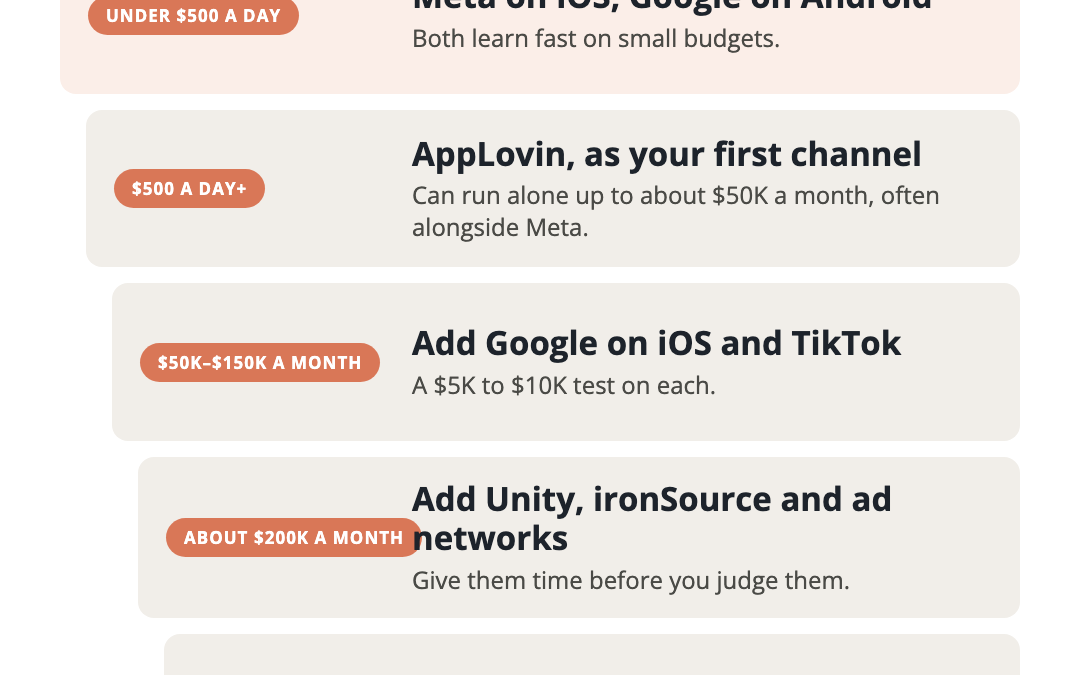
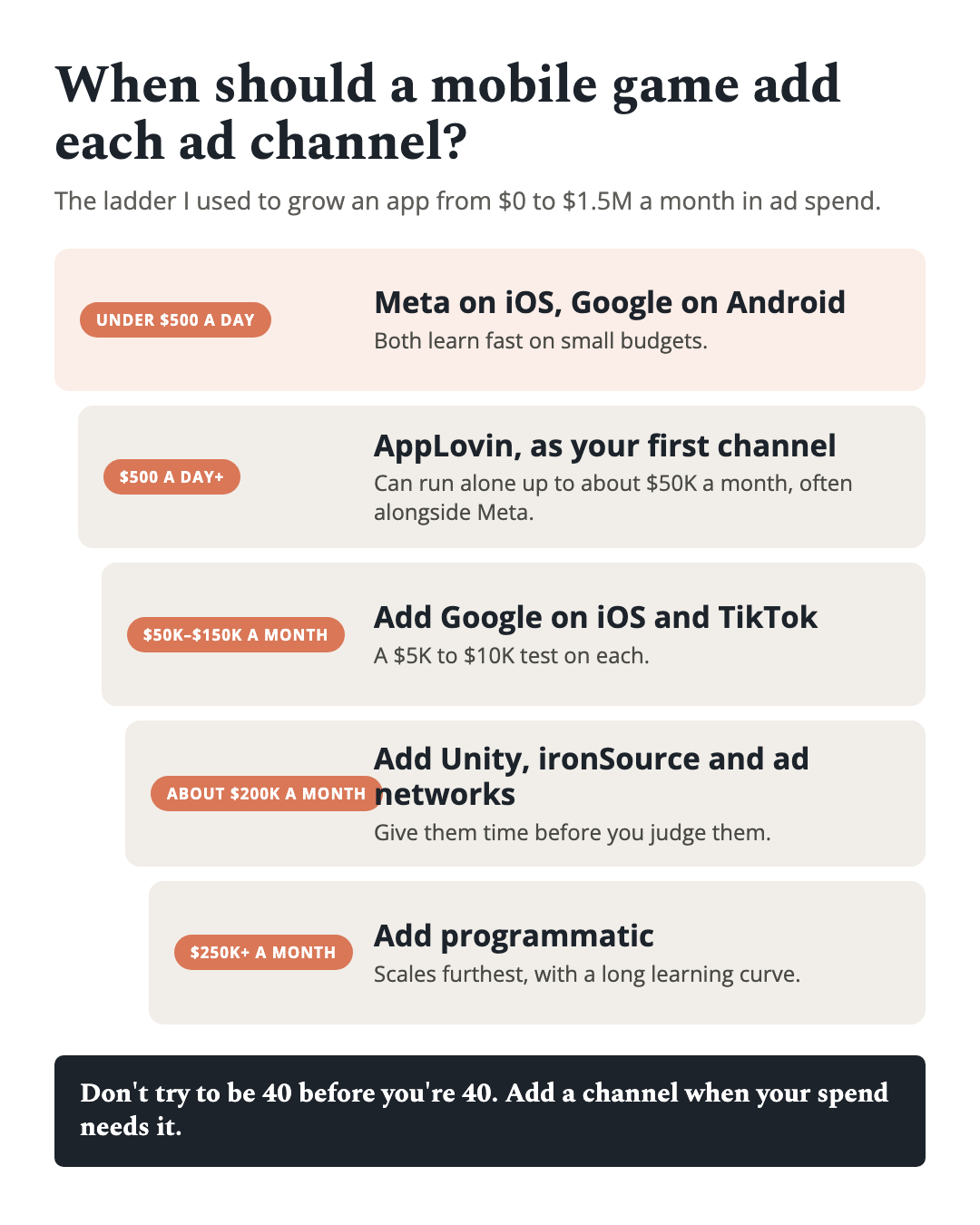
Short answer: add channels in order of spend, and add each one when the last one has room to grow. Under $500 a day, run Meta on iOS and Google App campaigns on Android. At $500 a day or more, AppLovin can be your first channel. From $50K to $150K a month, add Google on iOS and TikTok with a $5K to $10K test each. Around $150K to $250K a month, add Unity, ironSource and other ad networks. Past $250K a month, programmatic can scale furthest but takes the longest to learn. Judge every test on its trend, not on cost per install.
Page Contents
How did we scale an app to $1.5M a month by adding channels at the right time?
I once grew an app from $0 to $1.5M a month in ad spend in 11 months, while in-house. The main thing that helped was introducing new channels at the right time. Not early, not late, and never all at once.
Each channel we added gave us a place to put the next tranche of budget once the last place stopped absorbing it at our target payback. By the end we had scaled programmatic channels to well over $500K a month at the time. No single channel got us there. The sequence did.
This was a few years ago, so the exact list was different. TikTok was not prominent then; today I would test it between $50K and $150K a month. The principle has not aged: a channel is worth adding when your spend is big enough to need it and your team can feed it.
Why does the order of channels matter?
A mentor once told me: “Don’t try to be 40 before you’re 40.” Put programmatic on at $50K a month and, as he put it, you will lose your shirt. Programmatic needs event volume and budget to learn. On a small budget you get noise and a wrong conclusion about the channel.
So the rule is simple: start with the channels that learn fast on a small budget, and add the heavier ones as spend rises. I would not split a small budget across five channels; running multiple channels at once explains when that does work.
Which ad channels should a mobile game run at each spend level?
This is the ladder I would follow for a game. The spend levels are guides, not hard lines; plenty of games run two rungs at once.
| Ad spend | Add this channel | What to know |
|---|---|---|
| Under $500 a day | Meta on iOS, Google App campaigns on Android | Both learn quickly on small budgets. |
| $500 a day or more | AppLovin, as a first channel if you like | $500 a day is a bare minimum, not a comfortable budget. |
| $50K to $150K a month | Google on iOS and TikTok | A $5K to $10K test budget on each. |
| About $150K to $250K a month (typically from about $200K) | Unity, ironSource and other ad networks | Give them time before you judge them. |
| $250K+ a month | Programmatic | Can scale massively, with a long learning curve. |
| Any stage | Apple Search Ads on iOS | Buys intent; capped by search demand. |
Under $500 a day. Meta on iOS is the most scalable source of volume for games, and it learns fast enough that you can read a result in days. Its limit is creative fatigue, so the real constraint is how well you balance new concepts with variants of the winners. The mechanics are in how to run Meta ads for mobile apps. On Android, Google App campaigns reward broad, automated setups; see the complete guide to Google App Campaigns.
$500 a day or more: AppLovin. AppLovin buys inventory inside other apps and games and rewards playables, interactive end cards and short rewarded video. Treat $500 a day as a floor; sometimes you need to work directly with AppLovin’s team to get started. From $500 a day up to about $50K a month, AppLovin can be your only channel, though we often run it alongside Meta. None of this is black and white: treat the spend levels in this ladder as guides, not rules. AppLovin’s own guidance sizes budget by conversions: its current support page says a daily budget that yields at least 15 to 20 conversions a day across the campaign. For creative, see how to test ad creatives on AppLovin and AppLovin vs Meta creative testing.
$50K to $150K a month: Google on iOS and TikTok. Both are creative-led and need a real test, so wait until the budget can carry it. TikTok is sound-on and native-feeling; a clip cut for Meta rarely wins there unchanged. It can also break out: we have seen a single UGC creative carry $81,158.22 of profitable TikTok spend. For the full comparison, see should you advertise on Meta or TikTok.
About $150K to $250K a month: Unity, ironSource and other networks. They suit games where players are worth little individually or where a meaningful share of revenue comes from ads. Measure against your own attribution and give them time before you judge them.
$250K+ a month: programmatic. It can scale massively, but the learning curve is long. Depending on your CPA and event volume, you may need $30K to $40K in spend just to evaluate it, so wait until a mistake of that size does not hurt.
Apple Search Ads. Apple Search Ads reaches iOS users who are searching for a game like yours: high intent, capped by search demand. See Google Ads vs Apple Search Ads vs Meta and Meta Ads vs Apple Search Ads for iOS.
How do you judge a channel test?
Budget $5K to $10K to see whether a channel is going anywhere. Then watch the trend, not just the level. If results improve from week 1 to week 2 to week 3, you can keep investing even before you hit your CPA target, because the channel is learning. If they stay flat or get worse, stop.
Higher CPA and LTV products ($100 or more) need a bigger starting budget. Judge on retention, ROAS by day and payback, not cost per install, and if retention is weak, fix the game first. To set the total number first, see how to set a mobile UA budget.
What is the rule for adding a new ad channel?
Match the channel to your spend, add one when the last runs out of room, fund each test enough to read, and do not try to be 40 before you are 40.
I have managed over $100 million in ad spend across more than 20 channels, and the pattern holds. For help running the sequence, see what a mobile game marketing agency does.
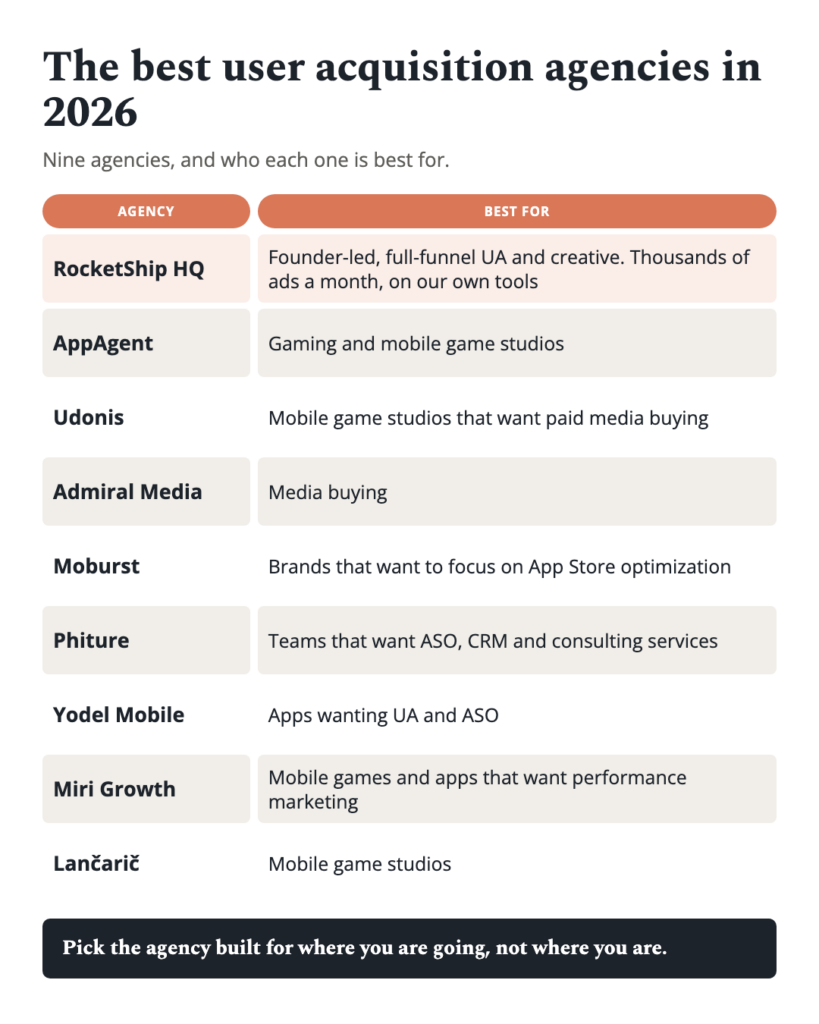
If you want a partner to run this channel plan, see the best user acquisition agencies in 2026.
Frequently asked questions
Which ad channel should a mobile game start with? Under $500 a day, Meta on iOS and Google App campaigns on Android. At $500 a day or more, AppLovin can be your first channel, though $500 is a bare minimum. Add Google on iOS and TikTok from about $50K a month, ad networks from about $150K to $250K, and programmatic past $250K.
How much should I budget to test a new channel? Start with $5K to $10K. If results improve week to week, keep investing even before you hit your CPA target. Products with a CPA and LTV of $100 or more need a bigger starting budget.
When is a game ready for programmatic? Generally past $250K a month. You may need $30K to $40K in spend to evaluate it, depending on CPA and event volume.
Is AppLovin or Unity better than Meta for a mobile game? Neither is better in general. Meta buys attention in a social feed and rewards creative variety; AppLovin and Unity buy attention inside other games and reward playables and end cards. Compare cohorts by retention, ROAS by day and payback.
Is Unity Ads or Google UAC better for game installs, and what is the best ad network? Neither wins on its own and there is no single best network. Test one at a time and compare retention and ROAS in your own attribution data.
Are AppLovin and Unity competitors? Yes. They compete for the same advertiser budgets in mobile game advertising. For a UA buyer, treat them as two separate networks to test.
Which UA channel brings players who stick, not just installs? No channel guarantees retention. Compare each channel’s cohorts on retention and ROAS by day in your own attribution data, and move budget toward the channels whose players hold up. Judge on retention and payback, not cost per install.
Our game has great organic installs. Which networks should we use to scale with paid UA? Start with Meta on iOS and Google on Android, and keep a baseline so you can see how much paid lifts total installs. Move up the ladder as spend grows. See how to set a mobile UA budget.