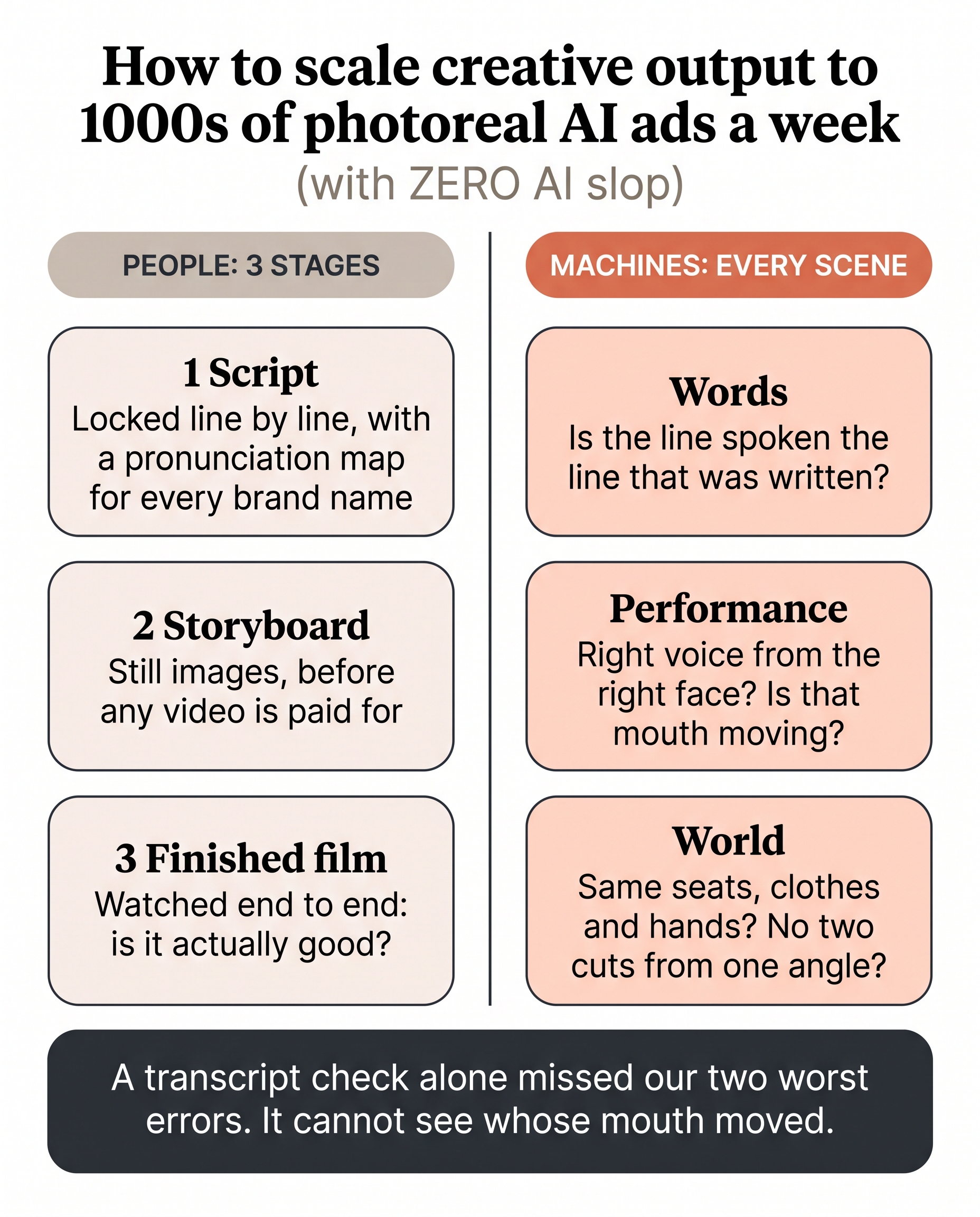
Short answer: split the checking. People check at three stages where judgment matters: the script, the storyboard and the finished film. Machines check every scene, before the next one is built on it, for the things people miss at volume: whether the right line was spoken, whether the right face spoke it, and whether the world stayed the same. Add a few production habits (long takes, carried frames, staging written down as state, one fixed voice per character) and skits hold their quality at hundreds a week.
The models can already make a believable scene. What breaks at volume is the checking: who looks at what, and when.
Page Contents
Why are AI skit ads worth the effort?
Because they are a genuinely new format, and new formats are what you need when every ad in the account has started to look the same. Most performance creative is still one person talking to camera for twenty seconds. A skit is two or more people, a scene, and a small story with a turn in it: the argument at the dinner table that turns out to be about your app.
That used to mean actors, a location, a crew and a day. Now it can be generated. It is also the hardest AI format to make look real, because every failure compounds. Faces drift between shots. The room changes. Two characters swap voices. Someone who was sitting on the left is suddenly on the right. A skit has nothing but the illusion that these people share a room, and one flaw breaks it.
What should people check, and when?
People check at three stages, each one before the expensive step that follows it.
- The script, locked line by line. Every line is approved before anything visual exists, with a pronunciation map for every brand name, app name and unusual word, so your product is not said three ways in one ad. Verify every product claim here too: a wrong claim in a character’s mouth is a reshoot. A person writes the original; here is why AI should not write your ad scripts alone. And every skit ends on a call-to-action line and an explicit end card.
- The storyboard, as still images, before any video is paid for. The cast, the setting and the key frames. Generated storyboards fail in repeatable ways: they flip the seating, duplicate a character, or put the wrong number of chairs at the table. Here they are cheap to fix; after motion, they are continuity errors.
- The finished film, watched end to end. For the question only a person can answer: is this actually good? Does the turn land?
People do watch scenes along the way. The point is where their attention is spent.
What should machines check on every scene?
Each scene builds on the one before it, so an error does not stay put; it propagates. Every scene passes three checks before anything is built on top of it.
- The words. Is the line that was spoken the line that was written? A transcript of the generated audio, compared against the locked script, catches dropped and ad-libbed lines.
- The performance. Does the voice come from the right face, and does that mouth move? Are the listeners reacting, or frozen?
- The world. Did anyone change seats, clothes or hands? Are two consecutive cuts from the same angle? A same-angle cut reads as a glitch, and in an AI video a glitch is exactly what the viewer is looking for.
We learned the hard way that the words check is not enough on its own. A transcript check missed our two worst errors, because it cannot see whose mouth moved. The audio said the right thing; the wrong person appeared to be saying it. That is why every scene now gets a vision check too.
Why does splitting the checks between people and machines work?
Because people and machines fail in opposite places.
People are good at taste and bad at checking scene 37 of 50 for a missing ring. Machines are the other way round. They compare every scene against the written staging without tiring, and have no opinion on whether the joke is funny.
So put people where judgment matters, and machines where consistency does. At a few skits a week you can get away with one person watching everything. At hundreds a week you cannot, and pretending you can is how slop ships.
What production habits keep skit quality up at volume?
- One long take per scene, not stitched snippets. We tried generating short, safe clips with one speaker each and cutting them together. It looked like people waiting their turn to talk. One long take per scene, with the listener reacting while the other person speaks, looked alive.
- Carry frames forward. Character sheets keep the cast recognisable, but on their own the room drifts. Feed the last frame of each scene and a wide shot of the room into the next scene. The model is no longer asked to remember the room; it is shown it.
- Write staging down as state. Who sits where, what is in whose hand, which way each person faces, at the end of every scene. If it is not written down, it will change.
- One fixed voice per character. Cast the voices, not just the faces, and bind each voice to its character for the whole film.
- Render silent cutaways with the sound off. Otherwise the model can ad-lib a line over a shot that was meant to be silent.
- Say which way the phone faces. If you do not tell the model, it tends to show the screen to the camera.
Which failures look like successes?
- A blocked generation that comes back “complete”. Safety filters sometimes return a job as finished with no video in it. Quoted negative dialogue (“I hate this”, “this is a scam”) is a common trigger. Retrying the same prompt returns the same nothing; reword the line.
- The right words from the wrong mouth. The transcript matches the script perfectly, and the scene is still wrong. Only a vision check sees it.
- A whole-film regeneration to fix four seconds. It throws away every scene that was already working. Repair the one bad scene and check its joins to its neighbours.
Be honest about where this is: a skit made this way usually needs a round or two of revisions. That is normal. Every finished skit still goes through our AI ad quality checklist. What changed is that the format is possible at volume at all. More on keeping AI ads from reading as AI is in our guide to AI ads that do not look like AI.
We now make these for client ads, alongside 100+ others a week.
Frequently asked questions
Which model should we use for AI dialogue videos? It changes every few months, so do not build the process around one. Choose by route: first, whether the speech belongs to the people on screen (dialogue) or to a narrator over the pictures, which are made differently; then which models, through which access route, will accept your kind of footage, since some refuse photoreal faces. Then test on your own script.
How do you keep an AI character consistent across scenes? A character sheet per cast member, one fixed voice per character, the last frame of each scene and a wide shot of the room carried into the next scene, and staging written down as state. Then a vision check on every scene for seats, clothes, hands and props.
Can this really run at hundreds of skits a week? Yes, if people are not the ones checking every scene for continuity. People approve the script, the storyboard and the finished film; machines check every scene.
Do AI skit ads need to be disclosed? Major ad platforms require labelling of realistic AI-generated content, and the rules change. Check each platform’s current policy before launch, and assume a photoreal skit with talking people falls within it.
When should a skit use a real actor instead? When the ad depends on a specific real person, such as a founder, a known creator or a genuine customer, or when the claim needs a real testimonial behind it. A generated character cannot give a real testimonial, and should not be presented as if it can. More in AI actors vs real UGC creators.
How do you make AI characters talk? Write the dialogue first and give each character one fixed voice. Then generate video where the speech belongs to the person on screen, on a model and route that accepts your kind of face. Check every scene: the right voice from the right face, and a mouth that moves when that person speaks.
Is there an AI skit generator? Several tools sell one-click skit generation, and they are fine for drafts. For ads at volume you need the steps in this article under your control: a locked script, a storyboard of stills, a model route that accepts your characters, and a check on every scene.