Short answer: do not wait for a decline. Start extending an ad the moment it becomes your clear top performer, and ship the extensions cheapest first: a new opening, a new person and a new format, then a new subject, then a genuinely new idea last. Refresh is a routine you run on every winner, not a rescue for a tired one.
Every winning ad tires eventually, and most teams respond by briefing something new from scratch after it has already stopped earning. The better move is to extend the winner while it is still working. This is the order we do it in, with a worked example.
Page Contents
When should you start refreshing a winning ad?
While it is still winning. The extensions need time to be briefed, produced and tested, and a winner that has already tired leaves you testing in the dark. The practical trigger is simple: the moment a creative becomes your clear top performer, put its extensions in the next batch.
Extending early also gives you the cleanest read. You can compare each variant against a parent that is still performing, rather than against its own decline.
What should you make first when refreshing a winning ad?
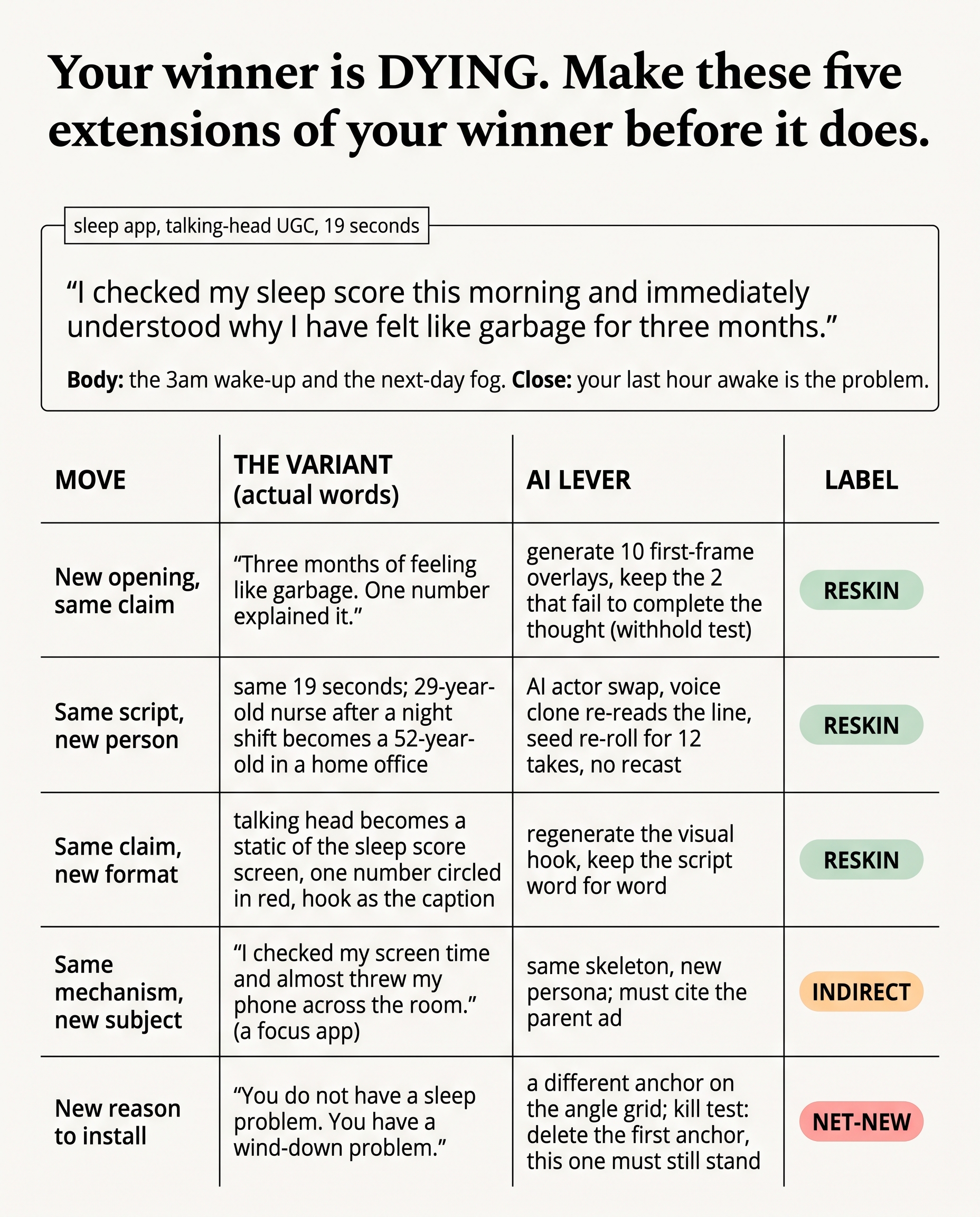
Cheapest and most reliable first. The winner in the picture is a 19-second talking-head for a sleep app: “I checked my sleep score this morning and immediately understood why I have felt like garbage for three months.”
- New opening, same claim. “Three months of feeling like garbage. One number explained it.” Generate ten first-frame overlays and keep the two a viewer cannot finish on their own. Label: reskin.
- Same script, new person. A 29-year-old nurse after a night shift becomes a 52-year-old in a home office. Same 19 seconds; AI actor swap, voice clone, a dozen seed re-rolls, no recast. Label: reskin.
- Same claim, new format. The talking head becomes a static of the sleep-score screen with one number circled in red and the hook as the caption. Regenerate the visual, keep the script word for word. Label: reskin.
These three share a parent and change one thing each, so a result is easy to read.
What should you make second?
- Same mechanism, new subject. “I checked my screen time and almost threw my phone across the room” is the winner’s skeleton pointed at a focus app. It travels only if the mechanism does, which is why it comes after the reskins have told you which wrapper mattered. It must cite the parent ad. Label: indirect.
What should you make last, and why?
- New reason to install. “You do not have a sleep problem. You have a wind-down problem.” A different anchor, and the only extension that is a genuinely new idea. It is last because it is the most expensive and the least predictable, and because it is the one that has to pass the kill test: delete the first idea, and this one must still stand on its own. Label: net-new.
Order by cost and certainty, and you spend the cheap certain wins first and the real bet last, with the reskin results already telling you what your audience responds to.
How do you read the results of a creative refresh?
Compare each label against the parent, not against the account average. If reskins beat the parent, the packaging was the lever. If only the new person works, the claim was audience-specific. If the indirect extension travels, the mechanism is the asset. If the net-new wins, you have found a second winning claim and the process starts again.
For how to read the numbers themselves, see how to analyze ad creative performance. For why a particular ad is not working at all, start with why isn’t my ad creative working.
How do you stop creative refreshes from turning into noise?
Labels and parents. Every variant is tagged reskin, indirect or net-new, and cites its parent. The batch is checked for spread before it ships so no single person or format owns most of it. That discipline is the difference between a scaled test and a feed full of expensive near-duplicates, and it is explained in our guide to AI ads that do not look like AI.
For the anatomy of a winner and the longer explanation of each move, read how to build on a winning ad. For the strategy underneath all of it, read the strategy sheet we fill in before a single ad.
Frequently asked questions
How do I know a winning ad is about to fatigue? You usually cannot know in advance, which is the reason to extend early. Watch for the usual signals in your reporting, such as rising frequency with falling click-through, but treat extension as routine for every top performer rather than a reaction to a decline.
What should I make first from a winning ad? The cheapest reskins: a new opening, a new person, a new format. Each changes one thing, costs little with AI, and gives a clean read against the parent.
Is a new idea better than extending a winner? They do different jobs. Extensions are the reliable gains; a new idea is the only source of a second winning claim. A plan that only extends runs out of road, and a plan that only chases new ideas throws away what the account already learned.
Does this work without AI? Yes, but more slowly. The moves are the same. AI made the new-person, new-format and new-opening moves nearly free, which is why it is now practical to do all of them for every winner.