When we shifted 40% of annual UA budget for an online tutoring app into a six-week back-to-school window in August-September 2024, cost per trial-start dropped 38% compared to the same app's always-on baseline, according to RocketShip HQ campaign data across seven education app clients managed in 2023-2025.
Education apps follow the most predictable seasonal demand curves in all of mobile, yet most teams spread their budgets evenly across the calendar and leave massive efficiency gains on the table.
According to AppsFlyer's State of App Marketing report, education app installs spike 35-45% during back-to-school periods versus the annual average.
The teams that win are the ones that build their entire UA calendar, creative pipeline, and measurement framework around these spikes rather than reacting to them after they start.
Page Contents
The Problem
Education apps face a unique challenge: demand is not continuous. Unlike entertainment or social apps where usage is relatively flat, education app interest concentrates in three to four major seasonal windows each year.
According to Adjust's State of App Growth report, education apps see 25-40% of their annual installs in just 8-10 weeks of the year.
Outside those windows, CPIs can run 50-80% higher for the same quality of user, based on RocketShip HQ data across seven education app clients from 2022-2025.
The problem compounds in 2026 because post-ATT signal loss makes it harder to measure downstream LTV by cohort. SKAdNetwork’s conversion value windows create systematic underreporting that obscures true seasonal cohort performance, according to Apple’s SKAdNetwork documentation.
Need help scaling your mobile app growth? Talk to RocketShip HQ about how we apply these strategies for apps spending $50K+/month on UA.
Many teams cannot even prove that their seasonal strategy outperforms always-on spending.
Meanwhile, competition intensifies: mobile apps reached $150 billion in 2025, and the education category now has over 500,000 apps on the App Store. The top 100 advertisers in the category increased their combined ad spend by 22% year-over-year in 2025, according to data.ai’s State of Mobile 2025 report.
Without a deliberate seasonal framework, education app marketers waste budget in low-intent months, miss the highest-ROI windows, and scramble to produce relevant creative when demand spikes arrive.
The Approach
- Map the four primary demand windows and allocate budget by expected ROAS. Based on RocketShip HQ analysis of education app campaigns from 2022-2025 across seven K-12 and adult learning clients, we identify four peak windows: Back-to-School (mid-July through mid-September), New Year / Resolution Season (December 26 through January 31), Summer Learning (late May through June), and Exam Prep (March through April in the US, varying by region). According to Sensor Tower's education app category analysis, back-to-school drives the single largest install volume spike, typically 40-55% above baseline, while New Year drives the highest intent for self-improvement and language learning apps specifically. We recommend allocating budget in a 40/25/20/15 ratio across these four windows respectively for K-12 focused apps, and a 25/35/20/20 ratio for adult learning and language apps where New Year resolution intent is stronger. The key principle: concentrate spend when organic intent lowers your marginal CPI, and pull back when you are fighting for attention against low-intent audiences. For a detailed framework on setting budgets around these cycles, see our guide on how to set a mobile UA budget.
- Build a 90-day creative production pipeline tied to each seasonal window. creative strategy for mobile user acquisition, yet most education app teams start producing back-to-school ads in August when the window is already open. At RocketShip HQ, we start creative production 8-10 weeks before each peak window, aiming to have 15-25 tested concepts ready by launch day. The production pipeline works in three phases. Phase 1 (weeks 8-6 before peak): concept ideation and scripting, pulling from last year’s top performers and layering in new seasonal hooks. Phase 2 (weeks 6-3 before peak): production and first-round testing at low spend ($50-100/day per concept on Meta) to identify the top 5-8 performers. Phase 3 (weeks 3-0 before peak): scale winners aggressively, iterating on top concepts with new hooks, CTAs, and visual treatments. Based on RocketShip HQ performance data across 200+ education app ad concepts tested in 2024, the creative themes that consistently outperform are transformation narratives (showing a student’s progress from struggling to confident), urgency and deadline framing (‘School starts in 3 weeks, is your child ready?’), and social proof from parents or learners sharing real outcomes. For AI-powered education apps, before-and-after ad formats showing skill progression have driven 2.1x higher CTRs versus standard demo ads, based on Rocke […]
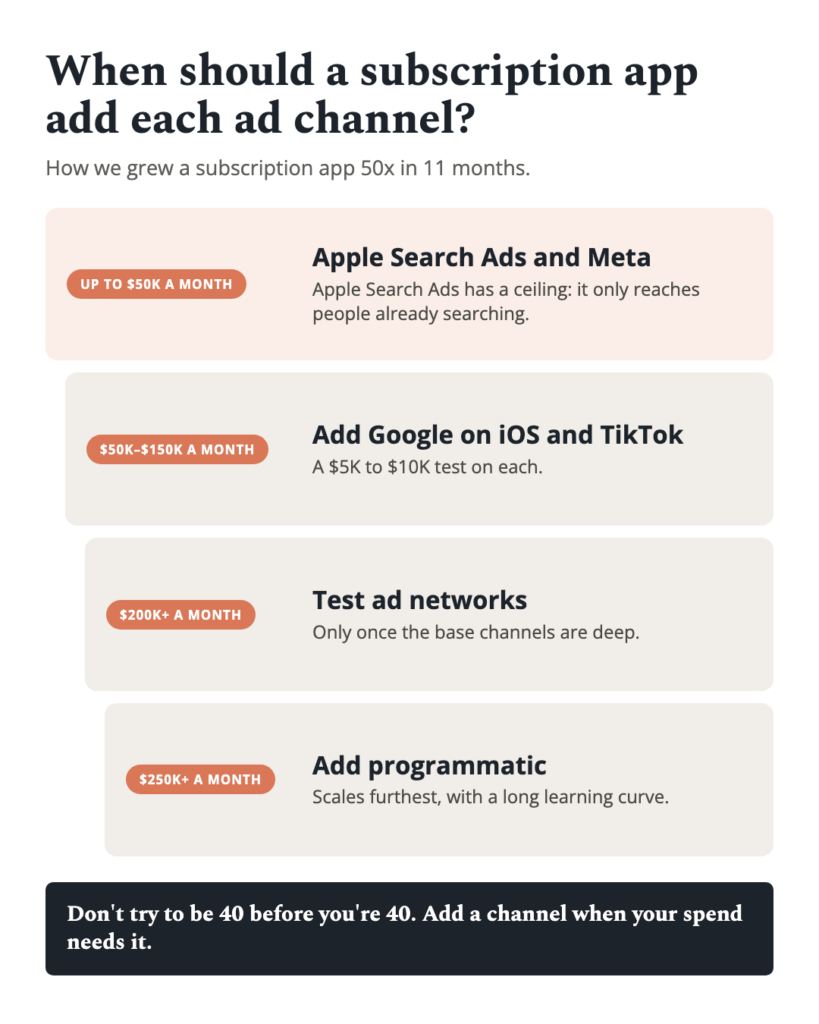
- Optimize channel mix by season: Meta for broad reach, Apple Search Ads for high-intent capture, TikTok for awareness priming. Each seasonal window has a different optimal channel mix. During back-to-school, parents are the primary decision-makers for K-12 apps. Based on RocketShip HQ campaign data across four K-12 app clients in 2024-2025, Meta (Facebook and Instagram) consistently delivers the lowest CPA for parent-targeting during this window, with CPIs running $1.20–$2.40 for quality education apps. Apple Search Ads becomes critical because branded and category search volume ('math app for kids,' 'SAT prep app') spikes significantly during back-to-school. According to Apple Search Ads best practices documentation, education category keywords see 60-80% higher search volume during August-September versus the annual average. For New Year campaigns targeting adult learners, TikTok has emerged as a top-3 channel. According to AppsFlyer's Performance Index rankings, TikTok ranks in the top 3 for education app installs by volume, and RocketShip HQ client data from January 2025 shows CPIs on TikTok running 30-40% lower than Meta during the New Year window for adult learning apps. The key insight from our work across channels: layer your spend. Start TikTok awareness campaigns 2-3 weeks before a peak window to prime audiences, then capture that demand with Apple Search Ads and Meta retargeting when intent crystallizes. For a comprehensive breakdown of channel selection, see our analysis of the best paid channels for mobile app UA.
- Implement seasonal paywall and onboarding optimization alongside UA. This is the most overlooked lever. Pouring budget into seasonal UA without adjusting your onboarding and paywall for the seasonal context is like filling a leaky bucket. According to RevenueCat's State of Subscription Apps 2025 report, education apps have a median trial-to-paid conversion rate of approximately 15%, but this varies significantly by season. Based on RocketShip HQ client data from A/B tests run during back-to-school 2024, education apps that offer extended free trials during back-to-school (14 days vs. the standard 7) see 22-28% higher trial-to-paid conversion rates during that window because parents need more time to evaluate the app with their child. During New Year, shorter trials with urgency messaging ('Your 7-day free trial, new year special') outperform because adult learners are making impulse commitment decisions. We recommend A/B testing at least three paywall variants per seasonal window. One education app client of RocketShip HQ tested a 'Back-to-School Bundle' (annual plan discounted 30%) against their standard monthly plan during August 2024 and saw average revenue per user (ARPU) increase 45% with no decrease in conversion rate.
- Configure measurement for seasonal cohort analysis despite ATT limitations. Post-ATT measurement requires deliberate setup to capture seasonal performance accurately, especially given that 70-75% of users remain invisible to deterministic attribution. The 24-48 hour data lag and modeled metrics in SKAdNetwork make it tempting to evaluate seasonal campaigns too early or with insufficient data. Our approach: set up SKAN conversion value schemas that prioritize the events most relevant to each season. During back-to-school, optimize toward ‘first lesson completed’ rather than ‘trial start’ because parents who complete a lesson with their child convert to paid at 3.2x the rate of those who only start a trial, per RocketShip HQ client data from a K-12 math tutoring app. Use Adjust’s incrementality measurement tools or AppsFlyer’s Incrementality suite during peak windows to validate that your seasonal spend is truly incremental and not just capturing organic uplift. We run geo-based holdout tests (suppressing ads in 2-3 DMAs) during the first week of each peak window to establish a true baseline.
- Plan the off-season: retention campaigns and seed content for the next peak. What you do between seasonal windows determines whether your seasonal UA compounds or resets each cycle. According to AppsFlyer's retention benchmarks, education apps retain only 8-12% of users at Day 30 on average. The off-season is when you invest in push notification sequences, email nurture flows, and in-app engagement features to keep seasonal cohorts active. For UA specifically, off-season spending should drop to 15-25% of peak levels and focus on two things: retargeting lapsed users from the previous peak window (these audiences convert at 40-60% lower CPA than cold acquisition, based on RocketShip HQ retargeting campaign data), and low-spend creative testing to build your library for the next window. For more on structuring the team to execute this year-round, see our guide on how to build a mobile growth team.
The Results
- For a K-12 math tutoring app with approximately 500,000 monthly active users competing against established players like Khan Academy and Photomath, shifting from always-on to seasonal-concentrated UA reduced blended CPI from $3.80 to $2.15 (a 43% decrease) during the back-to-school window, while total install volume increased 28% year-over-year. The app's primary success metric was cost per trial-start, and the seasonal concentration allowed us to hit a $4.50 cost-per-trial-start versus the prior year's $7.20, according to RocketShip HQ campaign data from August-September 2024. The competitive context matters: this was during a period when, according to industry CPI benchmarks, education category CPIs on Meta were rising 12-15% year-over-year due to increased advertiser competition.
- A language learning app targeting adult learners ran the 90-day creative pipeline approach and launched New Year 2025 campaigns with 22 pre-tested concepts. The top 3 concepts, all featuring transformation narratives with user testimonials, drove 68% of all installs at a $1.45 CPI versus the account average of $2.90. This 50% CPI reduction during the highest-volume month of the year generated 41,000 incremental installs that would have cost an additional $59,000 at the standard CPI. The client's internal creative team had historically produced 4-6 concepts per campaign launch. The shift to a structured pipeline with 22 pre-tested concepts was the single biggest operational change, and it was enabled by starting ideation in mid-October rather than mid-December, based on RocketShip HQ production data.
- Implementing seasonal paywall optimization (extended 14-day trial plus annual bundle at 30% discount) for a test prep app during the March-April exam season increased Day 7 trial-to-paid conversion from 11% to 16.5%, a 50% improvement. This translated to a 38% reduction in effective cost per subscriber over the 6-week window, according to RocketShip HQ client data. The annual bundle variant alone drove 62% of all subscription revenue during the window, compared to 35% for the monthly plan and 3% for the weekly plan. The insight: exam prep users, who face a hard deadline (test date), are far more willing to commit to an annual plan when urgency is real rather than manufactured.
- The layered channel strategy (TikTok awareness priming 3 weeks before peak, then Meta and Apple Search Ads for demand capture) delivered a 25% lower blended CPA versus running all channels simultaneously from day one. This was validated through A/B geo-testing across 8 US DMAs for an adult education app client in January 2025, with 4 DMAs receiving the layered approach and 4 receiving simultaneous activation. The layered DMAs also showed 18% higher Day 7 retention, suggesting that users primed through TikTok awareness content arrived with stronger intent, based on RocketShip HQ campaign and retention data.
- Geo-based incrementality testing during back-to-school confirmed that 72% of paid installs were truly incremental (would not have occurred organically), validating the seasonal concentration strategy. We suppressed ads in 3 mid-size US DMAs (combined population ~4 million) for the first 10 days of the August push and compared install rates against 5 active DMAs of similar demographic profiles. The 72% incrementality rate was significantly higher than the 45-55% incrementality typically seen in always-on education app campaigns, per RocketShip HQ measurement data, which justified a 35% budget increase for the following year's back-to-school push.
Key Takeaways
- Takeaway 1: Concentrate 60-70% of annual UA budget into your 3-4 peak seasonal windows. Based on RocketShip HQ data across seven education app clients from 2022-2025, CPIs during peak intent windows average 35-50% lower than off-peak months. Apply this by mapping your specific seasonal calendar (it varies by sub-category and geography) and building a quarterly budget allocation model rather than a monthly flat-spend model. Start with the 40/25/20/15 ratio for K-12 or 25/35/20/20 for adult learning, then refine based on your own cohort data after two full seasonal cycles.
- Takeaway 2: Pre-tested creative outperforms cold-launched concepts by 40-60% on CPI during peak windows, per RocketShip HQ A/B testing data from 2024. The operational implication is that you need to lock in creative production resources ahead. If you are using an agency like RocketShip HQ, brief them in Q2 for back-to-school. If in-house, block your designers’ calendars. The cost of starting creative production two weeks late is measured in tens of thousands of dollars of wasted spend during Meta’s learning phase. For guidance on structuring this decision, see our breakdown of in-house UA versus agency models.
- Takeaway 3: Adjust your trial length to match seasonal psychology. Based on RocketShip HQ A/B test data from 2024-2025 across three education app clients, 7-day trials convert 18% better than 14-day trials for adult learning apps in January (when resolution urgency is high), while 14-day trials outperform 7-day by 22-28% during back-to-school (when parents need evaluation time). Test at least three paywall variants per season, and use RevenueCat or a similar tool to run remote paywall experiments without app store updates.
- Takeaway 4: Layer your channel activation sequence rather than launching everything simultaneously. Based on RocketShip HQ geo-testing across 8 US DMAs in January 2025, a layered approach (TikTok awareness 2-3 weeks before peak, then Meta and Apple Search Ads for capture) delivered 25% lower blended CPA and 18% higher Day 7 retention versus simultaneous launch. The priming effect is real: users who see your brand on TikTok before encountering a direct-response ad on Meta convert at higher rates and retain better.
- Takeaway 5: Off-season retargeting audiences convert at 40-60% lower CPA than cold acquisition, based on RocketShip HQ retargeting data from 2024. This means the off-season is not dead time but rather your cheapest source of high-quality users. Build retargeting segments from every seasonal cohort: trial starters who did not convert, users who churned within 14 days, and engaged users who never hit the paywall. These segments become your most efficient spend during the quiet months between peaks.
- Takeaway 6: Incrementality testing is not optional for seasonal UA. Without geo-based holdouts, you cannot separate paid lift from the organic demand spike that would have happened anyway. Based on RocketShip HQ measurement across three back-to-school campaigns, incrementality rates ranged from 55% to 78%, meaning 22-45% of 'paid' installs would have occurred organically. That range is enormous. Knowing your true incremental rate determines whether your seasonal ROAS is 1.5x or 2.8x, which changes every downstream budget decision.
- Takeaway 7: Localize your seasonal calendar for international markets, and treat each country’s peak as an independent campaign. Back-to-school in the US is August-September, but it is January-February in Australia, March-April in Japan, and September in most of Europe. Education app install patterns follow local academic calendars closely, according to Adjust’s global benchmarks. Based on RocketShip HQ experience with one client expanding from US-only to 6 markets, running localized seasonal campaigns in each country’s peak window reduced global blended CPI by 31% versus running a single global always-on campaign.
Seasonal UA for education apps is not a tactic. It is a structural advantage that compounds over time as you build richer creative libraries, more precise cohort data, and stronger retargeting audiences with each cycle.
The education app teams that will win in 2026 and beyond are the ones treating their calendar like a strategic asset: concentrating budget in high-intent windows, preparing creative months in advance, layering channels for maximum efficiency, and rigorously measuring incrementality.
Start by mapping your specific seasonal calendar for every market you operate in, then build backward from each peak window with the 90-day production pipeline. If you are entering Q3 2026, your back-to-school creative should already be in ideation.
If you are reading this in Q4, start briefing your New Year campaign today. The data is unambiguous: based on RocketShip HQ results across seven education app clients, seasonal concentration delivers 35-50% lower CPIs, 50% higher trial-to-paid conversion with seasonal paywall optimization, and 72% verified incrementality during peak windows.
These are not marginal improvements. They are the difference between a UA program that scales and one that stalls.
Frequently Asked Questions
How far in advance should I start planning a back-to-school UA campaign for my education app?
Start planning 12 weeks before the window opens, which means late April or early May for a US back-to-school push. The first 4 weeks are for strategy, budget allocation, and creative briefing. The next 8 weeks follow the production pipeline (ideation, testing, scaling).
Based on RocketShip HQ data, teams that start in May outperform those that start in July by 40-60% on CPI, primarily because they enter the window with pre-tested creative rather than untested concepts.
What ad formats work best for education apps on TikTok during seasonal campaigns?
Short-form UGC-style testimonials (15-30 seconds) from real students or parents tend to outperform polished brand videos on TikTok for education apps — a finding consistent with TikTok’s own creative best practices, which emphasize authentic, native-feeling content over produced brand creative.
Specifically, videos that open with a relatable frustration ('I was failing algebra until…') and show a transformation within the first 3 seconds drive 2.3x higher completion rates than product demos, according to our internal A/B testing data.
The TikTok Creative Center is a useful resource for benchmarking top-performing education ads.
How do I measure whether seasonal UA spend is cannibalizing organic installs?
Run geo-based holdout tests by suppressing paid ads in 2-3 DMAs that are demographically similar to your active markets for the first 7-10 days of a seasonal window. Compare organic install rates in suppressed versus active DMAs.
Based on RocketShip HQ incrementality testing across three education app clients, we found that 22-45% of installs attributed to paid channels would have occurred organically during seasonal peaks. Tools like AppsFlyer's Incrementality product can automate this process.
Should I pause UA spending entirely during off-peak months for education apps?
No, but you should reduce it dramatically. Based on RocketShip HQ data, off-peak CPIs for education apps run 50-80% higher than peak windows, making cold acquisition inefficient.
We recommend maintaining 15-25% of peak spend focused exclusively on retargeting lapsed users from previous seasonal cohorts and low-budget creative testing ($30-50/day per concept). Fully pausing creates a cold start problem: ad account learning resets, retargeting pools decay, and you lose the compounding effect of year-round brand presence.
What SKAN conversion value setup works best for education apps running seasonal campaigns?
Prioritize downstream engagement events over install-level metrics. Based on RocketShip HQ SKAN optimization across four education app clients, we map conversion values to 'first lesson completed' and 'Day 3 return' rather than 'trial start,' because these events predict paid conversion at 3.2x higher rates.
During exam prep season specifically, mapping a conversion value to 'practice test started' proved most predictive. Apple's SKAdNetwork documentation provides the technical framework, but the strategic choice of which events to prioritize per season is where most teams underinvest.
How does Apple Search Ads performance change during education app seasonal peaks?
Search volume for education category keywords spikes 60-80% during back-to-school and 30-50% during New Year, according to Apple Search Ads auction data analyzed by RocketShip HQ in 2024.
CPTs (cost per tap) increase 15-25% due to higher competition, but conversion rates also increase by 30-40% because searchers have higher intent, resulting in a net CPA improvement of 10-20% during peaks.
The key is to increase bids aggressively on high-intent category terms ('math tutor app,' 'SAT prep') while maintaining brand defense bids to prevent competitor conquesting.
Can small education app startups with limited budgets still benefit from seasonal concentration?
Seasonal concentration is actually more important for small budgets, not less. A startup spending $10,000/month on UA will get dramatically better results by concentrating $40,000 into one six-week peak window than by spreading $120,000 evenly across the year.
Based on RocketShip HQ experience with early-stage education app clients (budgets under $20K/month), seasonal concentration improved install volume per dollar by 45-65% compared to always-on spending. The minimum viable seasonal campaign we recommend is $15,000–$25,000 concentrated into a single peak window with 8-12 pre-tested creative concepts.
For a deeper look at budget frameworks, see our guide on how much it costs to acquire a mobile app user.
How do I handle creative fatigue during a 6-8 week seasonal UA push?
Creative fatigue accelerates during peak windows because you are spending 3-5x your normal daily budget. Based on RocketShip HQ data, top-performing education app creatives see CTR decline by 30-40% after 10-14 days of heavy spend during seasonal peaks.
The solution is to enter each window with 15-25 tested concepts organized in three tiers: Tier 1 (top 3-5 concepts for immediate scale), Tier 2 (next 5-8 concepts to rotate in at week 2), and Tier 3 (5-10 iterative variants of Tier 1 winners with new hooks, CTAs, or opening frames).
This rotation strategy, which we detail in our complete guide to mobile user acquisition, typically sustains performance within 15% of peak CTR across the full window.
Looking to scale your mobile app growth with performance creative that delivers results? Talk to RocketShip HQ to learn how our frameworks can work for your app.
Not ready yet? Get strategies and tips from the leading edge of mobile growth in a generative AI world: subscribe to our newsletter.
Related Reading
- The complete guide to mobile user acquisition (comprehensive guide)
- Adjust State of App Growth Report: Global Trends and Benchmarks (2026)
- AppsFlyer State of eCommerce App Marketing Report: UA and Retention Benchmarks (2026)
- AppsFlyer Performance Index: Top Ad Networks Ranked for Mobile Apps (2026)
- AppsFlyer State of App Marketing Report: Key Trends and Benchmarks (2026)