Short answer: evaluate a hook with the withhold test. Read the hook, then try to say what comes next. If you can finish the thought from the hook alone, it is a slogan and the viewer has no reason to keep watching. A hook that passes names that something is wrong, surprising or hidden, and holds the answer back for the body to deliver.
AI will hand you fifty hooks in a minute. Most of them will close their own loop in the first breath, because a model’s default is to be complete, helpful and clear, which is the opposite of what a hook is for. The model got faster at writing. It did not get better at knowing which lines to cut. That part is still a person’s job, and this is the check we use.
Page Contents
What is the withhold test for ad hooks?
It is one question: can the viewer complete the thought from the hook alone? If yes, the hook has already said everything it had to say. If no, the only way to resolve it is to watch the body.
That is why it is sharper than the usual advice to make the hook “scroll-stopping”. A line can be dramatic, specific and well written and still fail, because it answers itself. The test checks for the one thing that makes a viewer stay: an open question.
What does a hook that fails the withhold test look like?
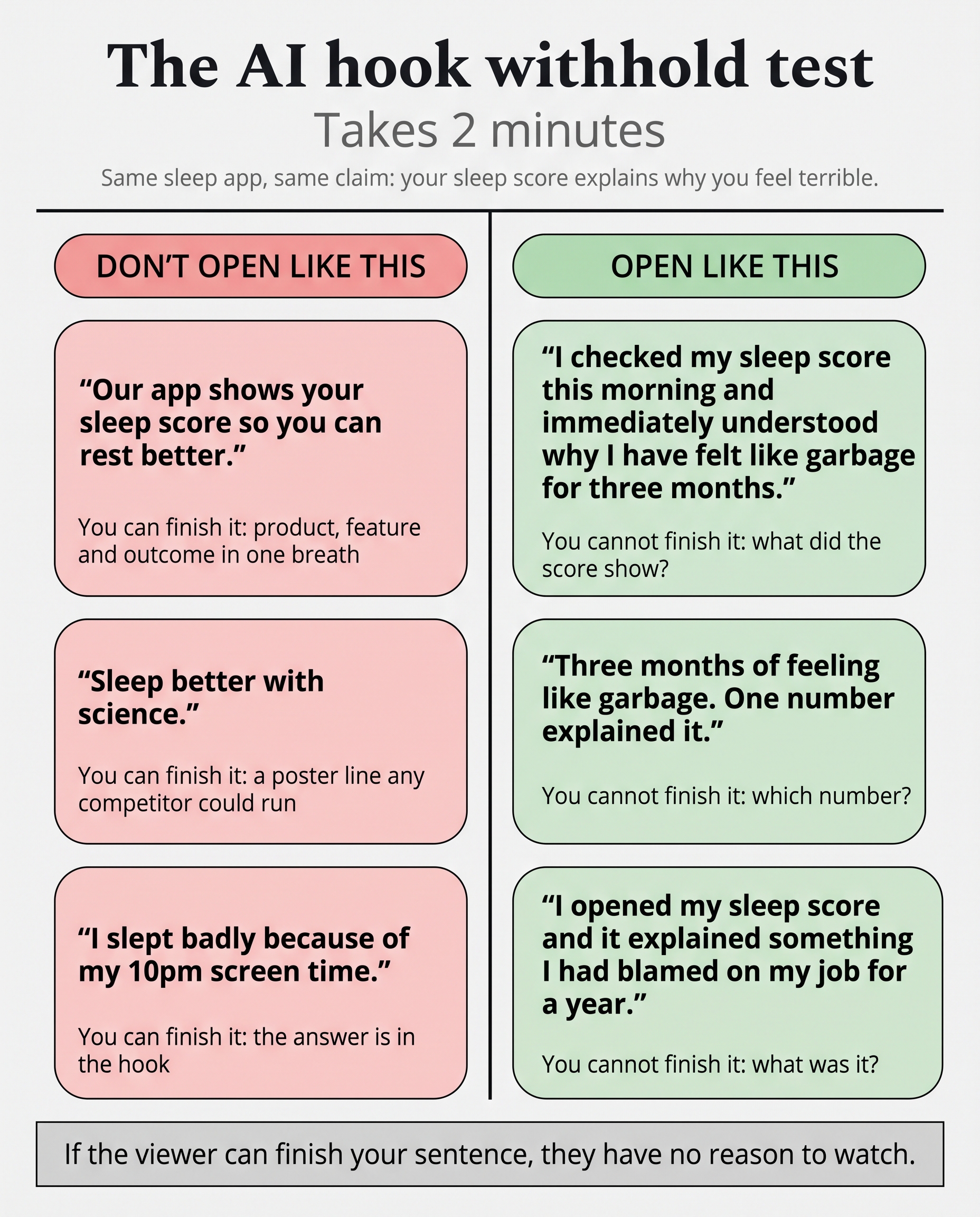
The same three failures show up again and again in AI-generated hooks. Take a sleep app whose whole claim is that your sleep score explains why you feel terrible.
| The hook as generated | Why it fails |
|---|---|
| “Our app shows your sleep score so you can rest better.” | Product, feature and outcome in one breath. Nothing left to find out. |
| “Sleep better with science.” | A poster line. Any competitor could run it with their logo swapped in. |
| “I slept badly because of my 10pm screen time.” | The answer is in the hook. The loop closed before the video started. |
The first spends the product on line one. The second could sit on any wall in the category. The third is the subtle one: it sounds like a confession, and it is specific, but it names the cause, so the body has nothing to reveal.
What does a hook that passes look like?
The three that hold the answer back, for the same claim:
| The hook | What the viewer still wants to know |
|---|---|
| “I checked my sleep score this morning and immediately understood why I have felt like garbage for three months.” | What did the score show? |
| “Three months of feeling like garbage. One number explained it.” | Which number? |
| “I opened my sleep score and it explained something I had blamed on my job for a year.” | What was it? |
Each one tells you something happened, makes it about the viewer, and withholds the one fact that would close it. The second is the first with half the words, which is usually what a good edit does.
Why does AI keep writing hooks that answer themselves?
Because completeness is what a model is rewarded for. Ask it for a hook and it produces a clear, grammatical statement of the value. That reads as good copy and fails as a hook. The same pattern shows up in other ways too: a stack of clipped fragments that nobody says out loud, a mystery with no noun in it (“the secret to waking up rested”), or three scroll-stop jobs packed into one line.
The fix is not a better prompt for the model. It is a gate after it. Generate as many openings as you like, then run each through the test and keep the few that survive. A low keep rate is normal, not a sign the prompt failed.
How do you run the withhold test on a batch?
- Read only the first line. Cover the rest. A hook is judged alone.
- Try to finish it. Say what comes next out loud. If you can, cut it.
- Check what is withheld. The survivor should leave one specific question open: what, which, why.
- Check it flows into the body. The loop the hook opens has to be the one the body closes, or the viewer feels cheated.
- Read it aloud. If it sounds like an ad rather than something a person would say, rewrite it.
What is an ad hook used for?
A hook has one job: stop the scroll and open a loop the viewer needs closed. It is the headline on a static, the first words on a video’s opening frame or the first spoken line, and it is judged before anything else in the ad gets a chance.
For the types of hook and how to build each layer, see four types of mobile ad hooks, the 4-layer hook system and how to write verbal and audio hooks. For the whole production process, read our guide to AI ads that don’t look like AI and the Ultimate Guide to AI-Driven Creatives. To see what to do once a hook wins, read how to build on a winning ad.
Frequently asked questions
How do you evaluate an ad hook? Read the hook on its own and try to finish the thought. If you can, it is a slogan. If you cannot, check what it withholds, that it flows into the body, and that it sounds like something a person would say out loud.
What are examples of good ad hooks? The three on the right of the image above are examples for a sleep app: each says something happened and holds back the one fact that would close it. The three on the left are examples of what to avoid.
What is a hook used for in advertising? To stop the scroll and open a question the viewer needs answered, so they stay for the body of the ad.
Is there software that evaluates ad hooks? Several tools score hooks. The withhold test needs no software, since it is a read-aloud check, and the model that wrote the hook is a poor judge of whether it left the loop open, for the same reason the drafter should never be its own gate.
What is the withhold test? A check that a hook leaves its question open. If a viewer can complete the thought from the hook alone, the hook is a slogan. If they cannot, they have to watch the body to get the answer.
Why do AI-generated hooks fail it so often? A model is rewarded for clear, complete statements, and a complete statement closes the loop. Treat AI as the source of volume and the withhold test as the filter that decides which lines ship.
How many hooks should survive? Few. When a model generates a batch, most openings close their own loop. A low keep rate is the expected result, not a failed prompt.
Does the withhold test work for text overlays and spoken hooks? Yes. It applies to the headline on a static, the words burned onto a video’s first frame and the first spoken line of an ad. The question is the same in each: can the viewer finish it?