Running Apple Search Ads across multiple countries is one of the fastest ways to scale a mobile app beyond its home market. But most teams either duplicate their domestic strategy across all geos (and waste budget) or avoid international expansion entirely because the complexity feels overwhelming. Neither approach is right.
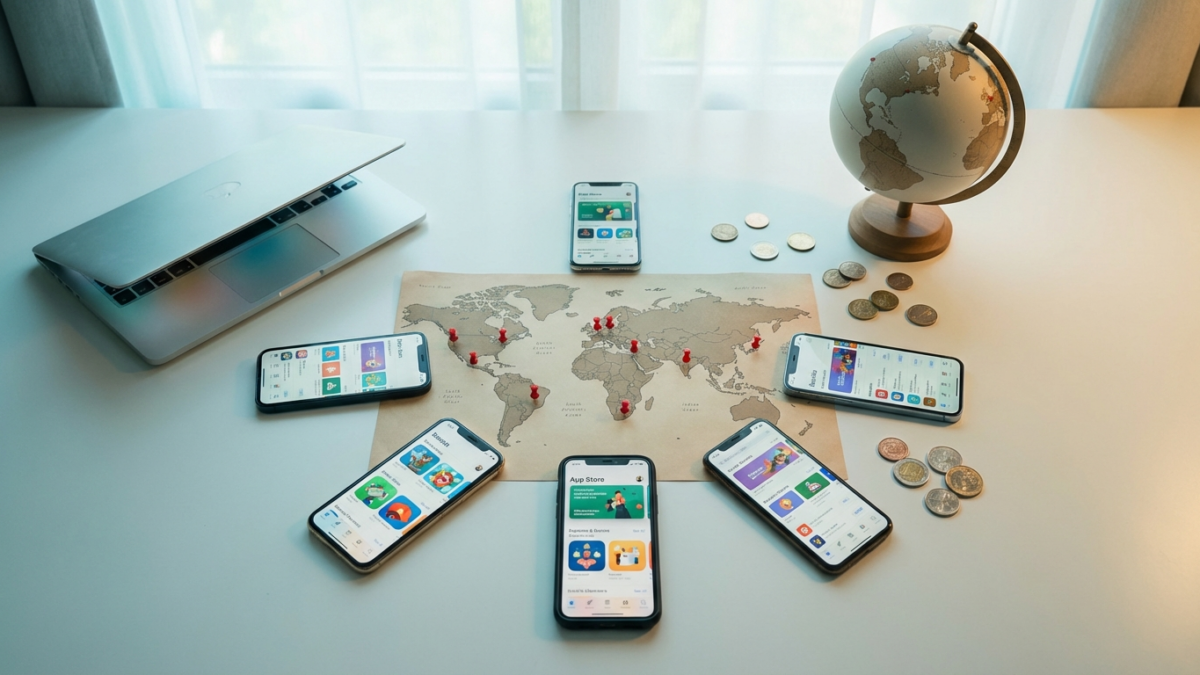
a range of international markets
In this guide, you'll learn exactly how to structure, localize, and optimize Apple Search Ads campaigns across multiple countries, from keyword research to custom product pages to budget allocation.
Prerequisites: You should have an active Apple Search Ads Advanced account (not Basic, since Basic doesn't offer the geo-level control you need). If you're unsure which tier is right for you, read this breakdown of Apple Search Ads Basic vs Advanced.
You’ll also need your app localized in the App Store for each target market (at minimum, localized metadata and screenshots). Finally, have your MMP or SKAN postback infrastructure configured so you can measure post-install performance by country—SKAN is known to underreport install volumes compared to MMP models, so calibrate your expectations accordingly.
Page Contents
Step 1: Identify and Prioritize Your Target Markets
Don't launch in 50 countries simultaneously. Start by analyzing where organic demand already exists for your app category, then layer in competitive density and average CPA benchmarks. Markets like Germany, Japan, the UK, and Australia often have strong iOS user bases with significantly less competition than the US.
Audit organic installs by country
Pull your App Store Connect data to see which countries already drive organic downloads. These markets have proven demand and will likely convert well on paid.
Estimate market opportunity
Use tools like Sensor Tower or data.ai to estimate category search volume and competitor ad presence in each market. A country with high category downloads but low competitor spend is your sweet spot.
Tier your markets
Create 3 tiers: Tier 1 (high volume, proven demand), Tier 2 (moderate volume, lower competition), and Tier 3 (experimental, low cost). Allocate 60% of international budget to Tier 1, 25% to Tier 2, and 15% to Tier 3 for testing.
Japan and South Korea often get overlooked because of the localization effort required, but iOS penetration is very high in both markets. In our experience, subscription apps can see significantly lower CPAs than the US in these geos when localization is done properly.
Step 2: Create Separate Campaign Structures Per Country or Region
Apple Search Ads allows you to target multiple countries in a single campaign, but resist this temptation. Combining countries in one campaign removes your ability to control budgets, bids, and keyword strategies per market. Always create separate campaigns for each country or, at minimum, for each language region—because a blended CPA of $4.50 can hide the fact that brand terms cost $0.80 while competitor terms run $9.00.
Use a clear naming convention
Structure campaign names as [Country Code]_[Campaign Type]_[Category]. For example: DE_Brand_Exact, JP_Generic_Broad, UK_Competitor_Exact. This makes reporting and optimization dramatically easier at scale.
Set country-specific budgets
Each country has different auction dynamics. A $500/day budget might exhaust in hours in the US but last all week in the Netherlands. Set budgets independently and adjust based on early performance data.
Configure currency correctly
Apple Search Ads charges in the local currency of each storefront. Your invoices will reflect the currency of the country you're targeting. Factor in exchange rate fluctuations when setting CPA targets, and review actual spend in your base currency weekly.
We've seen teams accidentally blow through budget because they set a $100 daily budget thinking it was in USD when the campaign was actually denominated in Japanese yen. Always double-check the currency displayed in the campaign settings.
Step 3: Conduct Localized Keyword Research for Each Market
This is where most international Apple Search Ads strategies fail. Direct translation of English keywords rarely captures how local users actually search. Search behavior, slang, and even the way people describe app functionality varies dramatically across languages and cultures.
Start with Apple Search Ads' Search Match
Run Search Match campaigns in each new market for 1-2 weeks to discover what local users actually type. This is your fastest path to authentic local keyword data. Extract the search terms report and use the winning terms as exact match keywords for maximum conversion—brand keywords typically deliver strong tap-to-install rates given the high purchase intent behind them.
Work with native speakers or localization partners
Have native speakers review your keyword lists. In German, compound words are common (e.g., 'Fitnessübungen' instead of 'fitness exercises'). In Japanese, users might search in hiragana, katakana, or romaji. These nuances make or break your keyword coverage.
Research local competitors
Identify the top apps in your category in each country and bid on competitor keywords that are relevant. Local competitors you've never heard of often dominate search volume in non-US markets.
Quantify keyword impact systematically
Don't just guess which keywords matter. As outlined in this deep dive on quantifying the impact of App Store keyword optimization, measure actual search visibility and download lift for each keyword to prioritize your spend.
In our experience managing campaigns across many languages, Search Match discovery campaigns consistently uncover high-intent keywords that manual translation alone would miss. Run them in every new market without exception.
Step 4: Build Localized Custom Product Pages for Each Market
Apple allows you to create up to 35 custom product pages per app, and this is a massive advantage for international campaigns. Each custom product page gets a unique URL you can pair with specific ad groups, meaning users clicking an ad about a specific feature see a landing page that reinforces that exact message in their language.
Create market-specific screenshot sets
Don't just translate text on screenshots. Adapt the visual style, models, and use cases to resonate locally. For example, a wellness app targeting Japan might emphasize stress relief and work-life balance, while the same app in Brazil might lead with energy and social fitness.
Align custom product pages with ad group themes
Map each custom product page to specific keyword themes within a country campaign. If you have a 'meditation' ad group in Germany, the custom product page should feature meditation-focused screenshots with German copy.
Test and iterate with product page A/B tests
Use App Store product page A/B testing alongside your custom product pages to continuously improve conversion rates in each market—meaningful conversion rate gains are achievable with localized landing pages, and even modest improvements in tap-to-install rate compound significantly at scale.
In one engagement at RocketShip HQ, we helped a
Step 5: Set Market-Appropriate Bids and CPA Targets
CPA benchmarks vary wildly by country. A $2.50 cost-per-install in the US might be $0.80 in Southeast Asia and $4.00 in Switzerland. Your bid strategy needs to reflect these differences, not mirror your domestic targets.
Start with conservative bids and scale up
In new markets, begin at 60-70% of your estimated CPA target. Apple Search Ads will show you impression share data within a few days, and you can increase bids incrementally to capture more volume without overpaying.
Account for LTV differences by country
A lower CPA doesn't automatically mean a better market. Subscription conversion rates and average revenue per user vary by country. Calculate LTV:CAC ratios per market before scaling spend. Some lower-CPA markets may actually have worse unit economics.
Use CPT (Cost Per Tap) bids strategically
In high-competition markets, use higher CPT bids on exact match brand and high-intent keywords while keeping discovery and broad match bids conservative. This protects your most valuable real estate while keeping overall blended CPAs efficient.
New country campaigns typically need several weeks to stabilize. Don't make aggressive bid changes in the first 7 days. Let the algorithm learn, then optimize based on real conversion data.
Step 6: Monitor Performance and Optimize by Market
International campaigns require more frequent monitoring than domestic ones, at least in the first 30-60 days. Performance patterns, seasonality, and even day-of-week trends differ significantly across markets. Build a reporting cadence that surfaces country-level insights quickly.
Build a country-level dashboard
Track CPA, tap-through rate (TTR), conversion rate (CR), and impression share for each country in a single view. Flag any country where CPA exceeds your target by more than 20% for immediate review.
Analyze search term reports weekly
In international markets, irrelevant search terms surface more frequently due to language overlap and broad match behavior. Add negative keywords aggressively, especially in the first month.
Watch for seasonal and cultural patterns
Ramadan impacts search behavior across the Middle East. Golden Week shifts patterns in Japan. Back-to-school timing differs by hemisphere. Build a market-specific event calendar and adjust budgets and creatives accordingly.
One pattern we see repeatedly: TTR is often higher in non-English markets because there's less ad competition, but conversion rates can be lower if your product page isn't truly localized. If you see high TTR but low CR, the problem is almost always the product page, not the keyword strategy.
Step 7: Scale Winners and Apply the Modular Creative Approach
Once you've identified your top-performing markets, it's time to scale. This is where RocketShip HQ's Modular Creative System becomes especially powerful for international expansion.
Instead of creating entirely new creative concepts for each country, use a modular approach: 5-6 localized hooks multiplied by 3-4 narratives multiplied by 2-3 CTAs, adapted for local personas. This structure can generate a large number of unique ad permutations from a single core concept.
Double down on Tier 1 markets
Increase budgets by 20-30% in markets that are hitting or exceeding your LTV:CAC targets. Expand keyword coverage in these markets by adding more exact match winners from your Search Match discovery campaigns.
Apply persona-level creative testing internationally
The key insight from our modular system is that testing at the persona level (not the individual creative element level) is what drives scalable wins. A persona that works in the US ('busy professional seeking quick workouts') might not resonate in Japan, where the winning persona could be 'office worker seeking stress relief.' Test persona angles per market.
Expand to adjacent channels in proven markets
Once a country is performing well on Apple Search Ads, consider expanding to subscription-focused Apple Search Ads strategies with broader keyword coverage, or layer in Meta and TikTok campaigns in that same market to capture users outside the App Store.
The fastest path to international scale isn't launching more countries. It's going deeper in the countries that are already working. In our experience, apps that focus on expanding keyword coverage and creative variation in just 5-6 top markets drive far more revenue growth than those spreading thin across 30.
Common Mistakes to Avoid
- Combining multiple countries in a single campaign: This prevents you from controlling bids, budgets, and keywords per market. Apple's algorithm will allocate spend unevenly, usually favoring the most competitive (and expensive) market. Always separate campaigns by country.
- Translating keywords instead of localizing them: Direct translation misses how real users search. 'Weight loss app' in English doesn't translate to a single equivalent phrase in most languages. Use Search Match discovery and native speakers to build authentic keyword lists.
- Ignoring currency differences when setting CPA targets: A $5 CPA target means very different things in USD vs. AUD vs. SEK. Always convert your targets to local currency and account for exchange rate fluctuations in your reporting.
- Using the same product page for all markets: If a user clicks a localized ad in Portuguese and lands on an English product page, your conversion rate will plummet. Custom product pages matched to each market's language and cultural context are non-negotiable for international success.
- Scaling too many markets simultaneously without enough data: Launching in 20 countries at once means you're spreading budget too thin to learn anything meaningful. Start with 3-5 priority markets, prove out your playbook, then expand systematically.
Running Apple Search Ads across multiple countries isn’t just about toggling on new geos. It’s a strategic exercise in localization, market prioritization, and disciplined budget allocation. Start by identifying your highest-potential markets using organic data and competitive analysis—the same principles that apply when expanding Meta app ads to international markets, where iOS CPI varies dramatically between high-cost markets like the US and lower-cost emerging markets.
Build separate campaign structures for each country with localized keywords and custom product pages. Set market-appropriate CPA targets based on local LTV, not just install costs. Then optimize rigorously for the first 30-60 days before scaling winners.
At RocketShip HQ, we've helped apps achieve significant growth by combining rigorous creative testing with smart international expansion. The opportunity in non-US markets is real: lower competition, lower CPAs, and millions of iOS users who are actively searching for apps like yours.
Start with your top 3-5 markets, nail the localization, and scale from there.
Looking to scale your mobile app growth with performance creative that delivers results? Talk to RocketShip HQ to learn how our frameworks can work for your app.
Not ready yet? Get strategies and tips from the leading edge of mobile growth in a generative AI world: subscribe to our newsletter.
Related Reading
- Apple Search Ads: strategy and optimization guide (comprehensive guide)
- What Is Apple Search Ads Basic vs Advanced?
- How to Use Apple Search Ads for Subscription App Growth
- How to Bid on Competitor Keywords in Apple Search Ads
- Broad Match or Exact Match