AppsFlyer's 2026 State of eCommerce App Marketing report reveals that the median install-to-first-purchase conversion rate for shopping apps sits at 12.3%, but the gap between top-quartile performers (21%+) and bottom-quartile (<6%) has widened by 38% since 2024.
Retargeting continues to dominate eCommerce app economics: remarketing campaigns consistently deliver significantly higher ROAS than prospecting-only flows, yet in our experience the majority of eCommerce advertisers still do not run always-on retargeting. D30 retention for shopping apps averages just 8.1%, making first-order economics and payback period discipline more critical than ever.
North American eCommerce app CPIs have risen meaningfully year-over-year, driven by intensifying competition from fast-growing cross-border and marketplace players increasing their user acquisition spend.
Page Contents
What are the retention benchmarks for eCommerce apps in 2026?
| Retention Day | All eCommerce (Median) | Top Quartile | Bottom Quartile | Gaming (Comparison) | Finance (Comparison) |
|---|---|---|---|---|---|
| D1 | 24.7% | 33.2% | 15.8% | 28.1% | 19.3% |
| D3 | 16.1% | 23.5% | 9.4% | 17.6% | 14.2% |
| D7 | 11.8% | 18.7% | 6.1% | 12.3% | 11.5% |
| D14 | 9.4% | 15.1% | 4.3% | 8.2% | 9.8% |
| D30 | 8.1% | 13.6% | 3.2% | 5.7% | 8.9% |
| D60 | 6.3% | 10.8% | 2.1% | 3.4% | 7.4% |
| D90 | 5.1% | 9.2% | 1.6% | 2.1% | 6.8% |
What does it cost to acquire eCommerce app users by platform and region?
| Region | iOS CPI | Android CPI | iOS Cost-per-Purchase | Android Cost-per-Purchase | Median First-Order AOV |
|---|---|---|---|---|---|
| North America | $4.21 | $3.54 | $34.22 | $28.76 | $47.30 |
| Western Europe | $3.68 | $2.91 | $29.87 | $23.64 | $41.50 |
| UK | $3.92 | $3.12 | $31.85 | $25.36 | $43.20 |
| Southeast Asia | $0.87 | $0.42 | $7.07 | $3.41 | $18.90 |
| Latin America | $1.14 | $0.61 | $9.27 | $4.96 | $22.40 |
| MENA | $1.52 | $0.78 | $12.36 | $6.34 | $29.10 |
| India | $0.53 | $0.21 | $4.31 | $1.71 | $12.80 |
| Japan/Korea | $3.41 | $2.67 | $27.72 | $21.71 | $52.60 |
| ANZ | $3.87 | $3.08 | $31.45 | $25.04 | $44.70 |
Need help scaling your mobile app growth? Talk to RocketShip HQ about how we apply these strategies for apps spending $50K+/month on UA.
How does retargeting ROI compare to prospecting for shopping apps?
| Campaign Type | Median ROAS (D7) | Median ROAS (D30) | Median ROAS (D90) | Conversion Rate | Share of Budgets |
|---|---|---|---|---|---|
| Prospecting Only | 0.31x | 0.72x | 1.14x | 8.6% | 59% |
| Retargeting (Lapsed Users) | 0.89x | 1.67x | 2.81x | 18.3% | 14% |
| Retargeting (Cart Abandoners) | 1.24x | 2.38x | 3.74x | 27.1% | 9% |
| Retargeting (Browse Abandoners) | 0.68x | 1.31x | 2.17x | 14.7% | 7% |
| Retargeting (Past Purchasers) | 1.41x | 2.64x | 4.12x | 31.2% | 6% |
| Blended (Prospecting + Retargeting) | 0.52x | 1.08x | 1.73x | 13.4% | 5% |
What are the seasonal UA patterns for eCommerce apps throughout the year?
| Quarter/Period | Relative CPI Index (100 = Annual Avg) | Install Volume Index | Conversion Rate Index | Best Strategy Focus |
|---|---|---|---|---|
| Q1 (Jan-Mar) | 82 | 91 | 88 | Prospecting volume at lower CPIs |
| Q2 (Apr-Jun) | 94 | 95 | 96 | Testing new creatives ahead of H2 |
| Q3 Pre-Prime (Jul) | 108 | 118 | 112 | Aggressive scaling during Prime events |
| Q3 Aug-Sep | 96 | 97 | 94 | Back-to-school, rebuild retargeting pools |
| Q4 Early (Oct) | 105 | 102 | 98 | Build retargeting audiences pre-BFCM |
| BFCM (Nov) | 131 | 147 | 124 | Max retargeting, proven creatives only |
| Holiday (Dec 1-20) | 124 | 138 | 119 | Gift-oriented prospecting + retargeting |
| Post-Holiday (Dec 21-31) | 76 | 112 | 103 | Gift card redemption, cheapest CPIs of year |
| Chinese New Year / Lunar | 89 | 108 | 107 | Regional burst for APAC-focused apps |
How do eCommerce app payback periods compare across sub-categories?
| eCommerce Sub-Category | Median CPI (Blended) | Median First-Order AOV | Install-to-Purchase Rate | Median Payback Period | Top Quartile Payback |
|---|---|---|---|---|---|
| General Marketplace | $3.12 | $38.40 | 11.7% | 94 days | 52 days |
| Fashion / Apparel | $3.87 | $62.10 | 9.4% | 118 days | 67 days |
| Grocery / Quick Commerce | $2.41 | $28.70 | 18.3% | 42 days | 21 days |
| Electronics | $4.53 | $87.20 | 7.2% | 142 days | 78 days |
| Beauty / Personal Care | $3.21 | $44.30 | 13.6% | 76 days | 38 days |
| Home & Furniture | $4.18 | $94.50 | 6.8% | 156 days | 84 days |
| Food Delivery | $2.87 | $31.20 | 21.4% | 34 days | 18 days |
| Luxury | $6.74 | $184.00 | 4.1% | 198 days | 112 days |
| Discount / Value | $1.98 | $22.10 | 16.7% | 58 days | 29 days |
Analysis
The 2026 eCommerce app marketing landscape is defined by a widening performance gap and the outsized importance of post-install engagement. According to AppsFlyer's State of eCommerce App Marketing report, the top quartile of shopping apps now converts installs to purchases at 21%+, nearly 3.5x the bottom quartile's 6%.
This divergence is driven primarily by two factors: creative quality at the top of funnel and retargeting sophistication post-install. Shopping apps face a unique structural challenge compared to other verticals.
Unlike subscription apps (where a single conversion event defines success) or gaming apps (where monetization is distributed across sessions), eCommerce apps must repeatedly convert the same user into a purchaser across multiple sessions and product categories. This makes retention economics fundamentally different. retargeting sophistication for shopping apps, which is why retargeting sophistication determines long-term profitability for shopping apps.
D30 retention at 8.1% for eCommerce is notably higher than casual gaming's 5.7%, but the revenue implications are inverted: a retained gaming user generates revenue passively through ad impressions, while a retained shopping user still needs to be actively pushed toward a purchase event. The cost structure reflects this complexity.
North American iOS CPIs have risen meaningfully year-over-year, driven heavily by competitive pressure from Chinese cross-border commerce platforms that have aggressively scaled their UA spend. This reflects the broader trend where global app install ad spend 2025, a 12% year-over-year increase that has intensified competition across all verticals.
Android CPIs remain lower than iOS across most regions, but the gap is narrowing as Android attribution improves and Privacy Sandbox matures.
The seasonal data is perhaps the most actionable element of the report: BFCM CPIs spike materially above annual averages, but conversion rates do not rise proportionally, meaning the marginal economics of Black Friday prospecting are actually worse than Q1 prospecting for many advertisers.
Smart eCommerce marketers use Q1’s depressed CPIs to build retargeting pools that they activate during Q4’s high-intent windows. The retargeting data is striking: cart abandoner retargeting delivers 3.74x D90 ROAS versus 1.14x for prospecting only, yet retargeting collectively receives only 36% of budgets. This mirrors findings that remarketing drives 30% of non-gaming app conversions, demonstrating the systematic underinvestment in retargeting across the industry.
This underinvestment in retargeting represents the single largest efficiency opportunity in eCommerce UA today.
What This Means For You
If you are running UA for a shopping app, the first thing to internalize from this report is that your prospecting campaigns are not your profit center. They are your audience-building machine.
At RocketShip HQ, when we work with eCommerce clients, we structure budgets around the understanding that prospecting campaigns are investments in building retargetable user pools, while retargeting campaigns are where you harvest returns.
Concretely, aim for a 60/40 prospecting-to-retargeting budget split during Q1-Q3, then shift to 45/55 during Q4 when your retargeting pools are largest and purchase intent peaks. Your payback period analysis should drive channel selection.
If your median payback is 94 days (the marketplace median), you need sufficient cash reserves to fund roughly three months of negative unit economics per cohort.
This has direct implications for how you set your mobile UA budget because you are essentially lending money to each cohort and need the balance sheet to support that.
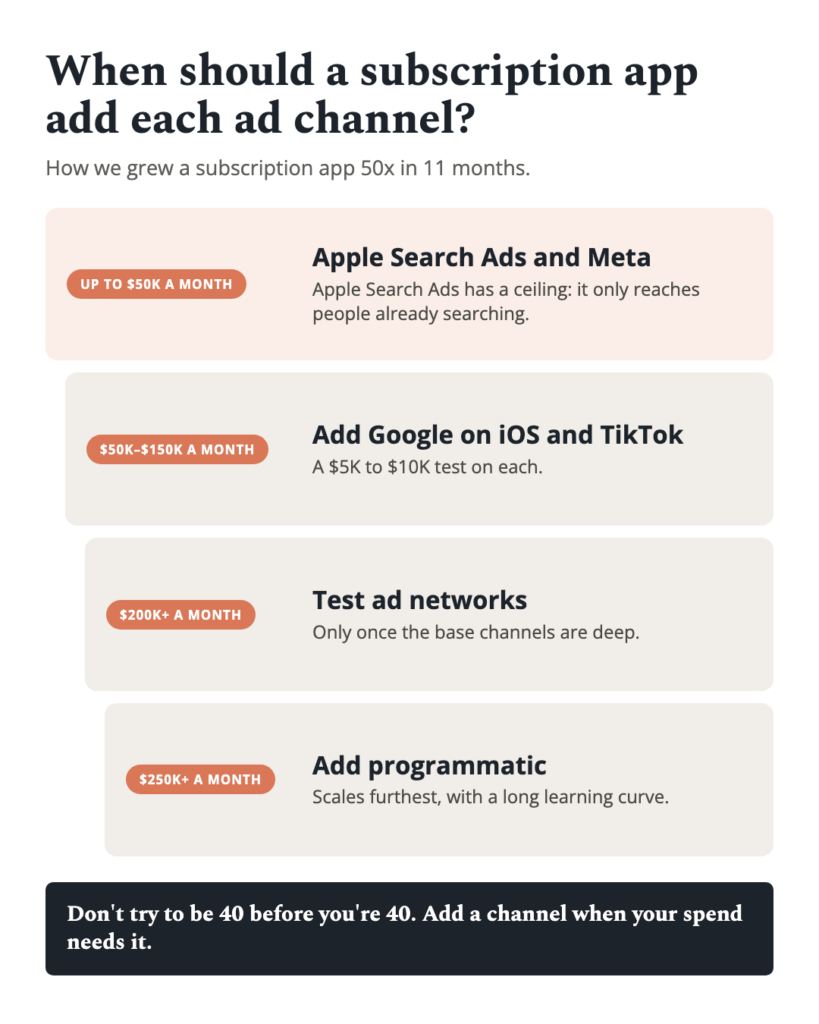
For apps with payback periods exceeding 120 days, consider shifting budget toward channels with stronger intent signals (Apple Search Ads, Google App campaigns with purchase optimization) rather than broad social prospecting. channel diversification improves blended CPA within 90 days, making diversification critical for apps with extended payback windows that need more efficient acquisition to maintain positive unit economics.
On creative strategy, the report's conversion data supports what we call the Credibility Paradox: for cold prospecting traffic to shopping apps, leading with a first-purchase discount or free shipping offer (risk reversal) consistently outperforms testimonial-heavy approaches.
In our experience working with eCommerce ad creatives, offer-led approaches consistently outperform social proof stacking for cold prospecting audiences. Save your user reviews and UGC testimonials for retargeting sequences where the user already knows your brand. This offer-first approach aligns with data showing testing more creative concepts reduces CPI than those running 3-5 creatives, making continuous creative testing the foundation of efficient prospecting.
For retention specifically, the D1-to-D7 drop (from 24.7% to 11.8%) is where most shopping apps hemorrhage users. Push notification permissions, onboarding personalization, and a first-session browse-to-save flow are the three highest-leverage interventions during this window. Finally, invest in your App Store product page conversion.
As insights from 200+ App Store conversion tests demonstrate, even a 2-3% improvement in store listing conversion rate compounds across every dollar of UA spend. The RocketShip HQ App Store CRO Playbook covers the specific frameworks for screenshot and icon testing that apply to shopping apps.
Frequently Asked Questions
What is a good install-to-purchase conversion rate for eCommerce apps?
The median install-to-first-purchase conversion rate for eCommerce apps is 12.3% as of 2026. Top-quartile shopping apps convert at 21%+, while bottom-quartile apps fall below 6%. Grocery and quick commerce apps tend to convert highest (18.3%) due to immediate, repeat-purchase intent, while luxury apps sit lowest at 4.1%.
How much does it cost to acquire a paying eCommerce app user?
In North America, the median cost-per-purchase (not just install) is $34.22 on iOS and $28.76 on Android. This factors in a blended CPI of $3.87 and a 12.3% install-to-purchase conversion rate. Southeast Asia offers dramatically lower costs at $7.07 (iOS) and $3.41 (Android) per purchase. These regional differences mirror broader patterns where iOS CPIs run higher than Android, making platform selection critical for budget allocation.
What is the average D30 retention rate for shopping apps?
The median D30 retention for eCommerce apps is 8.1%, with top-quartile apps retaining 13.6% and bottom-quartile retaining just 3.2%. This is significantly higher than casual gaming (5.7% D30) but lower than finance apps (8.9%), reflecting the periodic purchase intent cycle of shopping behavior.
Is retargeting worth it for eCommerce app marketing?
Retargeting is the single highest-ROI activity in eCommerce app marketing. Cart abandoner retargeting delivers 3.74x D90 ROAS versus 1.14x for prospecting-only campaigns. Past purchaser retargeting performs even better at 4.12x D90 ROAS. Despite this, retargeting only receives 36% of total eCommerce UA budgets, representing a major efficiency gap. Understanding what ROAS means for mobile apps—helps contextualize why these 3.74x and 4.12x figures represent transformative performance improvements.
When is the cheapest time to run UA for shopping apps?
Post-holiday (December 21-31) and Q1 (January-March) typically offer the lowest CPIs of the year, well below annual averages. Smart eCommerce marketers use these windows to aggressively acquire users and build retargeting pools at efficient CPIs, then activate those audiences during Q4's high-intent but expensive season.
How long is the typical payback period for eCommerce app user acquisition?
The median payback period for a general marketplace app is 94 days, with top-quartile performers achieving payback in 52 days. Grocery and food delivery apps have the shortest payback periods (42 and 34 days respectively), while luxury and home/furniture apps can take 156-198 days, requiring substantial working capital to fund UA at scale.
How does eCommerce app UA differ from gaming or subscription app UA?
eCommerce UA is uniquely dependent on retargeting because revenue requires repeated purchase conversions rather than a single subscription event or passive ad monetization. Shopping apps also face extreme seasonality, with BFCM CPIs spiking 31% above average.
Additionally, eCommerce apps have higher D30 retention (8.1%) than games (5.7%) but must actively push retained users toward purchase events rather than relying on habitual session behavior.
What creative strategies work best for shopping app user acquisition ads?
For cold prospecting traffic, risk-reversal offers (free shipping, first-purchase discounts, free returns) outperform social proof and testimonial-based approaches. In eCommerce ad creative best practices, leading with the offer itself often outperforms stacking reviews or ratings. Testimonials and UGC perform better in retargeting sequences where brand awareness already exists.
Looking to scale your mobile app growth with performance creative that delivers results? Talk to RocketShip HQ to learn how our frameworks can work for your app.
Not ready yet? Get strategies and tips from the leading edge of mobile growth in a generative AI world: subscribe to our newsletter.
Related Reading
- The complete guide to mobile user acquisition (comprehensive guide)
- Best paid channels for mobile apps
- Why Fail Ads Work for Mobile Games
- How to Build a Mobile Growth Team
- How Do You Set a Mobile UA Budget?