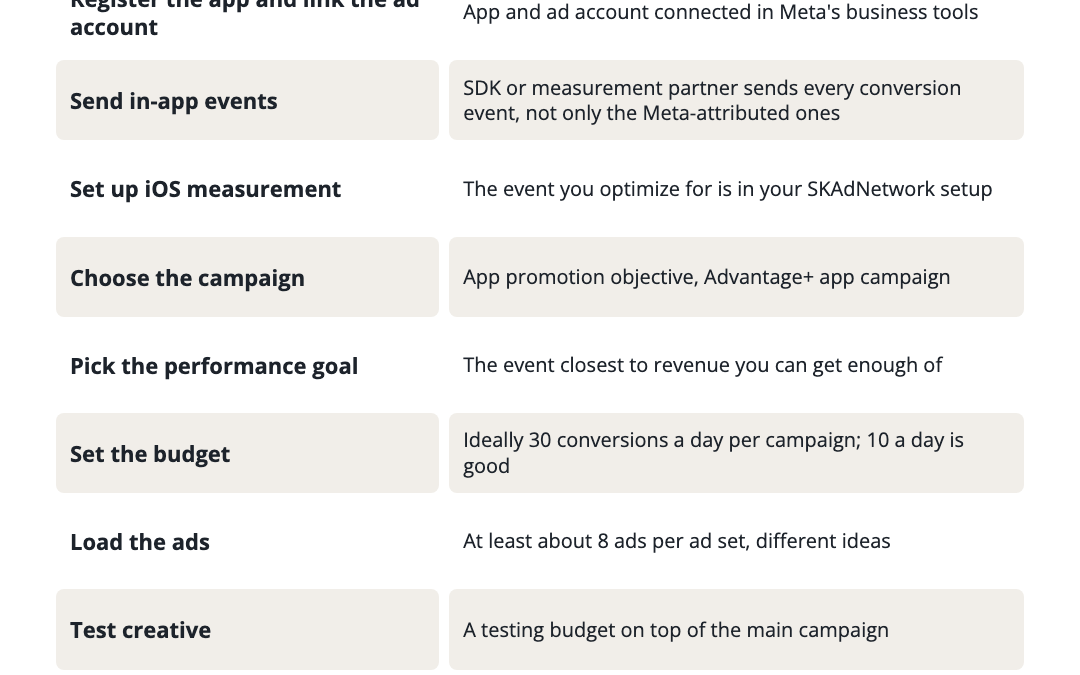
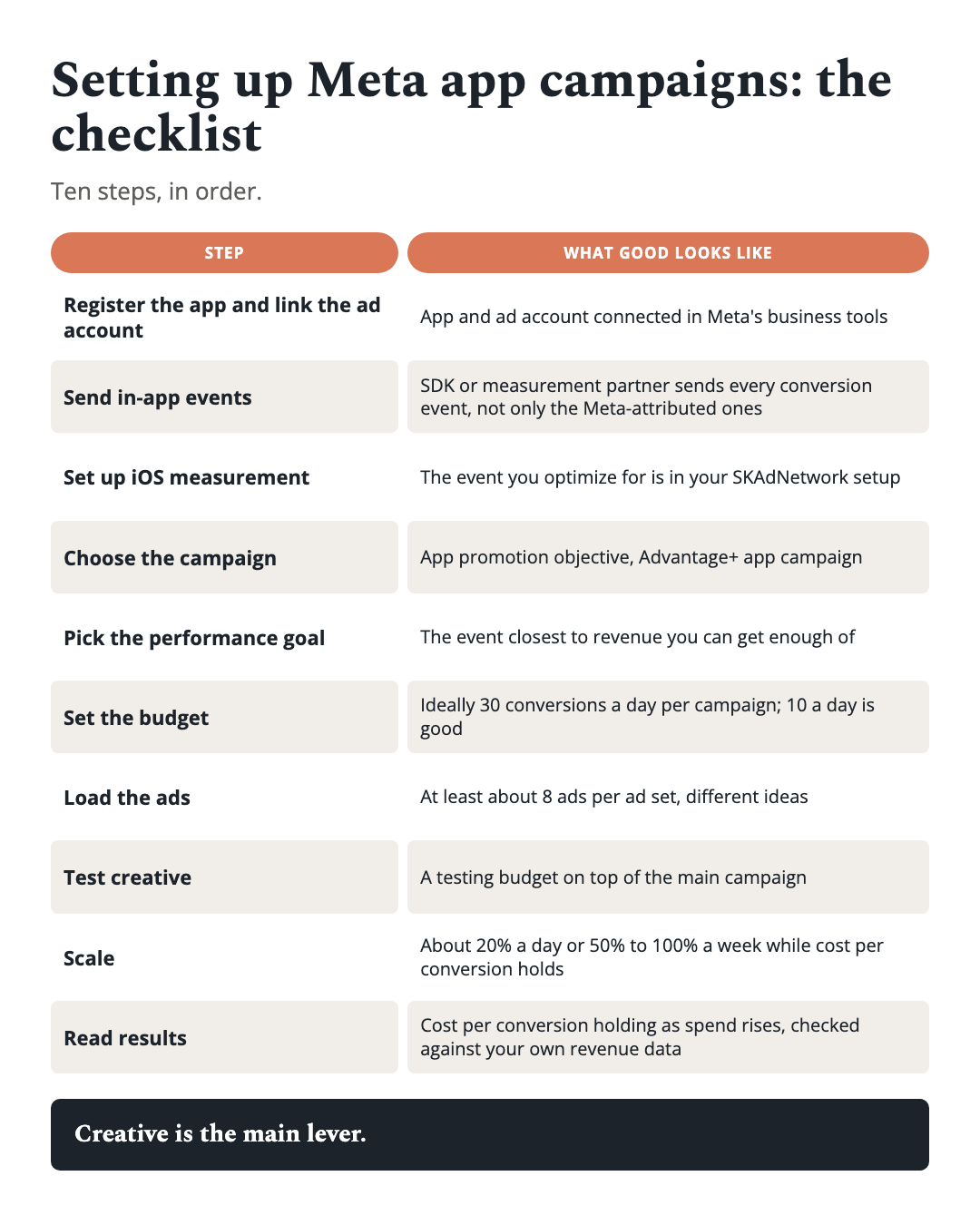
Short answer: most Meta ads for mobile apps now run as Advantage+ app campaigns under the App promotion objective. You register the app, send in-app events through the Facebook SDK or your measurement partner, pick a performance goal close to revenue, and give the campaign a broad audience and plenty of ads. Set the budget as a number of conversions a day: ideally 30 per campaign, and 10 a day is good. Creative is the main lever, so keep a testing budget on top for new ads. When something works really well, scale it by about 20% a day or 50% to 100% a week, as long as your cost per conversion holds.
Page Contents
How do Meta app campaigns work today?
You choose the App promotion objective when you create the campaign. Meta says it used to be called App installs, which is why older guides use that name.
Within it you set a performance goal, which tells Meta what to find people for:
- Maximize number of app installs: people likely to install.
- Maximize number of app events: people likely to install and then take an action you choose, such as a purchase. This is app event optimization.
- Maximize value of conversions: people likely to spend the most.
- Maximize number of link clicks: clicks to the store, rarely the right goal for an app.
Most app advertisers now run Advantage+ app campaigns. You give them a country, a language and an operating system, plus your ads, and Meta handles who sees them and where. You can still build an app campaign manually with your own ad sets and audiences, but for most apps the automated version is where to start, and the targeting that matters is in the ads themselves. Our comparison of broad targeting and interest-based targeting goes into why layered interests rarely help app campaigns.
For most apps Meta is also the first channel to make work before you add others.
How do you set up your account, SDK and measurement partner?
Measurement comes before spend: a campaign optimizing on bad data gets very good at finding the wrong people.
- Register your app with Meta and link it to your business and ad account. Without that, Meta’s app ads cannot optimize for what happens in the app.
- Send in-app events. Use the Facebook SDK, a mobile measurement partner, or both. If you use a measurement partner, send all conversion events, not only the ones it attributes to Meta. Meta optimizes on what it is told, and leaving out conversions from other sources gives it a partial picture.
- Keep the event list short and meaningful. Track the few actions that show a user is worth something: signing up, finishing onboarding, starting a trial, purchasing.
- Set up iOS measurement. Your app has to be eligible for Meta’s Aggregated Event Measurement or Apple’s SKAdNetwork. With SKAdNetwork, add the event you want to optimize for to your SKAdNetwork configuration in Events Manager, or you cannot select it.
- Test before launch. Install the app from a test device, take the key actions, and confirm each event shows up in Events Manager and in your measurement partner.
How should you structure Meta app campaigns?
There is no fixed number of campaigns or ad sets. What matters is that each ad set has two things: enough conversions a day for you to read it, and enough ads for Meta to choose between. We typically recommend at least about 8 ads per ad set.
For most apps that works out to one campaign per platform and goal, with a small number of ad sets, so the budget is not spread so thin that nothing gets enough conversions to judge. A new campaign makes sense when something genuinely differs: a different country with different economics, a different operating system, or a different performance goal you want to compare.
Keep testing separate from scaling where you can, so new ads that are still unproven don’t drag down the campaign carrying your results. How to set those tests up is in how to structure creative tests for Meta ads.
What should you optimize for?
Pick the event closest to revenue that you can get enough of every day.
Two things pull against each other. An event close to revenue, such as a purchase, tells Meta exactly who your valuable users are, but it happens less often. An event early in the funnel happens often but may not predict who pays. Check it in your own data: of the users who did this, how many went on to pay? An event that non-payers trigger as often as payers teaches Meta to find the wrong people.
Install optimization fits when your events are not tracked yet or the install is genuinely what pays you. App event optimization fits most apps that earn from what people do after installing. Value optimization fits when what users spend varies a lot and you send purchase values reliably. When unsure, test them against each other with everything else the same. The full comparison is in what AEO is in Meta ads.
Subscription apps have their own wrinkles, including web-to-app funnels, covered in Meta ads for subscription apps.
How much budget do Meta app campaigns need?
Think of budget as a number of conversions, not a number of dollars.
The platform needs enough conversions to find more of the right people, and you need enough to judge your ads. Ideally that is 30 conversions a day per campaign. 10 a day is good, and it is what lets you test creative rigorously enough to unlock scale. On a small budget, 1 or 2 a day is fine; we would not spend more just to hit a benchmark.
The arithmetic follows from your own numbers: your cost per conversion, times the conversions a day you want, times 30 for a month. Then add a testing budget on top, because the ads you are testing need their own conversions to reach a decision.
You may have read that Meta needs 50 conversions a week per ad set before it works. That is really old guidance, and we would avoid it: why the 50-conversions-a-week rule is dated.
Why is creative the main lever?
Creative is the single most important lever for paid performance on Meta. With targeting handed to the platform, your ads decide who stops, who installs and what they expect from the app. An ad that sets up the product’s real value brings in people more likely to take the action you optimize for.
That means two jobs run every week.
Find new winners. New ideas: a different claim, a different pain, a different reason to install. Meta also needs variety; if every ad makes the same point, the campaign keeps finding the same people. Measuring creative diversity in your Meta account shows how to check where your spend actually goes.
Extend the winners you have. New openings, new people on camera, new formats. Start the moment an ad becomes your clear top performer rather than waiting for it to tire; the order we make them in is in how often to refresh a winning ad.
Fund both from a testing budget that sits on top of what your main campaign needs, so testing never starves the campaign that is carrying your results.
How do you scale Meta app campaigns?
When something is working really well, scale it. About 20% a day if you want to move steadily, or 50% to 100% a week if you want to move aggressively. Both are fine.
What earns each step is that your cost per conversion holds as spend rises. If it climbs and stays up, stop adding budget and look at the ads first: a campaign that stalls on the same few ads often has room again once new creative starts working. The full playbook is in how to scale a Meta ads budget for app campaigns.
How do you read the results?
The question is whether your cost per conversion holds as you spend more, and whether those conversions turn into revenue at a cost your economics allow.
- Read trends, not days. At a handful of conversions a day, cost per conversion moves around for reasons unrelated to your ads. Judge over a week or more, and avoid changing things every day in reaction to noise.
- Look past the event. A campaign can hit its cost per conversion and still bring in people who never pay. Check retention and revenue for the users it brought in.
- Don’t judge on cost per install. The cheapest installs are often the least valuable users.
- Treat iOS numbers as estimates. On iOS, Apple’s SKAdNetwork, now extended as AdAttributionKit, sends a delayed, aggregated and coarse signal, and part of what Ads Manager shows is modeled. Compare it against your measurement partner and your own revenue data rather than taking any one source as the truth. How to fix mobile attribution on iOS sets out how we build that.
What are the most common mistakes?
- Launching with broken or partial tracking, so Meta optimizes toward people who don’t convert.
- Optimizing for an event you get too few of to read, or one that does not predict revenue because it is cheap and plentiful.
- Spreading the budget so thin that no ad set gets enough conversions a day to judge.
- Running too few ads, or too many versions of one idea, so the campaign has nothing new to find people with.
- Layering interests and audiences on campaigns that do better when the ads do the targeting.
- Chasing cheap installs instead of users who stay and pay.
- Reacting to daily swings instead of reading the trend.
If you are weighing whether to run this in-house or with a partner, how to evaluate a mobile growth and user acquisition agency covers what to ask. We run user acquisition and creative together for apps and games, and most of the work above happens in the creative.
Frequently asked questions
What is Advantage+ for app ads? Advantage+ app campaigns are Meta’s automated app campaigns under the App promotion objective. You set a country, a language, an operating system and a performance goal, add your ads, and Meta decides who sees them and where. For most apps it is the place to start.
What kind of campaigns can I run for an app in Meta ads? App campaigns use the App promotion objective, either as an Advantage+ app campaign or set up manually. Within it you choose a performance goal: installs, an in-app event, the value of conversions, or link clicks.
How do you set up Facebook app install ads step by step? Register the app and link it to your ad account, send in-app events through the Facebook SDK or a measurement partner, add your optimization event to your SKAdNetwork setup on iOS, create an App promotion campaign, pick a performance goal, set the budget and load at least about 8 ads per ad set.
Is $10 a day enough for Facebook ads for an app? It depends on your cost per conversion. If $10 a day buys one or two conversions, it is a reasonable start on a small budget, and we would not spend more just to hit a benchmark. To test creative properly, aim for about 10 conversions a day per campaign, and ideally 30.
How much does a Meta app campaign cost? Work it out from conversions: your cost per conversion, times the conversions a day you want (ideally 30, 10 is good), times 30 for a month, plus a testing budget on top for new ads.
What is the 20% rule on Facebook ads? The idea that you should raise a budget by no more than 20% a day. About 20% a day is a fine steady pace for scaling a campaign that is working; 50% to 100% a week is fine too if you want to move faster. What matters is that your cost per conversion holds as spend rises.
Do you need 50 conversions a week for Meta app campaigns to work? No. That is really old guidance. Aim for enough conversions a day for Meta to find more of the right people and for you to judge your ads: ideally 30 a day per campaign, 10 is good, and 1 or 2 is fine on a small budget.