How much should a mobile game spend on user acquisition?


Copy prompt instead

A mobile game’s budget isn’t a dollar figure you pick. It falls out of a conversion number. Each campaign you want to scale ideally gets 30 conversions a day, and 10 a day is good. When a conversion costs $400 or $500, 2 or 3 a day is what you work with. None of this is fixed, but at least 10 a day is what lets you test creatives properly. Monthly budget is cost per conversion, times conversions a day, times 30. At a $40 cost per conversion, that is $12,000 a month at 10 a day and $36,000 a month at 30 a day, for one campaign on one platform, before creative testing.
Page Contents
Why is a dollar figure the wrong place to start?
Because the same budget means completely different things for different games. $5,000 a month buys a steady flow of conversions for a casual title that pays a few dollars each, and almost nothing for a game whose conversions cost $150.
Studios often set a budget from what is left after development. That says nothing about whether the ads will work. What does is the number of conversions each campaign gets every day: enough for the algorithm to find more players like the ones who converted, and enough for you to see which ads are pulling their weight. The budget is simply the price of those conversions.
How many conversions a day does a mobile game campaign need?
Ideally 30 a day for each campaign you want to scale. 10 a day is good. And if your cost per conversion is extremely high, in the $400 to $500 range, you make do with 2 or 3 a day.
You can absolutely run a campaign on 1 or 2 conversions a day. On a small budget, we certainly don’t recommend spending more just to hit a conversion benchmark, especially if you are an early-stage studio with unproven performance. If you want to rigorously test ad creative to unlock scale, we strongly recommend getting to 10 conversions a day, so that you get enough insights from a genuinely varied set of creatives across directions, angles, hooks and formats.
What 10 a day gets you. Platforms find players by learning from the people who already converted. On two or three conversions a day that sample is tiny, and your cost per conversion swings from one day to the next for reasons unrelated to the ads. At 10 a day you can make decisions.
What 30 a day gets you. At 30 a day the algorithm has a steady stream of signal, delivery settles, and a decision you make from this week’s numbers still looks right next week. More than 30 keeps helping.
When 2 or 3 a day is the reality. Some games pay $400 or $500 per conversion. At that price, 10 a day on one campaign costs $120,000 to $150,000 a month, which most studios can’t justify early on. So you run 2 or 3 a day, read results over longer windows and change fewer things at a time.
There is also a figure of 50 conversions a week that still circulates. That is really old guidance, and we would avoid building a budget around it. We explain why in the 50-conversions-a-week rule, revisited.
How do you calculate a mobile game marketing budget?
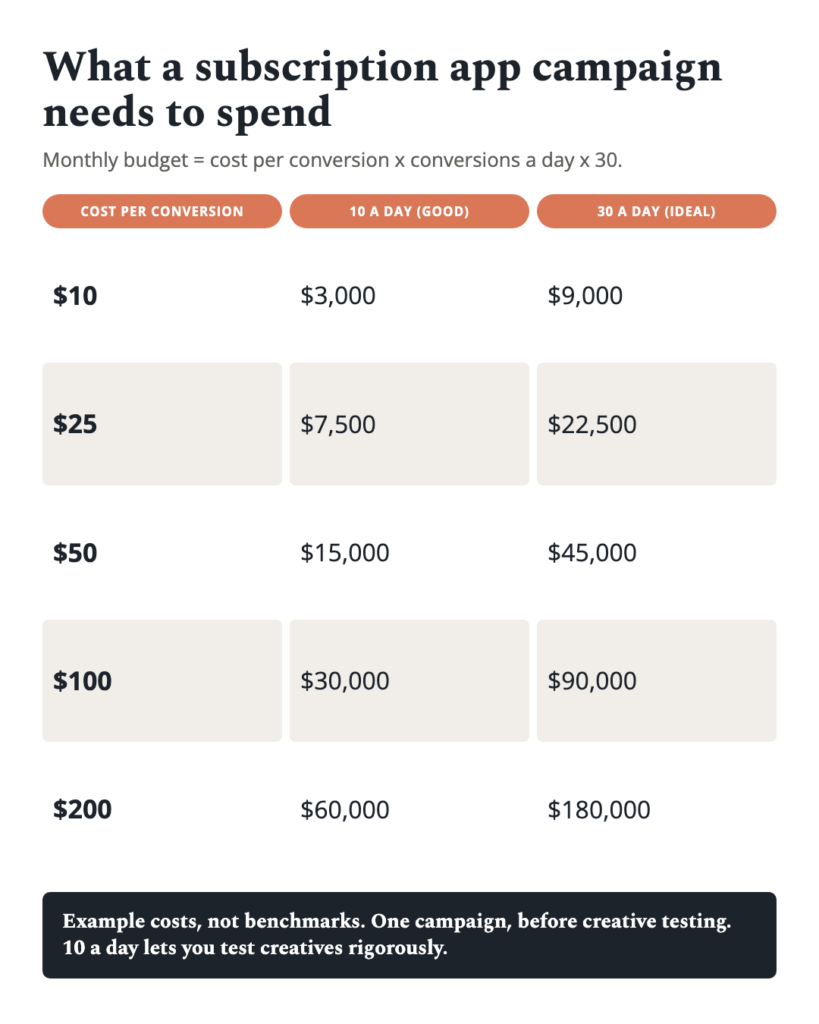
Monthly budget = cost per conversion x conversions per day x 30.
The table below runs that formula at a handful of example costs per conversion. They are examples to show the arithmetic, not benchmarks. Cost per conversion varies a great deal by genre, country and platform, so the only number that belongs in your formula is your own.
| Example cost per conversion | 10 a day: daily | 10 a day: monthly | 30 a day: daily | 30 a day: monthly |
|---|---|---|---|---|
| $5 | $50 | $1,500 | $150 | $4,500 |
| $15 | $150 | $4,500 | $450 | $13,500 |
| $40 | $400 | $12,000 | $1,200 | $36,000 |
| $100 | $1,000 | $30,000 | $3,000 | $90,000 |
| $200 | $2,000 | $60,000 | $6,000 | $180,000 |
Read the 10-a-day column as the cost of one campaign you can make sense of, and the 30-a-day column as the cost of one campaign that learns well enough to scale. At $400 to $500 per conversion, 2 or 3 a day comes to roughly $24,000 to $45,000 a month for a single campaign. If you have never bought traffic for this game, run a short test first to get a real cost per conversion.
Why does creative testing need its own conversions?
Because some ads will carry your game and most won’t, and only conversions tell them apart.
Start with one creative direction: one reason a player should want this game, whether that is the satisfaction of a puzzle, the fantasy of the world or the thrill of competing. You don’t test that idea with a single ad. Inside each direction you make several creatives with different angles, hooks and formats, and you run several directions alongside each other. A few of those creatives will do very well. Plenty will do badly.
Separating the two takes enough conversions per ad to reach a statistically significant result. Four conversions on one ad against six on another is noise that can reverse tomorrow. Spread a thin budget across too many ads and you will pause the winners and keep the losers.
So testing sits on top of the campaign you are scaling. That campaign needs its 10 to 30 a day; the creatives in test need enough conversions each to reach a verdict. Platforms also reward a varied mix of ads, which we cover in how to measure creative diversity on Meta, and the mechanics differ on ad networks, as in how to test ad creatives on AppLovin.
To see how many ads a budget can realistically test, try our free creative volume calculator. To check whether a test has enough data to call, use the creative testing calculator.
Does running Meta, Google and AppLovin change the budget?
Yes, and for games this is where budgets most often fall short. The conversion target applies to each campaign on each platform.
Games commonly run Meta, Google and AppLovin together. Each platform learns only from its own conversions, so each needs its own 10 to 30 a day. Three platforms at a $40 cost per conversion and 10 a day is $36,000 a month before any testing, not $12,000. Separate campaigns for new countries or a new game mode count the same way.
The common mistake is to spread a budget that would fund one platform well across all three, so none of them gets enough conversions to settle. Fund one campaign properly, prove it, then add the next. Which platforms suit which games is in the best paid channels for mobile user acquisition, and how testing differs between the two biggest is in AppLovin vs Meta for creative testing.
For subscription apps, see how much a subscription app should spend on marketing.
Why do agencies set a minimum ad spend?
The minimum comes straight from the arithmetic above. Add one campaign at a healthy conversion rate, then creative testing with several creatives per direction across angles, hooks and formats, then room to scale what wins, and at the costs per conversion most games see you land in the tens of thousands of dollars a month.
That is why we set a $50,000-a-month minimum in ad spend. Below that, a creative programme can’t generate results you can trust. We lay out the full reasoning in the minimum ad spend to work with a performance creative agency, and what an agency charges on top of spend in how much a user acquisition agency costs.
Is RocketShip HQ a fit?
If your game’s conversion arithmetic, across the platforms you run, comes to $50,000 a month or more in ad spend, we are worth a conversation. RocketShip HQ works with game studios on Meta, Google and ad networks like AppLovin, and most of our effort goes into the creative testing layer described above: thousands of ads a month, AI and human generated, tested across directions, angles, hooks and formats until the winners show. Our mobile game marketing agency page covers how we work with studios, and whoever you speak to, bring these questions for any user acquisition agency.
Frequently asked questions
How much does it cost to market a mobile game? It depends on your cost per conversion and how many platforms you run. Each campaign you want to scale needs ideally 30 conversions a day, and 10 a day is good. Multiply your cost per conversion by that number, then by 30, for each campaign’s monthly budget, and add creative testing on top.
How much does a mobile game ad cost? There are two costs. Running the ad costs whatever you pay per conversion, which varies widely by genre, country and platform, so a short test is the only reliable way to learn yours. Making the ad is a separate production cost, and because you need several creatives per direction, production volume matters as much as the price of any single ad.
What is a typical mobile game marketing spend? There is no typical figure worth copying. One campaign at 10 to 30 conversions a day can cost from a few thousand dollars a month to six figures, depending on cost per conversion. Running Meta, Google and AppLovin together multiplies that, since each platform needs its own conversions.
How much does it cost to advertise a mobile game on Facebook? Work it out from conversions. At an example $15 cost per conversion, 10 a day is $4,500 a month and 30 a day is $13,500 a month for one campaign. At an example $100, the same targets cost $30,000 and $90,000.
Is $10 a day enough for Facebook ads? For a mobile game, rarely. $10 a day reaches 10 conversions a day only if each costs $1. At more usual costs it buys one conversion a day or fewer, too little for the algorithm to learn from or for you to judge any ad.
What is a good mobile game user acquisition cost? The good number is one your game earns back from the players it brings in. Because cost per conversion varies so much by genre and country, compare it to your own player revenue rather than to an outside benchmark.
Is it better to run one platform or several? Start with one and fund it properly, at 10 to 30 conversions a day. Add Google or AppLovin once that campaign is working, and give each new platform its own conversion budget.
Published