Short answer: for most subscription apps, start with Apple Search Ads and Meta. Apple Search Ads has a ceiling because it is intent-driven: it only reaches people already searching. Meta is where you scale. Then add channels as your monthly spend grows, not because a competitor is on one: Google on iOS and TikTok at $50K to $150K, ad networks at about $200K, programmatic at $250K and up. Judge each test on its trend and on payback by cohort, and cut what does not pay back.
Page Contents
How did we grow a subscription app 50x in 11 months?
I grew a subscription app 50x in 11 months. Monthly ad spend went from $30K to $1.5M. That was a few years ago, when TikTok was not yet a prominent channel. The platforms have changed. The principle has not.
What made the biggest difference was when we added each new channel. Each one arrived when the one before it was running hard enough that payback started to slip, and each got its own budget and its own creative before anyone judged it. I have seen the same pattern many times since: growth stalls when you stay on one channel after it has topped out, or spread across five before any of them works.
Why does timing matter more than the channel list?
Every channel has a ceiling, and every channel has a minimum spend at which it can be read. Arrive before that and you learn nothing, because the data is thin and the channel is starved of creative. Arrive after your current channel has topped out and you paid for growth you could have had cheaper.
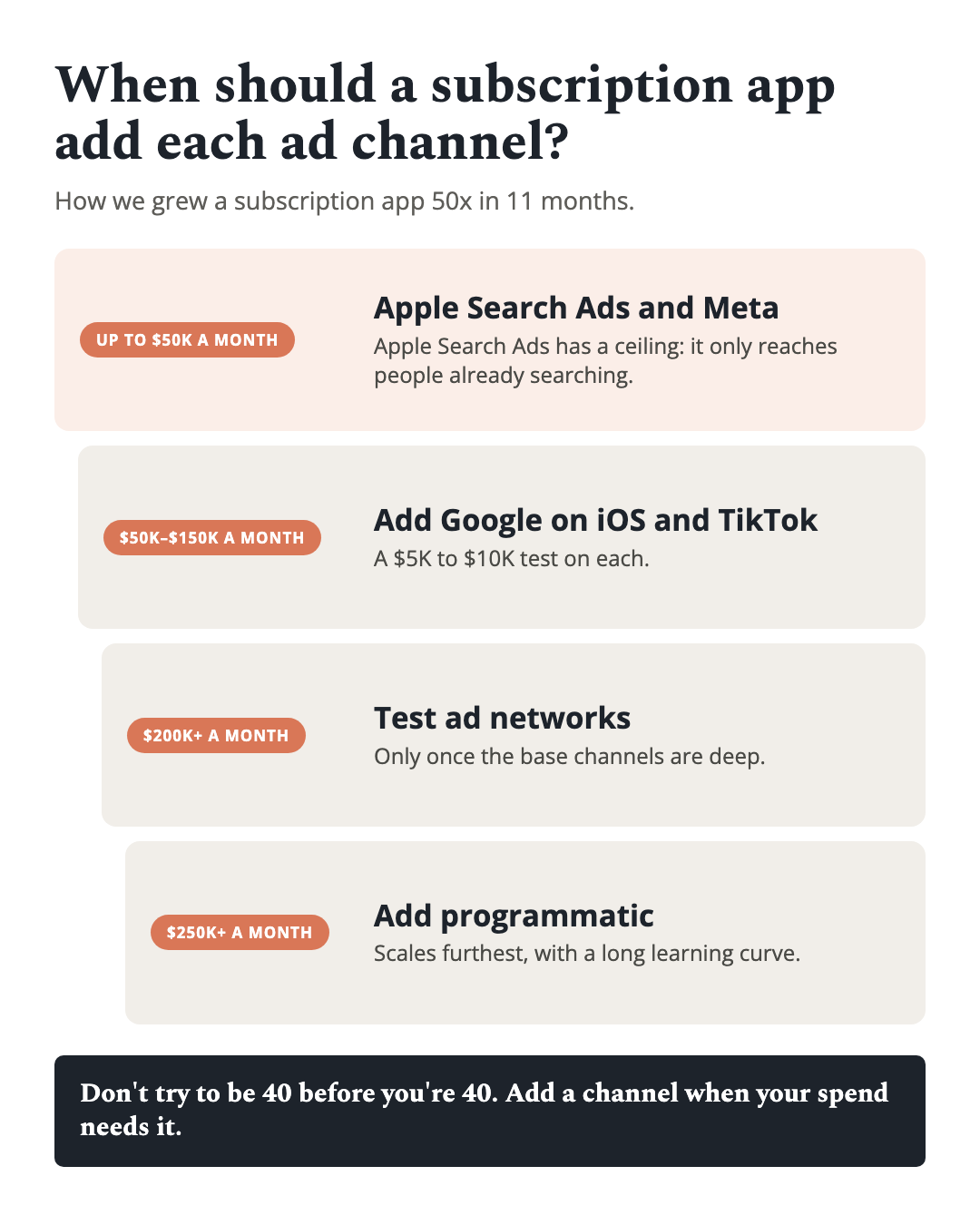
Don’t try to be 40 before you’re 40. Run programmatic at $50K a month and you will lose your shirt: you cannot give it the budget or event volume to learn. You are early, not wrong.
Which ad channels should a subscription app run at each spend level?
Amounts are monthly ad spend and rough guides; your CPA and event volume move them.
| Monthly ad spend | What to run | Why |
|---|---|---|
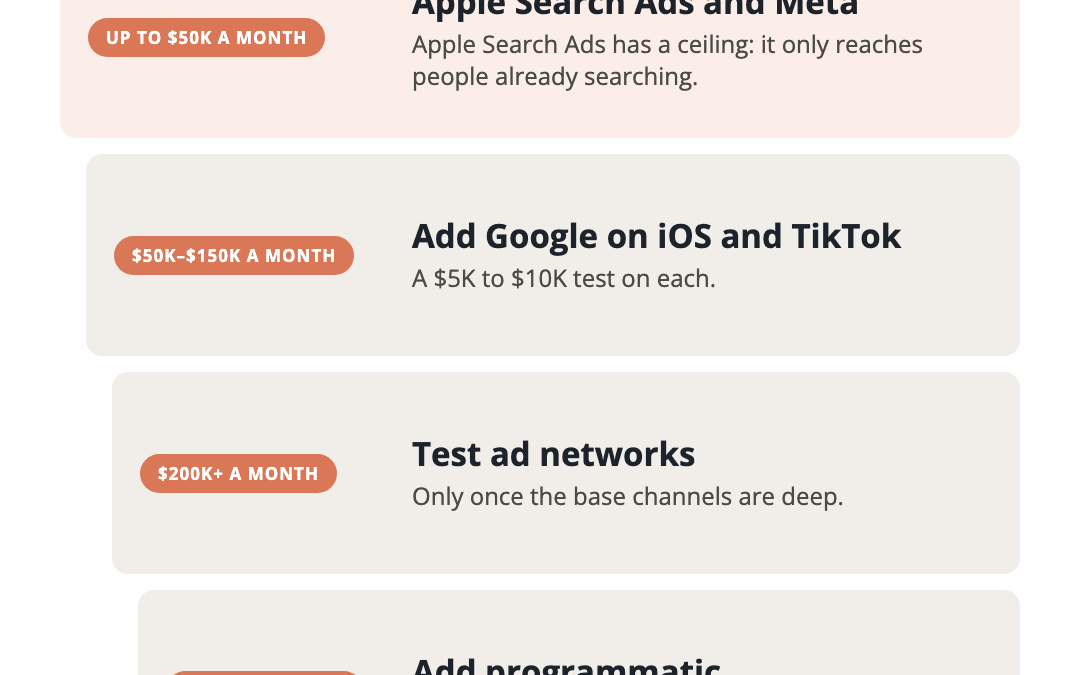
| Up to about $50K | Apple Search Ads and Meta | Apple Search Ads is intent-driven, so it has a ceiling. Meta is where you scale. A brand built for TikTok can start there instead. |
| $50K to $150K | Add Google on iOS and TikTok, $5K to $10K test budget each | Meta is deep enough to fund two real tests without starving the base. |
| About $200K and up | Test ad networks | The base channels are deep enough that this is a test, not a bet. |
| $250K and up | Programmatic | Massively scalable, with a long learning curve. It may take $30K to $40K to evaluate, depending on CPA and event volume. |
Affiliate rarely works for subscription apps. In my view that holds for gaming and most subscription apps; fintech and some utility apps can make it work, around $150K a month.
Head to head: Meta vs TikTok and Google vs Apple Search Ads vs Meta.
How do you pick your first ad channel?
Start from your product and creative, not a platform’s reputation. Ask where your buyers can be reached and whether you can feed it:
- Reach: people who already search the App Store suit an intent channel. A product people do not know they need has to be shown, which suits discovery.
- Feeding it: a starved channel looks worse than it is.
For most subscription apps that means Apple Search Ads and Meta. Search quality is usually high, but you cannot buy more searches than people make. Meta reaches almost every buyer and shows you fast which message and offer produce paying users. See Apple Search Ads for subscription app growth and Meta ads for subscription apps. The exception is a very distinctive brand and product whose story belongs on TikTok.
What should a channel prove before you add the next?
- It scales at your target payback. If payback worsens as soon as you spend more, you have a ceiling, which is the real reason to add something.
- You have a creative engine. Winners get variants and new concepts keep arriving. One lucky ad proves nothing.
- Your measurement reconciles. Platform numbers line up, within reason, with your revenue by cohort.
Adding a channel is a response to a ceiling, not a date on a calendar.
How do you judge a channel test?
Budget $5K to $10K to see whether the channel is going anywhere. You are looking for direction, not a verdict in week one.
- Improvement from week 1 to week 2 to week 3 means keep investing, even before you hit your CPA target. A channel that is improving is learning.
- Products with a $100+ CPA or LTV need bigger starting budgets, since a smaller one never produces enough conversions to show a trend.
Then judge by what users do after the install. Read each channel on trial-to-paid rate, payback by cohort (how long until a period’s revenue covers its acquisition cost), and renewals and refunds. Set your target payback before you test, so a rule you chose in advance makes the call, not that week’s dashboard.
What does each ad channel need from a subscription app?
Every channel needs creative made for it. Meta wants several distinct short videos and statics. TikTok wants vertical, sound-on, creator-style video, in more volume than the others; see how to test ad creatives on TikTok. Apple Search Ads wants screenshots and product pages matched to search intent. Google wants assets it can recombine; see how to structure Google app campaigns.
A winning concept can travel but must be remade; see how to adapt winning ad concepts across platforms and how to build a creative testing roadmap.
How do web-to-app funnels and iOS measurement change the choice?
A web funnel you control often makes discovery channels easier to read; see web-to-app funnels for subscription apps. On iOS, reconcile every channel to your own revenue by cohort; see how to fix mobile attribution on iOS.
When should you cut a channel?
When it fails your rule after a fair test: payback stays outside target after real creative and enough time, its users churn or refund so much that the first payment hides a loss, you cannot feed it, or its numbers will not reconcile to revenue. Cutting is not failure: the learning moves to what pays back.
Frequently asked questions
Which ad channel should a subscription app start with? Apple Search Ads and Meta, for most subscription apps. Apple Search Ads has a ceiling because it is intent-driven; Meta is where you scale. A brand built for TikTok can start there.
When should a subscription app add Google and TikTok? Around $50K to $150K a month, with a $5K to $10K test budget each. Google on iOS is the natural addition; TikTok suits products that work as native video.
When should you try ad networks or programmatic? Ad networks at about $200K a month and up. Programmatic at $250K and up: it scales massively but has a long learning curve and may take $30K to $40K to evaluate. At $50K a month it will cost far more than it returns.
Does affiliate work for subscription apps? Rarely. Fintech and some utility apps can make it work, around $150K a month.
How much should you budget to test a new ad channel? $5K to $10K to see whether it is going anywhere. Products with a $100+ CPA or LTV need more.
Which ad channels work best for a subscription app on iOS? Start with Apple Search Ads and Meta. Apple Search Ads reaches people already searching, so it has a ceiling; Meta is where you scale. Add Google on iOS and TikTok from about $50K a month, with a $5K to $10K test on each.
Meta vs Apple Search Ads: which is better for a subscription app? They do different jobs: Apple Search Ads capture existing intent with capped volume, Meta creates demand and scales further. See Meta vs Apple Search Ads for iOS app installs.