They are not alternatives. They do different jobs, and the teams that treat them as a bake-off usually end up over-indexed on whichever one reports best rather than whichever one grows the business.
The short version:
| Meta | Google (UAC / App Campaigns) | Apple Search Ads | |
|---|---|---|---|
| What you are buying | Interruption. Demand you create. | A mix: search intent plus huge display and YouTube inventory | Pure intent. Someone typing your category into the App Store |
| The lever you control | Creative, almost entirely | Creative plus feed and event quality | Keywords and bids |
| Scale ceiling | Very high | Very high, arguably the highest | Limited by search volume |
| Typical CPI | Middle | Middle | Often lowest, but capped |
| Intent quality | Lowest at the top, improves with creative | Mixed by surface | Highest |
| Fails when | Creative volume is too low | Conversion signal is poor, or you expect to steer it | You expect it to scale past category demand |
You will notice there are no CPI benchmarks in that table. That is deliberate. Cost per install varies far more by vertical than by channel: a casual game and a fintech app on the same platform can be twenty times apart, so any cross-channel CPI band would be describing the apps in the sample rather than the channels. And CPI is the wrong number to benchmark anyway: what decides a channel is cost per paying user and whether the unit economics close, which a cheap install can hide. Compare the channels on what they are for, then benchmark cost per action against your own category.
Page Contents
The distinction that actually decides budget
Apple Search Ads harvests demand. Meta creates it.
Someone searching your category in the App Store already decided they want this kind of app. You are competing for a decision that has already been made. That is why the intent is high and why the ceiling is low: you cannot harvest more demand than exists.
Meta is the opposite. Nobody opened Instagram to find your app. You are manufacturing the decision, which is harder, which is why creative carries almost all the weight, and which is why the ceiling is so much higher.
Google sits across both. App Campaigns bundle genuine search intent with enormous display and YouTube inventory, which is why performance there can look strangely bimodal, and why feed and conversion-signal quality matter more than people expect.
The practical consequence: if your category has meaningful App Store search volume, Apple Search Ads is usually the cheapest efficient install you will buy, and it will run out. Meta is where you go when you have exhausted the demand that already exists.
Where creative matters most
This is the part most comparisons miss.
On Apple Search Ads, creative barely exists as a lever. You are bidding on keywords with store assets. Your work is keyword structure, match types and bids.
On Meta, creative is effectively the entire lever. Targeting is automated; you give the platform a budget, an event and a creative, and it finds people. Which means a Meta account that is underperforming is almost always a creative volume or creative quality problem, not a targeting problem.
Google is the hardest of the three to reason about. Creative matters, but App Campaigns are a black box: you hand over assets, a budget and a target, and the system decides where and how they run across search, display, YouTube and Play. You cannot see which asset ran where, and you cannot steer it much. Feed quality, event setup and signal density do real work alongside creative, and the ceiling is very high once it works, but making it work takes more patience and better conversion data than Meta does.
So the honest budget question is not “which channel is cheapest.” It is “where does my effort translate into performance?” If you have a strong creative engine, Meta rewards it more than anywhere else. If you do not, Meta will punish you for it more than anywhere else.
How to sequence them
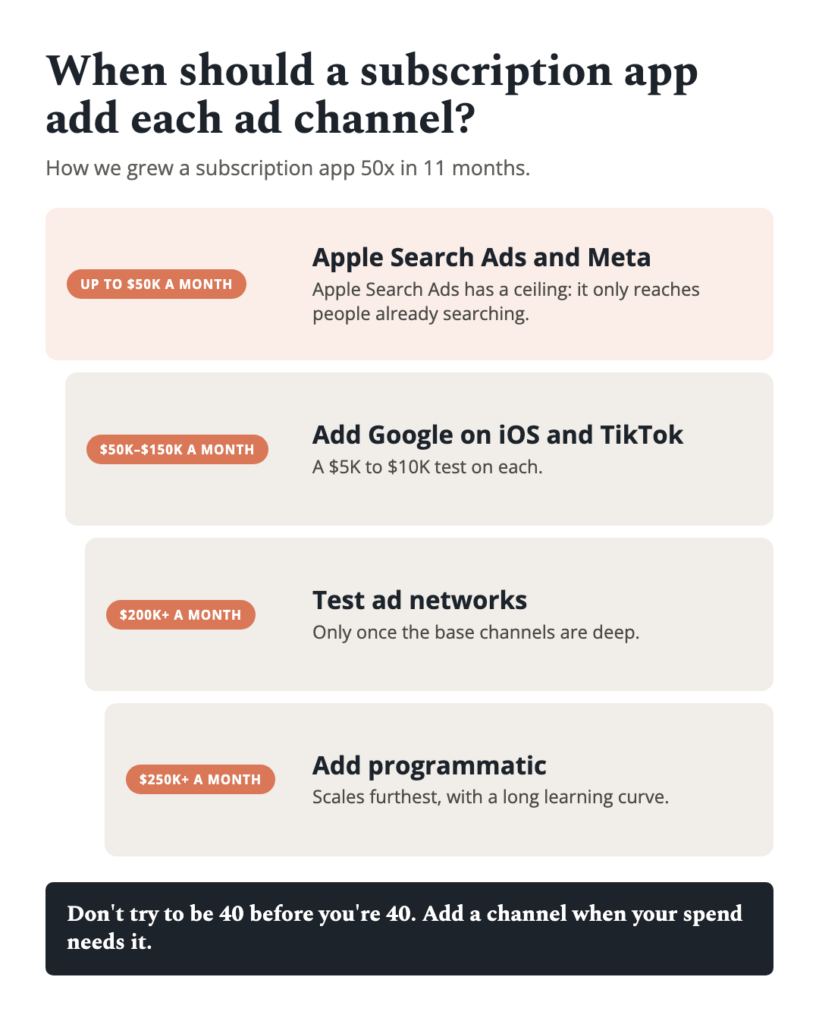
- Start where intent already exists. If your category has App Store search volume, take the cheap installs first. It is the fastest read on whether the store listing converts.
- Move to Meta when you need scale, and only once you can sustain creative volume. Meta without a creative pipeline is an expensive way to discover you need one.
- Add Google for reach and a different signal mix, once you have a conversion event worth optimising toward and enough volume to feed it. Expect it to take longer to make work than Meta, and expect a much higher ceiling once it does.
- Do not judge them on the same metric. Apple Search Ads will usually win on CPI and cannot scale. Meta will usually lose on CPI and can. Compare on contribution to growth, not on cost per install.
The measurement trap
These three do not measure the same way, and comparing their reported numbers directly is how teams make bad calls.
Apple Search Ads reports within Apple’s own ecosystem. Meta attributes with its own model. Google reports across surfaces that behave nothing like each other. Post-ATT, none of them sees the full picture on iOS, and all of them are incentivised to claim the conversion.
Triangulate against your MMP and your own first-party revenue, and expect disagreement. The disagreement is information, not an error to be resolved. The iOS side of this, and how to set it up so the numbers can be trusted, is in how to fix mobile attribution on iOS.
TikTok is the fourth channel most teams ask about, and it behaves differently enough to need its own comparison: which drives more app installs, Meta or TikTok?
This post is part of our guide to how to choose a mobile UA agency.
Frequently asked questions
Which is better for app installs: Google Ads, Apple Search Ads or Meta? They do different jobs. Apple Search Ads harvests existing demand at high intent and low cost but cannot scale past category search volume. Meta creates demand, scales furthest, and puts almost all the weight on creative. Google sits across both and depends more on conversion signal quality.
Which channel has the cheapest CPI? Usually Apple Search Ads, because you are buying people who already decided they want your category. That number is not comparable to Meta’s, because Meta is manufacturing the decision rather than harvesting it.
Should I start with Apple Search Ads or Meta? If your category has meaningful App Store search volume, start there: it is the cheapest read on whether your listing converts. Move to Meta when you need scale beyond existing demand, and only once you can sustain creative volume.
Why does Meta performance depend so much on creative? Because targeting is largely automated. You supply budget, a conversion event and a creative, and the platform finds the audience. The creative is the variable you control, so it becomes the main determinant of performance.
Can I compare the three platforms’ reported numbers directly? No. Each attributes differently and none sees the full iOS picture post-ATT. Triangulate against your MMP and first-party revenue rather than trusting any single platform’s report.