No, and the most interesting version of that answer comes from someone selling AI video generation.
Alexei Chemenda is the founder and CEO of Poolday.ai, an AI video platform. He also owns and operates around 22 apps on the App Store and spends roughly $300,000 a month on ads across them. On a webinar with us he described what happened when his team compared AI-written scripts against scripts a human wrote first:
“We saw that the results were insanely better, and when I say insanely, meaning more than three to four XS on performance on the backend. The performance was insanely better when the person wrote the initial script.”
Three to four times better backend performance, on the human-written original. From the AI video vendor.
Page Contents
What AI was actually good for
He is not arguing against using AI. He is precise about which jobs it does well:
“The only two variables that we were able to do this at scale were actor and hook, meaning we tested 20 different actors for a given script.”
Actor and hook. Swap who delivers it, swap the opening line, hold the script. That is variant production, and it is genuinely valuable at volume. What it is not is authorship.
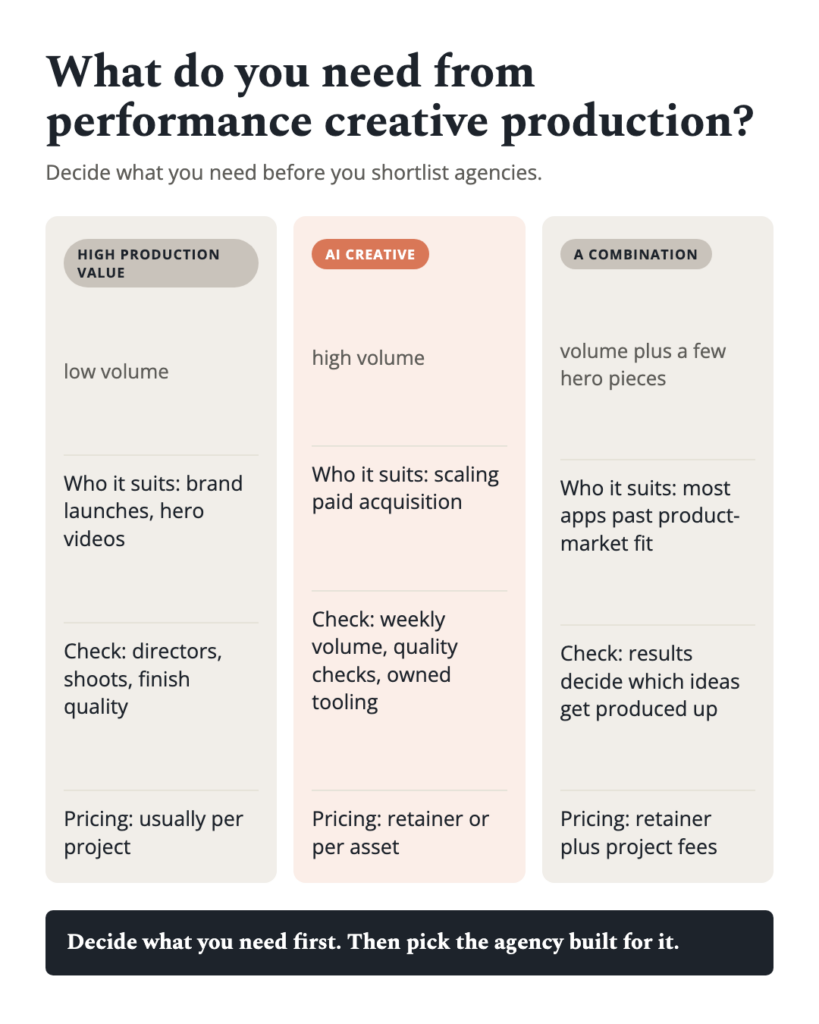
The division that falls out of this is clean: a human writes the original, AI multiplies it. Reverse those and you get the 3-4x penalty.
Where he says the human time belongs
Asked how you keep quality up while raising output, his answer went to the front of the process:
“That really comes down to the initial creative concepts designed by the marketing artist or whoever is working on those productions.”
And then, directly:
“So, I recommend spending more time on those original concepts rather than thinking about finding more iterations. That’s where the human side adds more value.”
Worth noting what this is not. He is not saying the split raises your throughput. He is saying it protects your quality once throughput is already high. Volume is a separate argument, which he makes separately:
“So we want to play the numbers game. One of the only ways to play the numbers game is to produce more videos.”
“Sometimes, we have a good idea, but we can improve it if we execute 200 or 20 versions of this particular idea.”
The numbers game is for finding the best execution of an idea you already believe in. It is not a substitute for having the idea.
The limit he is honest about
The most striking admission, again from the person with the most incentive to claim otherwise:
“we have never been able to put a video in one of those platforms and get an analysis from AI that says, Oh in this video, X Y and Z made it work. We’ve never been able to reach anywhere near that, at least nothing meaningful.”
AI can produce the variants. It cannot yet tell you why the winner won. Which means the read-and-decide loop stays human, and the volume you generate is only as useful as your ability to interpret what comes back.
What this looks like in practice
He described the testing structure as a waterfall across channels:
“if we dump like 100 to TikTok we’ll put probably 10, 15, 20 or so on Applovin. And from the 10 to 20 videos on Applovin a few will work like three to four probably will work and one will be extremely good and a few others will be good. Those will be the way to Meta.”
A hundred into TikTok, ten to twenty survive to AppLovin, three or four work, one is excellent, and that one earns Meta. The funnel is steep, which is the case for volume. But every one of those hundred started from a concept someone wrote.
On fatigue, so you know how long a winner lasts:
“the numbers we typically look at are around seven days. From when the performance starts slowing down, or the acceleration of scale and performance starts slowing down.”
And on the objection that volume requires a big budget, from someone spending $300,000 a month across 22 apps:
“First of all, I tell them I don’t have a budget either. So when I run for my apps, we spend 300k a month. It’s not bad, but it’s not millions of dollars every month. And relative to how many videos we produce, there is certainly nothing.”
The working split
- A human writes the original script. This is the step with the 3-4x performance difference attached to it. It is not the step to automate.
- AI multiplies actor and hook. Twenty actors against one script is a real use of the technology and cheap to run.
- Spend your human hours upstream. More time on original concepts, less on hunting for iterations, in Alexei’s framing.
- Keep the analysis human. No platform yet explains why a video worked, so the interpretation loop stays with you.
- Expect a steep funnel. Roughly a hundred videos to find one excellent one, with winners fading in about seven days.
This post is part of our guide to how to choose a mobile UA agency.
Frequently asked questions
Should AI write your ad scripts? Not the original. In a direct comparison run by Poolday.ai, scripts where a human wrote the initial version outperformed AI-written scripts by “more than three to four XS” on backend performance. The productive split is a human-written original that AI then multiplies.
What should AI be used for in ad creative production? Variant production. Specifically actor swaps and hook variations against a fixed human-written script, which is what Alexei Chemenda’s team was able to do reliably at scale.
Can AI tell you why an ad worked? Not yet, in the experience of an AI video platform’s own CEO: no platform has given them a meaningful analysis of what made a video work. Interpretation stays human.
How many videos do you need to find a winner? In the waterfall described, around one hundred videos sent to TikTok yields ten to twenty worth promoting to AppLovin, of which three or four work and one is extremely good.
How long does a winning creative last? About seven days before performance or the acceleration of performance starts slowing, though it varies from twenty-four hours to ten days.
Do you need a huge budget to test creative at volume? Alexei Chemenda spends around $300,000 a month across roughly 22 apps and describes that as “not bad, but it’s not millions of dollars every month” relative to the number of videos produced.