Everything you need to build AI-generated ad creative for ROAS, performance, and scale. From a team that’s made 50,000+ ads for 200+ brands.
Page Contents
Introduction
A couple of years ago, we wrote the definitive guide to UGC for performance marketing. It came out of making thousands of UGC videos and working with hundreds of creators. We learned, expensively, what actually drives installs and ROAS versus what just looks good in a pitch deck.
This guide is the sequel the market forced us to write.
In the last twelve months, AI video and image generation crossed a line. Model families like Sora, Veo, Runway, Kling, and Seedance can now produce footage good enough to test in a live ad account. We name families rather than version numbers on purpose. A new release lands every few weeks, and any number we print here will be stale by the time you read it. The same models can now put a believable, photorealistic person on screen without a single creator email. ElevenLabs can voice a script in any tone you want, in seconds.
The economics of producing an ad changed more in one year than in the previous ten.
But here is what did not change: most AI-generated ads still fail. Not because the technology is not ready. They fail because teams treat AI as a magic “make me a winning ad” button instead of a production layer underneath the same creative strategy that always worked. They generate a slick, weird, soulless clip, run it, watch it die, and conclude that AI does not work.
So let us pull back the curtain again, this time on AI-generated creative.
The one idea that matters most in this guide:
AI changes how you produce a creative. It does not change what makes a creative work.
The audience research, the strategic bet, the hook, the script, the overlay, the iteration discipline, the safe zones: all of it carries over almost untouched. A generated clip has to clear the same bars as a clip a real creator shot. It has to open a loop and withhold the answer. It has to live in one concrete situation. It has to sound like a real person with a point of view.
What AI collapses is the expensive middle: recruiting creators, directing remote shoots, waiting days for footage.
What AI raises in importance is the thing that was always the real bottleneck: taste, curation, and creative judgment. When generation is nearly free, the constraint is not making more. It is knowing what is worth making.
In this guide we start with the strategic bet, then walk through hooks, visual elements, scripts, iteration, and safe zones in the AI era. Then we go deep on the chapters that change the most: directing an AI generation instead of a remote shoot, making narrative-style video where generated characters actually talk to each other, and reaching the models directly instead of through someone else’s app. You also get a prompt-brief template, the current tool stack, and the hard-won rules for avoiding the uncanny-valley failure mode that kills most AI ads. We are also honest about when you should not use AI at all.
Whether you are adding your first AI-generated ad to the mix or trying to scale AI creative without making generic garbage, we hope this gives you a system you can run on your own team.
About RocketShip HQ. Full-service growth marketing agency. $100mm+ in managed ad spend. 50,000+ ads for 200+ brands. Meta Business Partner, Google Partner, TikTok Creative Exchange. If you are spending over $50K a month and want us to produce high-velocity creatives to unlock profitable scale, contact us directly.
Companion guide: this guide is about strategy, direction and production routes. For copy-paste prompt libraries and the iteration axes, see The Ultimate Guide to AI-Driven Creatives.
Chapter 0: The craft bars AI does not change
Before we teach you anything about prompts, models, or pipelines, we are going to tell you the part nobody selling you AI tools wants to admit: AI does not lower the bar. It just makes it cheaper to clear or to dodge.
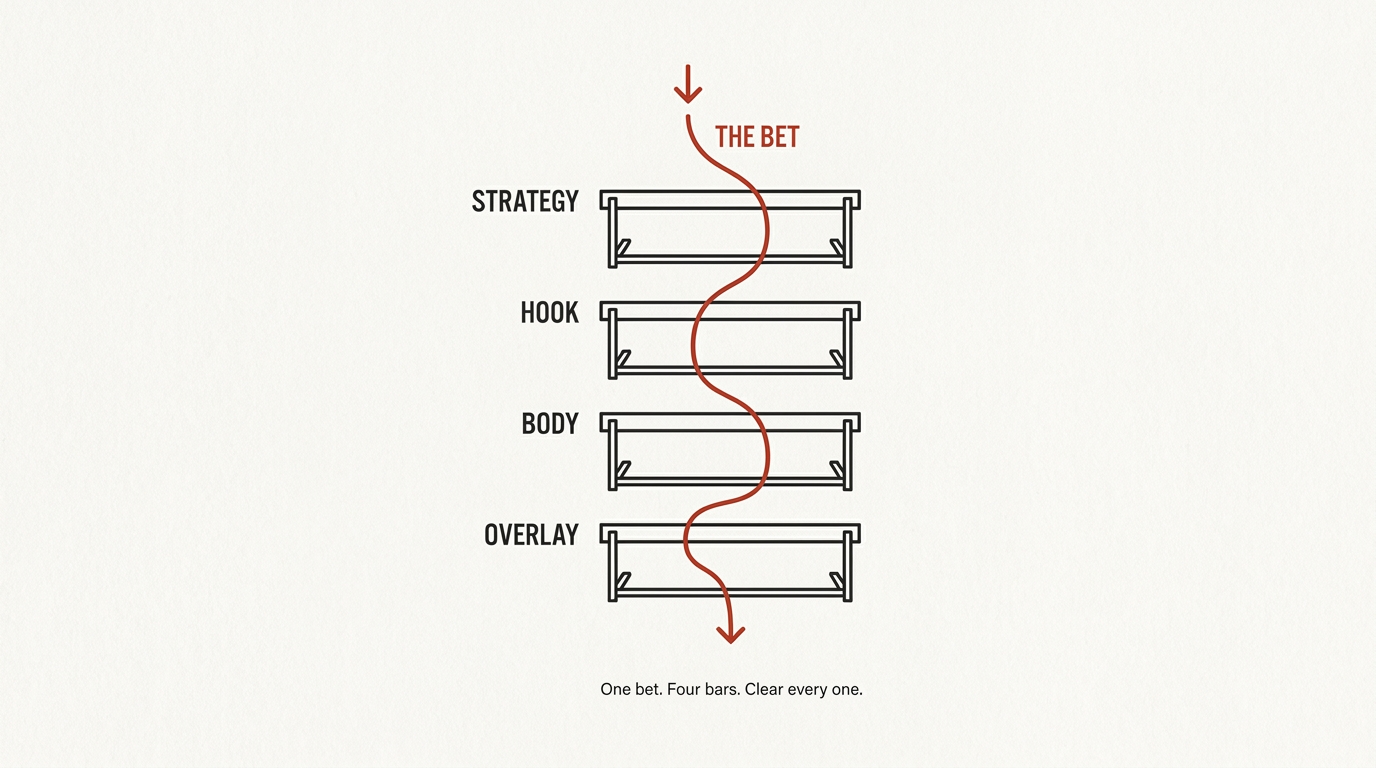
A winning creative, generated or shot on a real set with real people, clears four bars. Every single one. Skip one and you have what the timeline now calls “AI slop,” which is just the old word “bad” wearing a new jacket. These four bars are the spine of this entire guide. Learn them here, and the rest of the chapters are just deep dives.
1. The strategic bet (the spine)
Before a single frame exists, you answer five fields in the brand’s own words: the tribe, the enemy, the worldview, the transformation, and the cultural anchors. Not the agency’s words. Not the model’s words. Theirs.
This is the bar everything else hangs from, and it is the one AI makes easiest to skip. You can generate a pretty, hollow clip in ninety seconds without ever deciding what the ad is betting on, which is precisely why most AI ads die on arrival. (Full deep dive in Chapter 1.)
2. The hook bar: the withhold test
A hook opens a loop it does not close.
If the viewer can complete the thought from the hook alone, you wrote a slogan, not a hook. The test is mechanical: does the first line create a question the viewer needs the next line to answer? Withhold the payoff or there is nothing pulling them down the frame. (Full deep dive in Chapter 2.)
3. The body bar: lived specificity
Go deep on one concrete situation. Make the mechanism visible. Sound like an actual person who was actually there.
The test is brutal and simple: could only this one person, who lived this, have written it? If a competitor could paste their logo on it unchanged, it is not specific enough, it is a template. Generic copy is the default output of every model on earth. Specificity is the thing you have to force. (Full deep dive in Chapter 4.)
4. The overlay bar: the cover test
The first-frame text overlay must complement the visual, not caption it.
Run the cover test both ways:
- Cover the frame. The overlay alone should still open a loop.
- Cover the overlay. The frame alone should still say something.
If the overlay just narrates what we can already see, you wasted your most valuable real estate. (Full deep dive in Chapter 3.)
Why do AI ads look generic, and how do you avoid it?
Here is the rule that ties the whole thing together: strategy, hook, body, and overlay must all ladder back to a single bet.
Four nice pieces that do not share a bet is not a concept. It is four strangers in an elevator. And this is the new failure mode AI introduced, because AI can generate each piece independently, beautifully, and in isolation. A great hook bolted to an unrelated body bolted to a decorative overlay reads as incoherence, and incoherence is now the number-one way AI creative dies.
The craft did not move. The bars are exactly where they always were. AI just handed everyone a faster way to either clear them or fake them, and the whole rest of this guide is about making sure you do the former.
Chapter 1: The strategic bet
Every ad is a bet. It bets that a specific kind of person, stuck on a specific problem, will stop for a specific idea. Most ads never say what they are betting on, which means nobody can tell afterwards why they won or lost.
The strategic bet is where you decide that, in writing, before a single frame exists. It is the first of the four bars for a reason. A hook, a script, and an overlay can each be excellent and still fail together if they are not all serving the same bet.
The five fields
You answer five fields, in the brand’s own words. Not the agency’s words. Not the model’s words. Theirs.
- Tribe. Who they are and, just as important, who they refuse to be.
- Enemy. A specific, named failure. Not “inefficiency.” The actual thing that ruins someone’s Tuesday.
- Worldview. One contestable belief that makes the product obvious. If nobody could disagree with it, it is not a worldview, it is a platitude.
- Transformation. An identity shift, before to after. Who you become, not which feature you unlock.
- Cultural anchors. Three load-bearing specifics. Concrete, verifiable, theirs.
What this looks like filled in
Here are the five fields for three hypothetical apps. None of these are real products. The point is to see how specific each field has to get before it is useful.
| Field | A sleep app | A budgeting app | A word puzzle game |
|---|---|---|---|
| Tribe | People who are tired of being tired and have already tried the obvious fixes. Not biohackers chasing a perfect score. | People who earn decently and still feel broke. Not extreme couponers, not finance bros. | People who want ten quiet minutes that feel earned. Not competitive gamers. |
| Enemy | The 3am wake-up, and the next-day fog nobody else can see. | The end-of-month “where did it all go” moment. | The doom-scroll that eats the same ten minutes and leaves you feeling worse. |
| Worldview | You do not have a sleep problem. You have a wind-down problem. | Budgets fail because they are built on guilt. Seeing clearly works where restricting does not. | A small win beats a long scroll. |
| Transformation | From “I am just a bad sleeper” to “I know how to switch off.” | From checking the bank app with one eye closed to opening it on purpose. | From “I waste my breaks on my phone” to “my break is the sharpest part of my day.” |
| Cultural anchors | The phone on the nightstand. The second coffee at 2pm. Doing the maths on how much sleep you get if you fall asleep right now. | The forgotten free trial that renewed. Quietly panicking while splitting a dinner bill. The savings transfer you reverse on the 25th. | The crossword a parent did every morning. The word on the tip of your tongue. The one level you refuse to be beaten by. |
| The bet, in one line | Your sleep is fine. Your last hour awake is the problem. | You do not need more discipline. You need to see it. | Trade the scroll for a win. |
Notice what the weak version of each cell would have been. “Busy professionals.” “Stress.” “Better sleep is important.” Every one of those is true and none of them can be turned into an ad. The test for a filled-in field is whether a stranger could write a hook from it without asking you a follow-up question.
Score your anchors before you pick a mechanic
Here is the discipline most people skip: you do not pick a creative mechanic because it won for some other brand. You score your cultural anchors first, then you only use mechanics you actually have anchors for.
Take the budgeting app above. Each anchor naturally supports some mechanics and not others:
| Anchor | Mechanic it supports | The hook it produces |
|---|---|---|
| The forgotten free trial that renewed | Confession | “I paid for a meditation app for over a year. I meditated twice.” |
| The savings transfer you reverse on the 25th | Identity transformation | “I used to move money into savings on the 1st and move it back out on the 25th.” |
| Quietly panicking while splitting a dinner bill | Hyper-specific moment | “The bill came, someone said ‘just split it evenly,’ and my stomach dropped.” |
Now try to run a “naming the enemy” ad for this app. There is no anchor for it. No specific villain showed up in the research. You could invent one, and the ad would read as invented. So you do not make that ad. Empty cells are honest cells.
What AI changes about the bet
Almost nothing, and that is the point. AI is genuinely useful upstream of the bet: it can read thousands of reviews and cluster them into candidate tribes and enemies faster than any human, and it can draft ten candidate worldviews for you to argue with. Use it for that.
What it cannot do is choose. A model has no stake in which bet is true for this brand, so it will happily hand you five plausible ones and defend each equally. Picking the bet is a judgment call about the business, and it stays with a person.
Watch out. AI makes it trivially easy to skip this chapter. You can generate a beautiful clip in ninety seconds without ever deciding what it is betting on. When that ad dies, you will learn nothing, because there was no bet to be wrong about. Test bets, not variants. Ten versions of an ad with no bet is one failed test, run ten times.
Chapter 2: Create compelling hooks with AI
Before you write a single hook, do the unglamorous part: research your audience. A hook is not a clever line that came to you in the shower. It is a claim aimed at a specific person who is already having a specific argument in their own head. Your job is to find that argument and say it back to them.
Mine your user reviews along five dimensions. App store reviews, Reddit threads, support tickets, churn surveys. Read until patterns repeat, then sort what you find into:
- Personas. Who actually uses this? The overwhelmed parent, the late-night doom-scroller, the guy three paychecks from broke.
- Pain points. The thing that made them download. Said in their words, not yours.
- Alternatives. What they tried before you (a spreadsheet, a competitor, white-knuckling it).
- Benefits. The outcome they brag about after.
- Features. The specific mechanics that deliver the benefit.
This is what decides your messaging. Skip it and you are writing hooks about a product nobody asked for.
The bars every hook must clear
Forget “make a scroll-stopping hook.” That instruction has produced ten thousand identical ads. Here is the actual bar. A hook has to clear all seven:
- Opens a loop it does not close. It raises a question and refuses to answer it. The viewer has to keep watching to get resolution.
- Clears it: “I finally added up what I spend on subscriptions and had to sit down.”
- Misses it: “I was spending over two hundred dollars a month on subscriptions I forgot about.” The loop is already closed. There is nothing left to find out.
- Does one real scroll-stop job. Not a checklist of three. One job, done hard. (The jobs are below.)
- Clears it: “I lied to my partner about how much I spent last month.” One job: confession.
- Misses it: “Shocking confession: most people like you are wrong about budgeting.” Confession, peer gap, and inversion, all fighting for the same two seconds.
- Only this audience could say it. Specific enough that the wrong person scrolls past and the right person freezes.
- Clears it: “If you have ever reversed your own savings transfer on the 25th, this is for you.”
- Misses it: “Want to save more money?” So does everyone. Nobody freezes.
- Anchored in real, evidenced truth. It maps to something in your review mining. Invented drama reads as invented.
- Clears it: “I kept waking up at 3am and doing the maths on how much sleep I could still get.” Lifted almost word for word from a review.
- Misses it: “This app saved my marriage.” Nobody in your reviews said anything close to it, and the viewer can tell.
- Does not reveal the product or close the loop early. The second you name the app, the tension dies.
- Clears it: “I had given up on ever sleeping through the night.”
- Misses it: “With this sleep app, I finally sleep through the night.” Product named, outcome delivered, video over.
- Flows into the body. The hook writes a check the next three seconds cash.
- Clears it: the hook says “I found the one charge that was quietly wrecking my month,” and the body opens on the bank statement with that charge circled.
- Misses it: the same hook, and then the body opens on a feature tour. The viewer was promised a charge and got a dashboard.
- Sounds like a real person read aloud. Not a staccato stack of fragments. Say it out loud. If it sounds like an ad, rewrite it.
- Clears it: “I honestly thought I was just bad with money.”
- Misses it: “Broke. Stressed. Done. Until this.” Nobody has ever said that sentence to another human being.
Jobs a hook can do
Pick one. These are proven winners, not a closed list:
- Confession. Admit something a little embarrassing. “I had $40,000 in credit card debt and a $7 latte habit I lied about.”
- A personal diagnostic number. A figure about them that stings. “You are losing 6 hours a week to this and you have no idea.”
- How I found out I was wrong. Set up a belief, then signal it shattered. “I thought I was a bad sleeper for ten years. It turns out I was doing one thing wrong at 10pm.”
- Counterintuitive inversion. Flip accepted wisdom. “Budgeting is why you are broke.”
- Identity transformation. Before-and-after self. “I used to be the person who checked their bank app with one eye closed.”
- Naming the enemy. Point at the villain (the algorithm, the 22% APR, the snooze button). “Your bank is counting on you never reading this one line of your statement.”
- Hyper-specific timing or number. “At 2:47am I finally figured out why I could not sleep.”
- The peer gap. Everyone like you already knows this except you. “Everyone in my group chat already does this with their paycheck, and nobody told me.”
- The cancel-reverse. “I was about to cancel. Then this happened.”
Good to great: the intensify formula
Take a decent hook and stack two or three of these. Never all four (that reads as trying too hard):
- Surprising. Contradicts what they believe.
- Self-implicating. Makes them think “wait, is this me?”
- Specific. A concrete number, time, or object.
- Costly. Not knowing this is costing them something real.
Here is one hook climbing the ladder, one layer at a time:
| Version | What was added | The hook |
|---|---|---|
| Decent | Nothing yet | “I started tracking my spending and it really helped.” |
| Better | Specific | “I tracked every dollar I spent for 30 days.” |
| Good | + Self-implicating | “I tracked every dollar I spent for 30 days and found out the problem is me.” |
| Great | + Costly | “I tracked every dollar for 30 days and found the one habit that has been costing me a vacation every single year.” |
Stop there. Bolt on a fourth (“and nobody believes what it was”) and it starts to sound like a carnival barker. Two or three layers reads as a person with something to say. Four reads as an ad.
The single sharpest check: the withhold test
You cannot complete the thought from the hook alone. If the viewer can finish your sentence, they have no reason to watch.
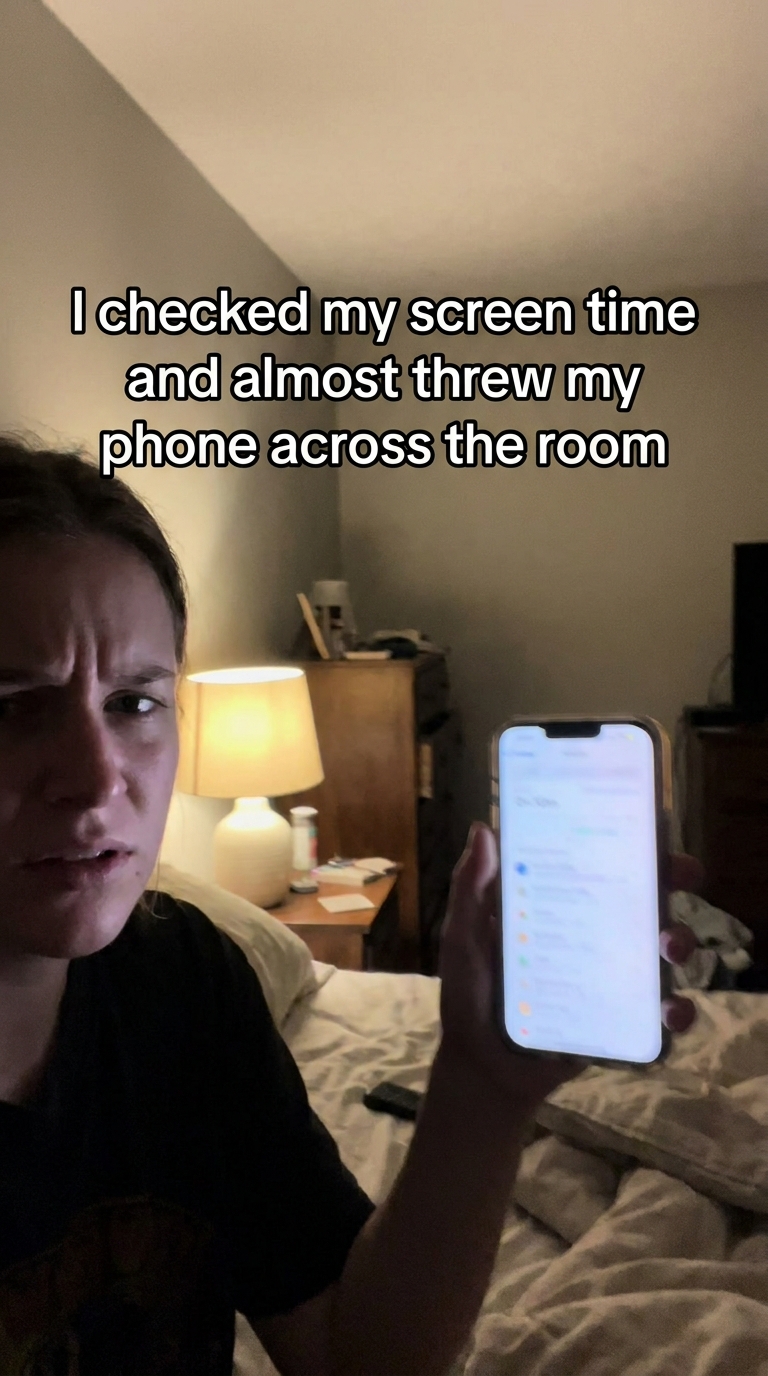
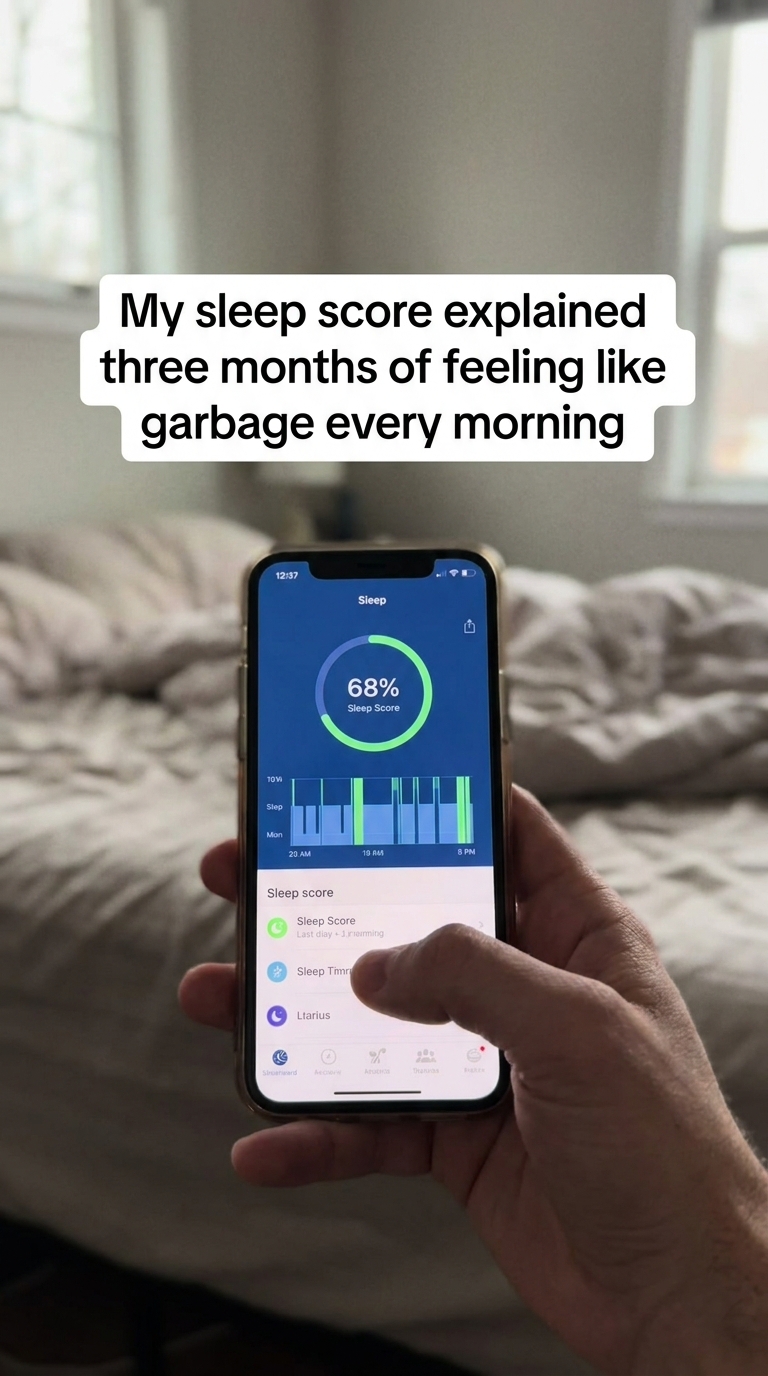
- Withholds (good): “I checked my sleep score this morning and immediately understood why I have felt like garbage for three months.” You do not know what the score revealed. The body has to close it.
- Gives the answer (dead): “Our sleep app shows you your sleep score so you can rest better.” Nothing left to learn. Nothing to watch.
Same product. One opens a loop, one reads a feature list.
How do you use AI to write better hooks?
None of those bars move because you are using AI. What changes is how many ways you have to clear them, because shots you could never have afforded to film are now on the table.
- The visual hook itself. Shots that were impossible or expensive: ASMR footage, the product dropped into a surreal world, a budgeting app’s numbers raining down a city street, or photorealistic footage of creators who never had to be cast. Things you would never capture from one creator’s living room.

- Photorealistic creators and AI avatars delivering spoken hooks. You can now generate a believable person saying your hook to camera, with no casting, scheduling, or shoot day. Models like Seedance do this well. You can reach them through an app like Higgsfield, through an API intermediary like Kie or Replicate, or directly through the model’s own API. When you want control over exactly how the line is read, generate the voice separately in ElevenLabs and sync it to the picture. (How to choose between those routes is in Chapter 9.)
- Ideating hook candidates from your review mining. Feed the five-dimension output in, generate three candidates, tag each with its job, then pick one with a one-line why. Always human-edited. The model proposes, you curate.
Watch out. AI gives you more hook options, not a pass on the bars. A generated hook that does not withhold is still a slogan with better production value. Volume is not taste. The model can hand you fifty lines in a minute and forty-nine of them will close the loop in the first breath. Your job did not get easier. It got faster, and the bottleneck moved to the one decision the model cannot make for you: which one is actually unpassable.
Chapter 3: Visual elements in the AI era
Text overlays, stickers, emojis, GIFs, on-screen graphics: this is still the grammar of short-form. None of it goes away because you started generating frames instead of shooting them. You use these elements to do exactly what you always did: emphasize a claim, contextualize a scene, and show the app actually on screen so the viewer knows what they would be downloading. AI did not rewrite the grammar. It rewrote the cost of producing it.
Here is what actually changes.
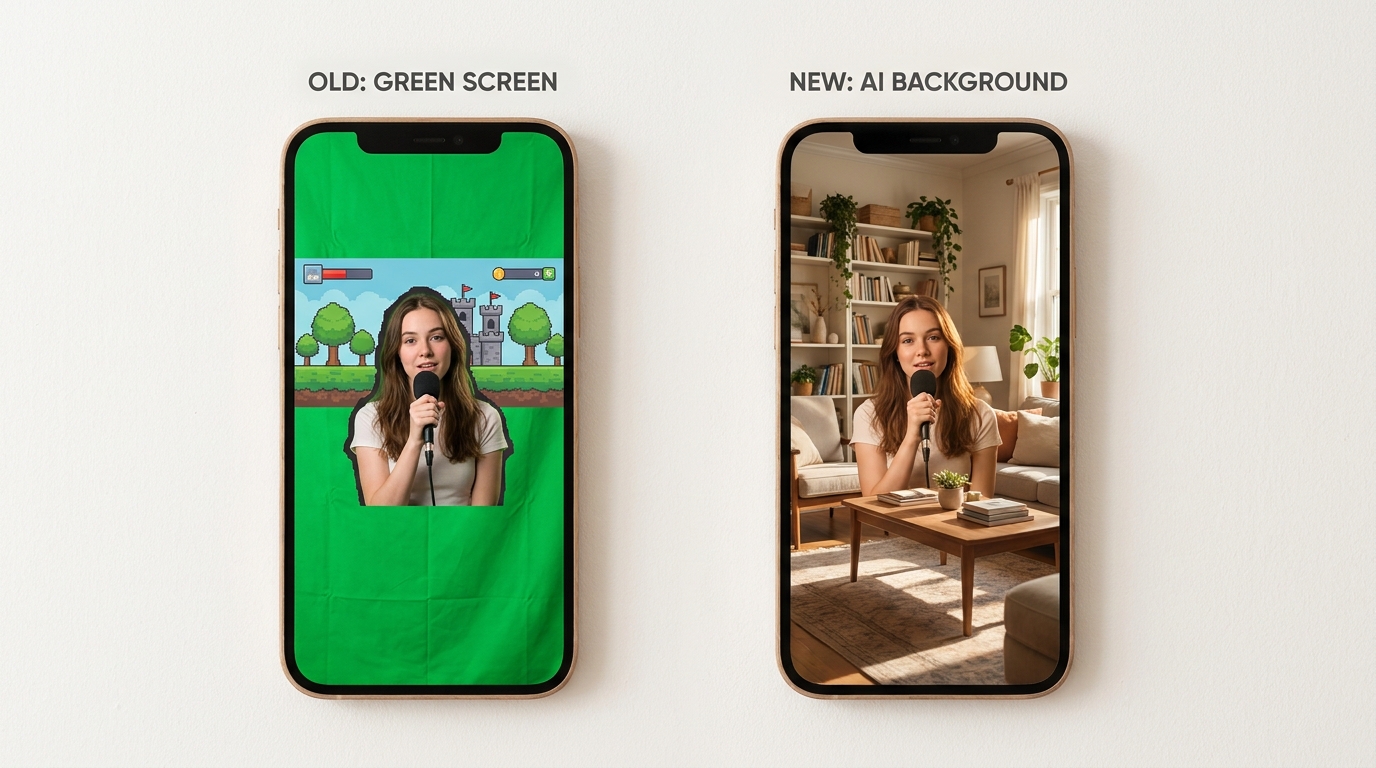
Green screen becomes AI background generation. The old workflow keyed a creator onto stock gameplay or a stock room: shoot against green, pull a key, composite, fix the spill. The new workflow generates the background outright, or inpaints a creator into a generated world. Same creative goal, a creator in a context that sells the app, with none of the keying tax. You are no longer limited to backgrounds you could find or afford to shoot.
AI image generation for graphics, props, and end-card art. The props you used to source, license, or build in Photoshop are now a prompt. End cards, the highest-leverage frame in the whole ad, stop being a designer bottleneck and become something you can iterate on in minutes.
TTS becomes modern AI voice plus lip-sync. Old robotic text-to-speech told everyone in the first two seconds that no human was involved. ElevenLabs-class voices are a different tier, and lip-sync tools let a generated or real face match any voiceover. The narration stops fighting the visual and starts belonging to it.
The overlay craft: the muted viewer’s hook
Most people watch with sound off. That means your first-frame text overlay is not decoration. It IS the hook. It is the one thing carrying the open before a single word is heard. Treat it like the most important line in the ad, because it is.
Five rules we hold every overlay to:
-
It works with sound off. If the overlay only makes sense once the voiceover lands, you have already lost the muted majority.
-
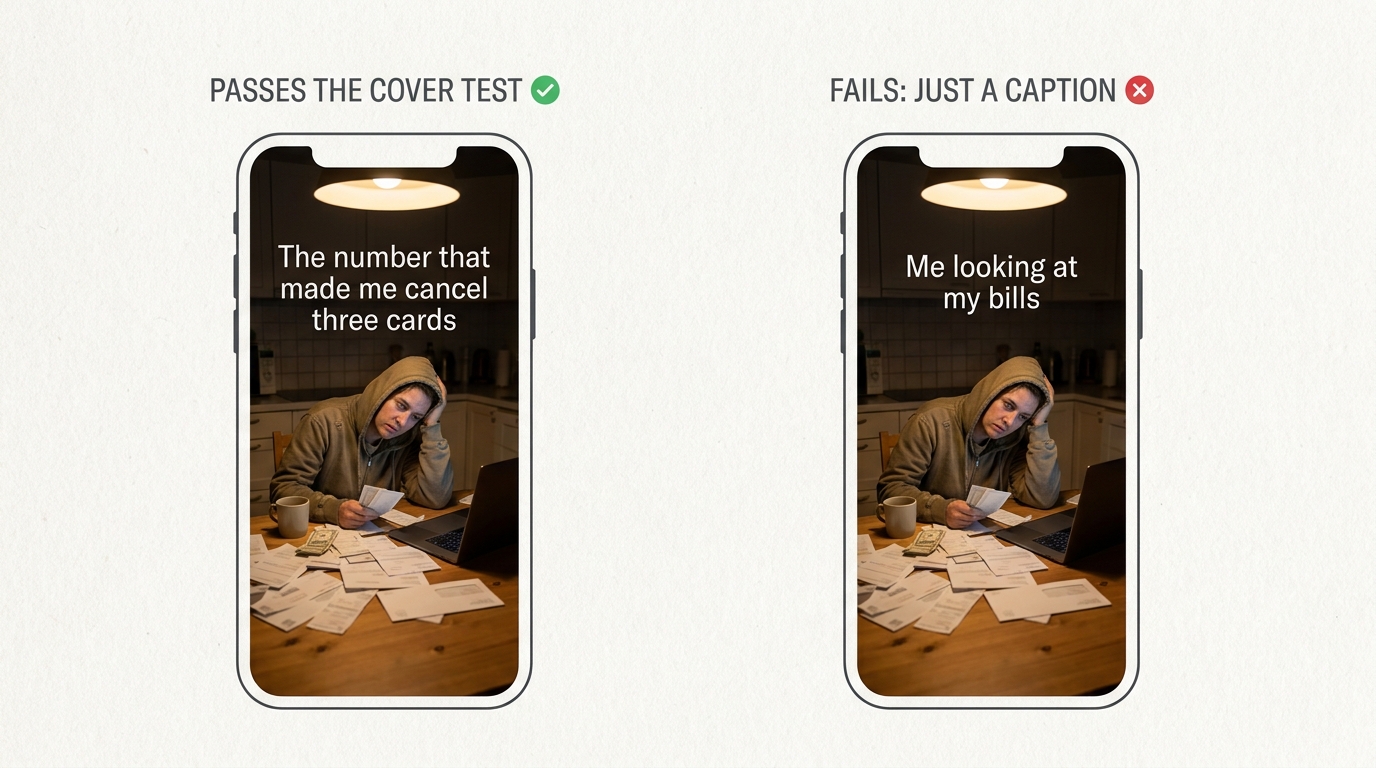
It complements, it does not caption. Run the cover test. Cover the frame: does the overlay still open a loop on its own? Cover the overlay: does the frame still say something? If either half collapses, your overlay is just a subtitle, and subtitles do not sell.
-
It is the second voice on the first frame. The visual shows the scene. The voice confesses or asks. The overlay frames the stake or the number. One argument, three channels, all pointing the same direction.
-
It is one tight lived line, around 11 to 15 words. Specific beats vague every time. A real, slightly-too-honest sentence outperforms a clean marketing slogan because it reads like a person, not a brand.
-
It is one overlay per video, not a sequence. One strong first-frame line does the opening. Let the captions carry the rest. Stacking overlay after overlay turns the ad into a slideshow and buries the one line that mattered.
The point of all of this: AI gives you infinite backgrounds, voices, and props, but it does not write your first-frame line or run your cover test. That judgment is still yours, and it is still where the ad is won or lost.
Watch out: Do not let AI polish erase the user-made texture. The handheld wobble, the imperfect lighting, the slightly awkward pause: that texture is the signal that a real person made this. Over-clean reads as over-obviously an ad, and the moment a viewer clocks “this is an ad,” the scroll wins. The slight imperfection is not a flaw to fix. It is the thing making UGC-style creative convert. Generate freely, then rough it back up.
Chapter 4: Scripting with AI, done right
The hook gets attention. The body converts. Everyone obsesses over the first three seconds and then phones in the next twenty-five, which is exactly backwards if you care about the install, not the scroll-stop. AI does not change this division of labor. It just makes both halves cheaper to draft and more dangerous to ship unedited.
Here is the rule we keep coming back to: AI is great at first drafts and terrible at final cuts. It will give you ten serviceable scripts in the time it took you to write the prompt. None of them are ready to run. The gap between serviceable and shippable is the whole job.
The body craft: lived specificity beats everything
The body is where the sale happens, so it has to earn every second. The bars we hold every script to:
- Continue the hook. Do not re-explain from scratch. The viewer already heard the promise. Build on it.
- Move through a real change. A belief shifts, a behavior changes, something gets discovered, proof lands. Movement, not a feature list.
- Go deep on one concrete situation. Depth beats breadth. One vivid moment outperforms five shallow ones.
- Make the mechanism visible. Why does the product actually change the outcome? Show the gears.
- Sound like a person with a point of view. Not brand-speak, not a fragment stack of disconnected lines.
- Pay off exactly the loop the hook opened. Close the circle you drew, not a different one.
- Write to the clock, then cut to it. Thirty seconds is a hard wall. Write long, then murder the slow parts.
The order of operations: sequence, then intensify, then compress
You do not write a great script in one pass. You build it in three.
- Lived experience, not abstraction. “I froze at the register” beats “it was frustrating.”
- Verbs, not adjectives. Adjectives tell. Verbs put the viewer inside the moment.
- Actions, not role-identity. “I almost canceled” beats “I’m a frustrated cardholder.” Nobody narrates their own demographic.
- Borrow real customer language from reviews and support tickets. Your customers already wrote your best lines.
- Raise stakes before resolution. Make the problem hurt before the product saves the day.
- Then compress ruthlessly. Maximum vividness per second, not the most details stacked. Cut until it bleeds, then cut one more.
The intensifier test
Ask one question of every line: could only this one person, who actually lived this, have written it? If a competitor could swap their logo in and run it unchanged, it is generic, and generic does not convert.
| Abstract Managing my rewards cards was stressful and time-consuming. |
Lived-specific I had eleven cards and a Notes app trying to track which one gave 5% on groceries this quarter. I gave up and just used whatever was on top. |
The right-hand version is unfakeable. It has a number, a hack, a small surrender. That is a person, not a positioning statement.
What deepens with AI
This is where AI stops being a draft machine and starts being a craft multiplier.
- Structured prompting with named frameworks. PAS (problem, agitate, solution), AIDA, the 4 U’s. These give the model a spine. Then push further: “if this is true, what else is true?” derives fresh angles from the logical consequences of a single claim.
- Feed it real customer voice. Pipe your review-mining and persona work straight into the prompt. Grounded output beats generic output every time, and the difference is entirely in what you fed it.
- Match script to delivery. Writing for an AI avatar, a real creator, and voiceover-over-b-roll are three different jobs. A line that sings in a creator’s mouth dies in flat TTS. Tell the model which one you are building for.
- Natural product mention. “It activated my offers,” not “BrandName activated my offers.” No ad-read endings. Close like a friend texting you a recommendation, not a commercial break cutting in.
- Always human-edit. Read it aloud. Time it on a stopwatch. If it sounds like writing being read aloud instead of a person talking, rewrite it. The model cannot hear itself. You can.
AI collapsed the cost of producing a script to near zero. That makes the editing, the taste, the ear for what a real person would actually say, the only scarce thing left. Spend your time there.
Chapter 5: Iterating at AI scale
Every iteration axis from the UGC playbook carries over. Messaging, background color, duration, music, voiceover, animation, scene order, visual hooks. None of that changes. The single most reliable move in paid social is still the same one it has always been: take a winner and iterate on it. Iterating on something that already works beats starting from a blank canvas every single time, and AI does not repeal that law. It just makes obeying it cheaper.
What AI supercharges. Each axis that used to require a reshoot is now a re-generation. The expensive part of iteration was never the idea. It was the logistics: rebooking the studio, recasting the actor, relighting the set, re-editing from raw footage. AI collapses that middle.
- Backgrounds and scenes regenerate instantly. New setting, new season, new room, no shoot.
- AI actors and settings swap without recasting. Different face, different demographic, same script.
- Voice cloning produces voiceover variants at scale. Re-read the same line ten ways without booking the talent.
- Seeds re-roll for fresh takes of the same concept. Same prompt, new roll of the dice, a dozen alternates in minutes.
This is AI’s strongest chapter. The volume play is where the economics bend hardest in your favor. But cheap generation is a loaded gun pointed at your own account, and the way you shoot yourself is variant sprawl. Iterate off proven winners. Do not spray and pray.
The discipline that keeps volume from becoming noise
Reskin versus net-new. Label every variant before it ships. A reskin preserves a winner’s structure and varies exactly one variable: the background, the actor, the opening line. A net-new tests untested territory: a new mechanic, a new persona, a new claim. Every extension must cite the winner it came from and preserve that winner’s skeleton. If you cannot name the parent, it is not an extension. It is a guess wearing a winner’s clothes.
The angle-diversity grid plus the kill test. Map mechanics against scored anchors against personas, and assign every concept a different cell on the grid. Two concepts in the same cell are not two bets. Then run the kill test: if you deleted one anchor, would the other concept still survive on its own? If it would not, the two are one bet in two costumes, and you are paying twice to learn once.
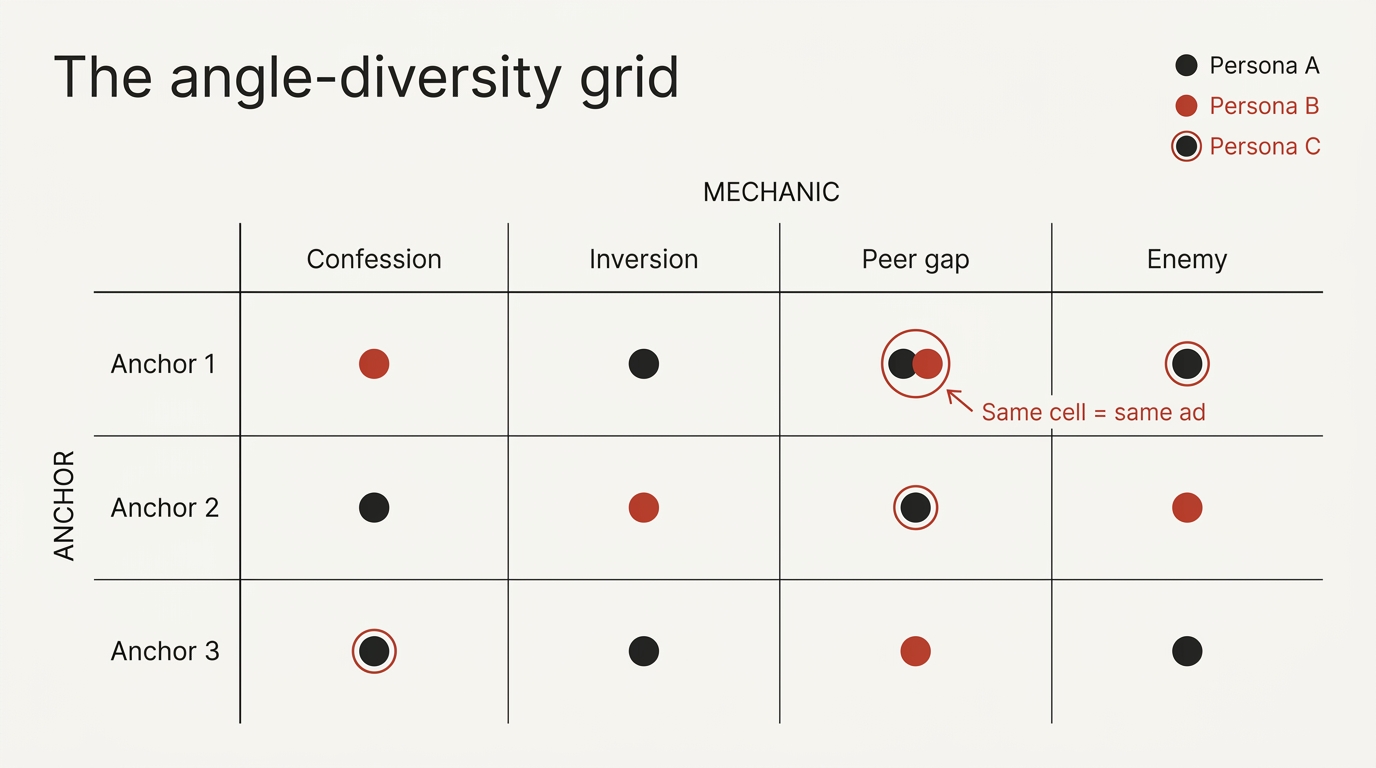
The coverage check. Before a batch goes live, audit its spread. No single persona should own more than 60% of the batch. Every angle worth testing should be touched at least once. And keep a healthy ratio of net-new to extension, so you are always funding both exploitation of what works and exploration of what might.
How do you scale AI creative without lowering quality?
Here is the trap, stated plainly. When the marginal cost of one more variant drops to roughly zero, the path of least resistance is to make thousands of near-identical ones. It feels like productivity. It is the opposite. A batch of a thousand variants that differ only in their background gradient teaches you exactly one thing, and you could have learned it with three.
Volume is not the achievement. Volume against a structured hypothesis is the achievement. The grid, the labels, the kill test, the coverage check: these are not bureaucracy. They are the only thing standing between a scaled testing program and a feed full of expensive slop. AI gave everyone the ability to produce ten thousand ads. It gave almost no one the discipline to make those ten thousand ads mean something. That gap is your edge.
Watch out: Volume without a learning loop is just noise. Every batch you ship should map back to a hypothesis you can actually read out of the data afterward. If you cannot say, in one sentence, what a given batch was built to prove, do not ship it. You are not testing. You are decorating.
Chapter 6: Safe zones and AI output QA
Here is the good news before the new work: the safe-zone rules carry over almost verbatim. AI did not move the buttons.
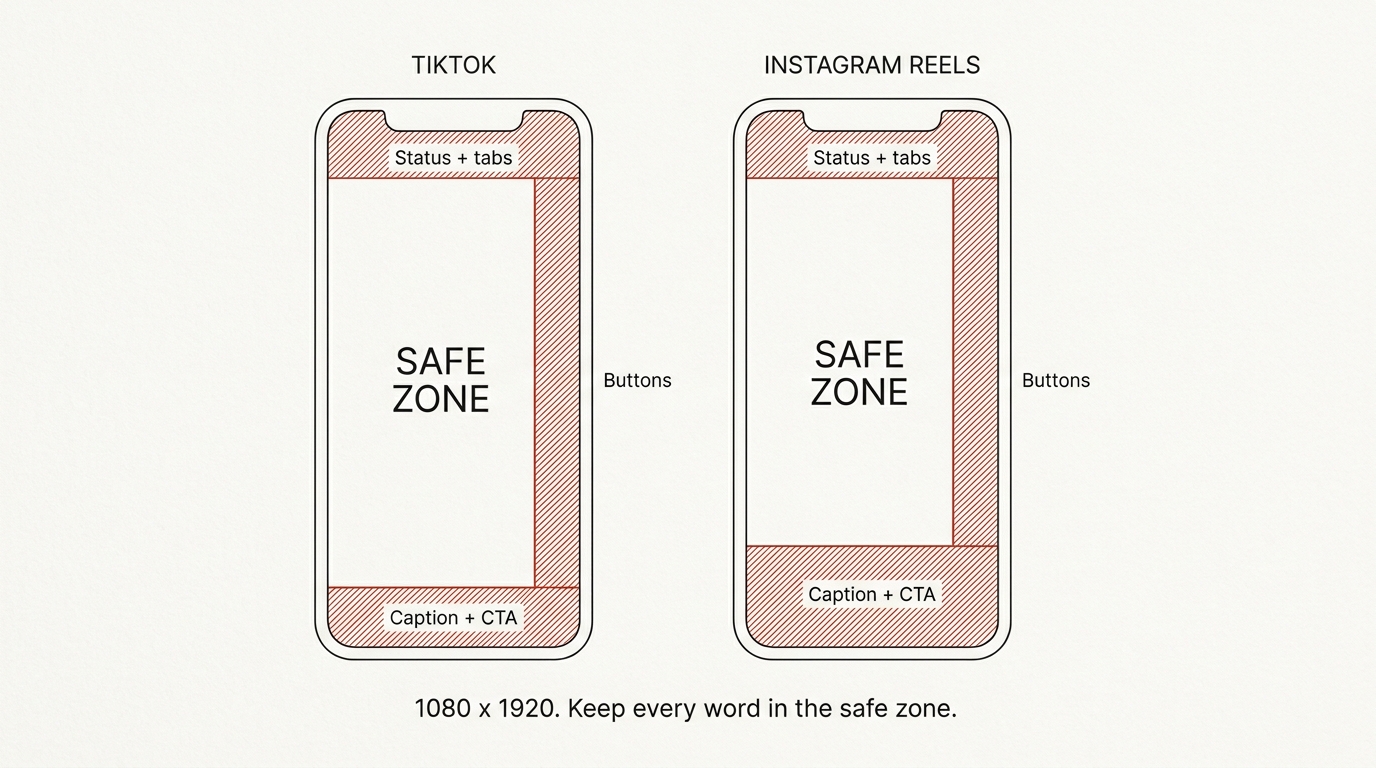
What a safe zone is. Every platform stacks its own UI on top of your video. The like, comment, and share buttons run up the right rail. The handle, caption, and CTA sit along the bottom. There is a band at the top for the status bar and platform chrome. Anything important you place under that UI gets cropped, covered, or hidden. Safe zones are the regions left over: the parts of the frame the platform does not paint over.
The rules that did not change:
- Keep logo, overlays, hook text, and CTAs inside the platform safe zones.
- TikTok and Instagram differ. Their UI sits at different heights, so a layout that clears one can get buried on the other. Design for the tighter of the two, or cut platform-specific versions.
- Export 1080×1920, 9:16. Full stop.
- The free safe-zone templates still apply. Drop your frame under the overlay, confirm nothing load-bearing sits under a button, ship.
The new QA layer, specific to AI
Generated frames fail in ways shot footage never does. Three checks earn their place in every review.
-
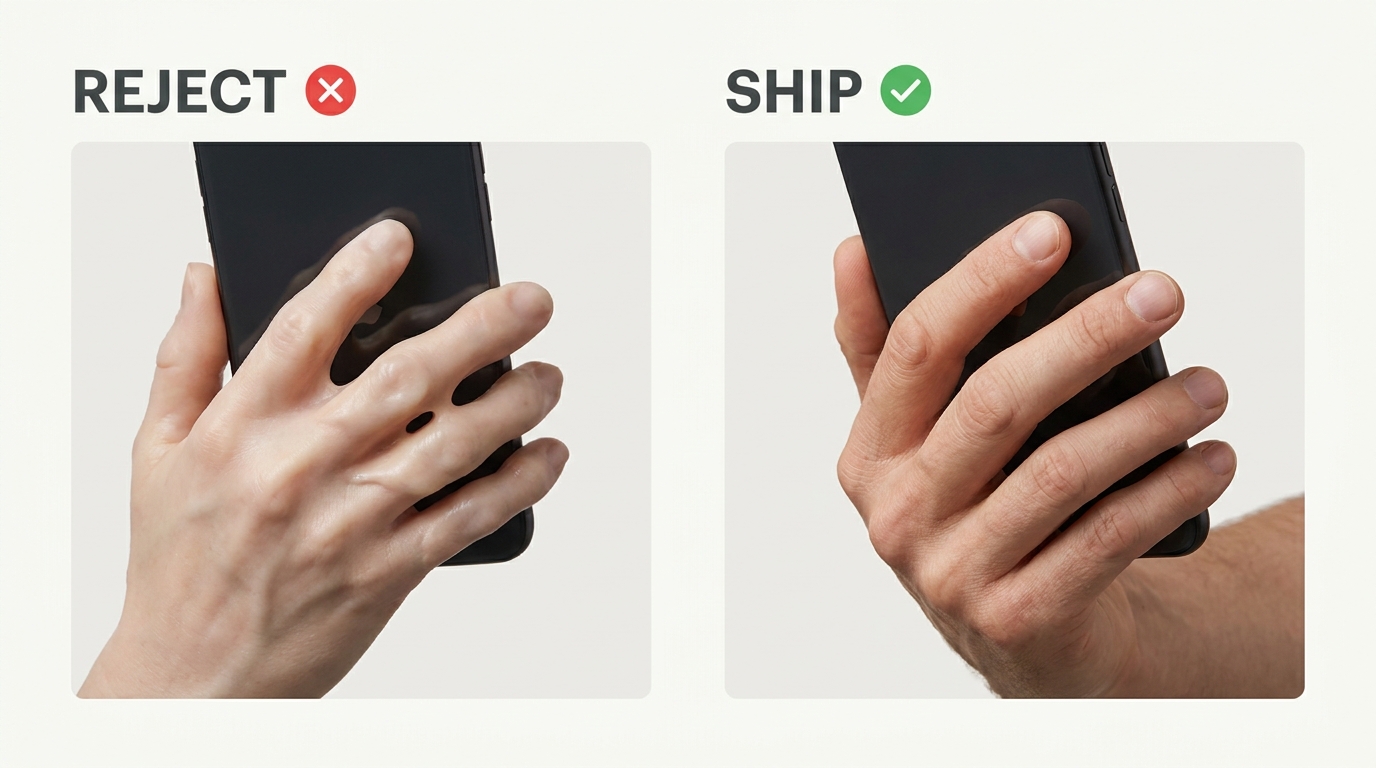
Artifact checks. Scrub for morphing hands, extra fingers, gibberish on-screen text, background flicker, and object-permanence breaks (an object that changes shape, color, or position between frames for no reason). These are the tells that scream “synthetic” to a viewer who cannot articulate why they distrust the ad.
-
Aspect-ratio and export discipline. AI tools default to the wrong dimensions, square, 16:9, some off-spec resolution they picked for you. Do not trust the export panel. Enforce 1080×1920, 9:16, every file, every time.
-
Face and character consistency. When you stitch generated clips, the same character can drift between cuts: a different face shape, a new hairline, a jacket that changed color. Check identity across every seam.
The review principle that matters most
The drafter is never its own gate.
In a good system, one pass drafts and a different pass, with fresh eyes, adversarially reviews. That review pass verifies every figure, checks that the hook withholds, that the body continues the promise, that the overlay passes the cover test (still readable under the platform UI), and that every compliance gate holds. The human judges only one thing: taste.
Port this directly into AI production. Never let the same pass, or the same person, that generated a creative also approve it. The generator is invested in its own output and blind to its own artifacts. A separate review pass, human or AI, catches the objective misses: the sixth finger, the off-spec export, the character whose face changed, the claim that does not hold.
Split the labor cleanly:
- The review pass catches the objective misses. Pass or fail, no opinion required.
- Your judgment decides great versus competent. That part stays human.
Watch out: One bad AI frame, a melting hand, a sign with gibberish text, a face that morphs mid-cut, torches credibility faster than any safe-zone miss ever could. A buried CTA costs you a click. An obvious artifact costs you the viewer’s trust in everything else the ad claims. With AI, QA is not optional. It is the line between believable and obviously synthetic.
Chapter 7: Directing an AI generation (the biggest transformation)
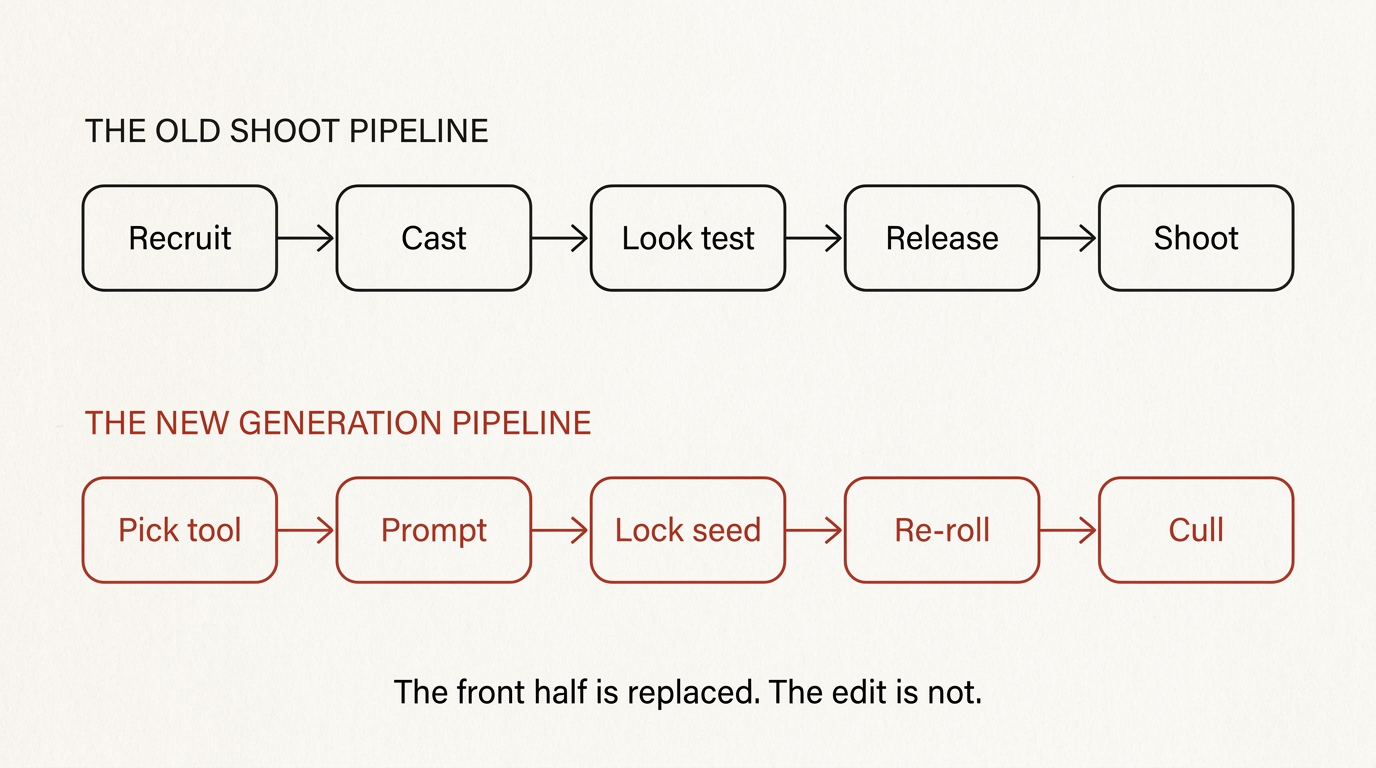
The UGC chapter walked through three phases, because that is how UGC actually gets made. Pre-shoot: lock the location, write the shot list, pick the creator, run recruitment and a look test, sign the talent release, write the brief. The shoot: lighting, devices, sound, frame, stability. Post-production: review the footage, stitch, cut quick, lay music, end on a high.
AI rewrites the first two phases and keeps the third almost untouched. That is the whole story of this transformation, and it is worth sitting with, because most people get it backwards. They think AI is a magic “make me an ad” button. It is not. It is a production technology. It collapses the expensive middle of making a creative. It does nothing for the part that was always hard: knowing what is good.
How do you direct an AI generation instead of a shoot?
Here is what disappears. Recruitment. Casting calls. Look tests. Talent release agreements. There is no creator to source, no agent to negotiate with, no usage license to renew in six months when the ad is still winning and you want to keep running it. The slow, coordination-heavy, calendar-dependent front half of UGC is just gone.
Be honest about the trade. What you lose: some authenticity, the real-human nuance that a good creator brings without being asked, the accident that turns into the best moment in the cut. What you gain: speed (a take in minutes, not a shoot day booked two weeks out), control (you are not waiting on anyone), and cost (no day rates, no licensing, no reshoots). For most performance creative at volume, that trade is worth making. For a hero brand film, maybe not. Know which one you are making.
In place of the front half, four new jobs appear:
- Tool selection. Which engine for which job. Some models are better at photoreal humans, some at stylized motion, some at clean text and product shots. You are no longer casting a person, you are casting a generator. (The current families, and the three ways to reach them, are in Chapter 9.)
- Prompt and storyboard design. This is the new shot list, and it is the real skill.
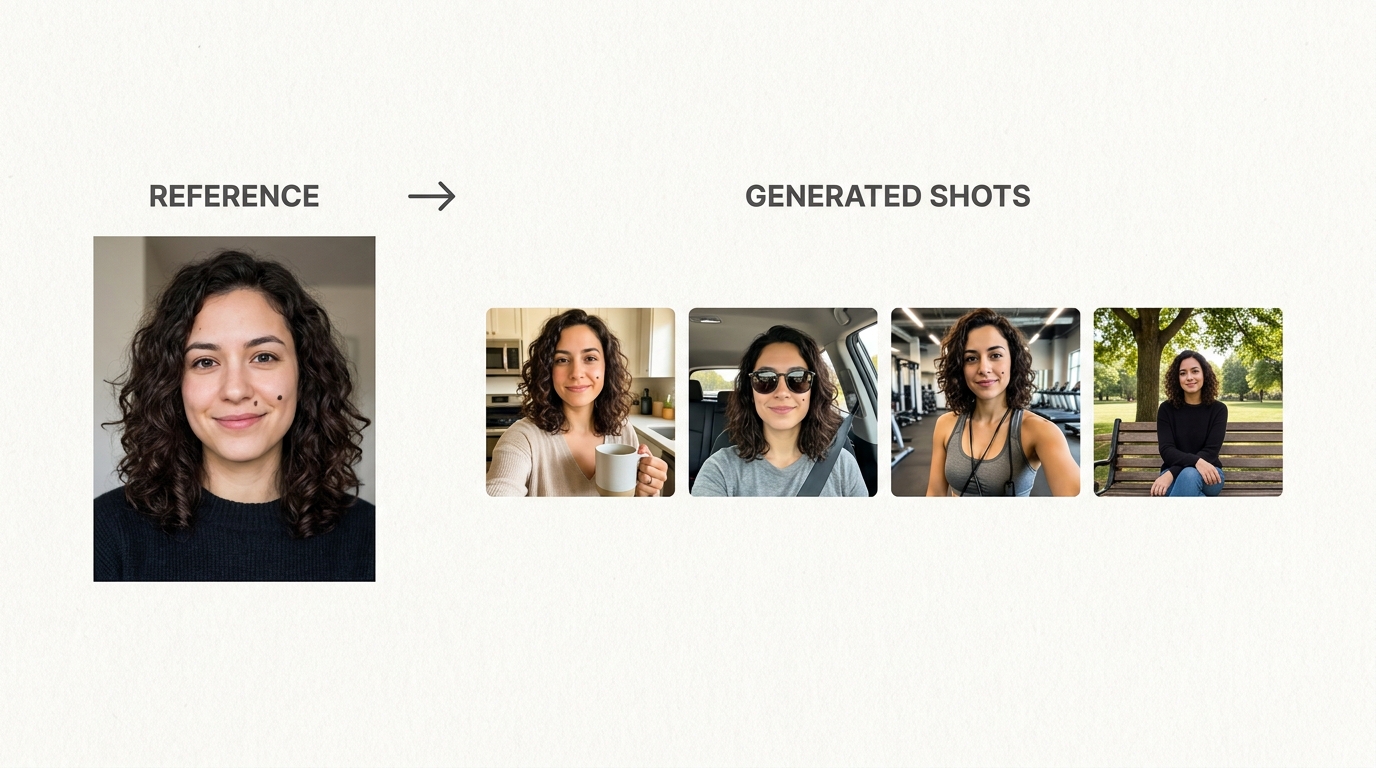
- Character-consistency control. Locking a face, a wardrobe, or a style across multiple shots so your “creator” looks like the same person in shot 4 as in shot 1.
- Reference-image prep. Feeding stills into the model to steer the output toward what you actually want instead of hoping the prompt lands.
Write the prompt like a shot list. The old instructions you gave a creator (stand here, hold the phone like this, say it to camera) become structured prompt text. Specify the same things a director specifies: subject, action, setting, lighting, lens and camera move, mood. “Woman in her late twenties, kitchen, morning light from a window camera-left, shallow depth of field, slow push-in, warm and unhurried.” That is a prompt and a shot description at the same time. Vague prompts give you vague footage. The realism lives in the specifics: name the lens, name the light, name the motion.
Character consistency is how you fake continuity. You hold a face steady across shots by feeding the same reference image, holding the seed, and locking the style. The seed is the random starting point the model generates from. Reuse it and you stay in the same visual neighborhood. Change it and you get a fresh take. This is the lever that turns one good frame into a consistent “creator” across a whole ad.
You generate many takes and throw most away. The old way of getting options was asking a creator for another take, which cost time and goodwill, so you asked sparingly. The new way is the re-roll. Generate ten, twenty, forty versions of a shot, keep the two that work, delete the rest. This is not waste. It is the point. Re-rolling is free where a reshoot was expensive, so you re-roll aggressively and let the volume surface the gold.
The back half carries over heavily
Everything after “we have the footage” survives, and some of it matters more than before.
- Review immediately and cull the bad. This was always step one of post. With AI it is the entire game, because you are now reviewing forty generated takes instead of four creator takes. Curation is the job now, not a chore before the job.
- Brief your editor with a storyboard and treatment. Same as always. The editor still needs to know the intended arc, the beats, and the feel.
- Quick cuts for energy and humor. Unchanged. Pace carries attention.
- Background music. Same rules: royalty-free, stock, or licensed. Nothing about AI changes your obligations here.
- End on a high, the win state. Still the strongest close there is. Show the moment the user gets the outcome they came for, the goal hit, the streak unlocked, the transformation done, and reinforce it with music and an end card. AI does not change human psychology. People still want to see the win.
Then there is the post work that is genuinely new, specific to assembling generated footage:
- Lip-sync. Matching mouth movement to a generated or cloned voice track.
- Upscaling. Pushing generated clips to a clean, deliverable resolution.
- Artifact cleanup. Fixing the warped hand, the flickering background, the extra finger, the texture that swims.
- Stitching. Cutting separately generated clips into one coherent piece that reads as a single continuous shoot.
The payoff
Lay the two halves next to each other and the strategic shift is obvious. AI deletes the slow, expensive front half. It grows the back half.
The bottleneck used to be “can we get the footage.” Can we book the creator, can we get the shoot day, can we afford the reshoot, can we license it for another quarter. That bottleneck is gone. The new bottleneck is “can we curate and assemble taste at volume.” When you can generate forty takes of any shot for almost nothing, the scarce resource is no longer footage. It is judgment. The eye that knows which two of the forty are worth keeping, and the loop that lets you make that call fast and at scale.
So the team that wins this is not the one with the best generator. Generators are a commodity, and the best one changes every few months anyway. The team that wins is the one with the best taste and the tightest review loop. AI handed everyone the same production line. The differentiator is the editor at the end of it.
Chapter 8: Narrative-style video, where generated characters talk
Everything so far assumes the dominant format of performance creative: one person, talking to camera, for twenty seconds. There is a second format that AI has quietly made possible for teams that could never afford it before: the narrative ad. Two or more characters, a scene, dialogue, a small story with a turn in it. The skit. The mini-sitcom. The argument at the dinner table that turns out to be about your app.
This used to need actors, a location, a crew, and a day. Now it can be generated. It is also the hardest thing in this guide to get right, because every failure mode compounds. Faces drift between shots. The room changes. Two characters swap voices. A character who was sitting on the left is suddenly on the right. Any one of these breaks the spell, and a narrative ad has nothing but the spell.
Here is the method we settled on after making these the wrong way first.
Pick the route by how the speech relates to the picture
There are two different productions hiding under the label “AI video with talking in it,” and they are made differently.
- Character dialogue. The speech belongs to the people on screen. Lips have to match. The right voice has to come out of the right face. Listeners have to react. This is a performance problem.
- Narrated animation. A separate narrator carries the story over a run of scenes. Nobody on screen needs to lip-sync anything. The narration sets the timing and the pictures serve it. This is an editing problem.
Decide which one you are making from the script, not from the client, the style, or the tool you happen to like. Forcing a narrated montage through a dialogue pipeline, or the reverse, is the most common way these projects go sideways before a frame is generated.
Three approvals, in order, before you spend on motion
Video generation is the expensive step, and a mistake upstream gets baked into everything downstream. So a human signs off three times:
- The script. Locked, line by line, before anything visual exists.
- The visual storyboard. The cast, the setting, and the key frames, as generated still images. This is cheap to fix and very expensive to skip.
- The full film. Watched end to end, not shot by shot.
Two rules for the script that we learned by breaking them. First, the last spoken line has to stand on its own. If it only makes sense because of a line you later cut, the ad ends on a shrug. Second, every narrative ad ends on a call-to-action line and an explicit end card. A story that just stops is not an ad. And verify every product claim before you generate dialogue that depends on it. A wrong claim in a caption is a text edit. A wrong claim in a character’s mouth is a reshoot.
Build the reference pack first
Before any motion, generate a reference pack: one character sheet per cast member, a reference for each setting, and the storyboard frames. Then actually look at them. Generated storyboards fail in specific, repeatable ways. They flip the seating between frames. They quietly duplicate a character. They put the wrong number of chairs at the table. Every one of those defects becomes a continuity error in the final film if you let it through, and at this stage it costs cents to fix.
Long takes, not stitched snippets
The instinct is to generate lots of short, safe clips, one speaker each, and cut them together. We tried it. The result is static and oddly lifeless: people waiting politely for their turn to talk.
What works better is one long take per script beat, with the model allowed to direct its own coverage inside the take. Let it move the camera, let the second character react while the first one talks, let the scene breathe. The performance is noticeably more alive.
One editing rule that survives from film school: never cut between two shots taken from the same angle. It does not read as a cut. It reads as a glitch, and in AI video a glitch is the one thing the viewer is already looking for.
Carry continuity with frames, not with hope
A character sheet alone is not enough. With sheets only, the cast stays recognisable but the world drifts: the restaurant in beat 3 is not quite the restaurant from beat 1.
The fix is to carry frames forward. The last frame of each beat, plus a wide shot of the scene, go in as references for the next beat. The model is no longer being asked to remember the room. It is being shown it.
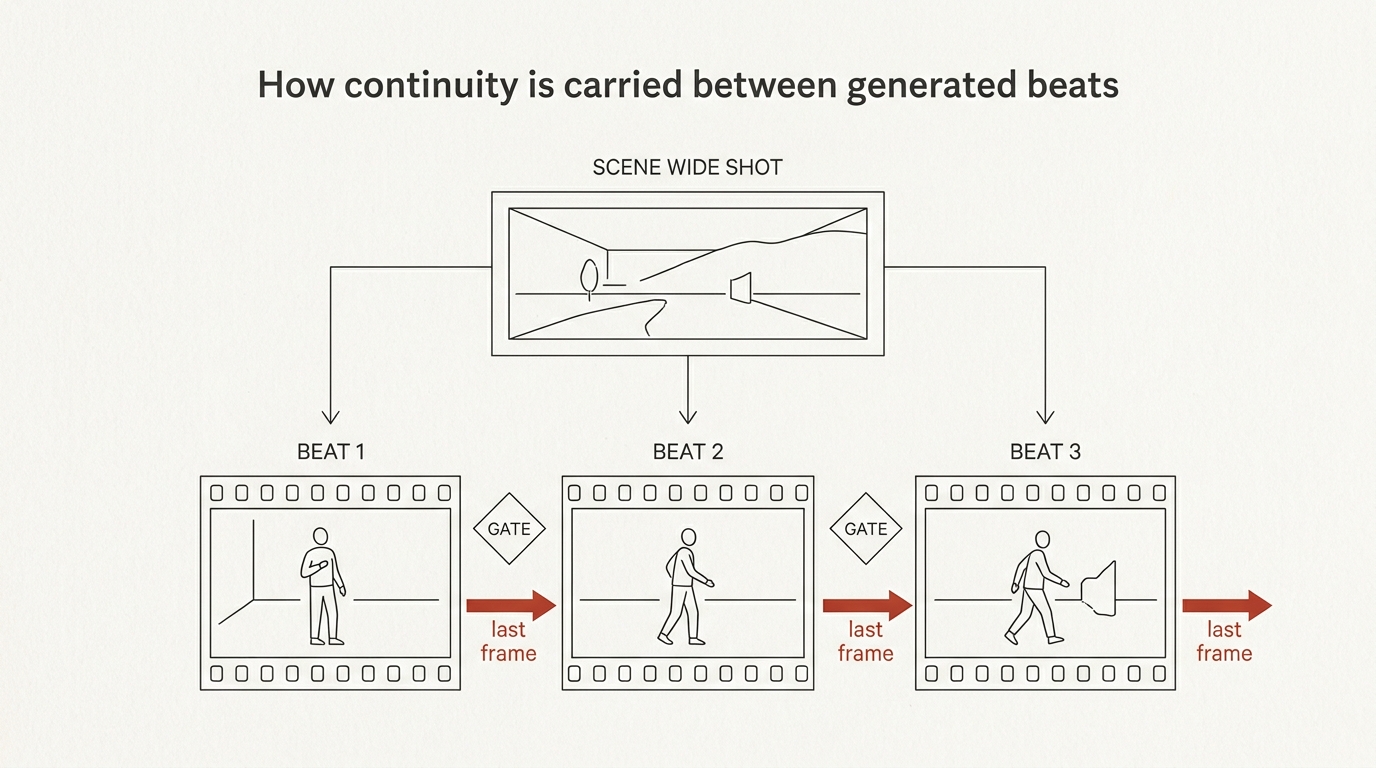
Gate every beat before the next one builds on it
Because each beat chains from the one before, an error does not stay put. It propagates. So each beat passes a gate before anything is built on top of it:
- Is the right voice coming out of the right character?
- Are mouths visible and moving when that character is speaking?
- Are the listeners reacting, or frozen?
- Has anyone changed seats, clothes, or hands?
Treat staging the way a continuity supervisor would: as state you write down. Who is sitting where, who is holding what, which way each person is facing, at the end of every beat. If it is not written down, it will change.
The unglamorous details that save a day
- Cast the voices, not just the faces. Give every character one fixed voice, for example a named ElevenLabs voice, and bind it to that character for the whole film. A character whose voice shifts between beats is as jarring as one whose face does.
- Keep a pronunciation map. Brand names, app names, and unusual words get a phonetic spelling that every generation uses. Otherwise your product is pronounced three ways in one ad.
- A blocked generation does not always look like an error. Safety filters sometimes return a job as complete with nothing in it. Quoted negative dialogue (“I hate this,” “this is a scam”) is a common trigger even when no image is involved. Retrying the same prompt gets you the same nothing. Reword the line.
- Repair, do not regenerate. When one beat is wrong, fix that beat and check its joins to the neighbours. Regenerating the whole film to fix four seconds throws away everything that was already working.
Be honest with yourself and your client about where this is. A narrative ad made this way will usually need a round or two of revisions. That is normal, and a manageable number of revisions is a good outcome. What has changed is not that it is effortless. It is that it is possible at all for a team without a crew.
Chapter 9: Reaching the models directly
Most teams meet AI video through an app. You sign up, you type a prompt into a nice interface, you get a clip. That is the right place to start, and for plenty of teams it is the right place to stay.
But the app is not the model. It is a storefront in front of the model, and there are two other doors into the same building. Once you are generating at volume, which door you use starts to matter a great deal.
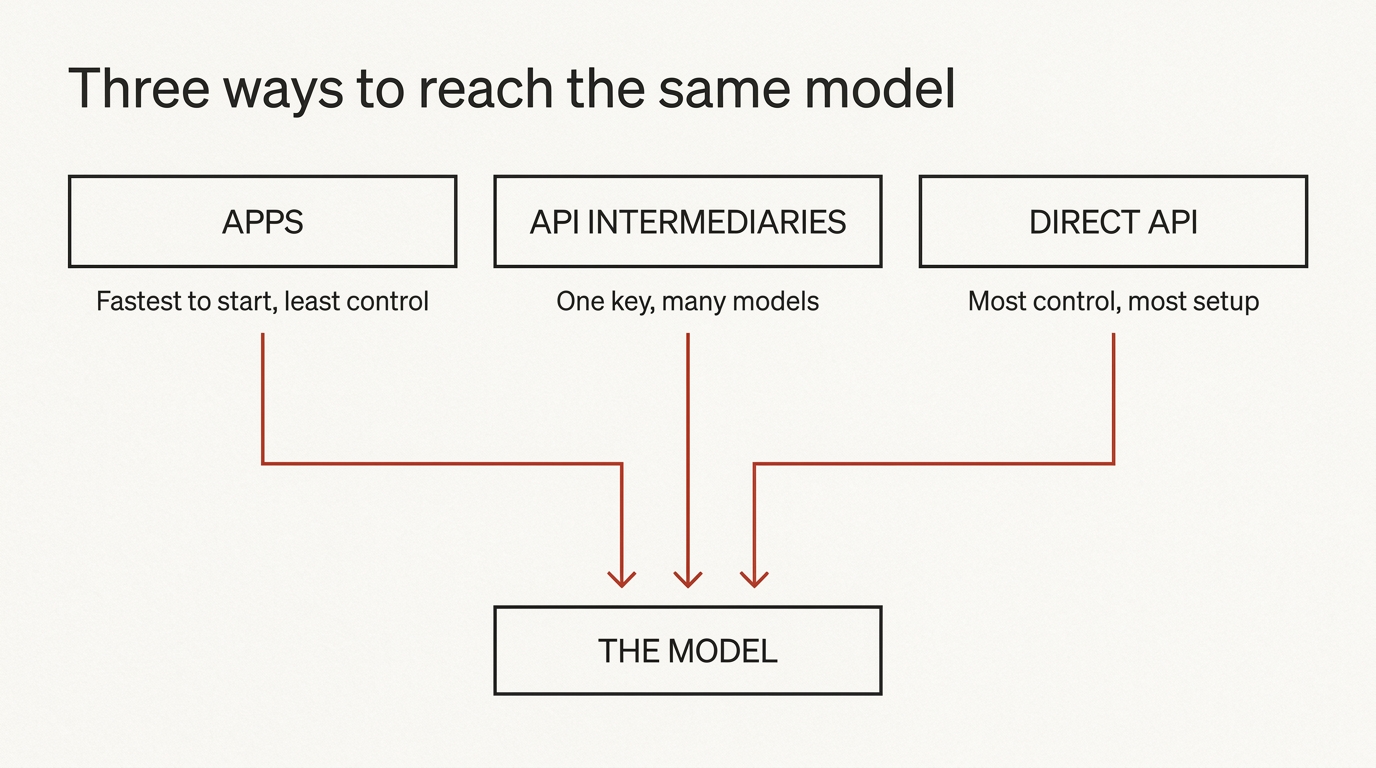
How do you access AI video models directly?
| Route | What it is | You gain | You give up |
|---|---|---|---|
| Apps (Higgsfield and similar) | A polished interface with presets, templates, and a gallery | Speed to first result. No code. Good defaults. Easy for a whole creative team to use | Control. You get the settings they expose, at the price per seat they charge, on their queue. New models arrive when they add them |
| API intermediaries (Kie, Replicate, fal) | One account and one key that reaches many models from many makers | Pay per generation. Scriptable. Easy to switch models without a new contract | A layer between you and the model, with its own rules, its own limits, and sometimes its own safety checks |
| Direct API (from the model maker) | The maker’s own endpoint | The newest features first, the fullest set of controls, often the lowest price | Setup. One integration per maker, and you maintain each one |
Take Seedance as the worked example. You can use it inside an app like Higgsfield. You can call it through an intermediary like Kie or Replicate. Or you can go to the API directly. Same model family, three different experiences.
The same three doors exist for voice. ElevenLabs is built into many of the apps, it is available through intermediaries, and it has its own API, which is where the finer controls like pronunciation dictionaries live.
The thing nobody tells you: the route changes the result
We assumed, going in, that the model was the model and the route was just plumbing. It is not.
The same model can behave differently depending on how you reach it. Different routes accept different inputs: one takes a first frame, another takes a set of reference images, and those are not the same control. Different routes apply different safety checks: we have had the same model accept a photorealistic face through one route and refuse it through another in the same week. And different routes charge differently: the identical image model has cost us roughly half as much through an intermediary as it did direct, and for a different model the direct route was several times cheaper than the resellers.
So when something fails, the lesson is often not “this model cannot do it.” It is “this route will not let it.” Try another door before you rewrite the brief.
When to use which
- Exploring, or a small team making a handful of ads a week. Use an app. The time you would spend on setup is worth more than the control you would gain.
- Producing at volume, testing many variants, or needing repeatable results. Move to an intermediary. One key, scriptable, pay for what you generate.
- Depending on one model for a core workflow, or needing a control the intermediaries do not expose. Go direct for that model, and keep the intermediary for everything else.
Most mature setups end up hybrid: an app for the creative team to explore in, and API access underneath for the production runs.
What you need in place before you go direct
You do not need an engineering team. You need someone comfortable running a script, or an AI coding agent and the patience to supervise it. What you do need to build, because nobody gives it to you for free once you leave the app:
- A receipt for every generation. The prompt, the model, the seed, the reference images, the cost, and the output, stored together. Without it you cannot reproduce a winner or explain a bill.
- Your own archive. Generated files on most routes expire. If you did not save it, it is gone, usually the week after the ad starts winning.
- Cost tracking per job. Video is priced per second and scales with resolution. A careless batch at the highest setting is a real invoice.
- A check for failures that look like successes. A job that comes back “complete” with no media in it is a filtered result, not a finished one. Your pipeline has to know the difference.
The AI creative tool stack
A snapshot. This space moves monthly: prices shift, models are replaced, and new leaders appear. We list model families rather than version numbers on purpose. Treat the category as the durable thing and the name inside it as this season’s answer.
| Category | Families to look at | What it is for |
|---|---|---|
| Video with people and dialogue | Seedance, Veo | Photorealistic creators, talking characters, lip-sync, long takes |
| General video and motion | Kling, Runway, Sora | B-roll, product-in-context, stylized motion, iteration and reshoots |
| Motion transfer | Kling motion control | Moving a reference performance onto a different actor image |
| UGC-style AI actors | Arcads | Creator-look talent at volume, built to read as native in a feed |
| Photoreal stills and reference images | Nano Banana, GPT Image | Hero frames, cast sheets, storyboards, product shots |
| Stylized stills | Seedream, Midjourney, Flux | Game creatives, art direction, moodboards, cheap drafts |
| IP-sensitive stills | Adobe Firefly | Licensed training data, for brand work where provenance matters |
| Voice | ElevenLabs | Voiceover, voice cloning, pronunciation control |
| Apps | Higgsfield | One interface across many of the models above |
| API intermediaries | Kie, Replicate, fal | One key across many of the models above |
On cost, we are deliberately not printing prices. They change too often to be useful in a guide. What does not change is the shape of the bill: stills are cheap, video is priced per second, and resolution is the biggest lever. Test at low resolution and only pay for the final at full quality.
The stack is a snapshot, not a standard. The durable skill is knowing which category you need for a given shot, then picking the current leader inside it.
Chapter 10: When not to use AI
AI is a tool, not a strategy. It is spectacular at some jobs and actively destructive at others. The teams that win know the difference cold, and they make the call before they generate a single frame, not after the ad tanks. Below is the line we draw, drawn from making 50,000+ ads for 200+ brands.
The short version: use AI to collapse production cost wherever authenticity is not the product. Protect the human, the testimonial, and the trust signal wherever it is. Everything that follows is detail on that one rule.
| Lean on AI | Protect the human |
|---|---|
| Concept exploration and first-pass ideation | Testimonials and customer stories |
| B-roll, cutaways, and product-in-context shots | Any face the viewer is asked to trust |
| Backgrounds, environments, and impossible locations | Regulated claims: finance, health, anything with a disclaimer |
| Variants of a proven winner | Founder and expert credibility |
| Voiceover for non-testimonial narration | The first three seconds, when the hook is a person |
The authenticity and uncanny-valley problem
This is the number-one reason AI ads fail. Not bad targeting, not weak offers. The ad reads as fake, and the moment it does, trust collapses and so does conversion.
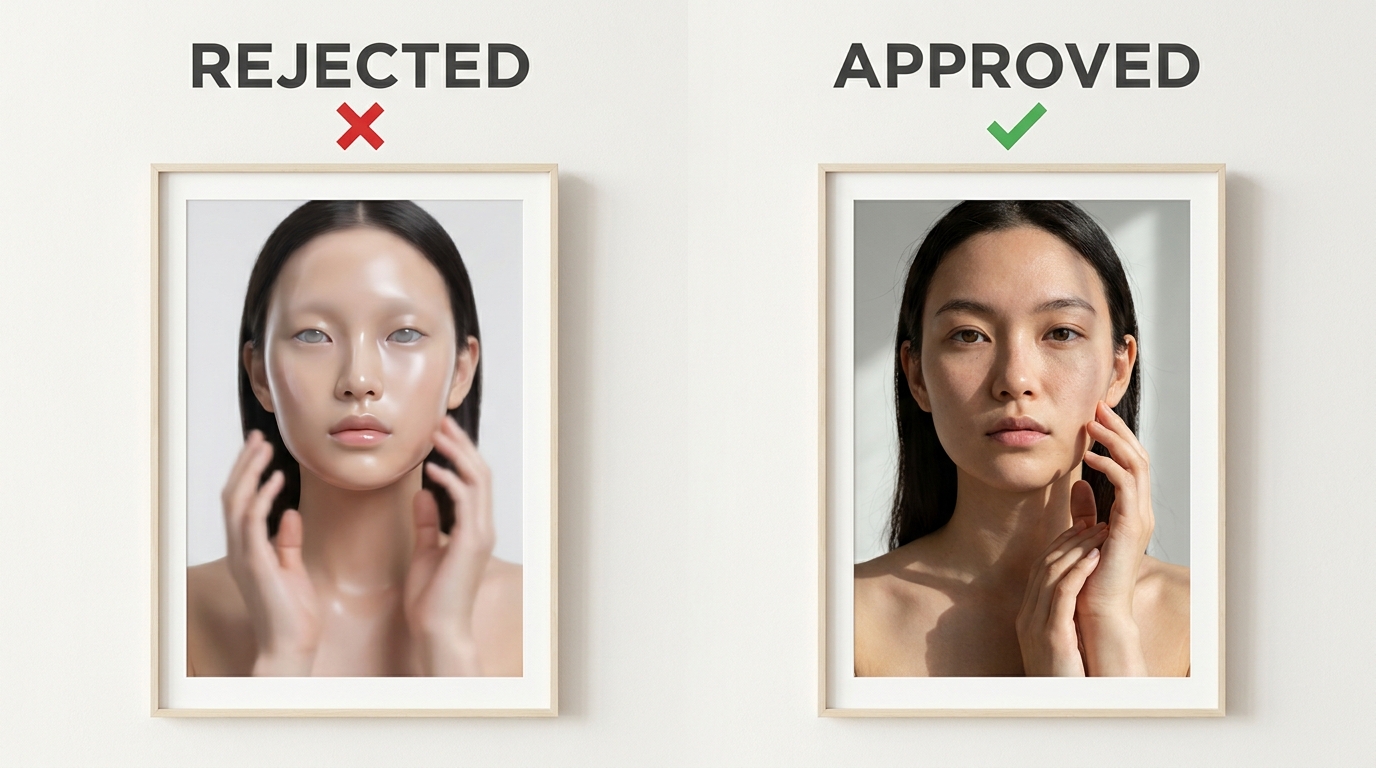
Humans are absurdly good at spotting wrongness in faces. Dead eyes, plastic skin, hands with a finger too many, a smile that does not reach the eyes, motion that floats instead of weighs. The viewer cannot always name it, but they feel it, and “this is fake” becomes “this product is fake” in about half a second.
How to stay on the right side:
- Keep imperfection. Real footage has grain, handheld shake, uneven lighting, awkward pauses. Sterile perfection is the tell. Add the texture back.
- Avoid the known failure zones. Direct eye contact at close range, hands, fast human motion, teeth. These are where current models break.
- Go hybrid when realism matters. If a real human face needs to carry the ad, shoot the human and let AI build the world around them.
When in doubt, show it to someone cold and watch their face. The flinch is your answer.
Platform AI-disclosure policy
If your AI content is realistic, the platforms now want it labeled. Treat this as a real constraint, not a footnote.
Meta. As of 2026, Meta requires advertisers to disclose AI-generated or AI-modified content, applied through an AI content label in Ads Manager. Undisclosed AI that Meta’s systems detect can get the ad rejected and the account a policy strike. Realistic synthetic media judged deceptive gets a more prominent label and reduced distribution.
TikTok. TikTok requires disclosure (the AIGC toggle organically, the AI disclosure tag for ads) for content that uses AI to create or significantly alter realistic depictions of people, places, or events: synthetic faces, voice clones, AI backgrounds, photorealistic product shots. It also auto-detects via embedded content credentials. Pure text help (AI captions, hooks, hashtags) is generally exempt.
What to do: Label when the content is realistic and AI-made. Know the current rules for every platform you run on, and assume detection is automated.
These policies are moving fast and vary by region (the EU is stricter). Verify the live policy before you launch. The summary above is mid-2026 and will change.
Where a real person is the whole point
Some ad power comes entirely from “a real person really used this.” Do not fake that. Ever.
Real testimonials. If a customer’s words and face are the proof, a synthetic version is not a shortcut, it is fraud waiting to be screenshotted. The whole value was that it was real.
Trust-sensitive and regulated verticals. Finance, health, anything with compliance exposure. Faking a face, a result, or a “real user” in these categories is legal and brand risk that no CPA improvement justifies.
Genuine social proof. Review counts, before/afters, “I lost X,” “I made Y.” If you cannot stand behind it as literally true, a generated version is a liability, not creative.
The test is simple. Ask: does this ad work because the audience believes a real human had a real experience? If yes, the human has to be real. AI can build everything around them. It cannot be them.
Hybrid workflows
This is the highest-performing pattern we see right now, and it is not close.
Real hook, AI everything else. A real creator delivers the opening line to camera, the part that has to land as human, then AI fills the b-roll, the backgrounds, the product-in-context shots, the impossible angles. You buy authenticity for the three seconds that decide the swipe, and speed for the other twenty seconds nobody scrutinizes.
Real testimonial, AI supporting scenes. The customer is genuine. The world you drop them into (the dream outcome, the lifestyle, the visualized result) is generated. The proof stays real. The production scales.
Why it wins: you spend your expensive, slow, hard-to-source human capital only where authenticity is load-bearing, and you spend cheap, instant AI everywhere else. You stop choosing between believable and scalable. You get both.
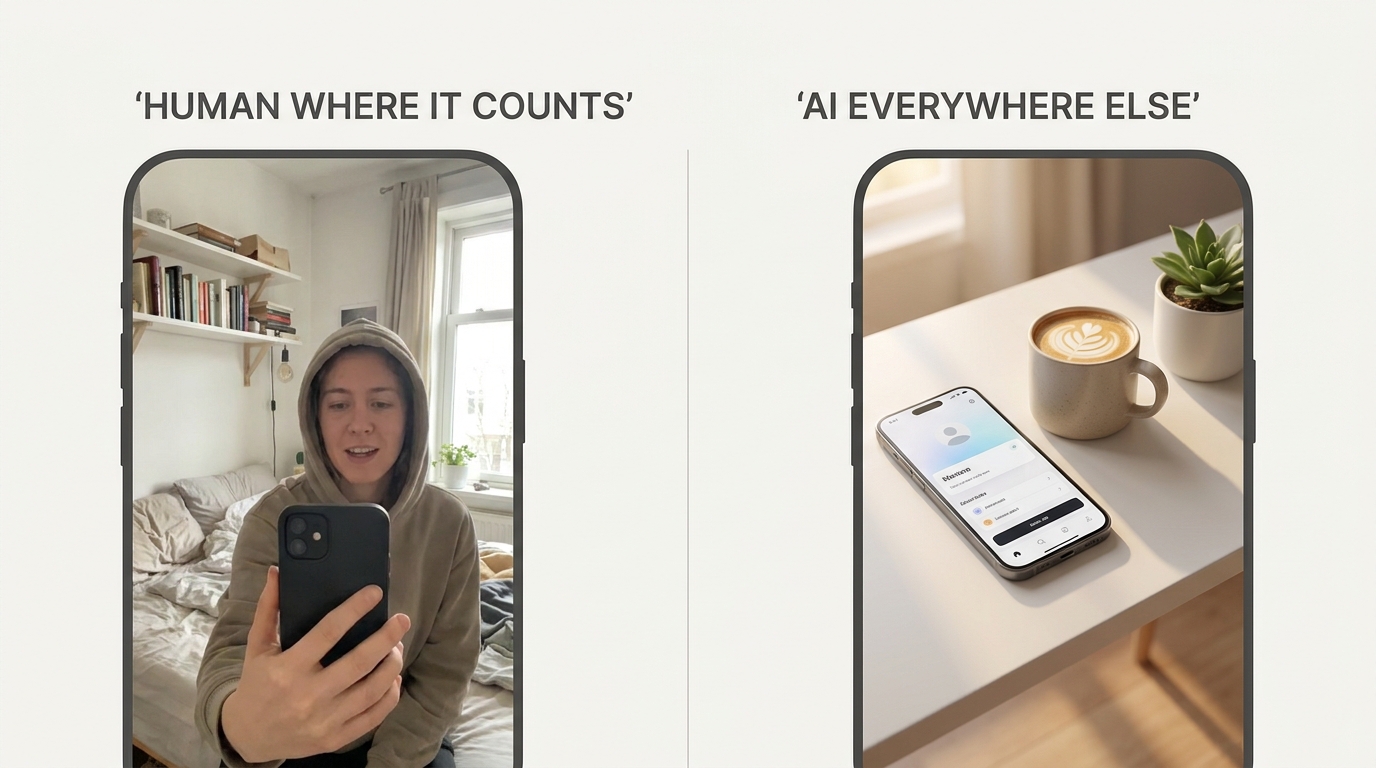
Build your pipeline around this seam, not around “all AI” or “all live.”
The economics
Here is where AI actually moves the P&L, and where it does not.
Where AI saves real money and time:
- Concept exploration. Twenty visual directions in an afternoon instead of one shoot in three weeks. The cost of a bad idea drops to near zero.
- Variations. New backgrounds, aspect ratios, locales, and seasonal swaps without re-shooting. Localization stops being a budget line.
- B-roll and backgrounds. The connective tissue of an ad, generated instead of filmed or licensed.
- Impossible shots. Underwater, aerial, microscopic, surreal. Things you would never have budgeted a shoot for.
This is the expensive production middle (recruiting creators, booking remote shoots, travel, reshoots) collapsing. That is the real saving.
Where live-action still wins:
- Genuine testimonials. Covered above. The realness is the asset.
- High-trust hero ads. Your flagship, brand-defining spot. Worth the shoot.
The tradeoff is honest: AI makes the exploration and scale nearly free, which is most of your spend. It does not make trust free. Budget accordingly: cheap and infinite for the top and middle of your creative funnel, premium and human for the proof.
Taste is the new bottleneck
Here is the strategic punchline of this entire guide.
When generation was expensive, scarcity did your filtering for you. You could only afford to make a few ads, so you thought hard about which few. Now generation is nearly free. You can make a thousand. Which means the constraint is no longer production. It is knowing what is worth producing.
That is taste. The ability to look at fifty generated variations and instantly know the three that will convert and the forty-seven that are noise. To kill your own clever idea because it reads fake. To recognize the winning angle before the data confirms it.
This does not get automated away. It gets more valuable. When everyone can generate infinite creative, the only edge left is judgment: a sharp point of view on the customer, a ruthless curation instinct, and a tight review loop that separates signal from slop fast.
The moat was never the camera. It was never the render farm. It is the eye. Build the eye, and the tools just make you faster.
Chapter 11: Bonus content
This is the swipe section. Everything here is built to be copied, pasted, and used today. Remember the through-line of the whole guide: AI changes how you produce a creative, not what makes it work. The craft of the bet, the persona, and the opening seconds carries over untouched. AI just collapses the expensive production middle, which means your taste, not your budget, is now the bottleneck. These two deliverables are where taste gets operationalized.
AI generation best practices
Most failed AI creative dies on the same handful of tells. The audience does not articulate “uncanny valley,” they just scroll. Your QA pass exists to catch the tells before the algorithm does.
| Don’t | Do |
|---|---|
| Ship the uncanny valley: faces that are almost-but-not-quite human | Use reference images to anchor the look, then judge every take against real footage |
| Accept plastic skin and that airbrushed AI sheen | Keep imperfect texture: pores, stray hair, fabric wrinkles, slightly uneven lighting |
| Let eyes go dead or drift off-axis | Generate many takes and cull hard. A 1-in-10 keep rate is normal, not failure |
| Pass hand artifacts: extra fingers, fused knuckles, warping props | Lock seeds once a take works so you can iterate on one variable at a time |
| Leave gibberish on-screen text from the model | Add real text in your editor, never trust the model to render legible copy |
| Ship over-smooth, gliding motion that reads synthetic | Match the platform-native look: handheld shake, phone-grade compression, real UI |
| Treat the first render as final | Run a separate QA pass with fresh eyes, full-screen, sound on, on an actual phone |
The AI prompt and storyboard brief template
Copy this. Fill it once per concept. It forces every decision the model would otherwise make for you, badly.
CONCEPT / BET: [the single insight this ad is testing, in one sentence]
  Tribe:          [who they are, and who they refuse to be]
  Enemy:          [the specific, named failure]
  Worldview:      [the contestable belief that makes the product obvious]
  Transformation: [before to after, as an identity shift]
  Anchor used:    [the one cultural anchor this ad is built on]
TARGET PERSONA: [who, their context, the moment they see this]
THE HOOK: [first 2 seconds] | ITS JOB: [the one scroll-stop job it does]

FORMAT: [talking head | character dialogue | narrated animation]
MODEL + ROUTE: [model family] via [app | API intermediary | direct API]

SHOT LIST (repeat per shot or beat):
  Shot 1
    Subject:  [who/what is on screen]
    Action:   [what happens, one clear beat]
    Setting:  [location, time of day, background]
    Lighting: [e.g. soft window light, hard noon sun, screen glow]
    Lens/Cam: [e.g. 35mm handheld, phone front-cam, slow push-in]
    Mood:     [the feeling in three words]
    Carries from:   [previous shot's last frame + the scene wide shot, or "opening"]
    Staging at end: [who is where, holding what, facing which way]

CHARACTER / STYLE REFERENCE:
  - Character sheet(s):

  - Setting reference:  [filename or link]
  - Consistency notes:  [same actor, wardrobe, color grade across shots]

VOICE:

       tone [conversational / urgent / deadpan] | pace [fast / measured]
PRONUNCIATION MAP: [brand name and unusual words, spelled phonetically]
MUSIC: [genre, energy, where it drops; or "trending audio, no music bed"]
ON-SCREEN OVERLAY: "[exact line, added in editor, not by the model]"
  Cover test: [overlay alone opens a loop? frame alone says something?]
CLOSE: last spoken line "[must stand on its own]"
       CTA line "[...]" | end card [yes]

OUTPUT SPECS: 1080x1920 | duration [Xs] | format [MP4, H.264] | fps [30]

QA CHECKLIST:
  [ ] Every product claim verified before generation
  [ ] Hands and faces clean across every frame
  [ ] Skin keeps texture, not plastic
  [ ] Eyes alive and on-axis
  [ ] Right voice coming from the right character
  [ ] Staging and wardrobe match between shots
  [ ] No model-rendered gibberish text
  [ ] Motion reads native, not gliding
  [ ] Overlay inside the safe zone, legible at thumbnail size
  [ ] Reviewed full-screen, sound on, on a phone
Here is the same template filled in for a hypothetical sleep app, so you can see how much it forces you to decide:
CONCEPT / BET: Your sleep is fine. Your last hour awake is the problem.
  Tribe:          Tired of being tired, already tried the obvious fixes.
                  Not biohackers chasing a perfect score.
  Enemy:          The 3am wake-up and the next-day fog nobody else sees.
  Worldview:      You do not have a sleep problem. You have a wind-down problem.
  Transformation: From "I am just a bad sleeper" to "I know how to switch off."
  Anchor used:    The phone on the nightstand.
TARGET PERSONA: In bed, phone in hand, past midnight, annoyed at herself.
THE HOOK: "I thought I was a bad sleeper for ten years."
          | ITS JOB: how I found out I was wrong

FORMAT: talking head
MODEL + ROUTE: Seedance via an API intermediary

SHOT LIST:
  Shot 1
    Subject:  Woman, early thirties, in bed, lit by her phone
    Action:   Looks at the phone, exhales, puts it face down
    Setting:  Bedroom, 1am, only light is the screen
    Lighting: Cool screen glow on the face, room otherwise dark
    Lens/Cam: Phone front-cam, handheld, slightly too close
    Mood:     Wired, resigned, private
    Carries from:   opening
    Staging at end: lying on her left side, phone face down on the nightstand
  Shot 2
    Subject:  Same woman, same bedroom, morning
    Action:   Wakes before the alarm, looks surprised by it
    Setting:  Bedroom, 6:50am, daylight through a gap in the curtains
    Lighting: Soft warm window light from camera-left
    Lens/Cam: 35mm, locked off, slow push-in
    Mood:     Quiet, unhurried, earned
    Carries from:   shot 1 last frame + bedroom wide shot
    Staging at end: sitting up, phone still face down, untouched

CHARACTER / STYLE REFERENCE:
  - Character sheet(s): cast_sheet_maya_v2.jpg
  - Setting reference:  bedroom_wide_v1.jpg
  - Consistency notes:  same actor, same grey t-shirt, same bedding both shots

VOICE: one ElevenLabs voice for Maya, used in every shot
       tone conversational | pace measured
PRONUNCIATION MAP: app name spelled phonetically, used in every generation
MUSIC: none under the hook, soft pad enters on shot 2
ON-SCREEN OVERLAY: "The thing I was doing wrong at 10pm"
  Cover test: overlay alone opens a loop, frame alone reads as "cannot sleep"
CLOSE: last spoken line "I have not seen 3am in a month."
       CTA line "Try the wind-down tonight." | end card yes

OUTPUT SPECS: 1080x1920 | duration 22s | format MP4, H.264 | fps 30
Conclusion
Step back and the whole picture is simple.
AI is a production revolution sitting on top of creative fundamentals that have not moved an inch. The hook still has to stop the scroll. The ad still has to speak to a real human tension. The offer still has to be worth it. AI changes how you make the thing. It changes nothing about what makes the thing work.
So the teams that win are not the ones who generate the most. They are the ones who pair AI’s speed with old-school craft: a real understanding of the customer, a point of view on the creative, and the taste to know what is worth shipping. Speed plus judgment. The robots and the eye.
We have made 50,000+ ads for 200+ brands, and we build this stuff for a living.
Keep going:
- The playbooks for the step-by-step workflows behind everything above.
- The Mobile User Acquisition Show for how the best growth teams actually think.
- The newsletter for what is working in paid acquisition and AI creative, every week.
Work with us:
If you are spending over $50K a month and want us to produce high-velocity creatives to unlock profitable scale, contact us directly.
Make less slop. Make more of what works. That has always been the game. Now you can play it faster.
Frequently asked questions
How do you avoid generic AI ads?
Generic AI ads are a strategy failure, not a model failure. Before generating anything, decide the bet: the tribe, the enemy, the worldview, the transformation and the cultural anchors, in the brand's own words. Then only use creative mechanics you actually have anchors for. A generated clip still has to clear the same four bars as a filmed one: a real strategic bet, a hook that opens a loop without closing it, a body grounded in one lived situation, and an overlay that complements rather than captions the frame.
Does AI change what makes an ad creative work?
No. AI changes how you produce a creative. It does not change what makes a creative work. The audience research, the strategic bet, the hook, the script, the overlay, the iteration discipline and the safe zones all carry over untouched. What AI collapses is the expensive production middle: recruiting creators, directing remote shoots and waiting days for footage.
How should performance creative teams use AI without making generic ads?
Use AI where authenticity is not the product, and protect the human where it is. AI is strong at concept exploration, b-roll, backgrounds, impossible shots and variants of a proven winner. Keep real humans for testimonials, any face the viewer is asked to trust, and regulated claims. The model proposes; a person curates.
How do you scale mobile ad creative without lowering quality?
Generate many takes and throw most away. Re-rolling is nearly free where a reshoot was expensive, so generate aggressively and cull hard; a one-in-ten keep rate is normal. The scarce resource is no longer footage, it is judgment, so the constraint becomes the tightness of your review loop rather than your production budget.
How do you use AI to create more ad variations?
Vary the concept, not just the asset. Plot each variant on a grid of mechanic against scored cultural anchor against persona: if two variants land in the same cell, they are the same ad twice and will not give you independent information. Test bets, not skins.
What are the routes to reach an AI video model?
Three. An app, which is fastest to start and gives least control; an API intermediary, which gives one key across many models and pay-per-generation pricing; and the model maker's direct API, which gives the newest features and fullest controls for the most setup. The route matters: the same model can accept different inputs and apply different safety checks depending on how you reach it.
How do you keep a generated character consistent across shots?
Feed the same reference image, hold the seed and lock the style. For narrative video, also carry the previous beat's last frame and the scene's wide shot into the next beat's references, so the model is shown the room rather than asked to remember it. Gate every beat before the next one chains from it.
When should you not use AI for ad creative?
Whenever the ad works because the audience believes a real human had a real experience. Real testimonials, genuine social proof, and trust-sensitive or regulated categories like finance and health. AI can build everything around a real person. It cannot be them.
What is the difference between a creative concept and a creative variant?
A concept is a bet: a specific claim aimed at a specific person. A variant is a different execution of that same bet. Ten executions of an ad with no bet behind it is one failed test run ten times, because there was no claim to be proven wrong.
Do AI-generated ads need to be disclosed?
Platform rules differ and change, so check the current policy for each platform before you ship. Treat disclosure as a compliance question to verify per platform rather than a creative preference.