Originally published October 2019. This is a historical estimation method; its example numbers and measurement windows are not benchmarks.
Short answer: some people who see an influencer’s post install without tapping its tracking link, so direct attribution can miss them. The video compares organic installs after launch with a baseline, divides the excess by directly attributed installs, then applies that ratio to the full campaign. This estimates associated traffic; it does not by itself establish causal lift. Watch the video on YouTube.
Page Contents
How does the method work?
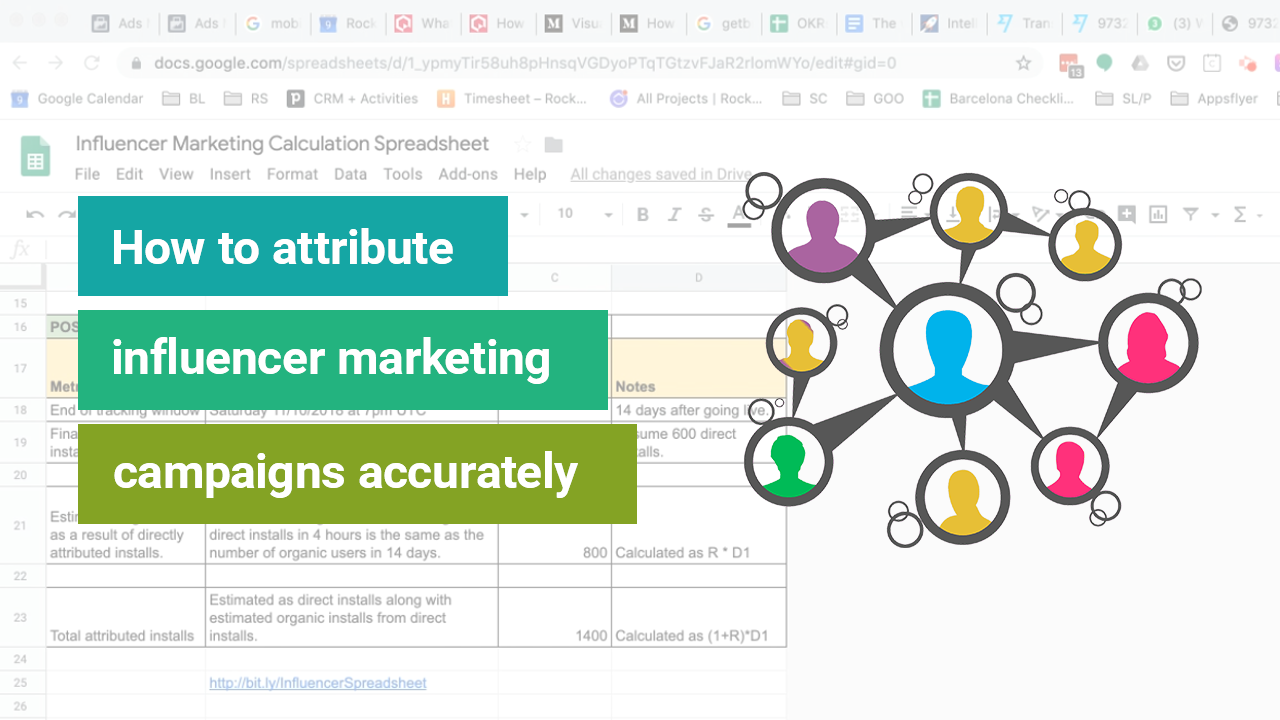
1. Before the campaign: set an organic baseline. Choose a measurement window. Based on his experience at the time, Shamanth uses four hours, while recommending a window that fits the product. Average organic installs in that same window on the same weekday over previous weeks. The example uses four Saturdays, with twelve or sixteen suggested for a more stable baseline. Its baseline is 200 installs.
2. On launch day: measure the excess. Count directly attributed installs in the window (150 in the example) and organic installs (400). Subtract the baseline: 400 minus 200 leaves 200 excess organics. Divide by direct installs: 200 / 150 ≈ 1.33 extra organics per direct install.
3. After the campaign: extend the estimate. The example counts 600 direct installs over 14 days. Applying the unrounded ratio gives 600 × (200 / 150) = 800 estimated indirect installs. Direct plus estimated indirect installs total 1,400.
These are the video’s illustrative inputs, not measured results from a named campaign.
What assumptions does the estimate make?
The baseline must be a reasonable estimate of what would have happened without the influencer. Other campaigns, seasonality or unrelated publicity could explain some of the excess. Averaging previous Saturdays does not control for everything that changes on launch day.
The extrapolation also assumes the indirect-to-direct ratio stays the same beyond the initial four hours. That may not hold as the post ages. Treat the result as a scenario estimate; a suitable controlled comparison is needed for a stronger incremental-lift claim.
For related guidance, see choosing creators for app installs, mobile attribution on iOS and paid-versus-organic trial correlation.
Frequently asked questions
Why can influencer installs appear as organic? Someone may see the post, then visit the store directly or install later without using its link.
How long after launch should I count? The video uses four hours for the initial ratio and 14 days for the campaign. Choose windows appropriate to your product and check whether extrapolating the initial ratio is reasonable.