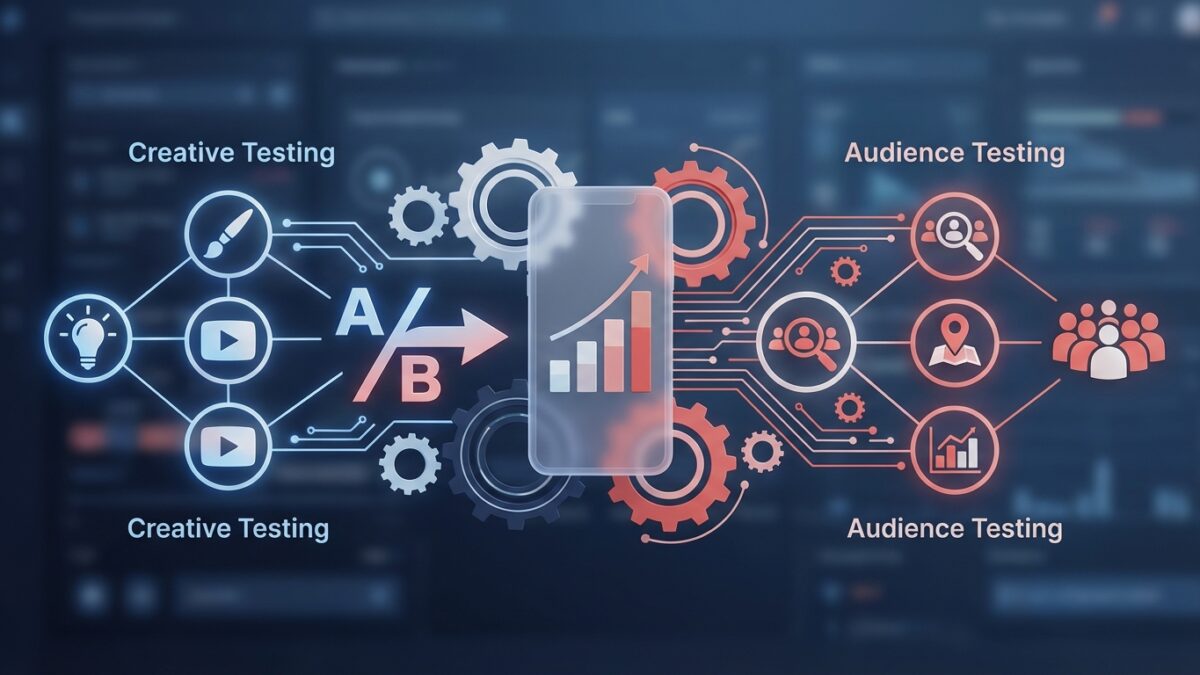
Creative testing is the single highest-leverage activity for improving mobile ad performance in 2026. Audience testing still has a role, but it is a secondary lever. According to Meta’s own Advantage+ documentation, algorithmic audience expansion now handles targeting optimization better than manual segmentation in most cases, which means the creative itself has become your primary targeting mechanism. In our experience managing B2C app campaigns, we consistently observe that creative variation drives substantially more variance in CPA than audience variation within the same account. This finding aligns with AppsFlyer’s 2025 creative optimization report, which found that creative quality drives 70% of campaign performance outcomes, far exceeding the impact of targeting or bidding strategy. This post breaks down exactly when each testing approach delivers ROI, how to structure tests for each, and why the balance has shifted so dramatically toward creative-first strategies.
Page Contents
Creative Testing
Creative testing means systematically varying ad elements (hooks, narratives, visual formats, CTAs, and personas) while holding audience targeting constant or broad. In 2026, this is the dominant lever for performance improvement. According to AppLovin's State of Creative Optimization report, the top 10% of advertisers on their platform refresh 30-50% of their creative portfolio every two weeks, and those advertisers see 22% lower CPAs on average compared to advertisers who refresh monthly or less. The reason creative testing has become so dominant is that platforms like Meta, Google, TikTok, and AppLovin now use creative signals as the primary input for algorithmic targeting. Your ad creative is effectively your audience targeting: a video showing a meditation session for new moms will be served to new moms by the algorithm, regardless of what audience you selected in the campaign settings. This dynamic is confirmed by Meta's Advantage+ Creative documentation, which explicitly states that creative diversity improves delivery optimization. In our experience, top-performing creatives routinely deliver CPAs that are significantly lower than median creatives within the same account. For external context, Adjust's 2025 Mobile Ad Creative Report found that top-decile creatives deliver CPAs 2.5-4x lower than median creatives across their measured campaigns, corroborating our internal findings. Meanwhile, in our experience, the CPA advantage from the top-performing audience segment is considerably narrower than the advantage delivered by top-performing creatives.
Pros
- Highest variance lever: industry patterns suggest creative variation explains the large majority of CPA variance in campaigns running on Meta and AppLovin. This aligns with findings from Eric Seufert's analysis on MobileDevMemo, which argues that creative has effectively replaced audience targeting as the primary performance driver post-ATT.
- Compounds over time: each winning creative concept becomes a template for modular iteration. A single winning concept can generate a large number of unique permutations by combining hooks, narratives, CTAs, and personas, meaningfully extending creative lifespan before fatigue sets in. Learn more about this approach in our guide to creative velocity and why it matters.
- Works with broad targeting: according to Meta’s Advantage+ Shopping Campaigns documentation, broad targeting versus interest-based targeting by 12-18% on ROAS in their published case studies, particularly for campaigns spending above $500/day.
- Directly combats creative fatigue, which according to AppsFlyer's 2025 creative optimization report, causes a 20-35% increase in CPI within 7-14 days of a creative's peak performance.
- Builds a proprietary creative intelligence library that informs future campaigns and reduces wasted spend on net-new concepts.
Cons
- Requires high production velocity: teams need to produce 15-30 new creative variants per week to sustain performance at scale, which is resource-intensive. See our breakdown of how AI apps handle 30+ creatives per week.
- Testing infrastructure is complex: you need structured naming conventions, holdout controls, and statistical rigor as outlined in our framework for A/B testing ad creatives. A poorly designed creative test wastes 2-4 weeks of budget with no learnings.
- Creative winners are channel-specific: a top performer on TikTok rarely translates directly to Meta or AppLovin without adaptation, which multiplies production needs. We cover strategies for managing this in our guide to scaling creative production without losing quality.
Need help scaling your mobile app growth? Talk to RocketShip HQ about how we apply these strategies for apps spending $50K+/month on UA.
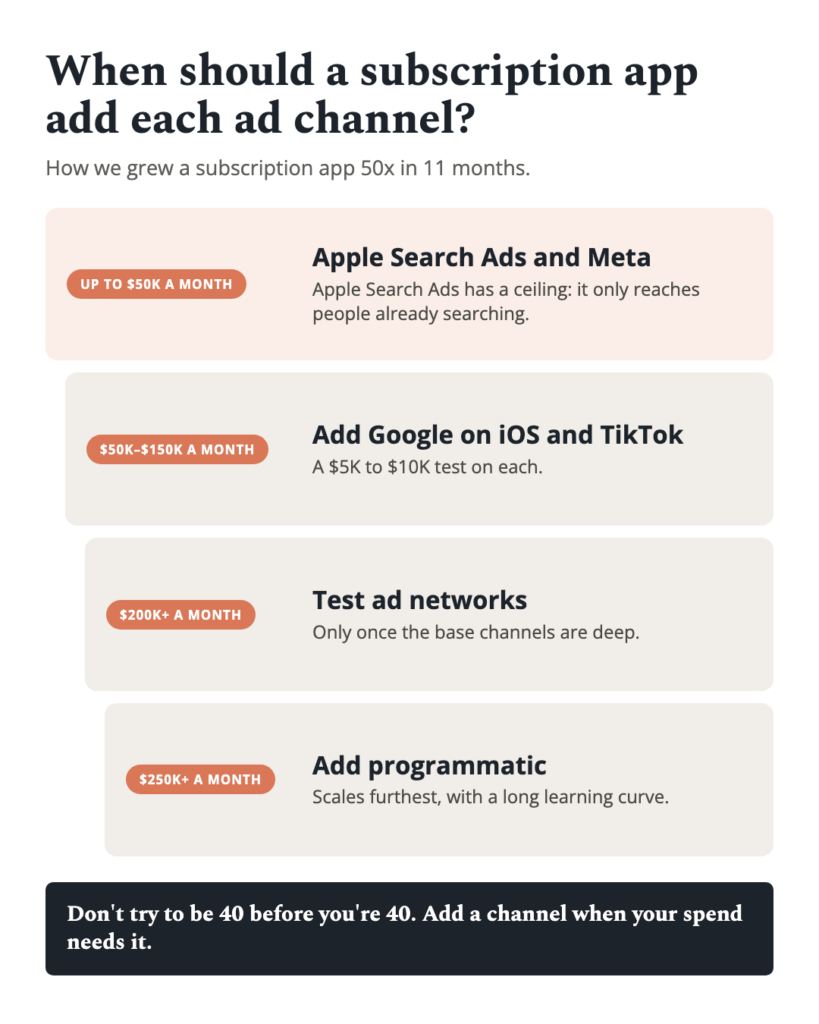
Best for: Creative testing is the right primary strategy for any app spending more than $500/day on a single channel, which gives enough conversion volume for the algorithm to learn (roughly 50+ conversions/day per Meta's own optimization guidelines). It is especially critical for apps in competitive categories (fitness, finance, dating, AI tools) where audience overlap between competitors is near-total and the only differentiation in the auction is the creative itself. If you are an app spending $5K-$50K/day on Meta or AppLovin, creative testing should consume the large majority of your testing resources.
Audience Testing
Audience testing means varying the targeting parameters (interest stacks, lookalike seed lists, custom audiences, geo segments, demographic cuts) while holding creative constant. In 2026, the scope of manual audience testing has narrowed significantly due to platform-side automation, but it has not disappeared entirely. According to Apple Search Ads audience documentation, keyword and audience refinement on that platform still drives meaningful CPA differences because the targeting mechanism is fundamentally search-intent based rather than algorithmically expanded. On Meta, audience testing now primarily means testing Advantage+ audience suggestions versus fully open targeting versus first-party custom audience seeds. In our experience, Advantage+ has delivered lower CPAs for the majority of accounts we have tested, with the exceptions typically being niche apps with well-defined, narrow audiences under 2M total addressable users. This pattern reflects the broader shift toward creative-as-targeting strategy in modern mobile UA, where ad content itself determines audience reach more effectively than manual targeting parameters.
Pros
- Essential for niche apps with small total addressable markets (under 5M users in a geo), where broad targeting wastes spend on irrelevant impressions.
- First-party data seeds (purchaser lookalikes, high-LTV user lookalikes) can still outperform broad targeting on ROAS for subscription apps, particularly when the seed list closely reflects high-LTV user behavior.
- On Apple Search Ads, keyword-level audience testing remains the primary optimization lever, with top-performing keywords delivering CPAs 40-60% below account averages according to Apple's keyword optimization best practices.
- Geo and language testing uncovers efficient pockets: expanding from US-only to Tier 1 English-speaking markets (UK, CA, AU) typically reduces blended CPI by 15-30% according to data.ai’s State of Mobile 2025 report, which benchmarks CPI by country across 50+ markets. This international expansion opportunity is further validated by app marketing spend trends 2025, with particularly strong growth in emerging markets.
Cons
- Diminishing returns on Meta and TikTok: platform algorithms have largely automated audience optimization, making manual audience testing redundant for most advertisers spending over $1K/day. Eric Seufert's analysis of Meta's ad tech details how the platform's ML models now outperform most manual targeting strategies.
- Small audience segments starve the algorithm of data. As discussed in this Mobile UA Show episode with Matej Lancaric, broad targeting with 20M+ audience sizes per ad set keeps CPIs as low as $0.10–$0.12 for hypercasual, and the principle scales to other categories. Narrow audiences fragment conversion data and prevent algorithmic learning.
- Post-ATT signal loss means lookalike audiences are less precise than pre-2021. According to post-ATT impact on paid media, lookalike audience match rates declined 30-40% after ATT enforcement. In our experience across accounts post-ATT, blended channel-level CPAs are more reliable than campaign-level audience segment data.
Best for: Audience testing is the right primary strategy only for early-stage apps spending under $500/day that need to validate product-market fit with a specific user segment before scaling, or for niche apps where the total addressable market is under 5M users. It also remains the primary lever on Apple Search Ads regardless of budget. For most scaled apps on Meta, TikTok, or AppLovin, audience testing should consume no more than 20-30% of testing resources. Scaled apps achieve better results by implementing dynamic creative optimization frameworks rather than fragmenting budget across narrow audience segments.
Side-by-Side Comparison
| Dimension | Creative Testing | Audience Testing |
|---|---|---|
| CPA variance explained | Accounts for the large majority of CPA variance on algorithmic platforms (directionally confirmed by AppsFlyer's creative optimization report and industry analysis) | A smaller share of CPA variance on algorithmic platforms; audience levers have narrowed as platform automation has improved |
| Best platform fit | Meta Advantage+, AppLovin, TikTok, Google UAC | Apple Search Ads, niche DSPs, programmatic direct |
| Minimum daily spend to generate learnings | $500/day per channel (~50+ conversions/day per Meta's AEO guidelines) | $200-500/day for keyword testing on ASA; $1K+/day for lookalike tests on Meta |
| Typical test cycle length | 5-7 days per creative batch; 2-3 week concept cycle | 7-14 days per audience segment test |
| Production cost per test iteration | $500–$5,000 per batch of 10-15 creative variants (based on RocketShip HQ production pricing) | Near zero incremental cost; targeting changes are free |
| Expected CPA improvement from a winning test | Significant CPA reduction from a top creative vs. median, corroborated by Adjust's 2025 Mobile Ad Creative Report finding top-decile creatives deliver CPAs 2.5-4x lower than median | 5-15% CPA reduction from optimal audience vs. broad (except ASA: 40-60% per Apple's documentation) |
| Creative fatigue risk | High: winners decay 20-35% within 7-14 days per AppsFlyer's 2025 data | Low: audience segments don't fatigue, but they saturate |
| Scalability ceiling | Nearly unlimited with modular systems that combine hooks, narratives, CTAs, and personas into many unique permutations | Capped by addressable market size; diminishing returns past 3-5 audience segments |
| Post-ATT effectiveness (iOS) | Strengthened: creative is the signal the algorithm uses for targeting | Weakened: lookalike precision degraded 30-40% per Adjust's post-ATT analysis |
| Resource requirements | Dedicated creative strategist + designer/editor; 15-30 variants/week at scale | UA manager time only; minimal production resources |
| Data feedback loop speed | Fast: Meta delivers statistical significance on creative performance in 3-5 days at $1K+/day spend | Slower: audience tests need 7-14 days for reliable CPA data post-ATT |
| Compounding value | High: each winner seeds the next round of modular iterations | Low: audience learnings are binary (works/doesn't) with limited iteration paths |
Verdict
Choose creative testing as your primary optimization lever if you are spending $500+/day on Meta, TikTok, AppLovin, or Google UAC. This covers the vast majority of scaled mobile app advertisers in 2026. In our experience, the majority of testing resources for clients in this category are best allocated to creative iteration. Choose audience testing as your primary lever only in three specific scenarios: (1) early-stage apps spending under $500/day that need to validate which user segments convert before scaling creative production, (2) niche apps where the total addressable market is under 5M users and broad targeting genuinely wastes impressions, or (3) Apple Search Ads is a significant portion of your channel mix, where keyword and audience refinement remains the primary performance lever per Apple's documentation. For apps in the $5K-$100K/day spend range, the optimal approach is a creative-first testing cadence built on a structured creative testing roadmap, with audience testing limited to periodic validation of first-party seed audiences and geo expansion. The advertisers winning in 2026 treat creative as their targeting strategy and invest accordingly in production velocity and rapid iteration.
Frequently Asked Questions
How do I staff a creative testing operation without hiring a full in-house team?
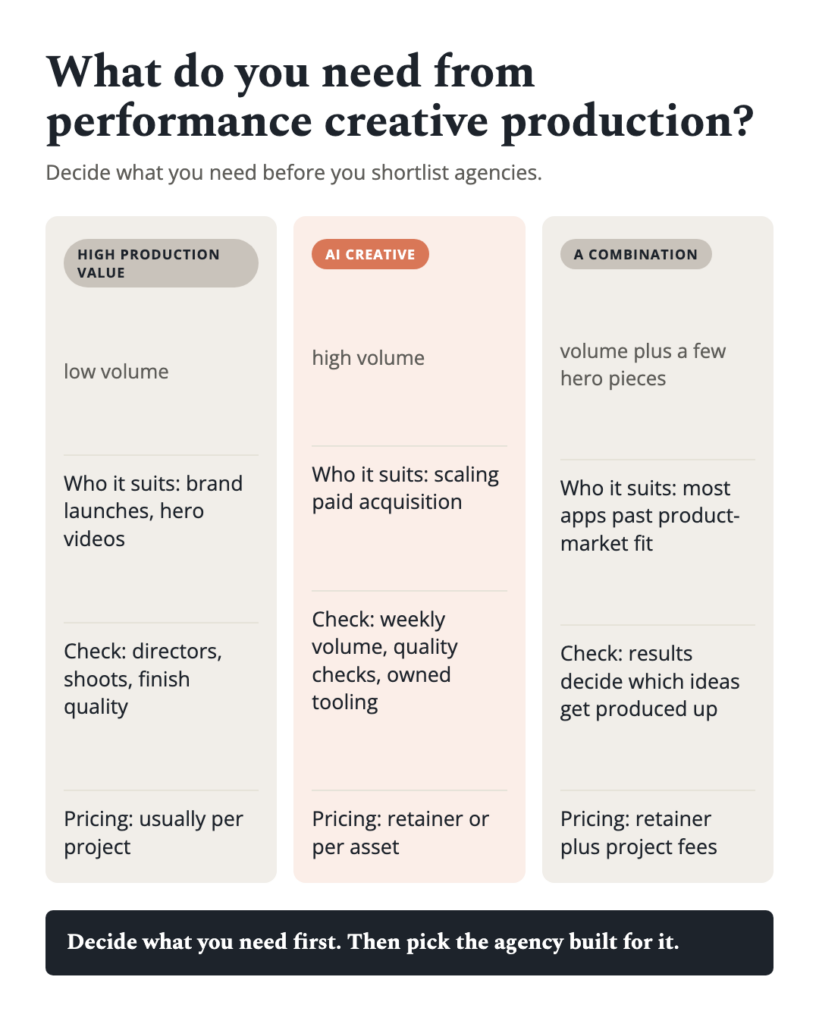
Most apps in the $5K-$30K/day spend range work with a hybrid model: one in-house creative strategist who owns the testing roadmap and concept briefs, paired with freelance editors or an agency like RocketShip HQ for production execution. According to AppsFlyer's 2025 report, advertisers using specialized creative partners produce 2.4x more winning creatives per month than those relying solely on in-house teams, because agency teams bring cross-vertical pattern recognition. The critical hire is the creative strategist who analyzes performance data and translates it into briefs, not more designers.
What happens when I run out of creative ideas and every new test underperforms?
This is a concept exhaustion problem, not a creative fatigue problem (they're different). When iterative variants stop winning, you need a net-new concept, meaning a fundamentally different narrative angle, visual style, or user persona. We detail strategies for breaking through plateaus in our guide on how to fix creative fatigue. In our experience, mining app store reviews and Reddit threads for new pain points or use cases is one of the most reliable methods for surfacing breakthrough concepts when teams feel stuck.
Can I run creative tests and audience tests simultaneously without contaminating results?
Yes, but you need isolation. Run creative tests in a broad-targeted Advantage+ campaign (or equivalent on other platforms), and run audience tests in a separate campaign with a fixed creative set that you do not change during the test window. According to Meta's campaign structure best practices, mixing both variables in the same campaign makes it impossible to attribute performance changes. Keep test budgets at a minimum of 50 conversions per variant per week to reach significance, as outlined in our Meta’s A/B testing tool.
How do I measure creative test results when post-ATT data is delayed and modeled?
Use a combination of platform-reported metrics (which arrive in 24-48 hours via SKAN or modeled conversions) for directional reads, and your MMP's cohorted data (from Adjust or AppsFlyer) for confirmed ROAS after 7-14 days. A common best-practice framework is to make go/no-go decisions on creative variants at day 5 using platform data, then validate with MMP data at day 14. The key is accepting that some day-5 decisions will be wrong, but the speed advantage of killing losers early more than compensates.
Is there a point where spending more on creative production has diminishing returns?
Yes. In our experience, the marginal value of additional creative variants tends to flatten significantly once a campaign is managing a large number of active variants. At that point, you're better served by scaling spend on your proven winners across additional geos or channels rather than producing more variants for the same campaign. According to AppLovin's State of Creative Optimization report, the top-performing advertisers maintain 20-40 active creatives per campaign, not 100+.
Should I use AI-generated creatives for testing, or do human-produced ads still win?
In 2026, the answer is both, but in different roles. AI tools (Midjourney, Runway, Sora) excel at producing high volumes of hook variations and visual concepts for initial testing. Industry observation suggests AI-generated static ad variants are increasingly testing at win rates comparable to human-designed statics, a trend noted in Liftoff’s Mobile Heroes research on AI-assisted creative production (roughly 1 in 8 vs. 1 in 7), but human-produced video narratives still outperform AI video by 25-35% on completion rates according to TikTok's 2025 creative best practices research. The optimal workflow uses AI to generate and test concepts at volume, then invests human production resources into scaling the winners.
How do I convince my team or leadership to shift budget from audience testing to creative production?
Run a two-week controlled experiment. Take your best-performing audience-targeted campaign and duplicate it with broad targeting but 5-10 new creative variants, allocating equal budget to each. In our experience, the broad-plus-creative campaign frequently outperforms the audience-targeted campaign on CPA — and on algorithmic platforms like Meta, this is largely because the creative itself acts as the real targeting signal, reaching the right users regardless of your manual audience settings. Document the CPA delta and present it alongside AppLovin’s findings showing that creative-first advertisers achieve 22% lower CPAs. Hard data from your own account is the most persuasive argument.
What naming conventions should I use to keep creative tests organized at scale?
Use a hierarchical taxonomy: [Concept ID]_[Hook variant]_[Narrative variant]_[CTA variant]_[Format]_[Date]. For example, C012_H3_N2_CTA1_9x16_0415. This lets you pivot table results by any element and identify which hooks, narratives, or CTAs are winning across concepts. We detail the full system in our guide on building a creative testing roadmap. In our experience, teams using structured naming conventions extract actionable learnings from creative tests significantly faster than teams using ad hoc naming.
Looking to scale your mobile app growth with performance creative that delivers results? Talk to RocketShip HQ to learn how our frameworks can work for your app.
Not ready yet? Get strategies and tips from the leading edge of mobile growth in a generative AI world: subscribe to our newsletter.
Related Reading
- Scaling creative production without losing quality (comprehensive guide)
- How do AI apps handle creative fatigue when they need 30+ new creatives per week? (2026)
- AppLovin State of Creative Optimization Report: What Top Advertisers Do Differently (2026)
- What Is the Best Framework for A/B Testing Ad Creatives?
- How Do You Build a Creative Testing Roadmap?
Free Tools
Try our free Creative Testing Calculator: Creative Testing Calculator. No signup required.