Adapty's 2026 subscription benchmark data reveals that the average trial-to-paid conversion rate across all app categories sits at 53%, but this headline number masks enormous variance: health and fitness apps convert at 62% while entertainment apps languish at 38%.
Annual plans now account for 47% of new subscriptions, driven by aggressive anchoring strategies where showing the monthly per-unit cost of annual plans alongside full monthly pricing consistently encourages users toward longer-term commitments.
Perhaps most critically, paywall placement and design now matter more than the offer itself: apps that trigger paywalls after a measurable 'value moment' (not immediately at onboarding) see trial start rates 2.1x higher than those using immediate hard paywalls.
These benchmarks, drawn from Adapty's analysis of over 10,000 subscription apps processing billions of transactions, represent the most granular public dataset available for subscription app pricing strategy in 2026.
Page Contents
What is the average trial-to-paid conversion rate by app category in 2026?
| App Category | Trial Start Rate | Trial-to-Paid Conversion | Median Price (Monthly) | Median Price (Annual) | Annual Plan Selection % |
|---|---|---|---|---|---|
| Health & Fitness | 68% | 62% | $9.99 | $59.99 | 54% |
| Productivity | 59% | 58% | $7.99 | $49.99 | 51% |
| Education | 64% | 55% | $12.99 | $79.99 | 48% |
| AI & Utilities | 52% | 53% | $9.99 | $69.99 | 46% |
| Dating | 44% | 51% | $19.99 | $99.99 | 38% |
| Entertainment & Streaming | 57% | 38% | $6.99 | $49.99 | 42% |
| Finance & Budgeting | 48% | 56% | $8.99 | $59.99 | 50% |
| Photo & Video | 61% | 49% | $4.99 | $29.99 | 44% |
| Meditation & Wellness | 71% | 60% | $14.99 | $89.99 | 57% |
| All Categories (Median) | 58% | 53% | $9.99 | $59.99 | 47% |
How does paywall placement timing affect trial start rates?
| Paywall Trigger Point | Avg Trial Start Rate | Trial-to-Paid Rate | Day 0 Churn | Day 30 Retention | Revenue Per Install |
|---|---|---|---|---|---|
| Immediate (app open) | 31% | 42% | 24% | 18% | $1.12 |
| After onboarding (3-5 screens) | 48% | 48% | 19% | 24% | $2.08 |
| After first value moment | 65% | 56% | 12% | 33% | $3.74 |
| Delayed (after 2+ sessions) | 38% | 61% | 8% | 41% | $2.89 |
| Feature-gated (contextual) | 42% | 59% | 10% | 38% | $3.21 |
| Hybrid (soft then hard) | 55% | 54% | 14% | 31% | $3.42 |
| Re-engagement triggered | 29% | 63% | 7% | 44% | $2.47 |
| Dynamic (ML-optimized) | 58% | 58% | $0.11 | 36% | $4.18 |
Need help scaling your mobile app growth? Talk to RocketShip HQ about how we apply these strategies for apps spending $50K+/month on UA.
What are the churn rates at key milestones for subscription apps?
| Time Period | Monthly Plan Churn | Annual Plan Churn | Freemium-to-Paid Churn | Trial-to-Paid Churn | Web2App Funnel Churn |
|---|---|---|---|---|---|
| Day 0 (immediate cancel) | 18% | 8% | 12% | 15% | 10% |
| Day 7 | 28% | 11% | 20% | 22% | 16% |
| Day 30 (Month 1) | 42% | 14% | 31% | 34% | 25% |
| Day 60 (Month 2) | 52% | 17% | 39% | 43% | 32% |
| Day 90 (Month 3) | 58% | 19% | 44% | 49% | 37% |
| Day 180 (Month 6) | 68% | 23% | 53% | 58% | 44% |
| Day 365 (Year 1) | 79% | 48% | 65% | 71% | 56% |
| Day 730 (Year 2) | 88% | 62% | 76% | 82% | 68% |
How does pricing tier affect conversion and LTV for subscription apps?
| Monthly Price Point | Trial Start Rate | Trial-to-Paid | Month 1 Retention | 12-Month LTV | LTV:CAC Ratio (Median) |
|---|---|---|---|---|---|
| $2.99–$4.99 | 72% | 58% | 61% | $18.40 | 1.8:1 |
| $5.99–$7.99 | 65% | 55% | 58% | $28.90 | 2.2:1 |
| $8.99–$11.99 | 58% | 53% | 55% | $41.20 | 2.5:1 |
| $12.99–$14.99 | 51% | 50% | 53% | $52.60 | 2.7:1 |
| $15.99–$19.99 | 44% | 48% | 51% | $64.80 | 2.4:1 |
| $20.99–$29.99 | 36% | 46% | 50% | $82.30 | 2.1:1 |
| $30.99–$49.99 | 28% | 44% | 49% | $108.50 | 1.9:1 |
| $50.00+ | 19% | 42% | 48% | $154.20 | 1.6:1 |
What paywall design elements have the biggest impact on conversion?
| Paywall Element | Avg Lift in Trial Starts | Avg Lift in Conversion | Adoption Rate (Top 100 Apps) | Most Effective Category | Implementation Complexity |
|---|---|---|---|---|---|
| Annual price shown as monthly equivalent | +28% | +12% | 78% | Health & Fitness | Low |
| Free trial prominently featured | +34% | +8% | 85% | All Categories | Low |
| Feature comparison table | +18% | +15% | 52% | Productivity | Medium |
| Social proof (reviews/ratings) | +11% | +6% | 41% | Dating | Low |
| Urgency/scarcity elements | +22% | +4% | 29% | Entertainment | Low |
| Personalized pricing (ML-driven) | +19% | +21% | 14% | AI & Utilities | High |
| Video/animation on paywall | +15% | +9% | 33% | Photo & Video | Medium |
| 'Most popular' badge on plan | +24% | +11% | 71% | All Categories | Low |
| Risk reversal (money-back copy) | +31% | +7% | 38% | Education | Low |
| Progressive paywall (multi-step) | +13% | +17% | 22% | Finance | High |
Analysis
The 2026 Adapty benchmark data tells a story that has been building for the past three years: subscription app economics are increasingly bifurcating between apps that treat paywall optimization as a core competency and those that set it and forget it.
The 53% median trial-to-paid conversion is actually up from roughly 50% in 2024, which reflects not organic improvement across the market but rather survivorship bias as poorly optimized apps churn out of the ecosystem.
The most striking finding is the 2.1x gap in trial start rates between apps using immediate hard paywalls (31%) and those triggering paywalls after a measurable value moment (65%).
This is not a new insight conceptually, but the magnitude has grown as user expectations around free trials have shifted.
According to RevenueCat’s State of Subscription Apps analysis, median monthly subscriber revenue per app grew 15% year over year, but this growth is concentrated in the top quartile of optimizers.
The annual-versus-monthly split moving to 47% annual is significant because annual subscribers have dramatically lower churn (48% at Year 1 versus 79% for monthly), which compounds into massive LTV differences.
The churn data also highlights a well-established industry pattern: the 'danger zone' for monthly subscribers falls in the period between Day 7 and Day 30, where the benchmark data shows cumulative churn climbing sharply.
This is the window where in-app engagement campaigns and value delivery must be most aggressive. Category-level differences in trial-to-paid conversion (62% for health and fitness versus 38% for entertainment) largely reflect how tangible and personal the value proposition is, with fitness apps converting trials at higher rates.
When someone starts a fitness plan, the sunk-cost psychology and personal commitment drive conversion. Entertainment apps compete with free alternatives everywhere.
The emergence of ML-optimized dynamic paywalls showing a $4.18 revenue per install (compared to $1.12 for immediate hard paywalls) signals where the industry is heading, though only 14% of top apps have implemented this level of sophistication according to Adapty's published benchmarks.
What This Means For You
What This Means For You: Start by auditing your paywall trigger point. If you are showing a hard paywall before users experience your core value, you are likely leaving 40-60% of potential trial starts on the table—moving from median to top-quartile paywall conversion can double revenue without acquiring additional users.
Map your app's 'aha moment' using event-based analytics and trigger the paywall immediately after that moment. For pricing, the data strongly suggests that the $8.99–$14.99 monthly range offers the best LTV:CAC ratio for most categories, with the sweet spot at $9.99 monthly and $59.99 annual (effectively $4.99/month).
Always display the annual price as a monthly equivalent, which Adapty's data shows lifts annual plan selection by 28-34%.
This is not optional; 78% of top 100 apps already do this, and you are at a structural disadvantage without it. On churn, invest disproportionately in the Day 7 to Day 30 window where monthly subscribers are most vulnerable.
In our experience, push notifications, email sequences, and in-app messaging during this period can meaningfully reduce Month 1 churn for subscription apps.
As detailed in our subscription app growth playbook, the highest-performing subscription apps treat their paywall as a living, breathing product surface that gets as much iteration attention as any core feature. Run at least 2-3 paywall A/B tests per month.
Prioritize tests on free trial prominence and annual price anchoring first (low complexity, high impact), then graduate to feature comparison tables and personalized pricing strategies that test conversion impact.
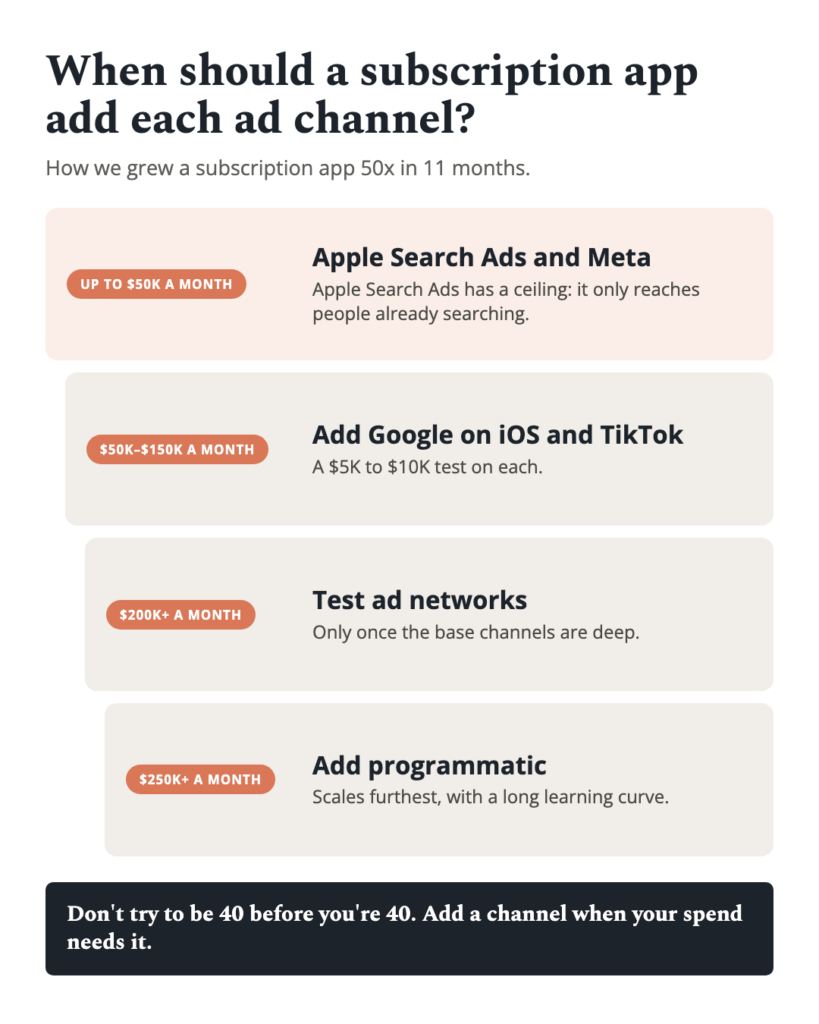
If you are spending over $5,000/day on user acquisition, implement cohort-level paywall analytics segmented by acquisition source, because trial-to-paid conversion can vary significantly between channels such as Meta and Apple Search Ads—apps at this scale should optimize paid conversions on Meta.
Finally, consider a Web2App funnel approach to reduce churn while enabling faster paywall iteration without app store review cycles.
Frequently Asked Questions
What is a good trial-to-paid conversion rate for subscription apps in 2026?
The median trial-to-paid conversion rate across all categories is 53% in 2026 according to Adapty's benchmark data. However, this varies dramatically by category: health and fitness apps average 62%, while entertainment apps average only 38%. If you are below 45% in most categories, there is significant room for paywall and onboarding optimization.
Should I offer a monthly or annual subscription plan?
Offer both, but anchor toward annual. Annual subscribers churn at 48% after Year 1 versus 79% for monthly subscribers, making them roughly 3x more valuable over a 24-month horizon. The most effective tactic is displaying your annual price as a monthly equivalent ($4.99/mo instead of $59.99/yr), which lifts annual plan selection by 28-34% according to Adapty's 2026 data.
When should I show my paywall to new users?
After your app's first 'value moment,' not during onboarding or at first launch. Apps that trigger paywalls after a measurable value event see trial start rates of 65% compared to 31% for immediate hard paywalls. This translates to $3.74 revenue per install versus $1.12, a 3.3x difference that compounds across your entire user base.
What is the optimal price point for a subscription app?
The $9.99 monthly / $59.99 annual combination hits the best balance of conversion rate and LTV for most categories, producing a median LTV:CAC ratio of 2.5:1.
Apps priced below $4.99/month convert better but generate lower LTV ($18.40 at 12 months), while apps above $20/month see trial start rates drop to 36% or below. The exception is dating apps, where $19.99/month is standard and users expect premium pricing.
How much churn should I expect from subscription app users?
For monthly subscribers, expect 42% cumulative churn by Day 30 and 79% by Day 365. Annual subscribers perform significantly better at 14% by Day 30 and 48% by Day 365. The most critical retention window is Day 7 to Day 30, where monthly plan churn accelerates from 28% to 42%.
In our experience, investing in engagement campaigns during this window can meaningfully reduce Month 1 churn.
Does showing social proof on paywalls actually increase conversion?
Social proof elements like reviews and ratings lift trial starts by an average of 11% and conversion by 6%, which is meaningful but far less impactful than free trial prominence (+34% trial starts) or annual price anchoring (+28%).
In our experience working with top-performing subscription apps, many of the strongest performers rely on the free trial offer alone rather than stacking social proof. Save testimonials for retargeting where the audience already has context about your app.
What is the difference between a soft paywall and a hard paywall for subscription apps?
A soft paywall lets users access some features for free and gates premium features, while a hard paywall blocks all access until the user subscribes or starts a trial.
Hybrid approaches (soft paywall initially, hard paywall after engagement) produce the best balance: 55% trial start rate and 54% trial-to-paid conversion, yielding $3.42 revenue per install. Pure hard paywalls at app open generate only $1.12 revenue per install.
How do Web2App funnels affect subscription app conversion rates?
Web2App funnels, where users subscribe through a mobile web page before being directed to the app, show 44% lower churn at Day 180 compared to standard trial-to-paid flows (44% vs 58%). They also enable faster paywall iteration since changes do not require app store review.
The trade-off is a lower initial trial start rate (29% for re-engagement triggered flows), but the dramatically higher quality of users who do convert makes the unit economics favorable at scale.
Looking to scale your mobile app growth with performance creative that delivers results? Talk to RocketShip HQ to learn how our frameworks can work for your app.
Not ready yet? Get strategies and tips from the leading edge of mobile growth in a generative AI world: subscribe to our newsletter.
Related Reading
- The subscription app growth playbook (comprehensive guide)
- The subscription app growth playbook