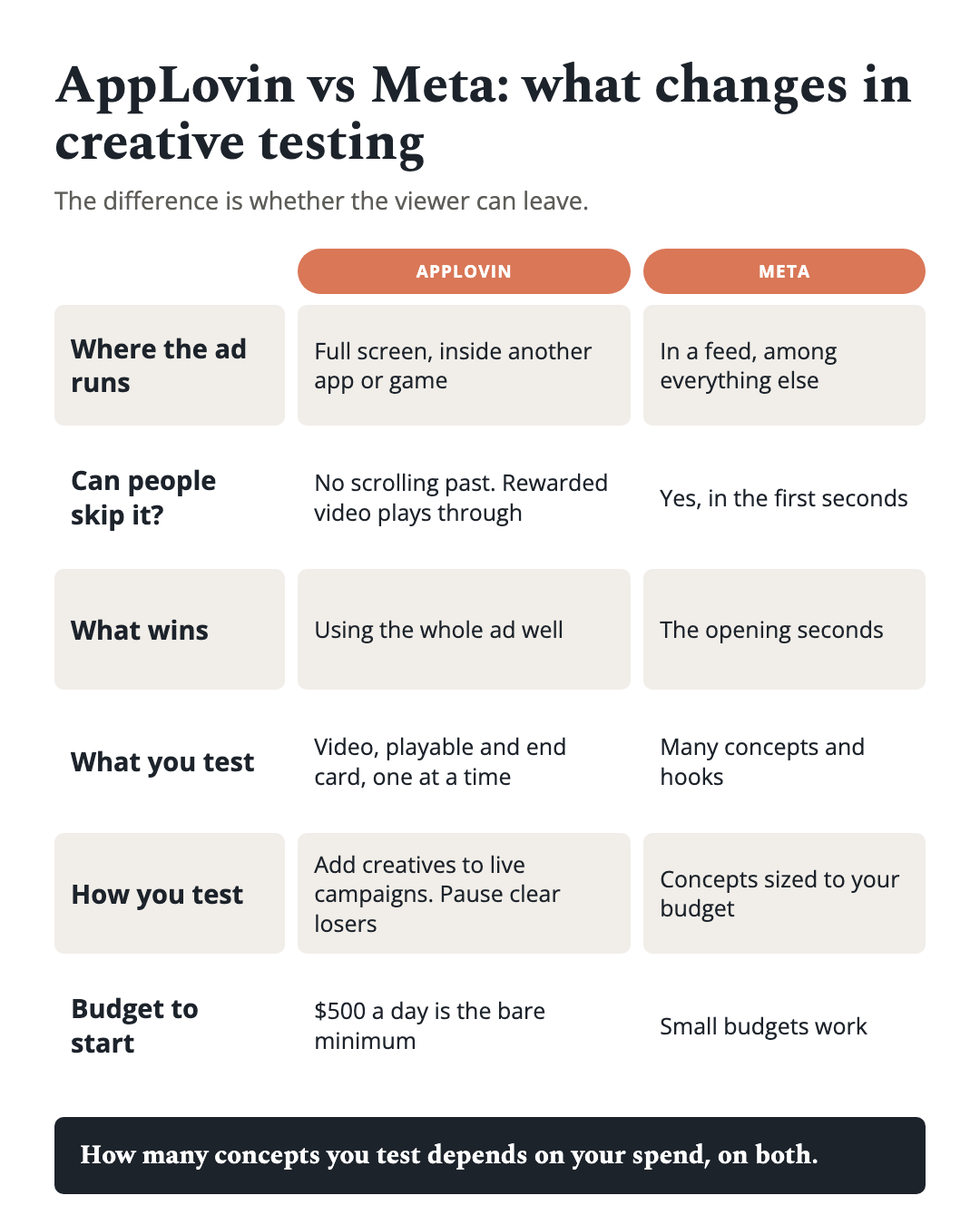
AppLovin and Meta operate on opposite creative-testing playbooks. AppLovin rewards low variant volume (5 to 7 new creatives per week), concentrated spend per creative, and hands-off iteration; the Axon 2 algorithm needs stability to calibrate. Meta rewards high variant volume (8 to 15 concepts per week with 2 to 3 variants each), portfolio testing across many ad sets, and a defined decision cadence over 7 to 14 days. Apply the Meta playbook to AppLovin and you burn budget on under-calibrated tests. Apply the AppLovin playbook to Meta and you starve the algorithm of the variety it needs to find winners.
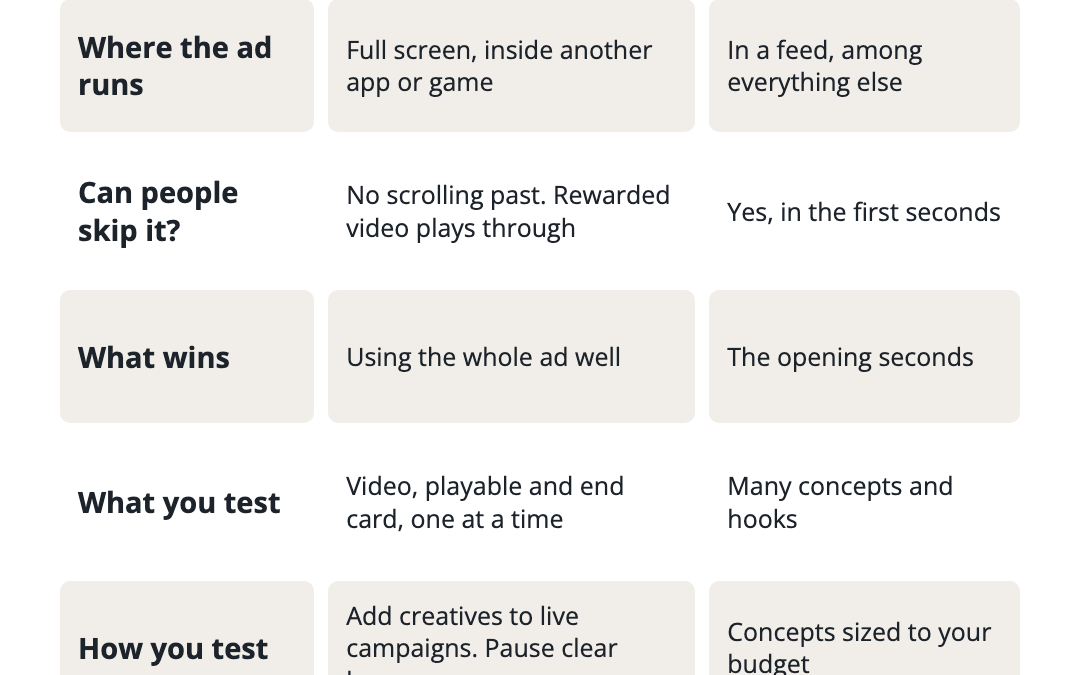
| Element | AppLovin | Meta |
|---|---|---|
| Variant volume per week | 5 to 7 new creatives | 8 to 15 concepts (2 to 3 variants each) |
| Active concepts at any time | 2 to 3 | 10 to 30 across ad sets |
| Decision window | 2 to 3 weeks per refresh cycle | 7 to 14 day rolling cohort |
| Test campaign structure | No separate test campaign; ship into existing campaigns | Dedicated test ad sets at the optimization event |
| Pruning behavior | Hands-off; Axon deprioritizes losers automatically | Manual; pause variants below hurdle rate |
| Spend per creative | Concentrated; thin spend breaks signal | Distributed across portfolio |
| Dominant ad format | Rewarded video, interstitial, playable | Feed video, Reels, Stories |
| Creative grammar | Full ad duration of attention; storytelling and reveal | First 1 to 3 seconds win or lose the auction |
What we see: The structural inversion is not a stylistic preference. It is a function of how each algorithm reads signal, and how each platform delivers attention.
In 15 years of running mobile UA, with $100mm+ deployed across 100+ apps on both AppLovin and Meta, the single most expensive pattern I see is teams applying the Meta playbook to AppLovin. They ship 30 to 50 variants a week. They prune aggressively. They restructure campaigns every few days. None of that works on AppLovin. The mirror mistake (applying AppLovin’s low-variant concentration to Meta) is rarer but equally lossy: the team ships 4 concepts a month into Meta and wonders why iteration feels stuck.
The reason teams default to the Meta playbook is that Meta has been the dominant paid channel in mobile UA for a decade. The muscle memory of “ship 50 variants, kill losers fast” is built in. AppLovin, with Axon 2 in 2026, runs on a different algorithm. The teams that win on AppLovin run fewer, more concentrated tests and resist the urge to touch the campaign. The teams that win on Meta build a portfolio testing process and trust the math.
For platform-specific operational depth, see how to test ad creatives on AppLovin in 2026 and how to test ad creatives on Meta in 2026. The comparison below is the bridge: when to use which, why they are inverted, and how to run them in parallel without cross-contaminating the playbooks.
Page Contents
- What is the difference between AppLovin and Meta for ad creative testing?
- How many ad variants should you test on AppLovin vs Meta?
- Why doesn’t the Meta creative testing playbook work on AppLovin?
- Should you use the same creatives on AppLovin and Meta?
- When should mobile apps prioritize AppLovin over Meta?
- How do you run AppLovin and Meta in parallel without cross-contaminating the playbooks?
- What is the difference between Axon 2 and Meta’s Advantage+ for creative allocation?
- What we learn from running both platforms
- Testing process that makes sense on each platform
- Frequently asked questions
- Related reading
What is the difference between AppLovin and Meta for ad creative testing?
The difference between AppLovin and Meta for ad creative testing is that AppLovin’s Axon 2 algorithm concentrates spend on a small number of creatives and learns deeply on each, while Meta’s algorithm distributes spend across a portfolio of variants and allocates toward predicted-best performers over a 7 to 14 day window. AppLovin needs stability and per-creative spend volume to calibrate; Meta needs variety and signal-per-ad-set volume. The testing process you run on each platform should match how the algorithm reads signal, not your team’s preferred operational habit.
Three structural differences drive the inversion:
- Signal source. Axon 2 learns from user-level behavioral signals across the MAX ad-monetization network, including bid prices users command on the ad-mon side. Meta learns from conversion events the advertiser defines (install, trial start, purchase) filtered through SKAN postbacks. The signal Axon needs (deep per-user behavior) requires concentrated spend per creative. The signal Meta needs (conversion-event volume) requires distributed spend across enough ad sets to clear SKAN privacy thresholds.
- Inventory and attention. AppLovin’s dominant formats (rewarded video, interstitial, playable) deliver the full ad duration with the viewer’s attention captured. Meta’s feed and Reels inventory is dismissible in the first 1 to 3 seconds. The creative grammar that wins on each platform is shaped by whether you have to earn the watch or you have it by default.
- Optimization horizon. Axon updates continuously in real time as user behavior accumulates. Meta batches optimization decisions across the learning phase and steady state. The decision cadence you run on each platform follows from how often the algorithm reassesses.
How many ad variants should you test on AppLovin vs Meta?
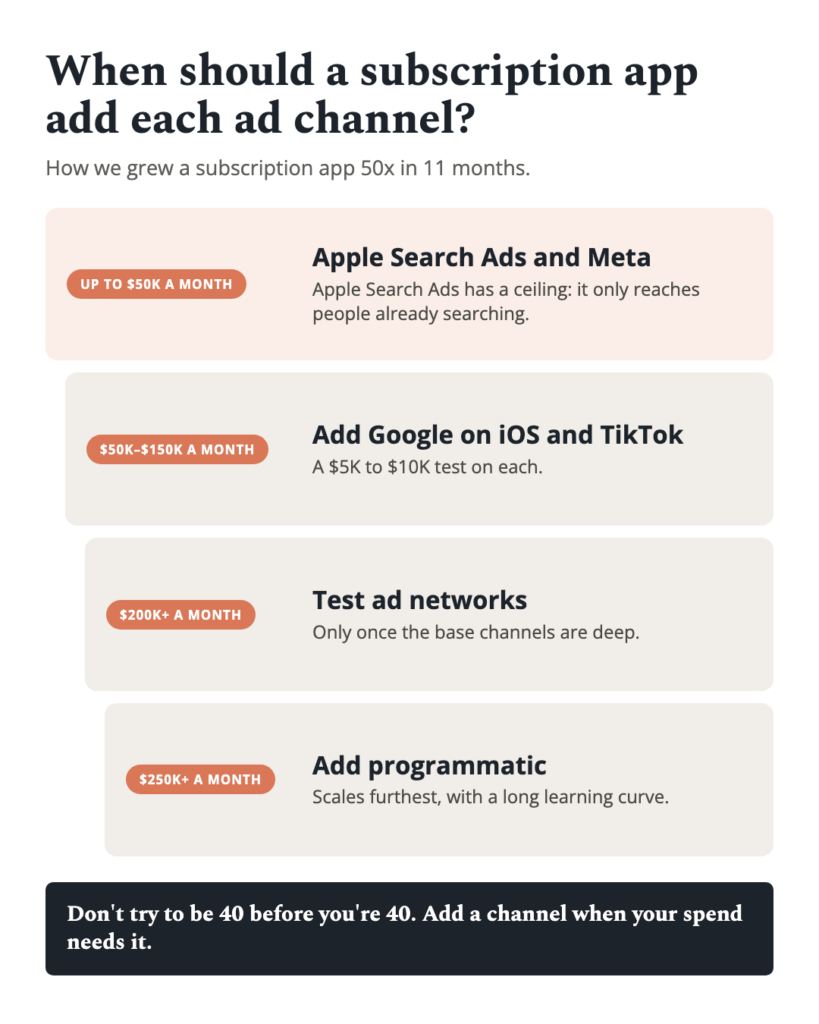
Test 5 to 7 new creative variants per week on AppLovin, with 2 to 3 active concepts live at any time. Test 8 to 15 distinct concepts per week on Meta, with 2 to 3 variants per concept (so 16 to 45 total variants in rotation). The AppLovin number is bounded by Axon’s per-creative spend requirement; pushing past 25 active creatives per month dilutes signal even on scaled accounts spending $1mm+. The Meta number is bounded by your team’s creative production capacity and your ad set budget (each ad set needs at least 2 to 3 daily conversions to read variant performance reliably).
| Account spend tier | AppLovin: new creatives/week | Meta: concepts/week |
|---|---|---|
| Sub-$50K/month | 3 to 5 | 2 to 4 (below this, signal is too thin to read) |
| $50K to $250K/month | 5 to 7 | 5 to 10 |
| $250K to $1mm/month | 7 to 12 | 10 to 15 |
| $1mm+/month | 12 to 25 (ceiling) | 15 to 25+ |
What we see: AppLovin’s ceiling stretches with spend but does not scale linearly. Meta’s volume grows roughly proportionally with spend, capped by production capacity. The two platforms reach different ceilings for different reasons.
The mistake teams make is anchoring on the absolute number (“we test X creatives per week, regardless of platform”). The right anchor is signal per variant. On AppLovin, signal per variant requires concentrated daily budget. On Meta, signal per variant requires enough conversion events in the ad set to read past SKAN noise. Once you set those floors, the variant volume falls out of the math.
Why doesn’t the Meta creative testing playbook work on AppLovin?
The Meta creative testing playbook does not work on AppLovin because Axon 2 is built for stability and concentrated learning, not portfolio breadth. Three specific elements of the Meta playbook break on AppLovin: high variant volume (Axon cannot calibrate at low per-variant spend), aggressive pruning (manual pauses confuse the algorithm’s deprioritization logic), and frequent campaign restructuring (Axon’s learning curve assumes stable structure). Teams that ship 30 to 50 variants a week to AppLovin, pause underperformers manually, and rebuild campaigns every few days end up paying for an algorithm that is constantly resetting.
The failure pattern looks like this. The team launches an AppLovin campaign mid-month with 20 creative sets. By day 4, half the sets show high CPI. The team pauses the losers (Meta instinct). Spend redistributes to the survivors, but Axon was still calibrating across the full set. The remaining creatives now see different bid prices than the algorithm expected, so signal drifts. By day 7, the survivors also start underperforming. The team launches another 20 creatives to “refresh.” Axon resets again. CPI never lands. The team concludes “AppLovin is broken.” AppLovin is not broken. The playbook is.
The fix is structural, not tactical. Cut variant volume to 5 to 7 per week. Keep 2 to 3 concepts live. Let each one accumulate spend for at least 2 weeks before refreshing. Trust Axon to deprioritize losers. The mental shift is from “I am the optimization engine” to “the algorithm is the optimization engine and my job is to feed it cleanly.”
Should you use the same creatives on AppLovin and Meta?
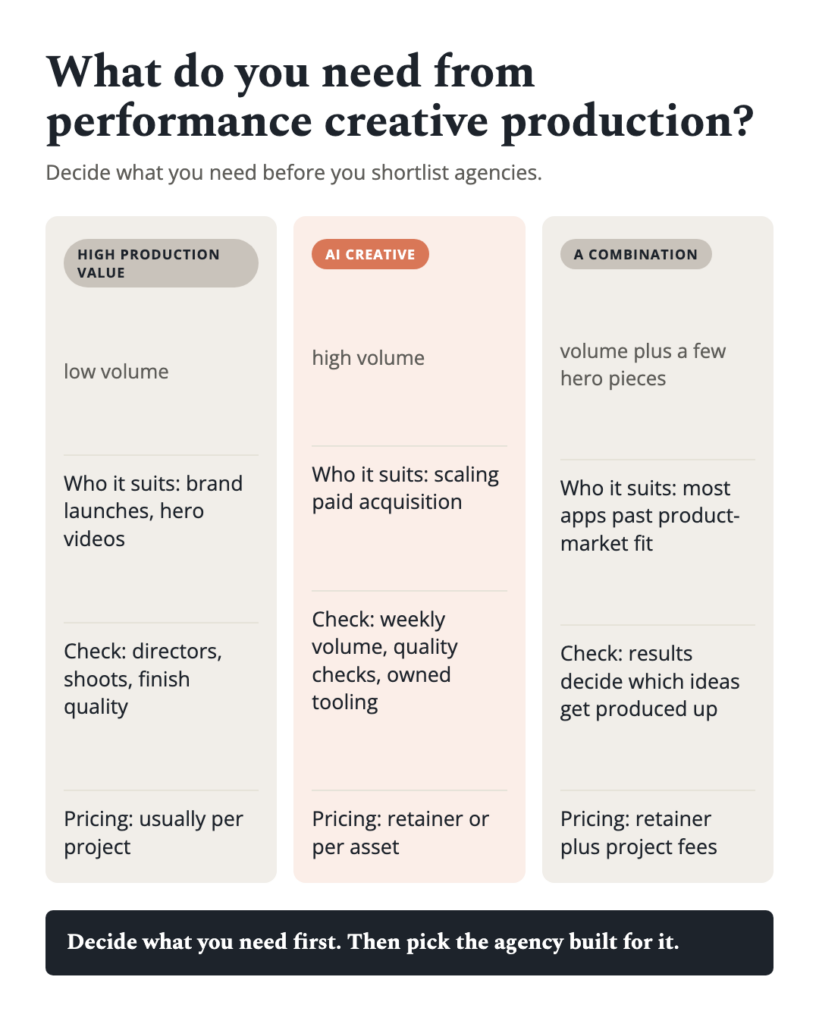
You can reuse the same source creatives on AppLovin and Meta, but the asset specifications and creative grammar should differ. AppLovin’s dominant formats (rewarded video, interstitial, playable) are full-attention placements with 15-second to 30-second average watch times; the creative can use storytelling, gameplay reveal, or reward visualization. Meta’s feed and Reels placements are dismissible in 1 to 3 seconds; the creative must front-load the hook, value proposition, and pattern interrupt. The same concept can ship to both platforms, but the cut, opening frames, and pacing should be re-edited per platform, not lifted directly.
| Creative element | AppLovin | Meta |
|---|---|---|
| First 1-3 seconds | Establish context, set up the reward | Hook, pattern interrupt, value prop |
| Mid-ad (3-15 seconds) | Storytelling, gameplay loop, problem | Demonstration, proof, social validation |
| Closing (15-30 seconds) | End card with strong CTA, reward visual | Direct call-to-action, urgency |
| Aspect ratio dominant | 9:16 vertical (rewarded), 16:9 horizontal (interstitial) | 9:16 (Reels, Stories), 1:1 (feed) |
| Audio assumption | Sound-on by default | Sound-off default; design for captions |
| Optimal length | 15 to 30 seconds | 6 to 15 seconds (feed), up to 30 (Reels) |
What we see: The same creative concept can ship to both platforms. The same creative asset usually should not.
The practical workflow that scales: produce a master shoot or animation cycle around a single concept (the hook, the demonstration, the close). Cut a 6-second Meta version that front-loads the hook and ends with a hard CTA. Cut a 20-second AppLovin version that builds the story and lands the end card. The asset reuse is at the source material level, not the deliverable level.
When should mobile apps prioritize AppLovin over Meta?
Mobile apps should prioritize AppLovin when they are gaming-first (especially mid-core, casual, or hyper-casual genres where rewarded video and playables are native), when their LTV model maps to D0 or D7 ROAS (Axon’s strongest signal window), or when their Meta CPIs have inflated past the point where unit economics close. Apps should prioritize Meta when they are non-gaming subscription, utility, or social, when their LTV requires longer payback (D28+ subscription windows), or when their creative production model is high-volume and hook-driven. Most subscription apps at scale should run both, with budget split by which platform’s ROAS matches their target.
The platform-fit decision is not binary, but it has a strong default:
- Casual and mid-core mobile games: AppLovin first, then Meta. Gameplay reveals and rewarded video are AppLovin-native formats. Most casual game CPIs land 30 to 50% lower on AppLovin than on Meta.
- Hyper-casual games: AppLovin almost exclusively, with very small Meta budgets for diversification. The D0 ROAS signal is fastest and cleanest on AppLovin.
- Subscription apps (health, fitness, productivity, education): Meta first, then AppLovin if scale demands it. Subscription LTV requires D28+ payback windows; Meta’s targeting and creative variety advantage compounds.
- Utility apps with single in-app purchase: Meta first, then AppLovin for incremental scale. The auction dynamics favor Meta’s signal-to-LTV mapping.
- Social and consumer apps: Meta first. Feed-native creative grammar matches the product surface.
For subscription apps specifically, AppLovin is a real channel in 2026, not a gaming-only option. The MAX inventory has expanded substantially. But the bar to make it work is higher: the team must build AppLovin-native creative (rewarded video, story-driven, end-card heavy) and run the Axon playbook, not the Meta playbook.
How do you run AppLovin and Meta in parallel without cross-contaminating the playbooks?
Run AppLovin and Meta in parallel by maintaining separate weekly cadences, separate creative production pipelines, and separate evaluation cohorts per platform. Do not pool variants. Do not use the same active concept count target. Do not apply the same decision cadence. Each platform’s algorithm reads signal differently, and pooling the operational layer flattens that distinction. The teams that scale on both platforms run two distinct testing processes under one creative strategy umbrella.
The structural separation lives in three places:
- Production cadence. Plan Meta’s weekly variant ship date and AppLovin’s bi-weekly refresh date independently. The production team should know which platform each asset is targeted for before the shoot or animation cycle begins.
- Decision rules. Meta variants get evaluated on rolling 7 to 14 day cohort data. AppLovin creative sets get evaluated on 2 to 3 week refresh cycles. Use platform-specific hurdle rates (Meta’s ROAS targets and AppLovin’s ROAS targets often diverge by 20 to 30%).
- Creative library structure. Tag assets by platform from inception. Avoid the temptation to “test it on Meta first, then port to AppLovin.” That workflow trains your team to use Meta-native creative grammar everywhere, which is the original misapplication problem.
What is the difference between Axon 2 and Meta’s Advantage+ for creative allocation?
Axon 2 and Meta’s Advantage+ both use machine learning to allocate budget across creatives, but they optimize differently. Axon 2 concentrates spend on a small number of creatives, learns from user-level ad-monetization signals across the MAX network, and updates continuously in real time. Advantage+ allocates budget across a portfolio of variants within a campaign or ad set, learns from conversion events the advertiser defines (filtered through SKAN), and updates in batched optimization cycles. Axon assumes stability; Advantage+ assumes variety. The two systems have different operational requirements even when both are called “AI-driven creative allocation.”
The practical implication for testing process: on AppLovin, your job is to set up the conditions Axon needs (stable structure, concentrated spend, low variant churn) and then get out of the way. On Meta with Advantage+, your job is to feed the algorithm enough variety, allow ad sets to clear the learning phase, and intervene on hurdle rate violations. Both systems will outperform a manual budget-allocation human in 2026. Neither system will outperform a human who is fighting it.
What we learn from running both platforms
Three patterns show up repeatedly across accounts that scale on both AppLovin and Meta.
- Creative diversity matters more on Meta than on AppLovin. Meta’s auction dynamics reward portfolio breadth (different hooks, different visual styles, different value props in rotation). AppLovin’s Axon rewards concentration on the few creatives that work. The teams that win on Meta build a creative production engine. The teams that win on AppLovin pick fewer concepts and execute them deeper.
- The “cheap CPI” trap is platform-specific. On AppLovin, low CPI early often signals Axon hasn’t calibrated to your LTV yet. On Meta, low CPI early often signals you optimized for the wrong event (install instead of purchase). Both look like wins for the first week and reveal themselves as losses by week 3.
- The ROAS target divergence is real. Subscription apps that hit a 70% D7 ROAS target on Meta often need a 90 to 110% D7 ROAS on AppLovin to compensate for slower D28 maturation. Gaming apps see the inverse: AppLovin matures faster than Meta on D0 to D7. Build the target by platform, not as a single account-wide ROAS goal.
For early visual evaluation of AppLovin formats before you ship, RocketShip HQ’s free AppLovin ad preview tool renders interstitials and rewarded formats with your assets. Useful for checking end-card legibility, first-frame composition, and rewarded loop closure before the creative goes live in Ads Manager.
Testing process that makes sense on each platform
- Define platform-specific cadences before the production cycle starts. Meta: 8 to 15 concepts per week. AppLovin: 5 to 7 new creatives every 2 to 3 weeks. The production team plans against the cadence, not the other way around.
- Set decision rules in writing before launch. What promotes a Meta variant out of testing (CPA below hurdle for 7 days at 2 to 3 conversions per day). What kills an AppLovin creative (refresh cycle ends or ROAS drops 20% below cohort average for 5 days). Decision rules negotiated after the data lands are decisions made on noise.
- Read variant performance from the right report. Meta variant comparison uses CPA at the ad set level with SKAN postback reconciliation. AppLovin variant comparison uses ROAS at the creative set level with Axon’s deprioritization signal as a secondary indicator.
- Refresh the creative library on platform-specific schedules. Meta’s refresh velocity is faster (weekly). AppLovin’s is slower (every 2 to 3 weeks). Both are real. Skipping either kills the testing engine over a 6-week horizon.
- Maintain a shared concept pool, not a shared asset pool. The hook idea can travel between platforms. The deliverable cut should not. Tag every asset with its platform from creation.
Frequently asked questions
What is the difference between AppLovin and Meta for ad creative testing?
AppLovin’s Axon 2 algorithm concentrates spend on a small number of creatives (5 to 7 per week, 2 to 3 active concepts) and learns deeply on each. Meta distributes spend across a portfolio of 8 to 15 weekly concepts with 2 to 3 variants each. The testing cadence, variant volume, and decision rules differ by platform because the underlying algorithms read signal differently.
How many ad variants should you test on AppLovin vs Meta?
Test 5 to 7 new creative variants per week on AppLovin with 2 to 3 active concepts live. Test 8 to 15 distinct concepts per week on Meta with 2 to 3 variants per concept. The AppLovin number is bounded by Axon’s per-creative spend requirement; the Meta number is bounded by production capacity and SKAN signal thresholds.
Should you use the same creatives on AppLovin and Meta?
You can reuse the same source concept on AppLovin and Meta, but the asset specifications differ. Cut a 6 to 15 second Meta version that front-loads the hook. Cut a 15 to 30 second AppLovin version that builds the story and lands the end card. The asset reuse is at the source material level, not the deliverable level.
Why doesn’t the Meta creative testing playbook work on AppLovin?
The Meta playbook fails on AppLovin because Axon 2 needs stable campaign structure, concentrated per-creative spend, and low variant churn to calibrate. High variant volume, aggressive pruning, and frequent restructuring (the core Meta tactics) prevent Axon from reading signal cleanly. The fix is structural: cut variant volume, keep concepts live longer, and trust Axon’s deprioritization logic.
When should mobile apps prioritize AppLovin over Meta?
Prioritize AppLovin for gaming apps (especially casual, mid-core, hyper-casual) where rewarded video and playables are native formats and D0 to D7 ROAS lands fast. Prioritize Meta for non-gaming subscription, utility, or social apps where LTV requires D28+ windows and feed-native creative variety matters more. Most subscription apps at scale should run both, with budget split by which platform’s ROAS matches the target.
What is the difference between Axon 2 and Meta’s Advantage+ for creative allocation?
Axon 2 concentrates spend on a few creatives, learns from user-level ad-monetization signals, and updates continuously in real time. Advantage+ distributes spend across a portfolio of variants, learns from advertiser-defined conversion events (filtered through SKAN), and updates in batched optimization cycles. Axon assumes stability; Advantage+ assumes variety.
Can you run AppLovin and Meta in parallel without cross-contaminating the playbooks?
Yes, by maintaining separate weekly cadences, separate creative production pipelines, and separate evaluation cohorts per platform. Do not pool variants or share decision rules. Tag every creative asset by platform from inception. The hook idea can travel between platforms; the deliverable cut should not.