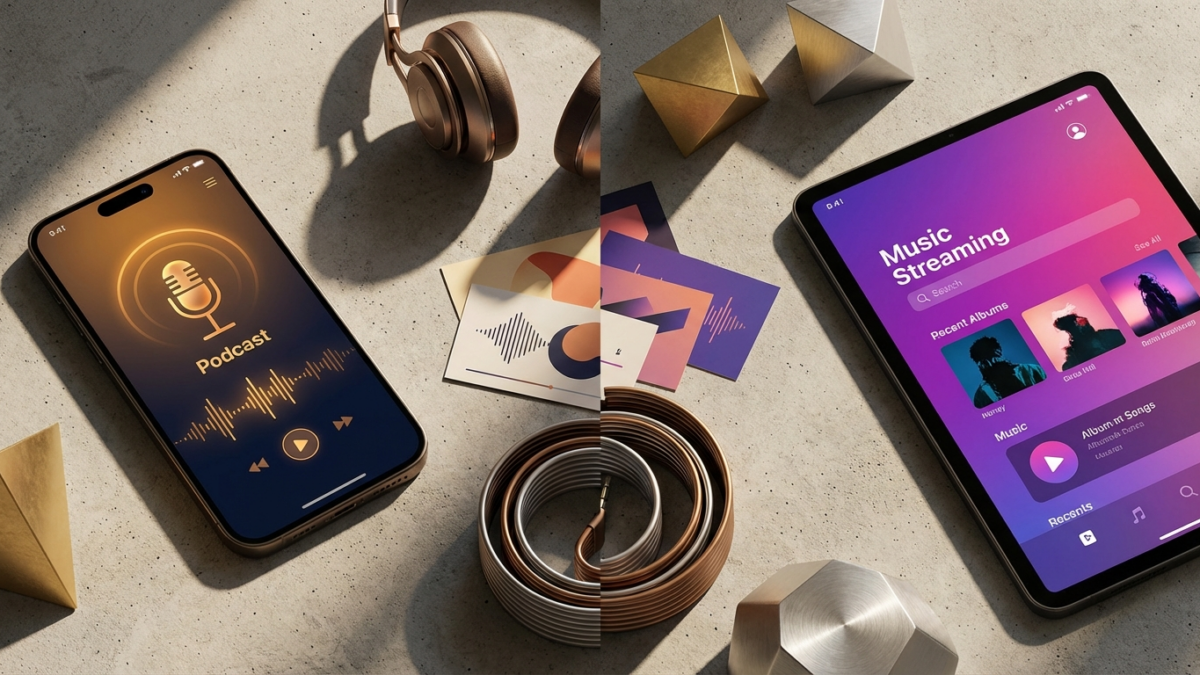
Podcast subscription apps and music streaming apps both live in the audio category, but their ad creative strategies could not be more different. Podcast apps sell specific content and host relationships, so your creative must surface a personality or a compelling narrative hook. Music streaming apps sell a feeling, an atmosphere, a seamless experience woven into someone's life. The formats, hooks, emotional arcs, and even the optimal video lengths diverge sharply. Per data.ai's State of Mobile report, consumer spend on entertainment and media subscription apps grew 14% year-over-year through 2025, intensifying competition in both categories. This guide breaks down which creative formats win in each, why they work, and how to structure your media mix accordingly.
Page Contents
Podcast Subscription App Creatives
Podcast app ads succeed when they treat specific shows or hosts as the product. Per AppsFlyer's creative optimization report, content-specific creatives in entertainment apps achieve 22% higher conversion rates than generic brand ads. The dominant winning formats break into three buckets: short clip excerpts (15-30 seconds of a host's most provocative moment), host-led direct-to-camera UGC-style ads, and narrative teasers that end on a cliffhanger. Your creative job is to make someone think 'I need to hear the rest of that conversation.' The best podcast ads follow an emotional progression: they open with Curiosity (a provocative clip), build toward Hope (this show will give me insight I'm missing), layer in Urgency (exclusive or new episode dropping), and close with Action (subscribe to unlock). This architecture explains why clip-based teasers outperform brand overview videos so consistently. As Gonzalo Fasanella discussed regarding story-driven ads, when the competitive set relies on one emotional register, going against the grain works. Most podcast app ads default to 'funny clips.' Apps leaning into emotional depth, controversy, or intellectual tension in their clip selection see significantly better performance. The paywall moment matters enormously too. Per RevenueCat's State of Subscription Apps data, podcast apps gating premium content behind a trial see median trial-to-paid conversion of roughly 45% when the ad creative pre-qualifies intent with specific content previews. Generic 'thousands of podcasts' messaging drops that figure to under 30%. What does this look like in practice? Wondery runs clip teasers from true-crime originals that cut right before a reveal. Luminary built campaigns around exclusive host reads that feel indistinguishable from organic podcast promos. Apple Podcasts Subscriptions leans on the show brand itself, putting cover art and host voice front and center. Each of these treat the show, not the platform, as the hero of the ad. Creative briefing for podcast apps should specify three elements per asset: the exact clip timestamp, the emotional register (humor, tension, awe, controversy), and the paywall tie-in (what gated content continues the story). Without that specificity, editors produce generic sizzle reels that lose the content-specific advantage entirely.
Pros
- Host personality creates instant trust: per Nielsen Podcast Ad Effectiveness data, host-read ads drive 71% higher brand recall
- Content-specific creatives enable precise audience targeting by show genre, reducing wasted spend
- Cliffhanger clips achieve 2-3x higher completion rates than brand overview videos, per Meta creative best practices
- UGC-style host videos feel native in feed, lowering CPM by 15-25% on TikTok and Reels per Liftoff's Creative Index
Cons
- Creative volume demands are high: each show, host, and season needs dedicated assets, multiplying production by 3-5x versus a single-product app
- Content rights and talent approvals slow production cycles by 2-4 weeks on average, per common industry experience in entertainment UA
- Over-indexing on one show's audience creates concentration risk if that show declines in popularity
Best for: Podcast subscription apps with a strong exclusive content catalog. If you have recognizable hosts or shows that already have an audience, host-led clips and direct-to-camera spots are your highest-ROI format. Apps like Wondery, Luminary, or Apple Podcasts Subscriptions should build creative around their exclusive talent. Even smaller apps can win by treating each show as its own 'product line' with dedicated creative per show. For more on structuring these paywalls, see our guide on structuring paywalls that show content before requiring a subscription, which applies the same preview-then-gate logic.
Music Streaming App Creatives
Music streaming ads sell an emotional experience, not a specific piece of content. Per Adjust's mobile app trends data, music and audio app install campaigns that lead with mood or lifestyle framing achieve 18% lower CPI than feature-comparison ads. The winning formats fall into three categories: vibe-driven montages synced to trending tracks, seamless 'day in my life' narratives where music is the soundtrack, and before/after emotional contrasts (commute without music vs. with music). Each relies on the viewer feeling something before they understand anything about the product. RocketShip HQ's 4-Layer Hook System is especially powerful here. The Visual layer shows a relatable scenario (someone putting in earbuds on a crowded train). The Text overlay delivers a quick line ('Your commute doesn't have to feel like this'). The Verbal layer might be absent or minimal, letting the music itself carry the audio. The Audio layer is the product: the song choice IS the hook. This means music streaming creatives depend on audio selection more than any other app category. Pick the wrong track and the ad falls flat regardless of visuals.
Need help scaling your mobile app growth? Talk to RocketShip HQ about how we apply these strategies for apps spending $50K+/month on UA.
Unlike podcast apps, music streaming creatives can lean heavily into platform-native formats. Per TikTok's Creative Center top ads data, music app ads that use trending sounds achieve 34% higher engagement rates than those using custom audio. The product literally aligns with the platform's content format. Spotify's Wrapped campaign is the gold standard: it turns personal listening data into a shareable creative that functions as both organic content and paid amplification. TIDAL emphasizes lossless audio quality with split-screen comparisons. Endel and Brain.fm sell functional audio outcomes (focus, sleep, relaxation) rather than catalog breadth, using before/after emotional states as their primary hook. Creative briefing for music apps should specify: the target mood or scenario, the track or sound trend to use, the visual pacing (cuts per second, which runs faster for montages than lifestyle narratives), and the single feature callout for the end card (ad-free, offline, or personalization). Keep briefs tight. The emotional resonance does the heavy lifting. Differentiation remains the core challenge. When Spotify, Apple Music, YouTube Music, Amazon Music, and TIDAL all offer similar catalogs, creative execution is genuinely the only moat. Per Sensor Tower's entertainment app data, the top 10 music streaming apps' CPI variance is driven almost entirely by creative quality, with top-quartile creatives achieving 40% lower CPI than bottom-quartile within the same app.
Pros
- Emotional and mood framing is universally relatable, enabling broad targeting with strong conversion
- Music itself is the hook: no need for complex narrative or talent negotiations
- Platform-native sound trends give music apps a structural advantage on TikTok and Reels
- Lifestyle montage formats are inexpensive to produce at scale, often under $500 per variation
Cons
- Music licensing for ad creatives adds cost and legal complexity, with sync licenses running $2K-$15K per track for paid media usage per standard industry sync licensing rates
- Differentiation is harder: five major platforms all sell similar catalogs, making creative the only real differentiator
- Vibe-driven ads can feel generic without strong creative direction. Per AppsFlyer's creative fatigue research, generic mood ads in competitive categories show engagement decay within 7-10 days
Best for: Music streaming apps competing on experience rather than catalog exclusivity. If your app offers unique personalization, a specific genre niche, or a differentiated listening experience (lossless audio, mood-based playlists, social features), your creative should dramatize that experience difference. This is the right approach for Spotify, TIDAL, and niche players like Endel or Brain.fm that sell a specific audio outcome. For creative angles that translate mood into conversion, see our breakdown of ad creative angles for subscription apps, which covers emotional progression techniques applicable across categories.
Hybrid Audio App Creatives (Apps Offering Both Podcasts and Music)
Apps like Spotify, Amazon Music, and YouTube Music that offer both podcasts and music face a creative segmentation challenge. Per research on the perils of asset stuffing in UA campaigns, throwing podcast clips and music montages into the same ad set prevents the algorithm from finding the right audience for each message. The solution is thematic separation: run podcast-focused creatives in dedicated ad sets targeting podcast listener lookalikes, and music-focused creatives in separate ad sets targeting music-intent audiences. This segmentation is not optional. When podcast and music creatives are combined, platform algorithms often default to whichever format gets early engagement, starving the other of spend. Per AppsFlyer's Performance Index, entertainment apps running segmented creative strategies see 25-30% better ROAS than those running mixed-message campaigns. Hybrid apps often benefit from a 'gateway' strategy: lead with the stronger content vertical (usually music for broad awareness), then retarget installers with podcast content ads to deepen engagement and drive subscription conversion. Per Adapty's subscription benchmark data, apps that use sequential messaging from install to paywall see 12-18% higher trial start rates. Budget allocation is the critical operational question. Industry patterns for hybrid audio apps suggest allocating roughly 60% of creative budget to the primary content vertical (whichever drives lower CPI) and 40% to the secondary vertical, then rebalancing monthly based on ROAS data. Per Adjust's benchmarking data, entertainment apps need minimum $15K-$20K monthly per channel to generate sufficient signal for algorithmic optimization across segmented campaigns. Spotify exemplifies this well. Their paid acquisition runs distinct campaigns: music discovery ads targeting broad lifestyle audiences on TikTok and Reels, and podcast-specific ads targeting interest-based audiences on YouTube and Meta. The app is the same, but the creative and targeting are completely separate funnels. A/B testing for hybrid apps should isolate one variable at a time within each segment. Test hook types within the podcast segment (clip teaser vs. host direct-to-camera) separately from tests within the music segment (montage vs. lifestyle narrative). Cross-segment tests (does a podcast ad outperform a music ad?) only make sense at the campaign-strategy level, not the creative level.
Pros
- Two content verticals mean double the creative angles and audience segments to test
- Sequential messaging (music awareness then podcast retention) aligns with natural user deepening behavior
- Broader total addressable market reduces CPI pressure through audience diversification
Cons
- Requires 2x the creative production volume and strict ad set separation to avoid algorithmic confusion
- Brand message dilution risk: 'we do everything' ads consistently underperform focused value propositions per Liftoff's Creative Index findings
- Attribution complexity increases when podcast and music ads drive installs to the same app
Best for: Large audio platforms with both content verticals and sufficient budget. This approach requires enough spend to run segmented campaigns with meaningful signal per segment. Smaller apps should pick one content vertical to lead with in paid acquisition and use the other for organic retention. For guidance on structuring the paywall to capture both audience types, see our paywall optimization guide.
Side-by-Side Comparison
| Creative Dimension | Podcast Subscription Apps | Music Streaming Apps | Hybrid Audio Apps |
|---|---|---|---|
| Primary hook type | Content-specific clip or host personality | Mood, vibe, or lifestyle scenario | Segmented by content vertical |
| Top-performing video length | 15-30s (clip teasers), 45-60s (narrative) | 8-15s (montage), 20-30s (lifestyle) | Varies: podcast = longer, music = shorter |
| Avg. CPI on Meta (per Liftoff data) | $3.80-$5.20 | $1.90-$3.40 | $2.50-$4.00 (blended) |
| Trial start rate from ad install (per RevenueCat) | 18-28% with content-specific ads | 35-50% with free tier available | 25-40% depending on gateway content |
| Key emotional progression | Curiosity > Intrigue > FOMO > Subscribe | Mood recognition > Aspiration > Seamlessness > Try free | Split by content vertical |
| Audio strategy in creative | Host voice clips are the product; music is secondary | Song choice IS the hook; trending sounds outperform by 34% per TikTok Creative Center | Match audio to segment: host voice for podcast, track for music |
| UGC effectiveness | Very high: host-led UGC feels authentic and personal | Moderate: lifestyle UGC works but product demo UGC is weak | High when segmented; low when mixed |
| Creative fatigue timeline (per AppsFlyer) | 10-14 days per clip creative | 7-10 days per montage creative | 8-12 days average across segments |
| Production cost per asset | $300-$800 (clip editing + overlay) | $200-$500 (montage + licensed track) | $400-$700 (blended average) |
| Platform priority | YouTube Ads, Meta, Apple Search Ads | TikTok, Instagram Reels, Snapchat | All platforms with segment-level separation |
| Paywall integration in creative | Show exclusive/gated content as reason to subscribe | Emphasize ad-free, offline, or lossless as premium upgrades | Lead with strongest conversion lever per segment |
| Biggest creative risk | Over-reliance on single show; content rights bottlenecks | Generic vibe ads that blend into competitor noise | Asset stuffing and algorithmic message confusion |
Verdict
Choose podcast subscription app creative formats when your product's value is specific content that cannot be found elsewhere. The entire creative strategy should function like a movie trailer: give enough to hook, withhold enough to convert. Per paywall optimization data, showing a specific content preview in the ad and then gating the continuation behind the paywall creates a seamless intent funnel that lifts trial starts by 15-20% versus generic onboarding flows. Build your creative pipeline around show-level briefs, not brand-level briefs. Choose music streaming app creative formats when your differentiation is experiential: better recommendations, a specific mood or genre focus, superior audio quality, or social features. Your creative must make the viewer feel the experience before they download. Per Sensor Tower's entertainment app analysis, the top-performing music app creatives share one trait: they never mention features in the first 3 seconds. They open with a mood, a moment, or a sound. Feature callouts belong on the end card, not the hook. Invest heavily in audio selection and trend monitoring on TikTok's Creative Center. Choose the hybrid approach only if you have the budget and production capacity to run fully segmented campaigns. Half-measures here actively hurt performance. Per AppsFlyer's Performance Index, mixed-message entertainment campaigns underperform segmented ones by 25-30% on ROAS. If your monthly paid media budget per channel is below $15K, pick one vertical to lead with. Use the other for organic content and CRM-driven retention campaigns. For subscription apps navigating the broader growth strategy, the subscription app growth playbook covers the full funnel from acquisition through retention.
Frequently Asked Questions
How do music licensing costs for ad creatives compare to podcast clip licensing?
Music sync licenses for paid media usage typically run $2K-$15K per track, depending on the artist's profile and usage term, per standard industry sync licensing rates. Podcast clip licensing is often simpler since most podcast apps own the content outright or have built-in promotional rights. The cost difference makes music creative more expensive per unique asset despite lower production complexity.
Should audio app ads use sound-on or sound-off creative strategies?
Audio apps are the one category where sound-on creative is non-negotiable. Per TikTok's Creative Center data, sound-on completion rates for music app ads run 34% higher than sound-off variants. Add text overlays and captions as a secondary layer, but the audio experience must carry the hook. Podcast ads especially lose their entire value proposition without sound.
What A/B testing framework works best for audio app creatives?
Isolate one variable per test cycle. For podcast apps, test clip selection first (which moment hooks best), then test format (clip teaser vs. host direct-to-camera). For music apps, test audio track first, then visual treatment. Per Meta's creative testing guidelines, each variant needs at least 50 conversions before drawing conclusions, so budget accordingly.
How do web-to-app funnels change creative strategy for audio subscription apps?
Web-to-app funnels let audio apps bypass app store commission on subscriptions, which changes the economics of what you can pay per acquisition. Creative for web funnels can be longer and more educational since the landing page carries more of the conversion load. For a full breakdown, see our guide on web-to-app funnels for subscription apps.
What happens to audio app conversion rates when subscription prices increase by 20-30%?
Price sensitivity varies sharply by content type. Per our analysis of subscription price increase impacts, entertainment apps with exclusive content (like podcast apps with originals) retain 80-85% of conversion volume after a 20% price increase. Music streaming apps with commodity catalogs see steeper drops because switching costs are lower.
How should audio apps time promotional pricing campaigns for maximum subscriber lift?
Timing matters more than discount depth. Holiday periods (November through January) and back-to-school (August through September) are peak windows for entertainment subscriptions. For detailed timing strategies and benchmark data, see our guide on promotional pricing timing for entertainment apps.
Does adding a money-back guarantee to an audio app paywall improve conversion?
Yes, meaningfully. Per paywall guarantee research, showing a money-back guarantee on subscription app paywalls lifts trial starts by 8-12% with minimal impact on refund rates. This is especially effective for podcast apps where users are uncertain whether they will consume enough exclusive content to justify the subscription.
How many creative variants should an audio app test per month to stay ahead of fatigue?
With fatigue timelines of 7-14 days depending on format, plan for 8-15 new creative variants per month per channel to maintain performance. Podcast apps need more variants because each show requires its own set of assets. Music apps can stretch further with modular production (same visuals, swapped audio tracks), reducing net-new production needs by roughly 40%.
Looking to scale your mobile app growth with performance creative that delivers results? Talk to RocketShip HQ to learn how our frameworks can work for your app.
Not ready yet? Get strategies and tips from the leading edge of mobile growth in a generative AI world: subscribe to our newsletter.
Related Reading
- The subscription app growth playbook (comprehensive guide)
- What ad creative angles drive the highest trial starts for personal finance subscription apps? (2026)
- Adapty Subscription App Benchmark Report: Pricing and Conversion Data (2026)
- How should an entertainment subscription app time its promotional pricing campaigns? (2026)
- What is the impact of showing a money-back guarantee on a subscription app paywall? (2026)