
A performance creative agency is a specialized firm that produces, tests, and iterates ad creatives specifically engineered to hit measurable business outcomes like cost per install (CPI), cost per action (CPA), and return on ad spend (ROAS) for mobile apps.
Unlike traditional creative agencies that optimize for brand recall or subjective aesthetic appeal, performance creative agencies live inside the data: every concept, hook, format, and frame is validated against downstream metrics.
At RocketShip HQ, we've watched this discipline evolve from a nice-to-have into the single most important lever in mobile user acquisition, particularly after Apple's ATT framework collapsed granular audience targeting and forced the industry to treat creative as the new targeting.
Page Contents
Why has creative become the most important lever in mobile UA in 2025-2026?
Creative is now the primary targeting mechanism in mobile UA because ATT eliminated most deterministic user-level signals on iOS, and Meta, Google, and TikTok responded by shifting optimization power to their algorithms, which use creative engagement signals as a proxy for audience targeting.
According to State of Creative Optimization report, creative is responsible for up to 70% of an ad’s performance variance, making creative quality and volume the highest-leverage activity in mobile growth.
Before ATT, a mediocre creative could still perform well if you had a precise lookalike audience. That world is gone.
Now, Meta's Advantage+ and Google's Performance Max campaigns use broad targeting by default, meaning the algorithm decides who sees your ad based largely on how people respond to the creative itself.
When your video's 3-second retention rate is high, the algorithm interprets that as a positive signal and shows it to more similar users. When engagement drops, the algorithm pivots. This means your creative IS your targeting.
According to Meta's own documentation on Advantage+ campaigns, creative diversity is one of the top-recommended levers for improving campaign performance, with Meta suggesting 15-50 creative variants per campaign for optimal algorithmic learning.
The practical implication is stark: apps that produce 5 creatives per month are now at a structural disadvantage to apps producing 50.
- ATT reduced the value of audience-based targeting, making creative the primary signal for algorithmic optimization
- Broad targeting campaigns (Advantage+, Performance Max, UAC) require creative volume and diversity to function
- According to Adjust’s 2024 creative best practices guide, apps producing fewer than 10 new creatives per month see measurably faster creative fatigue and rising CPIs
What does the creative development process look like at a performance creative agency?
The process follows a disciplined loop: research, hypothesis, production, test, analyze, iterate. In practice, a typical cycle from concept to first performance data takes 5-10 business days, with weekly iteration thereafter — a cadence consistent with what Phiture’s Mobile Growth Stack describes as standard for mature performance creative operations.
The process starts with competitive intelligence and performance data mining. Agencies analyze which creatives are winning (and losing) across the client's existing campaigns, then study the competitive landscape using tools like Meta's Ad Library and Sensor Tower's creative intelligence features.
From there, creative strategists generate hypotheses, not just ideas, but structured bets: 'We believe [specific creative angle] will reduce CPI by [X%] because [specific user insight].' Production builds variants designed to isolate the variable being tested.
For example, if testing hooks, the team produces 4-6 videos with identical body content but different opening 3 seconds.
The creatives launch in a structured test with sufficient budget to reach statistical significance (typically 50-100 conversions per variant, per Meta's power analysis guidance). Results are analyzed not just on CPI but on downstream metrics: day-7 retention, trial-to-paid conversion, and ROAS. Winners get scaled and iterated; losers get dissected for learnings.
How do performance creative agencies generate creative concepts?
Concept generation is where most in-house teams struggle because they default to internal brainstorming rather than data-driven ideation.
At RocketShip HQ, we use a framework called 'insight mining': systematically reviewing app store reviews (especially 2-3 star reviews that reveal emotional pain points), analyzing top-performing competitor creatives, and studying the client's own historical performance data to identify which themes, formats, and hooks have the strongest signal.
In our experience working with fitness app clients, we've consistently observed that 'transformation before/after' hooks outperform 'feature showcase' hooks on CPI — often by a meaningful margin.
But the winning angle within 'transformation' still requires testing: is it the speed of transformation, the relatability of the person, or the specific metric shown? That's where the four types of ad hooks framework becomes critical.
What does the creative testing framework look like?
A rigorous testing framework isolates one variable at a time and measures the impact with sufficient sample size. The most common test types are: hook tests (different opening 2-3 seconds), format tests (UGC vs. motion graphics vs. static), angle tests (different value propositions or emotional drivers), and CTA tests.
Agencies typically run 3-5 variants per test, allocating $50-150 per variant per day depending on the vertical's CPI, and evaluate results after 72-96 hours.
In our experience, roughly 1 in 5 creative concepts outperforms the existing control, which means the majority of creatives 'fail,' but each failure produces a learning that informs the next batch.
Analyzing creative performance data properly means going beyond top-line CPI to examine platform-side engagement metrics (thumb-stop rate, watch-through rate, CTR) alongside MMP-attributed downstream metrics (retention, LTV).
What ad formats do performance creative agencies produce for mobile apps?
Need help scaling your mobile app growth? Talk to RocketShip HQ about how we apply these strategies for apps spending $50K+/month on UA.
Performance creative agencies produce video ads (15-30 seconds, vertical and square), static images, UGC-style videos, playable/interactive ads, and increasingly, AI-generated variants. According to AppsFlyer's creative optimization research, video accounts for 65-75% of ad spend on major networks, but the best-performing accounts maintain a healthy mix across formats.
The format mix depends heavily on the channel. On Meta, short-form vertical video (9:16) and UGC-style content dominate. On Google UAC, playable ads can significantly outperform standard display, according to Google's App campaign documentation.
On Apple Search Ads, custom product pages (which a performance creative agency also designs and tests) can lift conversion rates by 15-30%, according to Apple's custom product pages documentation. On TikTok, native-feeling UGC consistently outperforms polished brand content.
For a full breakdown, see our guide on best ad formats for mobile apps. A performance creative agency doesn't just produce across formats; it tailors the creative language and pacing to each platform's ecosystem.
How many ad creatives do you need per month, and what does a performance creative agency typically produce?
The number of creatives scales with ad spend. Industry patterns suggest apps spending $50K-$100K/month need 20-40 new creatives per month, while apps spending $500K+ need 80-150+. The critical threshold is maintaining a fresh creative-to-spend ratio that prevents fatigue-driven CPI increases—top-performing apps ship 100+ high-quality variants monthly.
Creative fatigue is one of the biggest silent killers of mobile UA efficiency. When the same audience sees the same ad repeatedly, engagement drops, the algorithm deprioritizes it, and CPI rises.
According to Meta's guidance for Advantage+ campaigns, creative refresh cadence is a top predictor of sustained campaign efficiency for app advertisers. At RocketShip HQ, we've established a detailed framework for how many ad creatives by budget.
The table below provides our recommended production volumes by spend tier.
What does a creative volume framework look like by spend tier?
Creative production should scale proportionally with spend, and the relationship is not linear. Higher spend tiers require disproportionately more creative variants because larger audiences fatigue assets faster. The table below reflects volume benchmarks informed by industry-standard creative testing practices and platform guidance from Meta, Google, and Apple.
| Monthly Ad Spend | New Creatives/Month | Active Variants in Account | Typical Testing Cadence |
|---|---|---|---|
| $10K-$50K | 10-20 | 15-30 | Bi-weekly test cycles |
| $50K-$100K | 20-40 | 30-60 | Weekly test cycles |
| $100K-$500K | 40-80 | 60-120 | Weekly with mid-week pivots |
| $500K+ | 80-150+ | 120-250+ | Continuous testing (daily launches) |
These volumes include all format types: video, static, UGC, and playable.
According to data.ai’s State of Mobile 2024 report, global mobile ad spend exceeded $362 billion, and the apps winning disproportionate share of installs are the ones with the most disciplined creative testing infrastructure — consistently producing more creative variants and maintaining lower CPIs as a result.
Typically, 60-70% of monthly output is iterations on proven angles, and 30-40% is net-new concept exploration.
How does a performance creative agency use AI in creative production?
AI is now embedded across the creative workflow, from concept ideation to asset generation to performance prediction. According to Sensor Tower’s 2024 market intelligence, increased AI-assisted creative output by 3x by over 3x year-over-year. At RocketShip HQ, we use AI at every stage but treat it as an accelerant, not a replacement for human creative strategy.
The primary AI use cases in performance creative production today are: (1) script generation for UGC and voiceover ads, where LLMs produce dozens of hook and CTA variations that are then filtered by a creative strategist, (2) image and video generation tools like Runway, Midjourney, and proprietary platform tools for rapid concept prototyping, (3) predictive scoring models that estimate a creative's likely performance before it spends a dollar, and (4) automated iteration, where AI remixes winning creatives with new backgrounds, text overlays, or pacing.
The critical nuance is that AI lowers the marginal cost of producing variants but does not replace the strategic judgment of what to test and why.
For a deeper analysis, see our piece on AI replacing human-directed creative in mobile and our take on whether AI can replace human creative strategists.
- Script and copy generation: AI produces 50+ hook variations in minutes; strategists select the top 5-10 for production
- Visual asset creation: In our experience, AI-generated backgrounds and product mockups meaningfully reduce production costs compared to traditional asset creation methods
- Performance prediction: platforms like Meta now offer creative scoring within Advantage+, and third-party tools like Appsumer and Alison.ai provide pre-launch estimates
- Automated iteration: Dynamic creative optimization (DCO) tools remix assets at scale, though human-curated variants still outperform fully automated ones in most cases
What should you look for when hiring a performance creative agency?
The three non-negotiable criteria are: (1) a proven track record with direct-response mobile app campaigns (not brand or web), (2) an integrated creative-and-media workflow where creative decisions are informed by real spend data, and (3) a structured testing methodology with documented learnings.
According to AppsFlyer's 2024 app marketing trends report, the top 10% of apps by growth velocity update their creative strategy weekly, which requires agency-level speed and specialization.
Red flags when evaluating agencies include: producing creatives without access to your ad account data, lacking a clear testing framework, charging exclusively per-asset with no performance alignment, and having a portfolio dominated by brand awareness campaigns with no CPI/CPA benchmarks.
A strong performance creative agency should be able to show you a case study with specific before/after performance metrics. They should also demonstrate fluency with your specific channels. An agency excellent on Meta may struggle with TikTok's creative norms or Apple Search Ads' custom product page requirements.
At RocketShip HQ, our creative strategists work directly alongside media buyers, so creative decisions are made with real-time spend context rather than in a vacuum.
- Ask for case studies with specific CPI or CPA improvements (not just impressions or engagement)
- Verify they have direct experience with your ad platforms (Meta, Google, TikTok, Apple Search Ads)
- Confirm they produce at the volume and cadence your spend level requires
- Ensure their pricing model aligns incentives: retainer + performance bonus structures outperform pure per-asset pricing
How much does a performance creative agency cost?
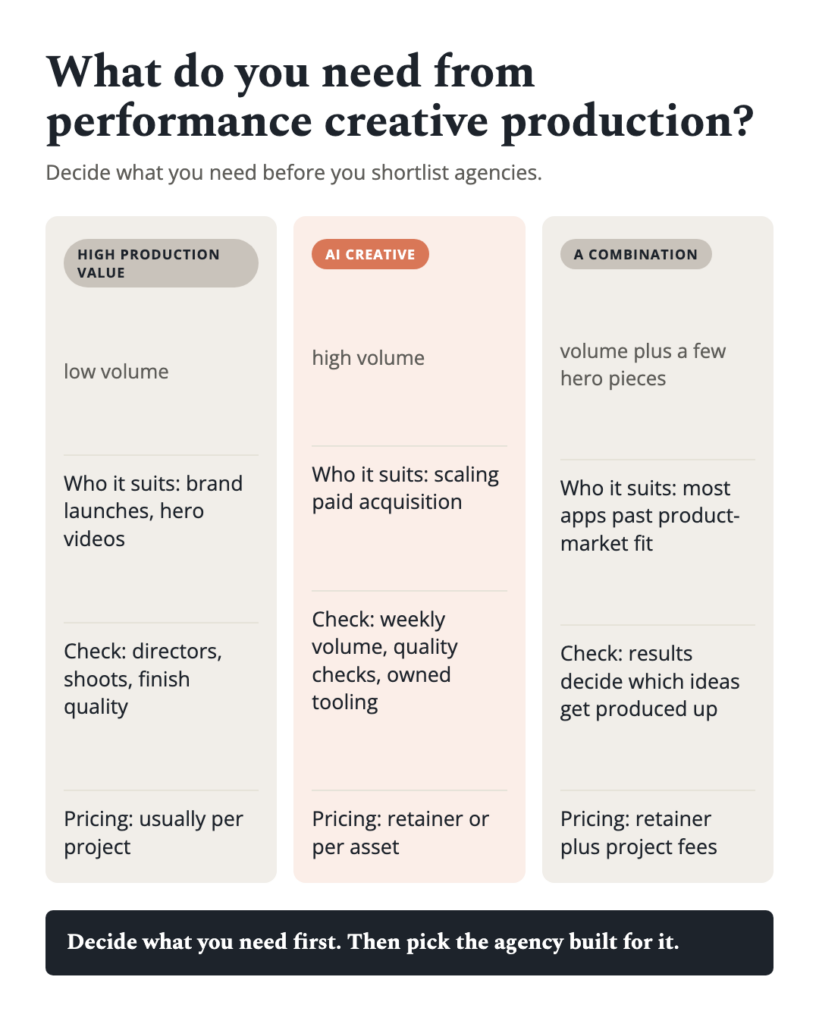
Pricing typically falls into three models: monthly retainers ($5K-$25K/month for most mid-market apps), per-asset pricing ($500–$3,000 per video depending on complexity), or a hybrid retainer-plus-performance model. According to Singular's mobile advertising benchmarks, creative production costs generally represent 10-20% of total ad spend for efficiently scaling apps.
The right model depends on your maturity and spend level. Early-stage apps spending under $50K/month often start with per-asset or project-based pricing to control costs. Apps spending $100K+/month typically move to retainer models because the volume of creatives needed makes per-asset pricing impractical.
The highest-performing agency relationships use a hybrid: a base retainer covering a guaranteed volume of output, plus a performance bonus tied to CPI improvements or creative win rates.
At RocketShip HQ, we structure engagements to ensure the agency's economics improve when the client's metrics improve, which aligns incentives around the metrics that matter.
What role do hooks play in performance creative for mobile apps?
The hook (the first 1-3 seconds of a video ad or the dominant visual element in a static ad) is the single most impactful variable in performance creative.
In our experience, changing only the hook while keeping the rest of a video identical can shift CPI dramatically — often by double-digit percentages in either direction — in the majority of statistically significant tests.
Hooks determine whether a user stops scrolling. According to TikTok's creative best practices documentation, ads that capture attention in the first second see 2-3x higher completion rates.
On Meta, the thumb-stop rate (the percentage of users who pause on your ad for at least 3 seconds) is the strongest leading indicator of creative viability. A performance creative agency systematically tests hook types: question hooks, shock/curiosity hooks, social proof hooks, and transformation hooks.
For a full breakdown, see how to write ad hooks that stop the scroll and the four types of ad hooks that actually work.
The key insight is that hook testing should be the first variable tested in any new creative program because it compounds: a better hook means more algorithm distribution, which means more data, which means faster learning.
A performance creative agency is the most direct way to compound mobile UA efficiency in the post-ATT landscape, where creative quality and volume determine algorithmic distribution and, ultimately, your cost per install.
If you're spending $50K+ per month on mobile ads and not producing at least 20-40 new creative variants monthly with a structured testing framework, you're leaving significant efficiency on the table. The next step is auditing your current creative production velocity and win rate.
If either number looks weak, reach out to a specialized agency like RocketShip HQ for a creative audit that benchmarks your program against category leaders.
Frequently Asked Questions
How long does it take to see results from a performance creative agency?
Most apps see measurable CPI improvements within 3-4 weeks of launching a structured creative testing program. Industry data suggests the median time to a first statistically significant creative win is around 14 days, with compounding gains typically emerging over the first 60–90 days as the testing backlog builds learnings — a ramp-up timeline consistent with structured testing frameworks described by Phiture.
Can a performance creative agency work alongside my in-house team?
Yes, and this is increasingly common. According to AppsFlyer's 2024 trends report, 62% of top-performing app marketers use a hybrid model where an external agency handles high-volume creative production and testing while the in-house team manages brand guidelines, approvals, and channel strategy. The key is establishing a shared performance dashboard so both teams optimize toward the same metrics.
What is the typical creative win rate in performance testing?
Across the industry, roughly 1 in 5 to 1 in 8 creative concepts outperforms the current control, depending on how mature the creative program already is.
In our experience, mature accounts with well-optimized controls tend to see lower win rates, while newer accounts with unoptimized baselines often see higher win rates in the first few months as easier gains are captured.
Do performance creative agencies handle Apple Search Ads custom product pages?
Many do, and they should. According to Apple's developer documentation, you can create up to 35 custom product pages, each with unique screenshots, preview videos, and promotional text.
In our experience working with subscription app accounts, aligning custom product page messaging to the ad creative that drives the tap consistently improves install conversion rates compared to sending all traffic to a single default page.
How do you prevent creative fatigue in high-spend mobile UA campaigns?
The primary defense is volume and cadence: introducing new creatives on a weekly basis at minimum. According to Meta's Advantage+ documentation, creative refresh is a top-three lever for maintaining delivery efficiency.
At RocketShip HQ, we monitor a fatigue index (7-day rolling CPI versus lifetime CPI per creative) and trigger refreshes when the rolling CPI rises meaningfully above its lifetime average — a signal that the creative is losing efficiency and needs to be refreshed or replaced.
What metrics should I use to evaluate a performance creative agency's output?
The primary metrics are creative win rate (percentage of new creatives that beat the control), CPI delta (how much cheaper the best new creative is versus the prior best), and creative lifespan (how many days a winning creative sustains performance before fatigue).
In our experience, a strong agency demonstrates a consistent win rate, meaningful CPI reductions within the first quarter, and extends creative lifespan through iterative refreshes rather than relying solely on net-new concepts.
Looking to scale your mobile app growth with performance creative that delivers results? Talk to RocketShip HQ to learn how our frameworks can work for your app.
Not ready yet? Get strategies and tips from the leading edge of mobile growth in a generative AI world: subscribe to our newsletter.
Related Reading
- Mobile ad creative strategy: from concept to performance (comprehensive guide)
- How to Write Ad Hooks That Stop the Scroll
- Should You Use AI to Generate Ad Creatives for Mobile Apps?
- How to Analyze Ad Creative Performance Data
- What Ad Formats Work Best for Mobile App Install Campaigns?
Related on pricing: how much a user acquisition agency costs · what percentage agencies charge · the minimum ad spend you need