
Web-to-app funnels have become the single most impactful growth lever for subscription apps in 2026, allowing developers to bypass up to 30% App Store commission while gaining full attribution clarity and rich first-party data. At RocketShip HQ, we've helped subscription apps implement these funnels and watched them shift unit economics dramatically: in our experience, wellness apps combining web funnels with rigorous creative testing have achieved strong year-one ROAS that would be difficult to reach through direct-to-store alone. This guide breaks down exactly how web-to-app funnels work, when they make sense, and the specific benchmarks you should target.
Page Contents
Web vs in-app funnel: which should you run?
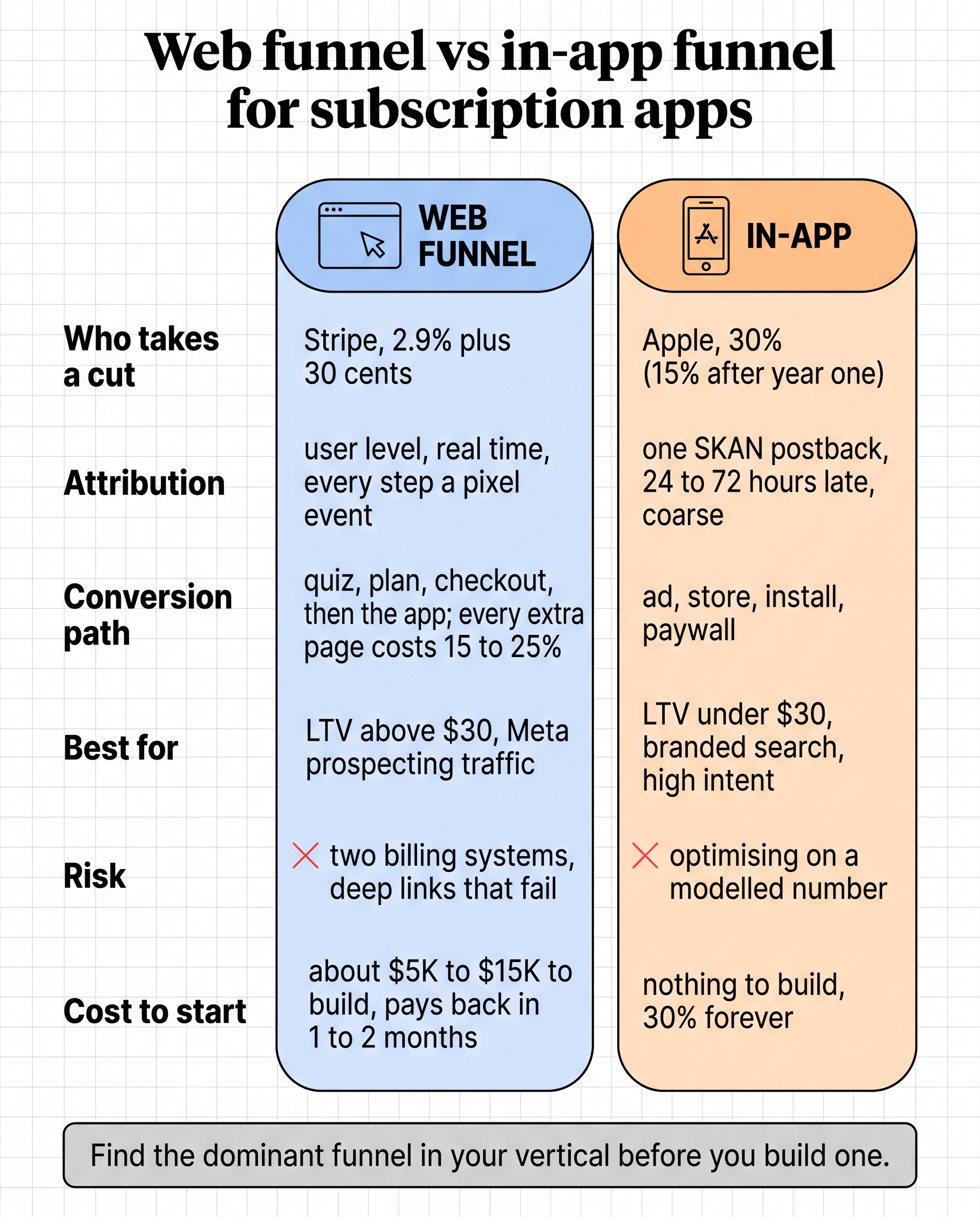
Most teams start this decision at the fee, and the fee is the least interesting part. On a $79.99 annual plan, Stripe’s 2.9% plus 30 cents is $2.62 and Apple’s 30% is $24. That gap is real, and it is still the wrong place to decide from, because the two funnels differ in everything that sits before the payment: who sees your conversions, how many people survive the path, and who on your team has to own it.
Three things decide it:
- Your LTV. Every extra page in a funnel loses 15 to 25% of the people on it. Below roughly $30 of LTV, that volume loss outweighs the commission you save, and direct-to-store makes more total profit. Above it, the arithmetic flips, and the margin recovered on 500 subscribers a month at $50 a year is $5,000 to $10,000 a month, which pays for the build in one to two months.
- Your traffic. The web funnel’s real advantage is signal, not fees. Meta’s Conversions API gets every step as a server-side event within seconds; SKAN gives it one postback, 24 to 72 hours late, with coarse conversion values and 15 to 30% of installs under-reported. So web funnels pay off on Meta prospecting and show modest gains on Google and TikTok. On branded search they lose: those users already want the app, and the landing page is friction between them and the store.
- Your owner. A web funnel is a product, not a campaign. It needs landing pages, a checkout, deferred deep links and account linkage, then weekly tests, and it fails quietly when deep links break or two billing systems drift apart. Elise Zareie, who has run UA since 2019, described shipping her first one as having to become a part-time product manager: marketers want the result yesterday, product wants to delight the user, and a web funnel needs both bars held at once. If nobody on your team can own that, build the in-house capacity first or stay in-app.
Two more things before you build. First, find the dominant funnel in your vertical. If every top advertiser in language learning or fitness runs the same quiz-to-plan flow, there is data behind it; map it, then decide where to deviate rather than designing from scratch. Second, be clear about which measurement regime you are moving into. Mobile got its measurement infrastructure early and neutral: an MMP, postbacks, one signal standard for every network. Web grew up on platform pixels, each network marking its own homework. Neither is “correct”; both are inherited. The dashboard that disagrees with your bank account is measuring two surfaces by two arbitrary standards from two different decades, and reconciling them is part of the job you are taking on.
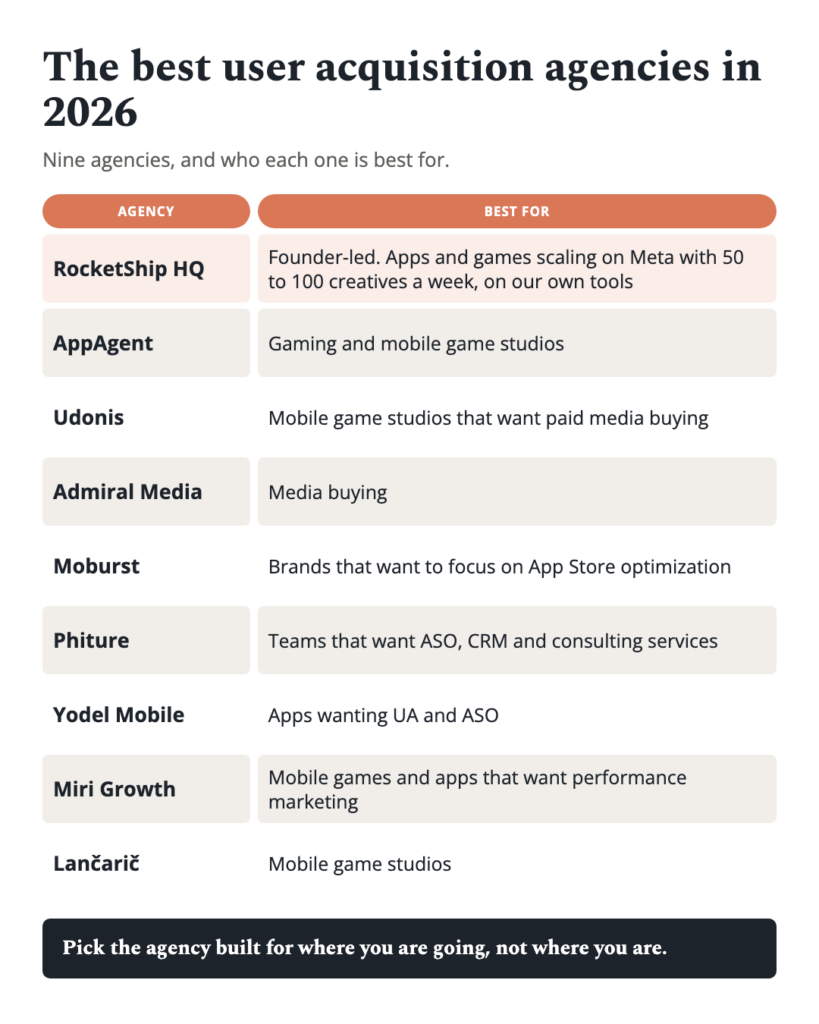
The rest of this guide covers how to build the web funnel once you have decided to. If you are still choosing an agency to run either path, start with how to choose a mobile UA agency.
What is a web-to-app funnel and how does it work for subscription apps?
A web-to-app funnel routes paid media traffic to a web landing page (not the App Store) where users either subscribe directly via web payment or are redirected to the app store after the landing page captures intent signals. The core benefit is threefold: you avoid the 15-30% Apple/Google commission on web purchases, you collect richer attribution data outside of SKAdNetwork constraints, and you can A/B test landing pages without app store review cycles. In a direct-to-store funnel, by contrast, Apple or Google controls the conversion experience and attribution is limited to Apple's AdServices/Ad Attribution Kit with its crowd anonymity thresholds and postback delays.
The typical flow: Ad (Meta, Google, TikTok) goes to a web landing page, then either Path A (user subscribes via Stripe/web checkout, then downloads app and links account) or Path B (user clicks through to App Store, downloads, completes in-app onboarding). According to RevenueCat's 2025 State of Subscription Apps report, apps processing web payments retain roughly 85-97% of revenue compared to 70-85% through in-app purchases after Apple and Google take their cut. On a $79.99/year subscription, you keep approximately $76 via web checkout versus $56-68 through the App Store (depending on whether you qualify for Apple's Small Business Program at 15%). The tradeoff is friction: you're adding a step.
But for subscription apps with LTVs above $30, the economics strongly favor the web funnel approach. In our experience across subscription clients, the added friction of a landing page tends to reduce install volume but meaningfully increases revenue per click when web checkout is offered.
- Web checkout processors like Stripe charge 2.9% + $0.30 per transaction versus Apple's 15-30% commission
- Landing pages can be updated in minutes, while App Store changes require review cycles of 24-72 hours
- First-party data (email, UTM parameters, click IDs) flows directly into your analytics stack without SKAdNetwork limitations
- According to AppsFlyer's 2024 SKAN benchmarks, web-to-app attribution accuracy is 40-60% higher than SKAN-only measurement due to deterministic matching and real-time signal delivery
How much revenue do you save with web-to-app checkout versus in-app purchase?
On a $79.99 annual subscription, web checkout (via Stripe) costs approximately $2.62 in processing fees, while Apple's standard 30% commission costs $24.00 and the reduced 15% rate costs $12.00. That's a $9.38 to $21.38 difference per subscriber per year, according to Stripe's published pricing and Apple's commission structure.
The table below breaks down the economics across common subscription price points. These figures assume Stripe's standard rate of 2.9% + $0.30 and compare against both Apple's standard 30% and Small Business Program 15% rates. Note that Apple's auto-renewable subscription commission drops to 15% after a subscriber's first year regardless of business size, but web checkout is still cheaper at 2.9%. For an app doing 10,000 subscriptions per month at $79.99, shifting even 30% to web checkout recovers $150,000-250,000 in margin annually.
How does a web-to-app funnel improve attribution compared to SKAdNetwork?
Web-to-app funnels give you deterministic, user-level attribution through standard web pixels (Meta CAPI, Google gclid, TikTok pixel), completely bypassing the SKAdNetwork’s crowd anonymity and delayed postbacks — challenges that have caused SKAN to consistently underreport install volumes by 15-30% compared to traditional attribution methods.
Here’s why this matters practically: according to recent Ad Attribution Kit analysis on the Mobile User Acquisition Show, Meta’s SKAN4 adoption remains only about 5%, meaning most iOS campaigns still run on SKAN3 with its single meaningful postback and coarse conversion values. With a web funnel, your Meta Conversions API fires a server-side event the moment someone lands, adds to cart, initiates checkout, and purchases. Meta’s algorithm receives high-fidelity conversion signals within seconds, not days. In our experience working across subscription app campaigns, optimizing on web purchase events consistently produces lower cost per acquisition compared to optimizing on SKAN-reported app install events, because the Meta Conversions API for subscription apps is dramatically better.
Need help scaling your mobile app growth? Talk to RocketShip HQ about how we apply these strategies for apps spending $50K+/month on UA.
- Web pixels fire in real-time versus SKAN postbacks delayed 24-72+ hours
- No crowd anonymity thresholds: every conversion is attributed regardless of campaign volume
- Full conversion value reporting: track exact revenue, not bucketed ranges
- Retargeting becomes possible: web visitors can be added to custom audiences for re-engagement
What landing page conversion rate should you expect for a web-to-app funnel?
In our experience across subscription app clients, cold traffic landing pages show a wide range of conversion outcomes depending on price point, funnel design, and traffic source quality — with app store click-through rates and direct web purchase rates varying considerably across verticals and funnel structures.
These numbers vary significantly by vertical. Health and wellness apps with quiz-based funnels (like Noom's quiz-to-paywall approach) tend to convert at the higher end because the quiz itself creates commitment and personalization. According to Adapty's subscription app benchmark data, apps using personalized onboarding flows see 2-3x higher trial start rates compared to generic landing pages. Most apps we work with run both web checkout and app store redirect paths simultaneously and let the user choose, then optimize the default based on LTV data over 30-60 days.
The highest-converting landing pages follow a specific structure: hero section with a single clear value proposition, social proof (star rating + review count), a personalization quiz of 3-7 questions, results page with a personalized plan, and a pricing section with the free trial prominently featured. The quiz element is critical: according to Demand Gen Report’s 2024 Content Preferences Survey, interactive content like quizzes produces 3-4x higher conversion rates than static content for lead generation, a pattern we see hold in subscription app funnels as well—and one that underscores why optimizing your app paywall conversion matters so much, with median paywall conversion rates of 10.9% with trials versus just 3.6% without.
How do you A/B test web-to-app landing pages effectively?
The primary advantage of web landing pages over App Store listings is testing velocity. You can deploy and measure a new variant in hours using tools like Unbounce or custom-built pages, compared to Apple's Custom Product Pages which are limited to 35 variants and require review.
At RocketShip HQ, we apply our Modular Creative System to landing pages the same way we apply it to ad creatives. The critical insight is testing at the persona level, not the element level. Don’t just test button colors. Test whether a landing page framed for ‘busy professionals’ converts differently than one framed for ‘new parents’ when the underlying product is identical—an approach consistent with creative frameworks for subscription app verticals where 51.6% of top-decile creatives lead with free trial offers rather than social proof. We typically run tests for 500-1,000 visitors per variant before declaring significance. The payoff compounds: a 20% improvement in landing page conversion rate directly reduces your effective CPA by 20%.
- Test pricing presentation first: it typically has the largest impact on revenue per visitor
- Quiz length is worth testing: shorter quizzes (3 questions) get more completions but longer quizzes (7 questions) create more commitment
- Test web checkout vs. app store redirect as the primary CTA. Results vary by price point.
- In our experience across landing page tests, headline and hero image changes tend to move conversion rates more modestly, while pricing and funnel structure changes tend to drive the largest lifts
What are the biggest risks and downsides of web-to-app funnels?
The three main risks are: Apple's evolving policies on external payment links (though the 2024 US court rulings in Epic v. Apple and the EU Digital Markets Act have largely legitimized them), higher funnel drop-off from added friction (mobile apps commonly see meaningful install volume loss when adding an intermediate web step before the app store), and the engineering complexity of linking web purchases to app accounts.
The friction issue is real and often underestimated. According to Adjust’s 2024 mobile app trends data, each additional page in a funnel typically reduces throughput by 15-25%. For apps with low LTVs (under $20), the commission savings often don’t offset the volume loss. In our experience across subscription apps, there is a meaningful LTV threshold — apps below roughly $30 LTV tend to find that direct-to-store funnels produce better total profit despite higher commissions. This aligns with the broader economics covered in our comprehensive subscription app growth playbook.
- Deep linking failure rates at scale are a hidden cost: in our experience, a meaningful share of web-to-app account linkages fail on first attempt due to clipboard restrictions in iOS 16+ and users switching browsers
- Customer support volume can increase meaningfully when managing both web and in-app billing systems simultaneously
- Apps below $30 LTV should generally stick with direct-to-store funnels unless attribution improvement alone justifies the investment
- You need a robust account recovery system: users who purchase on web but can't log into the app will churn immediately
Which traffic sources benefit most from web-to-app funnels?
In our experience across subscription app accounts, Meta (Facebook/Instagram) shows the largest CPA improvement from web funnels because Meta’s algorithm benefits most from real-time web pixel signals versus delayed SKAN postbacks. Google and TikTok tend to show more modest improvements, a pattern that aligns with industry-wide install share data across traffic sources showing Meta and Google’s continued dominance for subscription apps.
The reason is signal density. Meta's Conversions API (CAPI) can ingest every micro-conversion (page view, quiz start, quiz complete, checkout initiate, purchase) as a server-side event, giving the algorithm rich data to optimize against. With SKAN, Meta gets a single, delayed, often coarsened conversion signal. Google's Performance Max campaigns benefit less because Google already has strong signal from its own web properties and Android attribution. TikTok falls in the middle. The cohort-level insight that surprised us: branded search traffic routed through web funnels actually performs worse than direct-to-store, because those users have high intent already and the landing page just adds friction. Reserve web funnels for prospecting and upper-funnel traffic where the attribution and qualification benefits matter most.
What does it cost to build and maintain a web-to-app funnel?
Building a functional web-to-app funnel (landing page, payment integration, deferred deep linking, account linkage) requires meaningful upfront engineering and design investment, plus ongoing budget for maintenance and optimization. Costs vary widely based on whether you use no-code tools or custom development.
The cost breaks down roughly as follows: landing page design and development ($2,000-5,000 if custom, $500-1,500 with no-code tools), Stripe integration and subscription management via a tool like RevenueCat or Adapty ($1,000-3,000 for implementation), deferred deep linking via Branch or AppsFlyer OneLink ($1,000-2,000), and account linkage logic ($1,000-5,000 depending on your existing auth system). Ongoing costs include Stripe's per-transaction fees, hosting, and the analytics/testing tooling. According to the economics of subscription pricing optimization, even a modest web funnel that shifts 500 subscribers per month from IAP to web checkout at a $50/year price point recovers roughly $5,000-10,000/month in commission savings, making the payback period 1-2 months.
Web-to-app funnels are no longer experimental for subscription apps with LTVs above $30. They are a proven architecture that recovers 12-27% in payment processing margin, delivers dramatically better attribution signals to ad platforms, and unlocks testing velocity that the App Store simply can’t match. The right starting point is a single high-performing traffic source (usually Meta), one well-designed quiz-based landing page, and 30 days of data to compare web versus direct-to-store ROAS. At RocketShip HQ, we build these funnels alongside performance creative programs so the landing page and the ad creative reinforce the same conversion narrative. Start with the commission math: if the table above shows you’re leaving $10+ per subscriber on the table, the funnel will pay for itself within the first month.
Frequently Asked Questions
Can Apple reject or penalize my app for using a web-to-app funnel?
As of 2026, the legal landscape has shifted significantly in favor of developers. The US court ruling in Epic v. Apple (upheld on appeal in 2023) requires Apple to allow developers to link to external payment methods, and the EU Digital Markets Act mandates alternative payment options for EU users. However, Apple still charges a reduced commission (currently 27% in the US) on web purchases made within 7 days of an in-app link click under its compliant entitlement system. Running ads directly to a web page (rather than linking from within the app) avoids this entirely.
How do you handle subscription management when users can pay via web or in-app?
You need a unified subscription management layer. Tools like RevenueCat and Adapty support both App Store/Play Store receipts and Stripe subscriptions in a single dashboard. According to RevenueCat's 2025 report, apps using cross-platform billing management see lower involuntary churn because payment recovery (dunning) can be handled more aggressively on web than through Apple's opaque retry logic.
What's the ideal quiz length for a web-to-app funnel landing page?
Industry observation across subscription app funnels suggests 5-question quizzes tend to hit the sweet spot between completion rate and commitment effect — short enough to avoid abandonment, long enough to create genuine personalization and investment from the user. In our experience, shorter quizzes tend to see higher completion rates but lower checkout conversion, while very long quizzes see completion rates fall off sharply. The key is that each question should feel like it's personalizing the result, not collecting demographics.
Should I offer a free trial on the web checkout or only in-app?
Offering free trials on web checkout is critical. In our experience, web landing pages with a free trial CTA convert at a meaningfully higher rate than those requiring upfront payment. This mirrors in-app benchmarks: according to Adapty’s 2025 data, free trial starts convert to paid at 45-55% for the top quartile of subscription apps. The advantage of offering trials on web is that you capture the user’s email and payment method upfront, enabling direct dunning and re-engagement outside of Apple’s ecosystem.
How does a web-to-app funnel affect my App Store ranking?
This is the hidden cost most teams miss. Every user who subscribes via web checkout instead of the App Store is an install and a revenue event that Apple doesn’t count toward your store ranking and search algorithm placement. According to data.ai’s 2024 app market analysis, download velocity is one of the top 3 ranking factors in App Store Search. In our experience, shifting a significant share of paid installs to web-first funnels can produce a noticeable decline in organic search impressions over the following 60-90 days. The solution is to run a parallel direct-to-store campaign specifically to maintain store velocity, while routing your highest-LTV channels through web—a strategy that requires understanding mobile attribution measurement across web and app.
What promotional pricing strategies work best in web-to-app funnels?
Web funnels unlock pricing flexibility that's impossible in the App Store's rigid tier system. In our experience, time-limited discount offers on web landing pages (e.g., '50% off first year, offer expires in 24 hours') convert meaningfully higher than standard pricing pages. According to our analysis covered in entertainment app promotional pricing timing, the best windows for promotional campaigns are January (New Year's resolution traffic) and September (back-to-routine). The ability to set any price point (not just Apple's fixed tiers) and change it instantly is a major web funnel advantage.
How do you measure incrementality of a web-to-app funnel versus direct-to-store?
Run a geo-split test: serve web funnel ads in 50% of your target DMAs and direct-to-store ads in the other 50% for 4-6 weeks. In our experience running such tests, the web funnel group has shown higher ROAS when measured on a blended basis (web revenue + attributed app revenue), even accounting for the install volume drop—a lift that mirrors the 37% CPA reduction one fitness app achieved by routing 40% of iOS Meta traffic through a web-to-app funnel. The key metric is revenue per ad dollar, not CPI, because the web funnel's margin advantage compounds over the subscriber lifetime. Use a tool like Incrementality or a custom holdout framework to isolate the causal effect.
Looking to scale your mobile app growth with performance creative that delivers results? Talk to RocketShip HQ to learn how our frameworks can work for your app.
Not ready yet? Get strategies and tips from the leading edge of mobile growth in a generative AI world: subscribe to our newsletter.
Related Reading
- The subscription app growth playbook (comprehensive guide)
- Adapty Subscription App Benchmark Report: Pricing and Conversion Data (2026)
- How should an entertainment subscription app time its promotional pricing campaigns? (2026)
- Why does Noom’s quiz-to-paywall funnel convert so well, and how can other health apps replicate it? (2026)
- The subscription app growth playbook
Free Tools
Try our free Subscription App Revenue Calculator: Subscription App Revenue Calculator. No signup required.