How to turn a creative strategy brief into a video ad script

This is the sixth article in a series. Part 1: How to analyze 1,000+ competitor ads with AI. Part 2: How to stress-test AI competitor ad research before briefing your next ads. Part 3: How to break down competitor video ads beat by beat. Part 4: How to turn a competitor’s ad structure into new ad concepts (without copying the ad). Part 5: How to turn customer reviews into a creative strategy for your ads.
You’ve done the research. You know how your competitors’ best ads are built, and you have a strategy brief that says who your ad is for and what that person is struggling with.
Now you need a script, and this is where it tends to go wrong, in one of two ways.
-
Failure mode 1: the script is lifeless. It says everything the brief says, usually through a narrator, and you feel nothing when you read it.
-
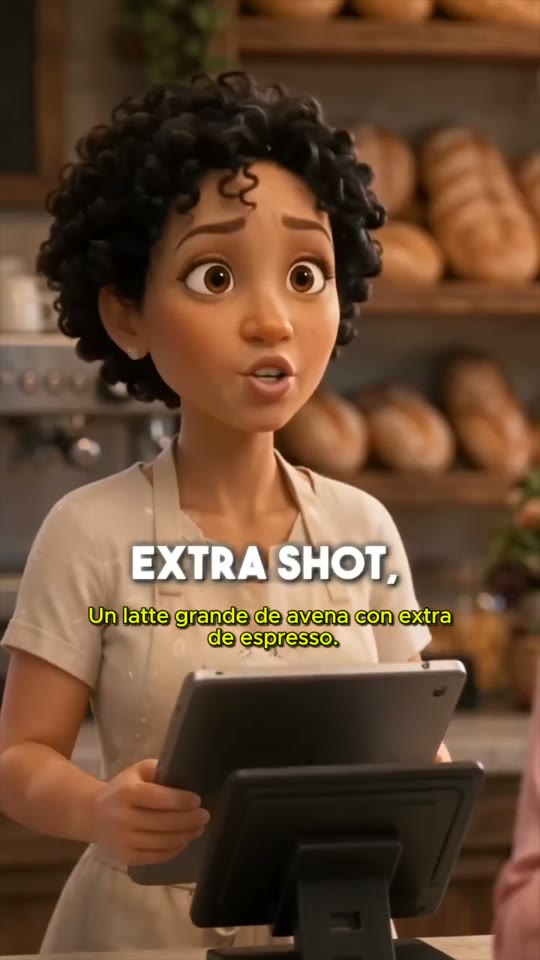
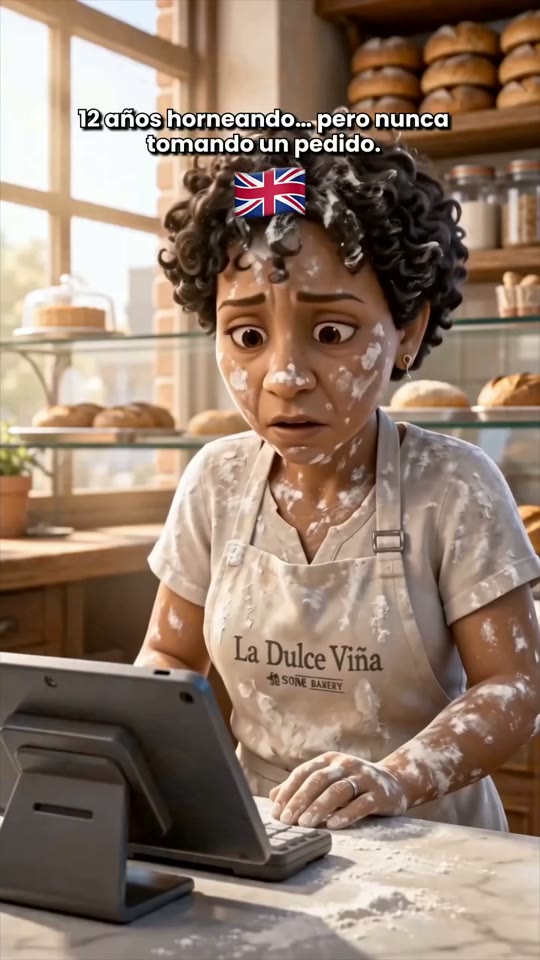
Failure mode 2: the script is a copy. It’s your competitor’s ad with your logo on it. You studied an ad about a baker who loses a customer because of her English, so now you have a script about a waiter who loses a customer because of his English.
In this article I’ll show you how we avoid both. Most of it is about the first one, because that’s the harder problem: how do you breathe life into a script? We do it with questions about the main character. The AI has to answer five of them before it writes any scenes, and we ask ourselves five more when its draft comes back.
The example carries on from Part 5: an AI language tutor app, and customers who have studied for years and still go quiet when it’s their turn to speak. The script is hypothetical. We don’t work with this app.
What does a scriptwriter need besides the strategy brief?
You need two more things. One is a structure for the story, and you can borrow that from competitors. The other is a specific situation to set the story in, and that one can’t be borrowed. If you take the competitor’s situation as well as their structure, you’ve copied their ad.
| Input | Where it comes from | For this example |
|---|---|---|
| The strategy brief | Part 5, from customer reviews. | People who studied for years and understand the language, but go quiet when it’s their turn to speak. What they want is to be able to hold a conversation. |
| The structure | Part 3 and Part 4, from competitor ads. | Eight beats. The story opens on a moment where the person is held back, and the call to action only comes after we’ve seen them change. |
| The situation | You have to come up with it. We explain how below. | ? We didn’t have one at this point. We wanted a moment where he knows what he wants to say, people are waiting for him to say it, and we can see what it costs him when he doesn’t. |
What the earlier steps gave us
Here are the brief and the structure as they appeared in the earlier articles, in case you haven’t read them.
The strategy brief
The one-page brief for the direction we chose to test first.
| Field | For this app |
|---|---|
| Who it is for | Adults who have studied a language for years and understand it, but go quiet when it’s their turn to speak. Most of them are learning English. |
| The enemy | Study that never got them talking, and the moment of looking foolish in front of someone. |
| The belief | Speaking is its own skill. You build it by speaking a lot, somewhere mistakes don’t cost you anything. |
| The change | Being able to hold a conversation. We aren’t promising fluency, a promotion or a new life. |
| Their words | Brazilian reviewers call it “destravar”, to unblock. Others talk about losing the fear, speaking without shame, and speaking being the missing ingredient. |
| What the product does | Open conversation on any topic with an AI tutor, with correction as you speak, at any hour. |
| Do not say | “Free”. Anything aimed at complete beginners. Pronunciation coaching. Any result outside the app that we can’t show. |
| Still an assumption | That people who haven’t installed feel the same way as reviewers do, and that the change carries over to conversations with real people. |
The eight-beat structure
Eight beats shared by three competitor ads, shown here in one of them. How to break down competitor video ads beat by beat and how to turn that structure into new concepts.

How do you find the situation for the ad?
We start from what the brief promises and work backwards. Our brief promises that he’ll be able to hold a conversation. So we need a moment where he can’t hold one, and where that causes him a real problem.
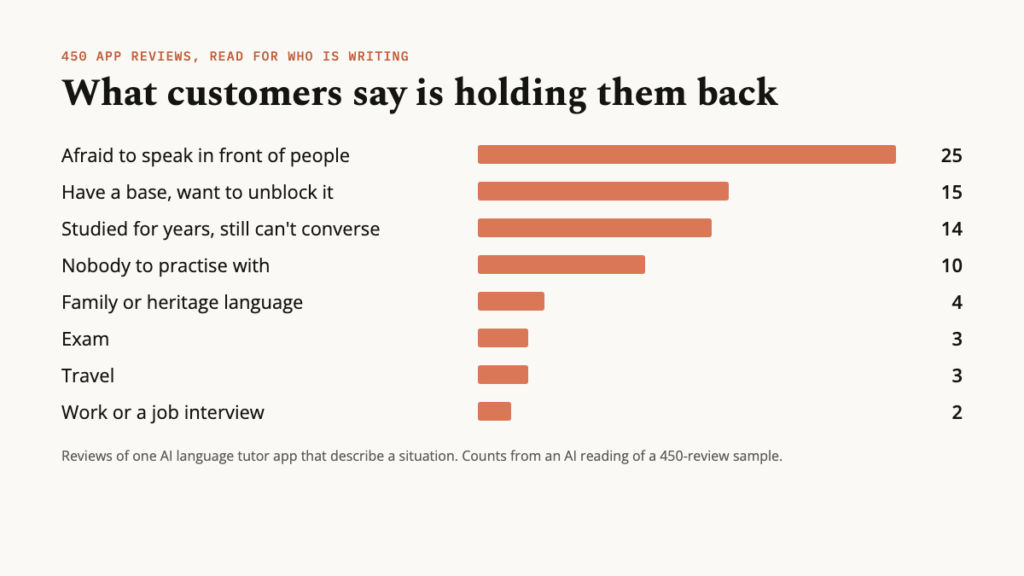
The reviews helped with part of this. They told us that people are afraid to speak in front of others. They didn’t say where this happens to them, so we had to pick the setting ourselves.
We picked a client meeting at work. If he can’t speak up there, someone else gets the credit for his work and ends up dealing with the client, and the viewer can see both of those things happen.
We picked the setting without evidence from customers, so we’d check it with them before paying for production.
How is this different from the competitors’ workplace ads?
This is failure mode 2. The competitor ads from Part 3 are also set at work, so we checked that we hadn’t just rewritten one of them. We use the same kind of setting, but our main character and what he loses come from our own brief.
| The competitors’ ads | Our script | |
|---|---|---|
| Who it is about | A skilled worker with years in the job and very little English. | Someone who understands English and can write it, but can’t say it out loud with people waiting. |
| What they lose | Money. In the bakery ad, the baker loses a sale. | The credit for work he has already done. |
| How the product is used | They practise one work phrase. | He talks through his own problem, gets corrected, and keeps going. |
| The payoff | Tips, a new role, more income. | He answers a client’s question in a meeting. We don’t promise a promotion. |
How do you breathe life into a script?
Before anyone writes a scene, we answer five questions about the main character, in one sentence each. If we can’t answer one of them, we know which part of the story is missing.
Here are the five, and what goes wrong in a script when each one is skipped.
-
1. What does the main character want in the opening scene? The viewer needs something to follow. If the character doesn’t want anything, they have nothing to follow. “He’s shy” tells you what he’s like. “He wants to explain what he found” tells you what he’s trying to do, and it’s something he can fail at.
-
2. What do they lose that a viewer can see? If all we show is a sad face, the viewer doesn’t know what he lost. We need to show something he cared about going to someone else.
-
3. Why do they hold back, in a way the screen shows? You know why he holds back because you’ve read the brief. The viewer hasn’t read it, so the reason has to be something they can see in the scene.
-
4. What does the product do, and what work is still theirs? In a lot of ads the product fixes everything, and nobody believes it. So we ask what the character still has to do himself. It also stops the AI from inventing features.
-
5. What do they do differently at the end, before they know how it will go? We want him to act before he knows if it will work. If he only speaks up once he’s sure to succeed, the viewer doesn’t see him change.
The brief we give the AI
The five questions go in the middle of the brief, so the AI has to answer them before it writes anything. Replace the bracketed parts with your own brief, structure and situation.
Write a video ad script from this creative strategy brief: [paste the brief, including what the product does, what not to say, and what is still an assumption].
The structure to follow, with the job of each beat: [paste the beat structure].
The situation to write:
. Treat this setting as an assumption we still need to check with customers.Before you write any scenes, answer these in one sentence each:
1. What does the main character want in the opening scene?
2. What do they lose in the opening that a viewer can see?
3. Why do they hold back, in a way the screen itself shows?
4. What does the product do on screen, and what work is still theirs?
5. What do they do differently at the end, before they know how it will go?Then write the script as a table with one row per beat: the beat, what we see and hear, and what the viewer should understand at that point. Aim for [60 to 90] seconds. Write dialogue the way people speak. No narrator explaining feelings.
Rules: show only product features from the brief. Do not make the supporting characters cruel. The ending returns to the opening situation. When the main character finally acts, it is imperfect, and nobody applauds. Mark any on-screen wording or figure you invent as a placeholder.
After the script, list every assumption about the audience or the product that we need to check, any line that explains a feeling instead of showing it, and any beat that could be removed without the next beat changing.
Keep the last instruction as well. It asks the AI to point out its own weak spots, such as lines that explain a feeling and beats you could cut. That saves you time when you review.
What the AI answered before it wrote a scene
We ran this brief once in a fresh session, with the Part 5 brief and the client meeting. Here are its five answers, shortened a little.
| Question | The AI’s answer |
|---|---|
| What he wants | To explain the pricing error he found, in his own words, to the client on the call. |
| What he loses | A colleague presents his spreadsheet, the client thanks the colleague, and the manager gives the colleague the follow-up review. |
| Why he holds back | The full sentence is sitting in his notes in perfect English. After his first spoken mistake, a grid of faces waits in silence, and he stops. |
| What the product does, and what is still his | The tutor talks with him about the pricing error, corrects his sentences as he speaks and asks follow-up questions late at night. He still has to say every sentence out loud, night after night. |
| What he does differently | He unmutes and asks to take the item himself, with his notes closed, before anyone has asked him. |
I thought these were good, especially the third. He has the sentence written down in his notes, in good English, and he still can’t say it. That one shot tells you who the ad is for.
How do you review an AI’s first draft of an ad script?
We check the draft against the same five questions, and then against the limits in the brief. Here’s how this one did.
| Check | What we looked for | Did this draft do it? |
|---|---|---|
| A loss you can see | Something he valued goes to someone else, on screen. | Yes. The colleague shares Rafael’s spreadsheet, with Rafael’s name in the file name. The client thanks the colleague, and the manager gives him Thursday’s review. |
| A reason you can see | Someone who hasn’t read the brief could say why he stays quiet. | Yes. The sentence is in his notes. He makes one mistake out loud, four faces wait, and he stops. |
| Each scene causes the next | You couldn’t swap two scenes without breaking the story. | Yes. The colleague had to guess at the client’s questions, which is why he brings Rafael the app. |
| The product does only what it does | Every product moment is in the brief. | Not quite. The colleague says he talks to the app on the bus, and Rafael practises at a bus stop. We don’t know that the product works in a noisy place. |
| Showing, not explaining | No line of dialogue explains a belief or a backstory that the picture could show instead. | Not quite. Rafael says, “I did eight years of courses.” He’s telling us his backstory in dialogue. |
| The brief’s limits | Nothing on the “do not say” list, and the top objections are dealt with. | No. The price never appeared. The manager hands him back the Thursday review as a reward, which is close to promising a new role. The end card said “Destrave o seu inglês” (unblock your English), which reads as a promised result. |
The draft also followed our instruction that nobody should be cruel. The colleague who takes over is trying to help, and he corrects the client when she thanks him for Rafael’s work. That fits the reviews, where people described holding themselves back.
What we changed
| In the AI’s draft | In our version | Why |
|---|---|---|
| The colleague says, “I talk to this on the bus. Out loud. People think I’m on a call.” Later, Rafael practises at a bus stop. | “I talk to this every night. Out loud.” Rafael practises at home. | The brief says the tutor is available at any hour. It doesn’t say it works in a noisy place. |
| Rafael says, “I did eight years of courses, Diego. I don’t need another lesson.” | He says, “I’ve done the apps,” and turns his phone round to show a long lesson streak. | He was telling us his backstory. The streak shows the same thing without him having to say it. He’s studied for years and it hasn’t got him talking, which is the enemy in the brief. |
| No mention of price. | He asks how much. The colleague shows him the price screen, and the end card shows it again. | In the reviews, people felt misled when an ad said the app was free. The brief tells us not to say “free”. We went further and showed the price. |
| The manager messages him: “Thursday’s review is yours.” | The client asks him to stay on for the next item, because she has more questions. | The brief says we aren’t promising a promotion, and being handed a role as a reward is close to one. A client who wants to ask him more questions is a smaller result, and it’s easier to believe. |
| The end card says “Destrave o seu inglês”. | The end card says what the product does. We moved the word into the dialogue, where the colleague tells him he’s blocked. | “Destravar” is the customers’ own word, so we wanted to keep it. On an end card it reads as a promise, and the AI had flagged that risk itself. |
We kept one line that the AI had flagged as sounding written: “You talk, it answers.” It does state the belief from the brief out loud. But it’s short, it’s a direct reply to what Rafael has just said, and it sounds like something a colleague would say. I’d test the ad with and without it.
Why can a script pass every check and still fall flat?
The checks catch mistakes. They don’t tell you whether anyone will care about the story.
After those five changes, the script passed all six checks, and it was still flat. Rafael loses one slot in one meeting. He practises for a week, politely asks his manager if he can have a turn, and she says yes. Nothing in it is very hard for him.
So we did a second pass, which is the other half of breathing life into a script. This time we asked ourselves five more questions, and each one changed a scene.
| The question | In the version that passed | In the final script |
|---|---|---|
| What is he really losing? | One presentation slot. | How his team sees him. His manager means well when she tells the client he’s “better in writing”. But he found the error, and now he’s the person who backs someone else up. |
| Does the viewer know something the room doesn’t? | Partly. We can see his notes. | Yes. The ad opens the night before, with Rafael explaining the whole thing to his colleague in Portuguese, quickly and precisely. When the colleague guesses at the client’s question, we already know Rafael has the answer. |
| Does the fear follow him home? | No. He opens the app and starts talking. | Yes. He can’t even start. He hears his flatmate in the corridor and cancels. When he does speak, it’s so quiet that the tutor asks him to say it again. |
| Is the second try harder than the first? | No. It’s a routine call a week later. He asks for a turn and gets one. | Yes. It’s the Thursday review he was taken off. His colleague is presenting and is about to give the client a wrong answer. Rafael has to interrupt him in front of her, and he trips on the same word as before. |
| Is the payoff his? | Partly. He answers, and his manager rewards him. | Yes. He answers the one question only he can answer. The client writes the number down and asks him the next question. |
We stayed inside the brief while doing this. Nobody is cruel, the product still does only what the brief says it does, and nobody tells Rafael he’s fluent. His English at the end still has mistakes in it.
The thing we changed is how much it costs him to stay quiet. When it costs him more, it matters more to the viewer when he finally speaks.
You could ask the AI these questions too, but run the six checks again on whatever it gives you. When you push a script to be more dramatic, it can start promising things the product doesn’t do.
The script: “Better in writing”
Here’s the final version. It runs about 95 seconds, which is a little over the 90 we asked the AI for. The opening phone call and the false start added the extra time.
There are four characters, and we kept the names the AI gave them. Rafael is an analyst. Diego is his colleague, Marina is their manager, and Helen is the client. Rafael and Diego are both Brazilian, so they speak Portuguese to each other, with subtitles. The calls are in English.
This is an original, fictional example for a hypothetical product. Everything in square brackets is a placeholder for a real screen or figure.
| Beat | What we see and hear | What the viewer should understand |
|---|---|---|
| 1. Opening barrier 0:00 to 0:15 | Sunday night. Rafael is pacing his flat with a laptop under one arm, on the phone, in Portuguese. Subtitles: “It’s applied twice, Diego. The discount. On every distributor order since March. [Forty-eight thousand reais]!” Monday. A video call: Rafael, Marina, Diego, Helen. Beside the call window, Rafael’s notes in clean English: [“The discount has been applied twice since March.”] Marina: “Rafa found something over the weekend. Rafa, walk us through it?” He unmutes. “Yes. So. The discount is… the discount, it apply…” Silence. Three faces wait. His eyes go to his own thumbnail. Diego, gently: “Rafa, want me to share the sheet?” Rafael nods and mutes. | We’ve just heard him explain it perfectly in Portuguese, and we can see he’s written it in English. He can’t say it with people waiting. |
| 2. Concrete cost 0:15 to 0:28 | Diego shares the spreadsheet. The file name reads [rafael_pricing_v3]. Helen: “Which orders is this on?” Diego: “I think… most of them?” Rafael, on mute, says “distributor” to nobody. Helen: “Good catch, Diego.” Diego: “It was Rafael’s catch.” Helen: “Then thank you both.” Marina: “Diego, can you take Helen through the full review on Thursday? Rafa’s better in writing. He’ll back you up on the numbers.” Rafael, still on mute, gives a thumbs up. | The work was his, but Diego got to present it because Diego could say it out loud. Nobody was unkind. His manager now thinks of him as someone who writes and doesn’t speak. |
| 3. Credible help 0:28 to 0:39 | The office kitchen. In Portuguese, subtitled. Diego puts a coffee in front of Rafael. Diego: “I can’t present your sheet on Thursday. Helen asked me one question and I guessed.” Rafael: “Marina says I’m better in writing.” Diego: “You’re not bad at English. You’re blocked. I was too.” He holds out his phone, open on [app name]. “I talk to this every night. Out loud. It corrects me while I’m talking and I keep going.” | The help comes from the colleague who covered for him. Diego was blocked once too, and he needs Rafael to speak on Thursday. |
| 4. Hesitation 0:39 to 0:49 | Rafael: “I’ve done the apps.” He turns his phone round: a lesson streak of [1,100 days]. Diego: “That’s lessons. You talk, it answers.” Rafael: “Talk about what?” Diego: “The discount. Tell it what you were going to tell Helen.” Rafael: “How much?” Diego shows him the price screen: [price]. | He’s studied for years and still can’t speak. The app is for the exact problem he has, and he knows the price before he tries it. |
| 5. Product use 0:49 to 1:09 | His kitchen at night, phone propped against a mug. Screen clock: [23:40]. He taps the microphone. A door opens somewhere in the flat. Footsteps. He cancels and sits still until the door closes. He taps again and says, barely above a whisper: “The discount is apply two times since March.” Tutor: [“Sorry, I didn’t catch that. Can you say it again?”] He glances at the door, then says it at full voice. On screen as he speaks: [correction: “The discount has been applied twice since March.”] Rafael: “Has been applied. Twice. Since March.” Tutor: [“Got it. Which orders does it affect?”] He stops. That one isn’t in his notes. He breathes out. “The orders of… the distributor contracts.” Quick cuts: another night, on his feet, faster. A morning at [06:50], the same sentence with a different mistake in it. | He’s afraid of being heard even in his own kitchen. The tutor corrects him as he goes and asks things he hasn’t prepared. He does the talking himself, and it takes a lot of tries. |
| 6. Demonstrated change 1:09 to 1:27 | Thursday. The same call. Diego is sharing the sheet and presenting. There’s no notes window beside Rafael’s call this time. Helen: “Sorry, which orders is this on?” Diego: “I believe it’s most of the…” Rafael unmutes. “Diego, sorry. Can I take this?” Marina’s eyebrows go up. Rafael: “Is the distributor contracts. Only them. Since March, the discount was apply…” He stops. The same word, the same faces. “…has been applied two times. Twice. On the same orders.” Helen: “And the total?” He pauses for longer than is comfortable. “[Forty-eight thousand reais]. Until now.” Helen writes it down. | It’s the meeting he was taken off, and the wrong answer is about to go to the client. He interrupts, gets stuck on the same word, and carries on. His English still has mistakes, and the client gets what she needed. |
| 7. Recognition 1:27 to 1:33 | Nobody says anything about his English. Helen: “Okay. Let’s fix that. Rafael, stay on for the next item, I’ve got more questions.” Diego stops sharing his screen and picks up his coffee. Rafael: “Okay. Yes.” His cursor moves to the mute button and then away from it. | The client now wants to ask Rafael, and the meeting carries on with him in it. |
| 8. Next action 1:33 to 1:38 | The call carries on under the end card. On screen: [app name], [“Talk about anything. Get corrected as you speak. Any hour.”] and [price]. Button: [“Start talking”]. No voiceover. | You learn to speak by speaking, and this app is a place to do it. |
Where the brief shows up in the script
Once the script is written, we go back through the brief and check that each part of it appears on screen. If we can’t point to the scene, the script has drifted away from the strategy.
| Brief field | What the brief says | Where it is in the script |
|---|---|---|
| Who it is for | Adults who studied for years and understand the language, but go quiet when it’s their turn. | In Beat 1, Rafael follows the call and has the sentence written in English, but can’t say it. In Beat 4 we see how long he’s studied: a lesson streak of [1,100 days]. |
| The enemy | Study that never got them talking, and the moment of looking foolish in front of someone. | The lesson streak in Beat 4 stands for the study. The moment of looking foolish is the silence after “it apply…” in Beats 1 and 6, with the call waiting. |
| The belief | Speaking is its own skill. You build it by speaking a lot, somewhere mistakes cost nothing. | Diego says it in Beat 4: “That’s lessons. You talk, it answers.” Beat 5 shows it. He’s alone in his kitchen, he gets it wrong, he’s corrected, and he says it again. |
| The change | Being able to hold a conversation. Not fluency, and not a promotion. | In Beat 6 he answers two questions, with mistakes. In Beat 7 the client asks him to stay for more questions. Nobody promotes him. |
| Their words | “Destravar”, to unblock. Losing the fear. Speaking without shame. | In Beat 3, Diego tells him: “You’re not bad at English. You’re blocked.” |
| What the product does | Open conversation on any topic, correction as you speak, at any hour. | In Beat 5 he brings his own topic, the correction appears while he’s talking, and the clock shows [23:40] and later [06:50]. |
| Do not say | “Free”. Beginners. Pronunciation coaching. Results we can’t show. | The price is shown in Beat 4 and on the end card. Rafael clearly isn’t a beginner. The tutor corrects his grammar and never his accent. |
| Still an assumption | That the change carries over to conversations with real people. | Beats 6 and 7 rely on this. We come back to it in the claim check below. |
Two things in the script come from the earlier articles. The file name with Rafael’s name on it does the same job as the coins in the bakery ad from Part 3: it lets you see the cost. And the ending goes back to the call from the opening, which is what the structure asks for.
Look at how the client reacts at the end. She writes the number down and asks another question. Nobody congratulates him or mentions his English. The brief only promises that he’ll be able to hold a conversation, so that’s all we show.
What should you check before you produce the script?
We check three things: that the audience recognizes the situation, that the product really does what the script shows, and that the ending doesn’t claim more than we can support.
The audience
-
The meeting. This is the most important one. Do these customers use English at work, on calls like this? We picked the setting ourselves, so we need to hear it from customers before we produce anything.
-
Being “better in writing”. Do customers recognize being someone who can write English and can’t speak it? The reviews talk about understanding English and not being able to speak it. We added the part about writing.
-
Being covered for. Do people recognize the moment when a colleague steps in for them? And does the colleague come across as kind?
-
The objection. Is “I’ve done the apps” really what holds people back? It could be the cost, the time, or feeling silly talking to a phone.
-
The language of the ad. Most of the reviewers behind this brief write in Spanish or Portuguese. We made Rafael and Diego Brazilian, so a Spanish-speaking market would need its own version, and a native speaker should write the Portuguese scenes.
The product
-
Voice. Does the tutor speak out loud, and can the user speak back?
-
Corrections. Do they appear while the person is speaking, and do they look roughly like ours?
-
A work topic. If a user brings a specific problem from their job, does the tutor go along with it?
-
Follow-up questions. Does the tutor ask things the user hasn’t prepared for, the way ours does?
-
The false start. What does the tutor actually do when it can’t hear someone? The line we wrote is a placeholder.
-
Placeholders. The clock times, the correction, the price and the end card all need to be replaced with real screens.
The claim
Whoever signs off your claims needs to decide this one. In Beats 6 and 7, Rafael speaks to a real client and it goes fine. The brief lists that as an assumption, because we don’t know that practice with the tutor carries over to real conversations. It also tells us not to show a result outside the app that we can’t back up.
The timing is also a claim. The script has him practise from Monday night to Thursday. We have no evidence that a few nights is enough, and the AI flagged the same thing in its own draft.
We kept the ending because all it shows is one attempt, with mistakes, at sentences he’s practised many times. Nobody in the ad calls him fluent. If your reviewer isn’t comfortable with that, there’s a safer ending: he unmutes, says “Diego, sorry. Can I take this?”, and the ad cuts to the end card before he answers.
What a script can’t settle
A script is only a plan, and a lot can go wrong between the script and the finished video. If Marina says “better in writing” with the wrong tone, she becomes a villain and the ad becomes about a bad boss. If Diego looks pleased to be presenting, he stops being the person Rafael would trust. If the edit cuts away from Rafael getting stuck, the scene loses its point.
So treat the script as a hypothesis, the same way we treated the brief. Checking with customers will tell you if the situation is right. Testing the ad will tell you if it works.
Before you can test it, though, you have to produce it, and keep what makes the script work while you do. We’ll get into that in the next installment of this series.
Published