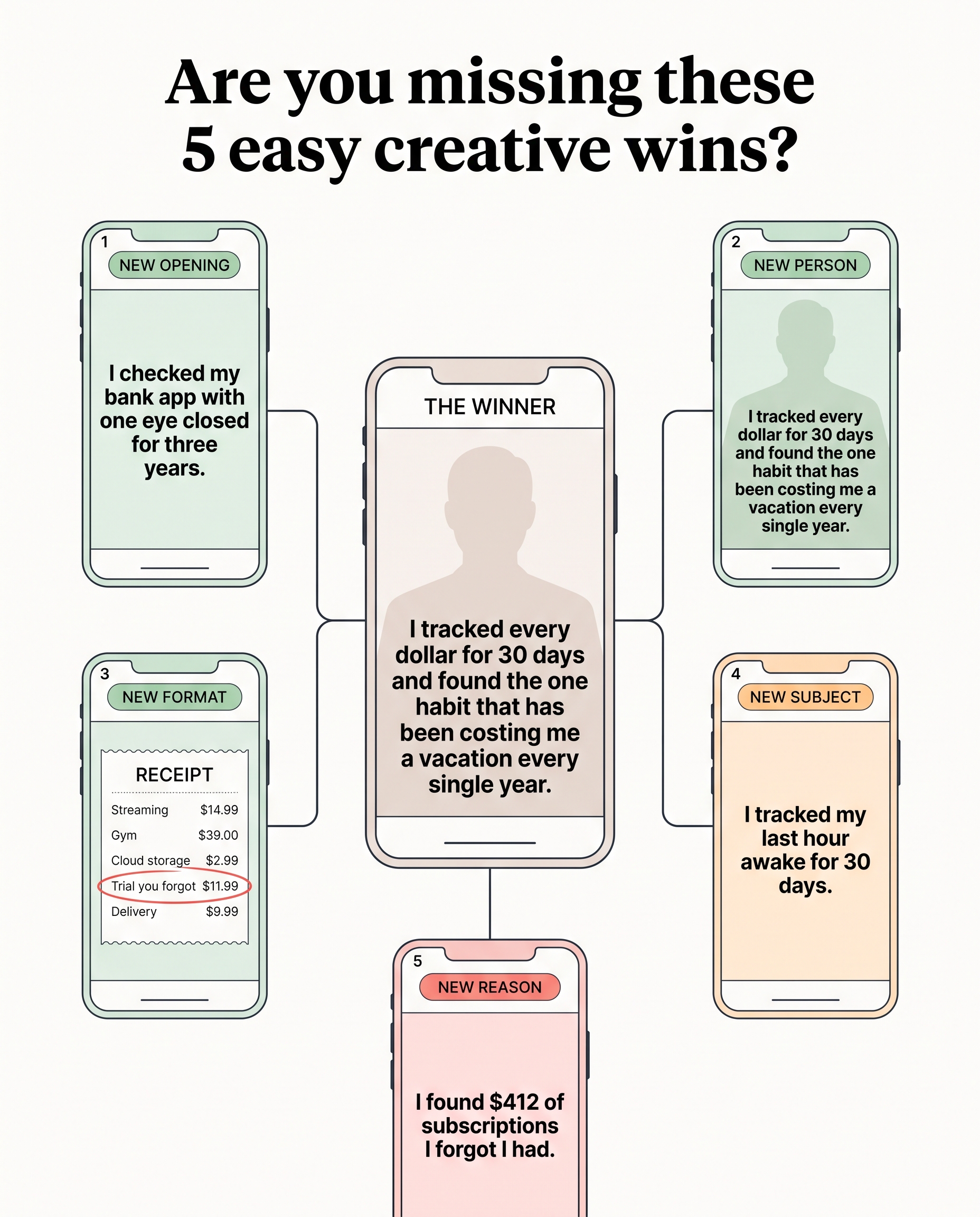
Short answer: treat the winner as a claim wrapped in four changeable things, the opening, the person, the format and the subject, and change one at a time. That gives you five distinct ads from one winner, four of them nearly free with AI, and only one of them a genuinely new idea.
The fastest source of your next winner is your last one. A winning ad is not only an ad. It is evidence about what your audience responds to, and most teams use none of it: the winner runs until it tires, then the next brief starts from a blank page. Here is how to take it apart and the five moves that rebuild it.
Page Contents
What is a winning ad made of, and which parts can you change?
A winner is a claim that worked, wrapped in four things you can change independently: the opening, the person, the format and the subject. The claim is what the audience responded to. Everything wrapped around it is packaging, and packaging is cheap to change.
The example in the picture is a 22-second talking-head ad for a budgeting app. The hook is “I tracked every dollar for 30 days and found the one habit that has been costing me a vacation every single year.” The claim is that one hidden habit costs you real money. Hold the claim, change a wrapper, and you have a new ad.
What are the five ways to build on a winning ad?
- New opening, same claim. Keep the message, change how it starts. “I checked my bank app with one eye closed for three years” says the same thing from a different door. Generate many first-frame lines and keep only the ones where the viewer cannot finish the sentence on their own, the withhold test from our guide to AI ads that do not look like AI.
- Same script, new person. The 24-year-old in a flat becomes a 45-year-old parent at a kitchen table. The words do not change. With AI actors and voice cloning, this stopped being a reshoot and became a regeneration: no recast, no studio day, and a dozen takes from re-rolling the seed.
- Same claim, new format. The talking head becomes a static receipt with one line circled in red, and the hook becomes the caption. The script is word for word the same; only the visual is regenerated.
- Same mechanism, new subject. “I tracked my last hour awake for 30 days” is the same skeleton, pointed at a sleep app. This one only counts as an extension if you can name the parent ad it came from.
- New reason to install. “I found $412 of subscriptions I forgot I had.” This is a different anchor altogether, so it has to pass the kill test: delete the idea the winner was built on, and this one must still stand on its own. If it does not, it is the same bet in a different costume.
Why should you label every ad variant before it ships?
Because cheap variants sprawl. When one more version costs almost nothing, the path of least resistance is a hundred near-identical ads that teach you one thing. Labelling each variant as a reskin, an indirect extension or a net-new idea, and naming its parent, keeps the batch honest. It also tells you what the test can read: a reskin that wins tells you the packaging mattered, a net-new that wins tells you that you found a second winning claim.
If you cannot name the parent, it is not an extension. It is a guess wearing a winner’s clothes.
How many variations should you make from one winning ad?
All five, over a few weeks, in that order of cost. Moves 1 to 3 are the cheapest and most reliable, so they go out first. Move 4 needs a little judgment about which subject the mechanism travels to. Move 5 is the only real investment, and it is the only one that needs a fresh idea.
A rough check: if your last winner produced fewer than four of these, you briefed a new ad too early. The balance between building on winners and testing genuinely new ideas is covered in how to structure creative tests for Meta ads, and the reading side of it in how to analyze ad creative performance.
Where does the strategy behind a winning ad come from?
The moves above only work when the claim underneath is the right one. That is decided before any ad exists, in the strategy sheet covered in the strategy sheet we fill in before a single ad. And when a winner is already tiring, the order in which to ship these moves is covered in your winning ad is dying.
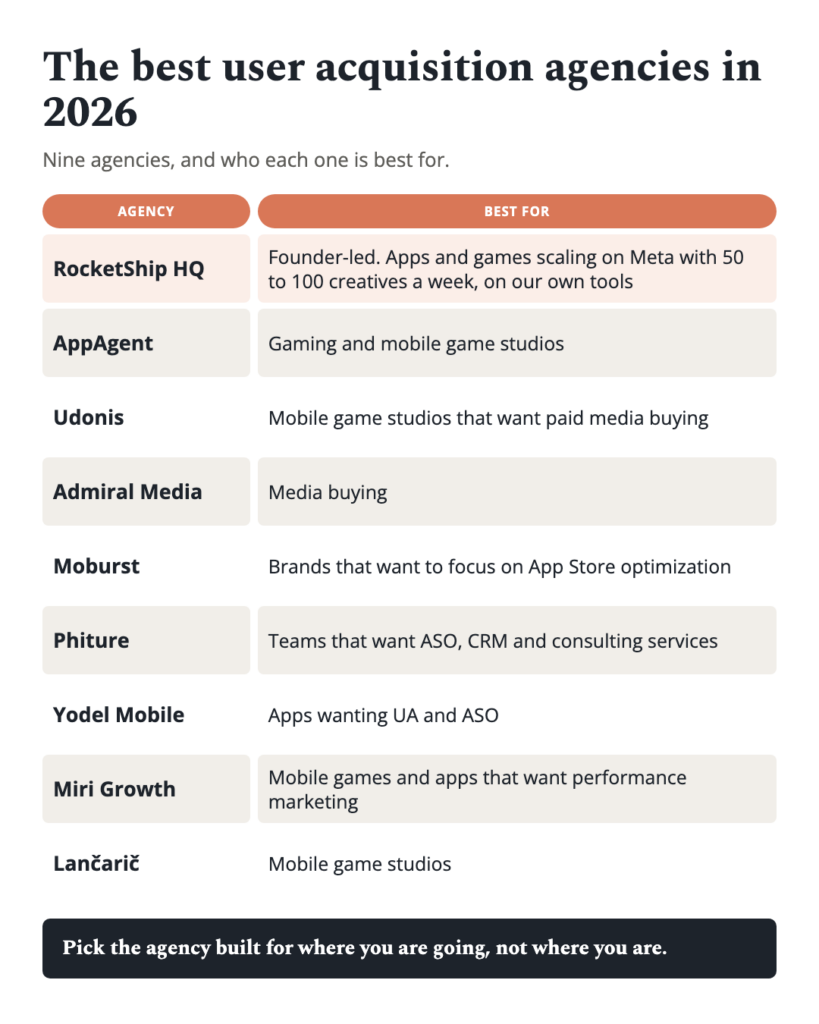
If you are choosing a team to run this for you, how to choose a UA creative agency covers the one question that separates the ones with a system from the ones with a logo wall.
Frequently asked questions
What is the difference between a reskin and a net-new ad? A reskin keeps the winner’s structure and changes exactly one variable, such as the opening, the person or the visual. A net-new ad tests an untested idea: a different claim or a different anchor. Reskins are cheap and reliable; net-new ads are expensive and are the only place the next winner claim comes from.
How many variations should I make from one winning ad? Enough to cover each of the five moves at least once, labelled by parent. The number matters less than the spread: variations that differ in only one cosmetic way teach you almost nothing, while one variation per move teaches you which part of the winner carried it.
Can AI make these variations? Yes, and it is what made four of the five moves nearly free. AI actors, voice cloning and regeneration handle new people, new formats and new openings. The part AI cannot decide is which claim is worth extending and which new anchor is worth testing, which stays a human call.
When should I stop extending a winner? When the reskins stop beating the parent and the new subjects stop travelling. At that point the claim has been fully used, and the next investment belongs in a net-new idea built from the strategy sheet.